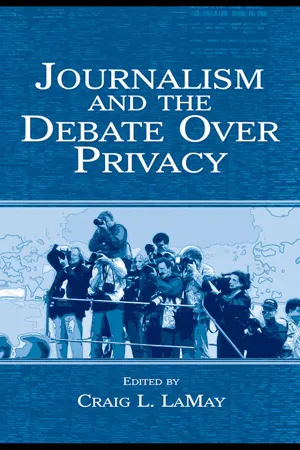
Journalism and the Debate Over Privacy situates the discussion of issues of privacy in the landscape of professional journalism. Privacy problems present the widest gap between what journalism ethics suggest and what the law allows. This edited volume examines these problems in the context of both free expression theory and newsroom practice.
Including essays by some of the country's foremost First Amendment scholars, the volume starts off in Part I with an examination of privacy in theoretical terms, intended to start the reader thinking broadly about conceptual problems in discussions about journalism and privacy. Part II builds on the theoretical underpinnings and looks at privacy problems as they are experienced by working journalists.
This volume features discussion of:
*privacy as a socially-constructed right--a moving target that changes with technology, social norms, national experience, and journalistic practice;
*privacy as both a property and a commercial right;
*privacy in terms of journalism ethics and journalistic codes;
*privacy as an attribute of press independence from government; and
*Bartnicki v. Vopper and its implications for journalism.
With this volume, editor Craig L. LaMay provides a concise, intellectually provocative overview of a topic that is of growing importance to journalists, both legally and ethically. The work is intended for scholars and advanced students in communication law, ethics, and First Amendment rights, and is also appropriate for First Amendment and media law classes in law schools.
- 336 pages
- English
- ePUB (mobile friendly)
- Available on iOS & Android
eBook - ePub
Journalism and the Debate Over Privacy
About this book
PART I
Theoretical Perspectives on Privacy and Free Expression
1
The Social Construction of Privacy
Debates about the social construction of reality are a persistent feature of contemporary academic debate.1 At one highly implausible extreme are those who claim, or who are claimed to claim,2 that the reality we experience is a social construction, and the “there” we believe to be there is a product not of a fixed external world, but of the way we contingently choose to organize the sense data that are the primary inputs of human experience.3 Under this view, the things we perceive as real and fixed, from badminton to butterflies, are the contingent products of human perception and human categorization.
At the other extreme, equally implausible, is the radical rejection of the social construction account of reality. Those who strongly reject social constructionism claim, or again are claimed to claim, that the reason we perceive the external world as real is because it is real. From everything we see about mountains to everything we feel about our parents, the belief that what we perceive to be external maps onto the existence of a natural and external physical, conceptual, and moral world. Although we perceive this world, what we perceive exists is independent of human action, and stands apart from the contingencies of human perception and social categorization.4
Between these two highly implausible positions is a much more plausible one, and one that fits with the perspective informing this chapter. Under this position, much of the external world exists independent of human action, whether the action be that of individual perception or that of collective categorization. Zebras, bananas and gravity are not the products of social construction, but instead are just a few of the myriad examples of a mind-independent and society-independent reality.5 Yet although much of the world we experience is thus not socially constructed (so this more plausible view maintains), much of it is. The existence of natural kinds and other forms of mind-independent reality is consistent with the existence of concepts and categories that are indeed socially and not naturally constructed. To put it differently, the proposition that some things are not socially constructed does not entail the conclusion that nothing is. And so we can readily and reasonably accept the nonsocial existence of much of the physical world, and much of science, while still believing, equally readily and equally reasonably, that chess, baseball, fashion, painting, and poetry, for example, and even the standards we use to evaluate performances in each, exist not as immovable and noncontingent objects of human perception but instead as the products of culturally contingent social conventions.
Even under this intermediate and much more plausible view, numerous issues remain. One of those issues is the classification, as socially constructed or not, of a large range of phenomena that are central to our everyday existence. Is law, for example, a feature of the prehuman world (as a caricatured version of natural law would have it),6 or is it a social artifact (as legal positivists believe)?7 Is morality itself part of the furniture of the world (as most moral objectivists believe),8 or does it vary with individuals and societies (as those who are labeled subjectivists9 or relativists,10 respectively, insist)? Of course many of the debates about the existence of God are best understood as debates about whether God is a reality or a social construction.
Is Privacy Socially Constructed?
As may now be apparent, given the title of this chapter, privacy appears to be a likely candidate for this middle ground, in which people who believe that some things are socially constructed and other things are not debate about which of these the item at issue is. Because privacy appears to be less fundamental than some things and more fundamental than others, we might have expected to discover that people have debated about where to array privacy on a scale of social construction (or not), and about the policy implications of placing it at one point rather than another along this scale.
Surprisingly, however, this debate about the ontological status of privacy is virtually nonexistent. Instead, the debates about privacy have had a singularly naturalistic tone, even more so as the Internet and other forms of cyberspace have given a special salience to debates regarding topics such as database privacy or the transmission of information about individuals that those individuals would prefer not to have transmitted.11 In much of the modern debate, the right to privacy, the right to be let alone, and most importantly the right to control information about oneself, have been framed as if these rights were morally primary and socially antecedent. Consequently, as the claims typically go, those rights have been conceptually uninfluenced by social changes, even as the exercise of those rights is increasingly threatened by the social and technological changes associated with advances in information technology.
The structure of the contemporary claims exposes their naturalistic premises. Under the typical claim, there is a right to privacy—a right that is as conceptually primary and morally immovable as, for example, the right to equality. The right to privacy is, so it is said, part of the “inner person.”12 However, the argument goes that as technological changes make invasion of privacy easier, the right—itself conceptually immune from these changes—is increasingly under threat. Just as technological changes make racial profiling easier without affecting the moral wrongness of racism, so too do technological changes make privacy invasion easier without affecting the moral wrongness of those invasions, and therefore without affecting the moral necessity of increasing our safeguards so that the right to privacy remains as well protected as it was in the precyberspace age.
This view is not an unreasonable one. Assuming some version of moral objectivism (without which the view is incoherent), the question then arises as to which features of morality lie at the foundations of our moral universe. For some people these foundations are singular, as with Ronald Dworkin’s view about the primacy of equal concern and respect,13 the utilitarian’s view about the primacy of the principle of utility,14 and the views of many people about the primacy of the single value of justice.15 For others these foundations are multiple, as with Bernard Gert’s moral rules16 and as with the views of those whom John Rawls refers to as “intuitionists.”17 But for both sets of views we do not typically see the right to control information about oneself listed among the moral primaries.
That the right to control information about oneself does not routinely (or ever, for that matter) appear as the single moral primary, or of the multiple moral primaries, is of course far from conclusive. Perhaps our moral monists have been mistaken in believing that the right to control information is not the single primary right from which all others are derived. And perhaps our moral pluralists (a less confusing appellation than intuitionists) have been equally mistaken in not listing control of personal information as among the small number of irreducible moral primaries. But the right to control personal information at least seems more specific than the typical moral primary, and thus it appears that the best argument for the nonsocially constructed nature of this right is not one that takes it be a moral primary, but instead one that takes it to be a secondary right that is related to primary rights (or other primary moral values) in a nonsocially constructed way.
There are two ways in which such a secondary right could be related to a primary right. One would be as an act of derivation or individuation. Although derivation and individuation are different from each other, the important point, and one that both derivation and individuation share, is that the relationship between the general and the particular is a logical, conceptual, or linguistic one. When Ronald Dworkin argues that a right to possess pornography is a component of the right to be treated with equal concern and respect,18 he is not making an instrumental point about the empirical relationship between equal concern and respect and pornography possession, but is rather making a conceptual point about just what equal concern and respect means. And when John Rawls argues that justice requires and includes the right to political liberty consistent with an equal liberty for all,19 his arguments are logical and conceptual, and in general not empirical.
Others would take the relationship between a primary right and a secondary one to be instrumental and empirical. To the utilitarian the right to free speech is recognized and protected because its recognition and protection would, as a contingent empirical matter, increase overall utility.20 And even to someone who believes that something other than utility is the appropriate primary building block of morality, a right could still exist because of its empirical connection with the primary building block of morality, whatever it was. As long as recognition of some right would, instrumentally and thus empirically, increase the quantity or manifestation of the primary building block, then there would be an argument for recognizing the right. Even if a right is not primary, therefore, it could well be crucially important in this instrumental and empirical way.
Under either the conceptual or the empirical understanding, the right to privacy may exist as just such a secondary right, secondary not because it is unimportant, but because, like rights to freedom of speech, freedom of religion, and freedom from torture, it is typically understood, described, in a way that makes it more particular than the typical moral primaries of justice, equality, liberty, and utility. We understand what is being said when privacy is described as an aspect of human dignity,21 but we also understand why it is understood that dignity is the moral primary of which privacy is only a component part.
With this distinction between moral primaries and secondary rights in hand, consider how one might justify a particular manifestation of the right to privacy. Take, for example, the German practice of concealing the names of civil litigants from the public record. If one brings a civil lawsuit in Germany, or if one is the defendant in a civil suit, one’s identity is masked in the published opinions, so that all we know about the typical plaintiff or defendant is that he or she is the plaintiff or defendant in Case Number 1138-7, or such and such. This is in marked contrast with the practice in the United States, where the fact of bringing a lawsuit, or even the fact of being the defendant in a lawsuit (a less voluntary action), commits one to having one’s name potentially disclosed in published opinions, and certainly available to all (except in rare exceptions involving trade secrets and a few other matters) in the publicly available court filings and other judicial records.
In Germany, the German practice is routinely defended on privacy grounds, even though such an argument is almost unheard of in the United States. In Germany, the right, albeit a secondary one, is thought of as an important component of, or importantly instrumental to, the right of personality, the right of personal sanctity, the right of personal integrity, or something of that variety. But when such arguments are raised in the United States in the same context, the reaction is little more than a raised eyebrow. Americans can get highly exercised about supposed invasions of their right to privacy, but they rarely appear to get exercised about the possibility that their names may appear in the Federal Supplement.
That an argument so well accepted in Germany is virtually unheard of in the United States is of course not conclusive of anything. It just mi...
Table of contents
- Cover
- Half Title
- Title Page
- Copyright
- Contents
- Preface
- Part I: Theoretical Perspectives on Privacy and Free Expression
- Part II: Journalism and Privacy
- The Contributors
- Author Index
- Subject Index
Trusted by 375,005 students
Access to over 1.5 million titles for a fair monthly price.
Study more efficiently using our study tools.
Frequently asked questions
Yes, you can cancel anytime from the Subscription tab in your account settings on the Perlego website. Your subscription will stay active until the end of your current billing period. Learn how to cancel your subscription
No, books cannot be downloaded as external files, such as PDFs, for use outside of Perlego. However, you can download books within the Perlego app for offline reading on mobile or tablet. Learn how to download books offline
Perlego offers two plans: Essential and Complete
- Essential is ideal for learners and professionals who enjoy exploring a wide range of subjects. Access the Essential Library with 800,000+ trusted titles and best-sellers across business, personal growth, and the humanities. Includes unlimited reading time and Standard Read Aloud voice.
- Complete: Perfect for advanced learners and researchers needing full, unrestricted access. Unlock 1.5M+ books across hundreds of subjects, including academic and specialized titles. The Complete Plan also includes advanced features like Premium Read Aloud and Research Assistant.
We are an online textbook subscription service, where you can get access to an entire online library for less than the price of a single book per month. With over 1.5 million books across 990+ topics, we’ve got you covered! Learn about our mission
Look out for the read-aloud symbol on your next book to see if you can listen to it. The read-aloud tool reads text aloud for you, highlighting the text as it is being read. You can pause it, speed it up and slow it down. Learn more about Read Aloud
Yes! You can use the Perlego app on both iOS and Android devices to read anytime, anywhere — even offline. Perfect for commutes or when you’re on the go.
Please note we cannot support devices running on iOS 13 and Android 7 or earlier. Learn more about using the app
Please note we cannot support devices running on iOS 13 and Android 7 or earlier. Learn more about using the app
Yes, you can access Journalism and the Debate Over Privacy by Craig LaMay in PDF and/or ePUB format, as well as other popular books in Law & Media & Entertainment Law. We have over 1.5 million books available in our catalogue for you to explore.