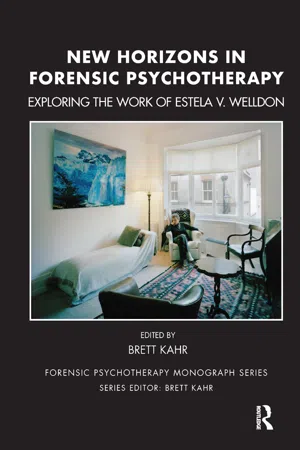
New Horizons in Forensic Psychotherapy: Exploring the Work of Estela V. Welldon, edited by the author, contains many rich contributions by some of Welldon's most distinguished former students and proteges. The book consists of important chapters on the creative ways in which colleagues have utilised and expanded upon Welldon's work in the field of forensic psychotherapy in a variety of settings, including in hospitals, prisons, community mental health clinics, and, also, in private practice.
eBook - ePub
New Horizons in Forensic Psychotherapy
Exploring the Work of Estela V. Welldon
- 302 pages
- English
- ePUB (mobile friendly)
- Available on iOS & Android
eBook - ePub
About this book
Information
PART I
FORENSIC PSYCHOTHERAPY IN THE PRE-WELLDONIAN ERA
CHAPTER ONE
“No intolerable persons” or “lewd pregnant women”: towards a history of forensic psychoanalysis
Do you not think that rage is a sickness of the soul?
Claudius Galenus of Pergamon, “The Diagnosis and Treatment of the Affections and Errors Peculiar to Each Person’s Soul”, n.d. (Galen, n.d., p. 258).
Shame and Disgrace cause most violent passions, and bitter pangs.
Democritus Junior [Robert Burton], The Anatomy of Melancholy: What it is, with All the Kinds Causes, Symptomes, Prognostickes, & Seuerall Cures of it. In Three Partitions, with their Severall Sections, Members & Subfections, Philosophically, Medicinally, Historically, Opened & Cut Up, 1660, Partition 1, Section 2, Member 3, Sublection 6. (Democritus Junior, 1660, p. 99).
The cruel treatment of the offender patient
Throughout much of history, human beings have treated offenders—vagrants, villains, outlaws, gangsters, hooligans, thugs, crooks, racketeers, or killers—with the utmost sadism, often punishing such people with a viciousness that far exceeded the original crime (Phillips, 1857; Bauman, 1996; Evans, 1996; Lyons, 2003; Hillner, 2015; Swain, n.d.; cf. Shepherd, 2016).
Consider the case of the famous literary character “Jean Valjean”, the protagonist of Victor Hugo’s classic nineteenth-century multivolume novel Les Misérables, first published in 1862. Desperate to feed his starving family, Valjean stole a loaf of bread; tragically, after his conviction, he had to endure nearly twenty years of incarceration as a result of this so-called crime.
During the medieval period, for instance, anyone who transgressed the codes of Christian convention would not only be humiliated and stigmatised, but also prevented from receiving any charitable assistance. In the thirteenth century, the hospital of St. John the Baptist in Oxford stipulated that it would not admit “mulieres lasci-uas pregnantes” (Innocent IV, 1246, p. 3) [lewd pregnant women], or “leprosos” (Innocent IV, 1246, p. 3) [lepers] or “paraliticos” (Innocent IV, 1246, p. 3) [cripples], let alone “furiosos” (Innocent IV, 1246, p. 3) [madmen]. In the fifteenth century, in similar vein, the hospital of St. John in Bruggewater (later known as Bridgewater), in Somerset, insisted that,
No lepers, lunatics, or persons having the falling sickness or other contagious disease, and no pregnant women, or sucking infants, and no intolerable persons, even though they be poor and infirm, are to be admitted in the house; and if any such be admitted by mistake, they are to be expelled as soon as possible. [Bekynton, 1457, p. 289]
While our ancestors during the Middle Ages often treated the marginalised with shameful neglect, throughout the early modern period those who perpetrated offences would be subjected to the most inhumane forms of cruelty and torture. For instance, during Elizabethan times, miscreants would be subjected to a range of horrifying punishments, which included being flung into a windowless pit, or manacled to a rack, or placed in hand-crushing iron gauntlets, before being hanged, disembowelled, quartered, and beheaded, or even burned at the stake. Some offenders would be squashed to death by a process known as the peine forte et dure, a form of execution sanctioned in England since at least the year 1275 (Parry, 1933). Those convicted of the crime of poisoning, in particular, would often be boiled to death (Hutchinson, 2005). Such cruelties persisted in diabolical fashion for centuries to come (e.g., Gatrell, 1994; McKenzie, 2007).
Even physicians behaved cruelly, assaulting the bodies of criminals both before and after death. During the sixteenth century, Antonio Musa Brassavola, an Italian medicus, recommended that doctors should test out new drugs on those condemned as criminals (Copeman, 1960). And it would be by no means unusual for the bodies of those executed to be subjected to anatomical dissections after their decease Rüffen, 2011).
As ever, William Shakespeare encapsulated the Tudor attitude towards criminality with superb literary concision. In his play The Tragedy of Hamlet, Prince of Denmark, written, in all likelihood, sometime between 1599 and 1602, the king, “Claudius”, exclaims, “And where th’offense is, let the great axe fall” (Act IV, Scene v, 219). Such a remark typifies quite chillingly the attitude towards perpetrators throughout much of the last millennium.
The neglect and abuse of offenders continued unrelentingly in the centuries that followed. And in spite of some valiant efforts by prison reformers, such as the remarkable eighteenth-century Englishman John Howard, who exposed the ghastly, unhygienic conditions that convicts endured (e.g., Howard, 1958; Southwood, 1958; Freeman, 1978; Radzinowicz, 1978), one struggles, when combing the historical record, for much evidence of any compassion and understanding towards those who, for whatever reason, perpetrated acts of criminality.
In the nineteenth century, the progenitors of forensic psychiatry endeavoured to provide a more sophisticated approach to the problem of homicidal insanity and other manifestations of criminal violence by proclaiming offenders as mentally deranged. But the vast majority of medical specialists who worked at the interface between alienism and the law regarded lunatic perpetrators as suffering from hereditarian or constitutional predispositions (Colaizzi, 1989; cf. Rafter, 1997, 2008; Wetzell, 2000; Horn, 2003; Davie, 2005; Bondio, 2006; Jalava, Griffiths, and Maraun, 2015)—a philosophy that would, potentially, discourage researchers from exploring intrafamilial aetiological factors in the development of offending behaviours. The German physician, Professor Dr Johannes Lange (1929), Oberarzt [senior physician] at the Krankenhaus in München-Schwabing, epitomised this tradition of biologising criminals; in his study of twins, he underscored the hereditary nature of offending behaviour, conceptualising crime as a manifestation of one’s inherited destiny. Furthermore, many criminologists construed illegal behaviours not only in genetic terms, but also in racial terms, claiming, for instance, that Jewish people or black people would be more likely to commit offences than Christians or Caucasians (e.g., Berkowitz, 2006; cf. Gilman, 1993).
Virtually no nineteenth-century medical professionals examined the early childhood experiences of the dangerous patient. This lack of interest in psychogenesis prevails to this day, and for many workers in the criminological field, the proto-biological approach remains paramount (e.g., Haycock, 2014).
Sigmund Freud and the humanisation of crime
The history of forensic psychotherapy begins, of course, with the contributions of Sigmund Freud, whose stupendous insights into the human mind and its violent depths have provided every mental health worker with an indispensable platform, whether or not one identifies oneself as a card-carrying Freudian.
We do not know when the young Viennese physician first became familiar with the study of criminology, but, while studying in France, during the last months of 1885 and the first months of 1886, Freud certainly attended the autopsies at the Paris morgue, where he had the opportunity to learn from Professeur Paul Brouardel (Freud, 1886), a pioneer of forensic medicine. Although we know little of the details of the autopsies that Freud observed, we can deduce, on the basis of some of Brouardel’s publications, that the future father of psychoanalysis might well have witnessed the impact of acts of violence, including infanticide (Brouardel, 1897). Freud would have had occasion to absorb the works of Brouardel not only from his visits to the morgue, but also from having had the privilege of meeting him at one of the famous soireés hosted by Freud’s neurological mentor, Professeur Jean-Martin Charcot (Freud, 1914).
It would not be long before Freud discovered the cruel underbelly of most human beings, having taken the time and the effort to listen to the narratives of his patients without interrupting them, as so many physicians of that era would have done. Appalled by the neglect and cruelty of the vast majority of late-nineteenth-century psychiatrists and other physicians, many of whom practised brutal acts of genital surgery in their attempt to deal with the neuroses (e.g., Church, 1893; Sims, 1893), Freud sought a more sympathetic route (cf. Kahr, 2013, 2017). By developing and perfecting the technique of the “talking cure” (quoted in Breuer, 1895, p. 23), Sigmund Freud learned how to elicit detailed, free-associative confessions from his analysands, and he soon came to appreciate that even the most seemingly kindly person harbours cruel thoughts and fantasies (e.g., Freud, 1900). One might argue that Freud espoused a uniquely tolerant position towards the criminal. He eschewed the easy splitting of human beings into the violent and the non-violent, and consequently, he became far more compassionate and far less punitive in his approach to those whose psychopathology had prompted them to engage in criminal enactments.
The psychoanalytic investigation of the overtly forensic patient may well have begun in earnest on 6 February 1907, when members of Freud’s Wednesday evening study group—the forerunner of the Wiener Psychoanalytische Vereinigung [Vienna Psycho-Analytical Society]—held a discussion on the psychology of vagrancy. During the course of the meeting, Professor Freud bemoaned that mentally ill offenders, many of whom become vagrant, would often be treated cruelly; and, according to Herr Otto Rank, Freud’s secretary and keeper of the minutes, the founder of the psychoanalytic movement expressed his sorrow at the “unsinnige Behandlung dieser Leute (soweit sie Demenz zeigen) in Gefängnissen” (quoted in Rank, 1907b, p. 101), which translates as the “nonsensical treatment of these people in prisons (in so far as they are demented)” (quoted in Rank, 1907c, 108).
From this point onwards, Freud’s interest in adopting a stance of concern and care for the criminal progressed. And while one cannot possibly do justice to the range and scope of his contributions in the context of a chapter-length study, we can, nevertheless, highlight a few seminal moments in Freud’s career as a practitioner, as a writer, and as a polemicist.
Freud (1916a) considered the problem of criminality most notably, perhaps, in his famous essay “Einige Charaktertypen aus der psychoanalytischen Arbeit”, published in Imago (the journal devoted to the study of applied psychoanalysis): a text better known by its English title, “Some Character-Types Met with in Psycho-Analytic Work” (Freud, 1916b). Although Freud devoted the bulk of this article to a study of characterology—investigating the whole personality of the individual, rather than solely specific symptoms—he also wrote sagaciously about criminal aspects of the human being in considerable detail and from a number of surprising angles.
In the first section of his three-part essay, Freud explored the question of people who regard themselves as exceptions to the rule, and he concentrated in some depth on the character of the late-medieval English villain Richard, Duke of Gloucester, as depicted in William Shakespeare’s immortal play, The Tragedy of King Richard the Third: Containing His treacherous Plots againft his brother Clarence: the pittiefull murther of his innocent nephewes: his tyrannicall vfuipation: with the whole courfe of his detef ted life, and molt deferued death. As it hath beene lately Acted by the Right honourable the Lord Chamberlaine his feruants, written circa 1592. Freud noted that Richard suffered from bodily handicaps and infirmities, which left him “rudely stamp’d” (Act I, Scene i, 16)—so much so that “dogs bark at me as I halt by them” (Act I, Scene i, 23)—causing him to develop considerable shame and aggression, which prompted him to become murderous. As Shake-speare’s protagonist laments, “And therefore, since I cannot prove a lover / To entertain these fair well-spoken days, / I am determined to prove a villain” (Act I, Scene i, 28–30). Thus, Freud made an important contribution to the study of forensic psychology avant la lettre through his recognition that murderers begin their careers as damaged youngsters.
In the second section of this 1916 classic, devoted to the study of those wrecked by success, Freud observed quite cunningly that many individuals will suffer a sense of breakdown not after they have failed in their efforts, as one might imagine, but, rather, after they have succeeded. For instance, Freud explored the mental disorder of “Lady Macbeth”—another famous Shakespearean character—and concluded that her illness developed after she had committed her crimes, rather than beforehand. In this respect, Freud has helped us to understand that violence and psychopathology often accompany one another, and that many criminals will become even more unwell after the commission of the offence.
In the third and final section of this psychological masterpiece, entitled famously, “Die Verbrecher aus Schuldbewugtsein” [”Criminals from a Sense of Guilt”], Sigmund Freud reflected upon a subset of his psychoanalytic patients, who, in spite of leading ostensibly respectable lives of probity, would confess in the course of treatment that they had, in earlier years, committed crimes such as theft, fraud, as well as arson. Thus, Freud reminded us that one could readily be an upstanding member of society and also, at the very same time, a forensic perpetrator. Addit...
Table of contents
- Cover
- Half Title
- Title Page
- Copyright Page
- Dedication
- Table of Contents
- Series editor’s Foreword
- Acknowledgements
- About the editor and Contributors
- Part I Forensic Psychotherapy in the Pre-Welldonian era
- Part II Forensic Psychotherapy in Action
- Index
Trusted by 375,005 students
Access to over 1.5 million titles for a fair monthly price.
Study more efficiently using our study tools.
Frequently asked questions
Yes, you can cancel anytime from the Subscription tab in your account settings on the Perlego website. Your subscription will stay active until the end of your current billing period. Learn how to cancel your subscription
No, books cannot be downloaded as external files, such as PDFs, for use outside of Perlego. However, you can download books within the Perlego app for offline reading on mobile or tablet. Learn how to download books offline
Perlego offers two plans: Essential and Complete
- Essential is ideal for learners and professionals who enjoy exploring a wide range of subjects. Access the Essential Library with 800,000+ trusted titles and best-sellers across business, personal growth, and the humanities. Includes unlimited reading time and Standard Read Aloud voice.
- Complete: Perfect for advanced learners and researchers needing full, unrestricted access. Unlock 1.5M+ books across hundreds of subjects, including academic and specialized titles. The Complete Plan also includes advanced features like Premium Read Aloud and Research Assistant.
We are an online textbook subscription service, where you can get access to an entire online library for less than the price of a single book per month. With over 1.5 million books across 990+ topics, we’ve got you covered! Learn about our mission
Look out for the read-aloud symbol on your next book to see if you can listen to it. The read-aloud tool reads text aloud for you, highlighting the text as it is being read. You can pause it, speed it up and slow it down. Learn more about Read Aloud
Yes! You can use the Perlego app on both iOS and Android devices to read anytime, anywhere — even offline. Perfect for commutes or when you’re on the go.
Please note we cannot support devices running on iOS 13 and Android 7 or earlier. Learn more about using the app
Please note we cannot support devices running on iOS 13 and Android 7 or earlier. Learn more about using the app
Yes, you can access New Horizons in Forensic Psychotherapy by Brett Kahr in PDF and/or ePUB format, as well as other popular books in Psychology & Forensic Psychology. We have over 1.5 million books available in our catalogue for you to explore.