Living Shorelines
eBook - ePub

Living Shorelines

The Science and Management of Nature-Based Coastal Protection

  1. 499 pages
  2. English
  3. ePUB (mobile friendly)
  4. Available on iOS & Android
eBook - ePub

About this book

Living Shorelines: The Science and Management of Nature-based Coastal Protection compiles, synthesizes and interprets the current state of the knowledge on the science and practice of nature-based shoreline protection. This book will serve as a valuable reference to guide scientists, students, managers, planners, regulators, environmental and engineering consultants, and others engaged in the design and implementation of living shorelines. This volume provides a background and history of living shorelines, understandings on management, policy, and project designs, technical synthesis of the science related to living shorelines including insights from new studies, and the identification of research needs, lessons learned, and perspectives on future guidance.

  • Makes recommendations on the correct usage of the term living shorelines
  • Offers guidance for shoreline management in the future
  • Includes lessons learned from the practice of shoreline restoration/conservation
  • Synthesizes regional perspectives to identify strategies for the successful design and implementation of living shorelines
  • Reviews specific design criteria for successful implementation of living shorelines
  • Provides detailed discussions of social, regulatory, scientific and technical considerations to justify and design living shoreline projects

International perspectives are presented from leading researchers and managers in the East, West and Gulf coasts of the United States, Europe, Canada, and Australia that are working on natural approaches to shoreline management. The broad geographic scope and interdisciplinary nature of contributing authors will help to facilitate dialogue and transfer knowledge among different disciplines and across different regions. This book provides coastal communities with the scientific foundation and practical guidance necessary to implement effective shoreline management that enhances ecosystem services and coastal resilience now and into the future.

Frequently asked questions

Yes, you can cancel anytime from the Subscription tab in your account settings on the Perlego website. Your subscription will stay active until the end of your current billing period. Learn how to cancel your subscription.
No, books cannot be downloaded as external files, such as PDFs, for use outside of Perlego. However, you can download books within the Perlego app for offline reading on mobile or tablet. Learn more here.
Perlego offers two plans: Essential and Complete
  • Essential is ideal for learners and professionals who enjoy exploring a wide range of subjects. Access the Essential Library with 800,000+ trusted titles and best-sellers across business, personal growth, and the humanities. Includes unlimited reading time and Standard Read Aloud voice.
  • Complete: Perfect for advanced learners and researchers needing full, unrestricted access. Unlock 1.4M+ books across hundreds of subjects, including academic and specialized titles. The Complete Plan also includes advanced features like Premium Read Aloud and Research Assistant.
Both plans are available with monthly, semester, or annual billing cycles.
We are an online textbook subscription service, where you can get access to an entire online library for less than the price of a single book per month. With over 1 million books across 1000+ topics, we’ve got you covered! Learn more here.
Look out for the read-aloud symbol on your next book to see if you can listen to it. The read-aloud tool reads text aloud for you, highlighting the text as it is being read. You can pause it, speed it up and slow it down. Learn more here.
Yes! You can use the Perlego app on both iOS or Android devices to read anytime, anywhere — even offline. Perfect for commutes or when you’re on the go.
Please note we cannot support devices running on iOS 13 and Android 7 or earlier. Learn more about using the app.
Yes, you can access Living Shorelines by Donna Marie Bilkovic, Molly M. Mitchell, Megan K. La Peyre, Jason D. Toft, Donna Marie Bilkovic,Molly M. Mitchell,Megan K. La Peyre,Jason D. Toft in PDF and/or ePUB format, as well as other popular books in Biological Sciences & Ecology. We have over one million books available in our catalogue for you to explore.

Information

Publisher
CRC Press
Year
2017
eBook ISBN
9781351647502
Edition
1

I Background

1 A Primer to Living Shorelines

Donna Marie Bilkovic, Molly M. Mitchell, Jason D. Toft, and Megan K. La Peyre
1.1 The Challenge: A History of Shoreline Armoring
1.2 What’s in a Name?
1.3 Role for Living Shorelines in Conservation and Climate Adaptation Strategies
1.4 Purpose and Book Organization
References

1.1 The Challenge: A History of Shoreline Armoring

For centuries, estuarine and coastal shorelines have been dramatically modified by humans for far-ranging and, at times, conflicting purposes, such as water access, commerce, aquaculture, and property protection. Legal principles governing these uses often tend to favor the interests of coastal property owners or societal rights to access and exploit natural resources. For example, in most coastal communities, shoreline armoring is allowed and accepted if property is deemed to be at risk. As a result, shorelines have been extensively armored globally and ecosystem function has diminished. The amount of shoreline armoring along a given coast varies depending on surrounding land use, with major coastal cities often having more than 50% of their shores hardened (e.g., Chapman and Bulleri 2003). However, shoreline armoring is not restricted to dense urban areas, as coastal areas in the process of change (e.g., agriculture to suburban) may experience the fastest rates of shoreline hardening (Isdell 2014). In sum, the United States has roughly 14% (22,000 km) of its ­extensive coastline armored (Gittman et al. 2015). In Europe, more than half of the >15,000 km of coastline that is eroding is artificially stabilized (EC 2004). Likewise, more than half of Mediterranean coastlines are armored and developed (EEA 1999). In Japan, approximately half of its coastline is reportedly eroding (15,900 km of the 34,500 km of total coast) and approximately 27% of that coastline has been hardened (Koike 1993). In Australia, the densely populated coastal cities typically have more than 50% of their coastlines armored (Chapman 2003). Pressures to abate erosion and secure shorelines in place will only continue, and likely increase, as the proportion of the global population living within 100 km of the coasts grows from one-third to an expected one-half by 2030 (Small and Nicholls 2003) and sea level continues to rise. This may be particularly problematic in areas where heavily urbanized landscapes intersect with higher-than-average rates of sea level rise; for example, the North American Gulf and mid-Atlantic coasts have the highest rates of rise in the United States (Boon and Mitchell 2015) and respectively have the third and fifth fastest-growing coastal populations in the continental United States (Crossett et al. 2004).
Closely associated with shoreline modification is the loss or alteration of intertidal and shallow subtidal habitats (e.g., wetlands, seagrasses) and ecosystem function (e.g., Bilkovic and Roggero 2008; Chapman and Bulleri 2003; Dethier et al. 2016; Dugan et al. 2011; Peterson and Lowe 2009 and references within). This has implications for ecosystem service provision to coastal communities including shore protection, fisheries production, and water quality benefits (e.g., Arkema et al. 2013; Bilkovic et al. 2016; Gedan et al. 2011; Scyphers et al. 2015). Growing concern about the cumulative effects of piecemeal alterations to the coastlines has reinforced the need for alternative shoreline management strategies.
While wetlands have been long recognized as providing some level of protection to coastal communities from wave-induced erosion, the intentional use of natural habitat elements to reduce shoreline erosion was first reported in the early 1970s (Garbisch and Garbisch 1994). Since that time, the understanding and practical application of nature-based techniques have grown tremendously. In recent years, nature-based approaches are being extensively promoted and practiced globally primarily because of (1) growing acknowledgment of the value of ecosystem services provided by coastal habitats (Barbier et al. 2011; Costanza et al. 1997) and the adverse effects of traditional armoring to coastal systems, (2) the extensive ongoing loss of many threatened coastal habitats (marsh, seagrasses) (Duarte 2009; Halpern et al. 2008; Waycott et al. 2009), and (3) the realization that dynamic erosion protection approaches that incorporate natural ecosystem elements (e.g., marsh, beach) may be mo...
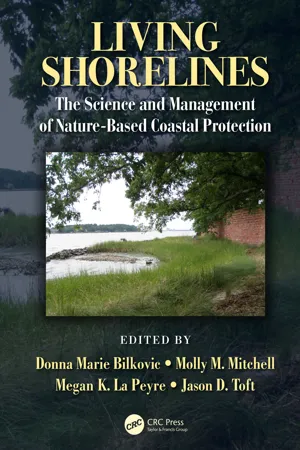
Table of contents

  1. Copyright Page
  2. Contents
  3. Foreword
  4. Acknowledgment
  5. List of Contributors
  6. Part I
  7. Chapter 1
  8. Chapter 2
  9. Part II
  10. Chapter 3
  11. Chapter 4
  12. Chapter 5
  13. Chapter 6
  14. Chapter 7
  15. Chapter 8
  16. Chapter 9
  17. Part III
  18. Chapter 10
  19. Chapter 11
  20. Chapter 12
  21. Chapter 13
  22. Chapter 14
  23. Part IV
  24. Chapter 15
  25. Chapter 16
  26. Chapter 17
  27. Chapter 18
  28. Chapter 19
  29. Chapter 20
  30. Chapter 21
  31. Chapter 22
  32. Part V
  33. Chapter 23
  34. Chapter 24
  35. Index