- 176 pages
- English
- ePUB (mobile friendly)
- Available on iOS & Android
eBook - ePub
Infantile Sexuality and Attachment
About this book
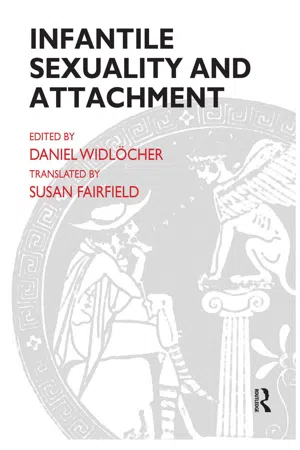
In this book, the author discusses on "eternal debate" between those who see asexual attachment as the earliest bond and those who see infantile sexuality as primary. Eight major contributors to psychoanalytic child studies set forth the current state of thinking in both camps.
Information
1
Primary Love and Infantile Sexuality: An Eternal Debate
HISTORY OF A DEBATE THAT DID NOT TAKE PLACE
In May 1937, at the Second Conference of Four Nations held in Budapest, Michael Balint drew up a “geopolitical” table of the differences he observed in the psychoanalytic theory of libidinal development. He contrasted the views put forth in London with those of the Viennese in order to show how the Budapest group disagreed with both sides. In London (that is, in the group around Melanie Klein), what was stressed was the love–hate dualism characterizing the initial stages of infantile sexuality. Referring to a paper by Joan Riviere, “On the Genesis of Psychical Conflict in Earliest Infancy” (1936), Balint observed that, for this school, the mental life of the newborn is narcissistic in nature, filled with cannibalistic oral drives stemming from an endogenous sadistic instinct and aggressive responses to frustration. Good and bad objects are set up in the psyche and undergo a complex play of projections. In Vienna, doubt was cast on the validity of this reconstruction of early stages of development. Citing Waelder’s paper, “The Problem of the Genesis of Psychical Conflict in Earliest Infancy” (1937), Balint noted that the criticisms concerned the existence of an oral-sadistic world, the importance of the mechanism of projection, and, finally, the concept of a fantasy life cut off from reality. But he commented that nothing was said about the origin of aggressive drives, or about the greed and insatiability of the libidinal drives as accurately described by Freud and taken up by Klein as the basis of her theory.
On the one hand, we have a theory that plausibly explains undeniable observational facts but is difficult to prove; on the other hand, a plausible critique of this theory without an adequate explanation of the data.
On both sides, the misunderstanding has to do with the fact that there had not been a reappraisal of the idea developed by Freud (1905a) in the Three Essays on the Theory of Sexuality to the effect that the satisfaction of the infantile sexual drive, based on the self-preservative drives, is autoerotic in origin, especially in the wake of his 1915 addition: “the narcissistic libidinal cathexis of the ego is the original state of things, realized in earliest childhood, and is merely covered by the later extrusions of libido, but in essentials persists behind them” (p. 218).
The Budapest school found that it could overcome this misunderstanding. Referring to the clinical data of transference, Balint (following Ferenczi here) showed that satisfaction and frustration govern the absence or presence of aggressive and persecutory manifestations, and that autoerotic narcissistic satisfaction is not a universal explanation. The primacy of object love, he asserted, was confirmed by the research of Imre Hermann on primary clinging reactions and by the work of Alice Balint on early mother–child relations. Thus it was ultimately the theory of primary narcissism that led the London/Vienna debate to an impasse. It would be a major contribution of the Budapest school to propose the existence of a primary object love and, as Balint put it, to abandon the myth of the amoeba. But this, he concluded, was merely a matter of opinion, and he left the debate unresolved.
The question left open, however, is that of infantile sexuality. Balint asked about its origins without ever making it clear that this was what was being talked about. To be sure, he mentioned that the oral drive does not explain everything, and that it is only one of the forms of attachment. But he did not specify whether or not the oral relation to the object plays a privileged part in later development. What role is to be accorded to autoerotism?
What would the psychoanalysts of London or Vienna respond to these criticisms coming from Budapest? Events, of course, did not permit a real debate to take place. We can assume that the answer, from both the ego psychologists and the Kleinians, would be to distinguish the narcissism of the ego or the self from that supposedly coming from the id. Can the drive be narcissistic without the person’s knowledge? The conditions for autoerotic satisfaction are different from those that obey the reality principle. What psychoanalysis must explain is the origin of infantile sexual fantasies and not the child’s affective development. To consider Balint’s argument once again, we could say that although there was hardly any sense in London and Vienna of how to use direct observation to verify the origin of infantile sexuality, what such direct observation showed in Budapest could certainly form a model of the analytic process but not of the origin of infantile sexuality.
In June 1996, in a lecture held at the Psychoanalytic Union of University College in London, Jeremy Holmes (1998) reviewed contemporary perspectives on the basis of which a new model of the psychoanalytically oriented therapeutic process could be constructed. He accorded a major role to attachment theory. Arguing that infantile sexuality should be redefined according to current research on early mother–child relations, he observed that these relations must be considered less in terms of infantile sexuality than in the light of different patterns of dependence and attachment. For example, in this view the emotional distance observed in the relation of a patient to his analyst is not so much a latent homosexuality as the trace of an infantile position of insecurity and avoidance. What might be attributed to oedipal problematics—a patient’s fear, for example, of getting too close to the analyst, suggesting a paternal interdict and castration anxiety—is to be considered a metaphor. The same holds true for whatever pertains to infantile sexuality. This is, to be sure, an extreme view, one that the author is proposing as a possible development. The issue has the merit of being clearly put forth as a call to debate.
Does this mean that such a debate has remained latent, or been forgotten, for over sixty years? My point here is not to go over the story of this latency. But let us note three essential points.
Throughout Freud’s work, first of all, there is a shifting opinion about the role of the object in the drive. But whatever Bowlby (1958) may think, Freud basically stands by the idea that the libidinal drive arises from an endogenous excitation and that its satisfaction comes from eliminating excitation. In An Outline of Psycho-Analysis (1938), a work that can be considered his final word on the subject, though he recognizes the mother as the child’s first love object, what is meant is the nourishing maternal breast. In accordance with the theory of anaclisis, what the subject lacks is the breast, and love ultimately comes down to the need for food. The mother’s importance is due to the fact that she satisfies the child’s physiological needs and thereby stimulates the erogenous zones.
In 1905, Freud’s position, based on clinical experience with adults and the analysis of dreams, was clear: all infantile sexual manifestations are autoerotic in nature. In 1910, with particular consideration of the case of Little Hans, he offers a more nuanced point of view. In Note 58, added in that year to the Three Essays, he observes: “I was further made aware in the account I have given in the text, which, in the interests of lucidity, describes the conceptual distinction between the two phases of auto-erotism and object-love as though it were also a separation in time.” And he adds that “children between the ages of three and five are capable of very clear [sexual] object-choice” (p. 194n). Moreover, as early as 1905 Freud noted that not all sexual excitation has a bodily origin: “It must . . . be admitted that infantile sexual life, in spite of the preponderating dominance of erotogenic zones, exhibits components which from the very first involve other people as sexual objects” (1905a, pp. 191–192). Such components would be the partial drives of voyeurism/exhibitionism or cruelty. Nevertheless, Freud is anxious to mention the role of anality in the first case and the skin of the buttocks in the second.
The introduction of the concept of narcissism only served to confuse matters. In Totem and Taboo (1912) he includes narcissism as an intermediary stage in the course of which the partial drives (of autoerotism) come together and are directed, not toward an external object (object love), but toward the ego. In the New Introductory Lectures (1933), he returns to this notion and modifies it: the libido is at first turned toward the ego, a veritable reservoir of drives from which object cathexes emerge though for the most part they always remain in the ego. This theory is no doubt meant to explain the origin of the narcissistic component of the personality, but it “juggles” between a phenomenological perspective (self-love) and a metapsychological perspective (the seat of psychic energy). And there is no trace of it either in the later additions (1915 and following) to the Three Essays or in the discussion of libidinal development in the Introductory Lectures (1916–1917). In the New Introductory Lectures he explicitly presents it as a theory he was compelled to renounce.
In point of fact, if Freud did not pursue his questioning very far, this is because infantile sexuality lost some importance in his eyes in favor of the dualism Eros/Thanatos. The problematics of the drives thus became absorbed in those of Eros and the life instinct.
After Freud, the theoretical differences among the schools were formulated around themes that had the effect of “erasing” this debate.
In the Viennese tradition, that is, with the emigration to the United States and the movement known as ego psychology there (and in London under Anna Freud), the Freudian position was vigorously maintained. In “Comments on the Formation of Psychic Structure,” a paper originally published in 1946 in the second volume of The Psychoanalytic Study of the Child, Heinz Hartmann, Ernst Kris, and Richard Loewenstein clearly affirmed the existence of a stage of primary narcissism. They spoke of an undifferentiated phase in which the ego and the id are not yet distinct from one another. The child is still unable to differentiate between the self and the surrounding world. The object does not exist; every experience of satisfaction is felt to come from an internal source. Experiences of severe privation lead to major intrapsychic disorganization. It is only through moderate privations that the child gradually comes to recognize the existence of objects outside himself, in the form of part objects directly linked to the felt privation. Thus the maternal breast is perceived as a part of the self as long as the drive is gratified and is progressively distinguished from the self in the course of repeated experiences of delayed satisfaction.
To be sure, cognitive and perceptive maturation is an additional factor in this gradual awareness of the external object, but we must also take into account the libidinal cathexis of the self. It is here that we can speak of a primary narcissism, the libidinal cathexis of the external object being constituted only in the situation of nonsatisfaction. These data seem consistent with direct observation of the young child. The child gradually discovers the mother’s attributes and gestures, but this discovery is the result of the libidinal tie that forms between the two. Primary identification is gradually followed by an object relation.
The authors refer to Balint in order to take issue with his claim that object relations exist right from the beginning. While they cannot judge the validity of this hypothesis, it seems more likely to them that Freud’s theory of primary narcissism applies to what can be observed in newborns. As we can see, the debate involves a certain ambiguity with regard to perception (object recognition) and libido (the desire directed toward the object). The work of René Spitz (e.g., 1965) follows this line of thinking. Though he offers a more highly refined view of perceptual maturation, he maintains that what the infant recognizes in the primary Gestalt are superficial aspects of things and not real libidinal objects. The latter are still blended in with primary objectless experience. In this sense, the stage of the precursory object that the child defines is hardly distinct from the initial preobject stage.
In Normality and Pathology in Childhood, Anna Freud (1954) continued her earlier work on developmental lines by isolating a first stage, leading to object relations, in which there is a biological unity of the mother–child couple. As Hoffer (1952) put it, the mother’s narcissism extends to the child, and the child includes the mother in his internal narcissistic world. According to Mahler (1952), this period is in turn divided into an autistic phase, a symbiotic phase, and a phase of separation-individuation. French authors of this period put forth the same thesis. In La Théorie Psychanalytique, Lab (1969) wrote that love is originally narcissistic; in other words, the drive that is at first satisfied autoerotically is later turned toward objects. And Renard (1969), discussing Balint, wrote:
On the theoretical level, Balint’s conception is clearly inadequate. This is so because, ever since Freud’s Beyond the Pleasure Principle (1920), we know that it is not possible to draw a fundamental distinction between the libidinal energy of sexual tendencies, whether aimed at an object or at the subject himself, and the libidinal instincts of self-preservation. If we abandon the notion of a primary narcissistic cathexis of the biological unity represented by the newborn, and even the fetus, how are we to understand the functioning of the mechanisms maintaining this unity and enabling its development? [p. 195, trans. S. F.]
In post-Freudian circles, then, there was no extension of Balint’s line of questioning. Retained in order to be refuted was the idea that, from birth, the child is oriented toward the mother. Balint was believed to have stopped at a psychological theory of the newborn’s perceptual capacity, and it was not recognized that his was a drive theory. If this point was not dwelled on, it was because the theory of primary narcissism seemed to provide a full answer to the question of the initial development of the libido. This conviction is essentially based on the theory of anaclisis and on the importance accorded to the source and aim of the drive to the detriment of the object. The object is interchangeable and contingent, as Freud had emphasized in “Instincts and Their Vicissitudes” (1915). The tension felt by the child is the psychic expression of the drive arising from its somatic source. Pleasure and unpleasure depend on whether the tension is or is not soothed; the object is merely the causal agent of this experience and does not play a part in its contents. Gradually, through the repetition of the experience of nonsoothing, the infant discovers itself as an object.
The term narcissism applies both to the child and to the drive. Applied to the child, however, it is confusing, since in the initial phase, when the newborn presumably feels pleasure and unpleasure, what we are instead dealing with is an “autism.” Freud had spoken of a phase of autoerotism, and when he introduced narcissism he held it to be an object and ascribed it to a later phase of the newborn’s development. Applied to the drive, the term narcissistic designates the movement of drive energy discharged in the undifferentiated ego. What is lacking here is the dimension of fantasy, more precisely the fantasmatic object relation, which is considered to be secondary and to appear later on.
It is in connection with fantasy that Melanie Klein and her pupils distanced themselves from the theory of primary narcissism. If there is primary fantasmatic activity, it directly presupposes the existence of the object as the predicate of desire. Good and bad objects must be understood as objects of thought, or rather object-thoughts. To be sure, narcissistic object relating is mentioned with reference to internal objects, but these objects belong to the very structure of the drive since they constitute the predicate of fantasy, and fantasy is present from the outset of psychic life. As Hanna Segal (1964) wrote, the sensation of a drive in the psychic apparatus is linked to the fantasy of a specific corresponding object. Thus to the wish for food there corresponds the fantasy of something that can satisfy this wish, namely the breast. It is clear that, from this perspective, the object is intimately connected right from the beginning with the structure of the drive and is not merely the agent of the experience of satisfaction. From the outset, then, there is a relation between the external object and the internal object, with processes of introjection and projection assuring the construction of the internal world.
This enabled Klein to break cleanly with the Freudian thesis. According to her, positing a preobjectal stage implies that—apart from the portion of the libido attached to the child’s own body—drives, fantasies, anxieties, and defenses are either absent or are unconnected to objects, as if operating in a void. But love and hate, fantasies, anxieties, and defenses, she argued, are bound up with object relations; so-called narcissistic retreats involve the constitution of internal objects. As Segal put it, drives are by nature object seeking. It seems to me that later Kleinians have remained faithful to this point of view.
Thus Balint was wrong to think that analysts in both Vienna and Berlin shared a belief in the existence of a stage of primary narcissism, or at least, with reference to this second “geographic” tradition, he gave more weight to the influence of Karl Abraham than to the originality of Klein’s thinking. But where Balint was undoubtedly right, and where his critique of the Kleinians has remained valid, is with regard to anaclisis. For it is in the very nature of the psychic structure of the drive to “intuit” its object; its aim depends on the satisfaction of need. In this sense, we cannot speak of a primary object love. The primary object, it seems to me, remains the object of satisfaction. Bowlby is careful to emphasize this major difference with the tradition stemming from Balint, even if both traditions have in common the reference to the primary object relation.
At the same time as Balint was making his exile’s way from Budapest to London, this is also where the thesis of “primary love” was finding echoes. Yet we must not forget that in Budapest the theoretical tradition was not forgotten. Imre Hermann continued his theoretical research on clinging while keeping alive the transmission of psychoanalysis throughout years of clandestine activity imposed by totalitarian censorship. The influence of the “regional” point of view, to use Balint’s term, appeared in the group of psychoanalysts, and the development of original programs, devoted to mental health and child treatment.
In London, Balint therefore joined the group of Independents, with whom he shared a spirit of open-mindedness, eclecticism, and creativity. As Rayner (1994) puts it, the approach of the British Independent school to the analytic process has to be seen in the context of their concern with infant and child development. This concern arises from the role they assign to the effects of early trauma on the later development and pathology of the adult, but also from the importance of early developmental models in their understanding of the normal and pathological relations of the self and its environment. To the purely genetic perspective of the Freudian and Kleinian traditions, they add the perspective according t...
Table of contents
- Cover
- Half Title
- Title Page
- Copyright Page
- Contents
- Preface
- 1. Primary Love and Infantile Sexuality: An Eternal Debate
- 2. Sexuality and Attachment in Metapsychology
- 3. Infantile Sexuality as a Creative Process
- 4. Sexuality and Erotism: From Sexuality to Fantasy
- 5. Sexual and Actual
- 6. Infantile Sexuality and the Autoerotism of the Transference
- 7. Separation
- 8. Attachment and Infantile Sexuality
- Contributors
- Index
Trusted by 375,005 students
Access to over 1.5 million titles for a fair monthly price.
Study more efficiently using our study tools.
Frequently asked questions
Yes, you can cancel anytime from the Subscription tab in your account settings on the Perlego website. Your subscription will stay active until the end of your current billing period. Learn how to cancel your subscription
No, books cannot be downloaded as external files, such as PDFs, for use outside of Perlego. However, you can download books within the Perlego app for offline reading on mobile or tablet. Learn how to download books offline
Perlego offers two plans: Essential and Complete
- Essential is ideal for learners and professionals who enjoy exploring a wide range of subjects. Access the Essential Library with 800,000+ trusted titles and best-sellers across business, personal growth, and the humanities. Includes unlimited reading time and Standard Read Aloud voice.
- Complete: Perfect for advanced learners and researchers needing full, unrestricted access. Unlock 1.5M+ books across hundreds of subjects, including academic and specialized titles. The Complete Plan also includes advanced features like Premium Read Aloud and Research Assistant.
We are an online textbook subscription service, where you can get access to an entire online library for less than the price of a single book per month. With over 1.5 million books across 990+ topics, we’ve got you covered! Learn about our mission
Look out for the read-aloud symbol on your next book to see if you can listen to it. The read-aloud tool reads text aloud for you, highlighting the text as it is being read. You can pause it, speed it up and slow it down. Learn more about Read Aloud
Yes! You can use the Perlego app on both iOS and Android devices to read anytime, anywhere — even offline. Perfect for commutes or when you’re on the go.
Please note we cannot support devices running on iOS 13 and Android 7 or earlier. Learn more about using the app
Please note we cannot support devices running on iOS 13 and Android 7 or earlier. Learn more about using the app
Yes, you can access Infantile Sexuality and Attachment by Daniel Widlocher in PDF and/or ePUB format, as well as other popular books in Psychology & Developmental Psychology. We have over 1.5 million books available in our catalogue for you to explore.