![]()
Part I
The Goal
The greatest thing in this world is not so much where we stand as in what direction we are moving.
Johann Wolfgang von Goethe
![]()
1
Lean IT
One of the success factors of a Lean IT transformation is building a common basis among everyone within the IT organization. This common basis is made up of definitions, knowledge and stories. In this section, we will lay down that common basis. We will define Lean IT and investigate the specifics of the IT context in which Lean is being applied. We will take a high-level look at what it means to transform an IT organization, what are the phases you will go through and how to identify the success of the transformation.
In order to ensure that the rest of the book makes sense, we must describe some basic concepts. Lean principles, dealing with waste and different types of activities are fundamental to creating a solid basis for your Lean IT transformation. We will also take a look at the relationship between Lean IT and a number of other trends in the world of IT, particularly Agile, DevOps and IT Service Management.
This book is definitely not exhaustive when it comes to Lean. A brief look at the Lean Community and the materials available to help you make your Lean IT transformation successful concludes this part of the book.
Before we dive into the process of transforming your IT organization, we need to define Lean IT. The Lean IT Association (2014) defines Lean IT as:
Lean IT is the extension of Lean manufacturing and Lean services principles to the development and management of information technology products and services. Its goal is to continuously improve the value delivered by IT organizations to their customers, and the professionalism of people working in IT.
What this means is that Lean IT is principally about improving the capabilities of the people working within IT, their way of working and the information technology products and services, in order to deliver more value to customers. Many of the principles, methods and tools have been borrowed from other industries where Lean has been applied. There are a few tools that are specific to Lean IT.
One interesting aspect of Lean is that despite the similarities between the application of Lean principles in manufacturing, healthcare or other services, there are differences. Initially, the term Lean was synonymous with what is now called Lean Manufacturing. As Lean principles were applied to industries other than manufacturing, variations such as Lean Services, Lean Healthcare, Lean Government and of course, Lean IT developed. This proliferation comes from the fact that the context within which Lean principles, tools and methods are applied is important in determining how they are applied. Even though the tools used in Lean Manufacturing and Lean IT may be exactly the same, for example, Value Stream Mapping, kaizen problem-solving and visual management, it is necessary for a Lean practitioner from a different context to understand the IT context to be effective within IT.
Why has Lean been so successful in manufacturing industries? Manufacturing mainly deals with machines that create products. Increasingly, the human factor is removed from the production equation; robots, automated processes and machinery are all aimed at removing, or helping to remove, the variability of humans and ensuring consistent quality. Machines are designed for efficiency, i.e. they create large amounts of products at a speed that humans cannot match. Unfortunately, in the process, they tend to produce more waste than people, who adapt quickly to re-use or reduce waste. The machines are subsequently tuned to ensure that they work better, producing more products per hour or less waste per product. This is, in general, a rational, scientific process, which deals with tangible products that are produced in a predictable, structured manner. It is also relatively easy to measure how the products are made. After many improvement iterations, the goal is to obtain a defined percentage increase in improvement each time. These characteristics explain why the Six Sigma methodology developed within the manufacturing industry.
Compare this with an IT organization and we find different challenges. Firstly, an IT service is an intangible entity. Even at the core of the service, software is not something you can pick up and look at. It is only by installing it and using it that the value can be understood. To a large extent, IT is unpredictable; we do not know when it will fail; we do not know how it needs to be improved. Within IT, we are also not used to measuring the service as a whole. We measure the performance of machines but that is only part of the service. The “people” part remains largely unmeasured. This is precisely where IT differs from manufacturing: The most critical component is still the people delivering the service. The software industry continues to make inroads into reducing the people effect, but people still make up a substantial part of where the IT service can fail.
Applying Lean to IT is thus a paradoxically different proposition. The paradox is that despite our focus on the technology, Lean IT is about applying the Lean approach to people, and to a much lesser extent to machines. Aiming for perfection means raising the level of professionalism of the people involved. This means improving their ability to solve problems, to deliver and provision services in a predictable time frame and quality, to work autonomously and in a team, and to improve their mastery of the subject matter. Aside from skills training, this means embedding a new mindset focused on Lean principles.
Since the context is so important, we will start by taking a look at the IT context and what it means to transform an IT organization, followed by a dive into the basics of Lean.
![]()
2
The IT Context
What makes applying Lean to IT different to applying Lean to other sectors or industries?
As we saw earlier, the success of a business is closely linked to the ability of its IT organization to deliver business needs quickly. There is an increasingly flawed assumption that IT is a supporting and sometimes non-core or non-essential “ department.” The flaw in this assumption exists in two respects.
Firstly, IT is treated as separate from the business. IT products and services have become so intertwined with business processes, that the IT organization can no longer be seen as a separate entity from the business. The need for cooperation is so intense as a result of the intimate link between business process and the associated automation which together enable business outcomes. Most business decisions or functions have been built into information systems for efficiency, consistency and quality control purposes. The people building and maintaining these systems are no longer just there to execute requests from “ the business” but are increasingly knowledgeable about the business process and can contribute to the improvement and further automation of the business process. In summary, information systems and services are a critical part of every business process.
Secondly, IT is seen as a simple, supporting function. IT has the characteristics of a business-within-a-business. In contrast to other “ supporting” departments (such as HR, Legal or Finance), IT contains the full range of business functions. It designs and develops products and services. The IT organization ensures that IT services run in production and it provides support and maintenance for these products and services. IT usually manages its own finances, as a result of complicated cost allocation and budgeting, based on economies of scale. Human Resources Management for IT is increasingly seen as a separate, specialist discipline, as can be seen from the development of the e-Competence Framework. IT departments have their own specialized purchasing and legal support to deal with the requirements for contracting external parties.
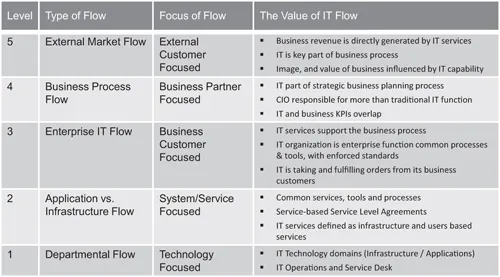
One useful model that illustrates the complexity of the IT environment quite well is described in the Lean IT book Run, Grow, Transform (Bell, 2012). The Flows of Value model defines five different levels of flow within an IT organization. The five levels are described in Figure 2.1.
FIGURE 2.1
Five flows of IT value as defined by Bell (2012).
The key premise of this model is that the focus of IT strategy, governance, organizational structures and measures change as IT organizations increase their scope from technological through enterprise to external customer focus. The model does not imply that each IT organization must achieve Level 5, although this is sometimes forced on the organization by external use of IT products and services. It simply describes the characteristic of each level of flow.
At the first level (Technology Focused), the value of IT flow is seen from the departmental level, and the focus is on technology domains. At the core of IT, the basic components of IT, the hardware and software, must work correctly. At this level, we find the various technologies required to make IT services work. From a value stream perspective, process improvement will focus on IT Operations and basic support processes and functions such as the Service Desk.
The next level (System/Service Focused) focuses on the coherent cooperation of the IT components into IT systems and IT services, meaning that infrastructure and applications work together in the eyes of the customer. IT services are typically initially defined as infrastructure and user-based services, such as workplace services or a service concerning an application of which the name is recognizable for the end-user. At this level, the IT organization perceives two forms of flow: Plan and Build processes on the one hand and Run processes on the other. The various IT groups largely split themselves into two camps, Application Development or Infrastructure, and there is limited connection between the camps.
Level 3 is focused on the Business Customer. The customers of IT are the employees of the IT Department’ s colleagues in different parts of the business, who gain real value when the two camps of the IT organization come together to deliver services that support business processes. Unfortunately, at this level, there is a false belief that IT is a service provider that is somehow a disconnected supplier to the actual business. This delivery of value typically involves IT taking and fulfilling orders from its business customer. The business customer is gaining a better understanding of the fact that IT is a function made up of both internal and external suppliers using common processes and tools. IT is seen as a single entity (Enterprise IT Flow) but still separate from the other business units.
At level 4, IT is seen as an integral part of the business. As IT becomes focused on its business partners, IT becomes an integral part of the strategic business planning processes. IT measures its success in terms that are relevant for the business, for example, end-to-end availability of IT services rather than just the uptime of IT components. Value is based on ensuring that IT services match business processes and the two (business process and IT service) are considered as one. There is a focus on flow across the entire business ecosystem, with IT-enabled value streams.
The highest level of value delivered by IT (level 5: External customer focused) is when I...