Behavioral medicine has now matured as a field to the point where all recognize that different populations are presented with different issues. Psychological reactions and patterns affect the health and well-being of children, as well as adults, and numerous standardized instruments for the assessment of a variety of areas of children's functioning are currently available. Yet, it can be difficult for practitioners and researchers searching through general compendia of resources for child assessment--which are frequently focused on general techniques rather than specific instruments--to identify the optimal ones to meet their particular needs and to choose among them.
This practical and comprehensive reference guide is the first to sort, present, and review all the measures that can be used to evaluate the behavioral, cognitive, and emotional aspects of children's health. It organizes the measures under eight general headings, such as quality of life, adherence, pain management, and patient satisfaction. Each chapter begins with a leading authority's overview of the underlying theoretical construct and any concerns about how to measure it. Descriptions and reviews of relevant instruments follow; these include information on administration, scoring, psychometric properties, and ordering, as well as comments by the instruments' developers.
Assessing Children's Well-Being: A Handbook of Measures will be welcomed by all those professionals and scientists who seek to assess and effectively address the complex interactions between physical health and mental health in children.
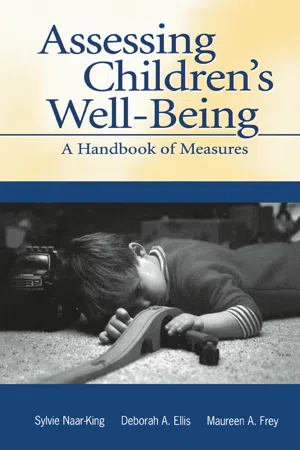
eBook - ePub
Assessing Children's Well-Being
A Handbook of Measures
- 324 pages
- English
- ePUB (mobile friendly)
- Available on iOS & Android
eBook - ePub
Assessing Children's Well-Being
A Handbook of Measures
About this book
Information
1
Health Status and Quality of Life
INTRODUCTION
Chronic health conditions that affect children represent an important and prevalent public health problem (Newacheck & Taylor, 1992) that can disrupt children’s functioning and activities (Newacheck & Halfon, 1998) and increase family burden (Drotar, 1997). In recent years, advances in medical treatment have prolonged the lives of children with conditions such as cancer and very low birth weight and have necessitated increased attention to the assessment of their functioning and adaptation. Studies of the long-term outcomes of children with chronic health conditions place a primary emphasis on assessment of functioning (Thompson & Gustafson, 1996). As interventions are developed to enhance the functioning and adaptation of children with chronic illness, reliable and valid measures of functional outcome become increasingly important (Bauman, Drotar, Perrin, Pless, & Leventhal, 1997). For all the aforementioned reasons, the measurement of children’s health status and quality of life has assumed increased importance (Spieth & Harris, 1996).
Health status refers to a description of the child’s overall level of health that includes the severity of the illness. Quality of life (QOL) refers to functional effect of an illness as perceived by the child or others who are knowledgeable about the child, such as caretakers (Spilker, 1990). One advantage of the construct of QOL is the fact that it is comprehensive and measures well-being in multiple domains such as physical, mental, and social (WHO, 1948).
Health status and QOL assessments have several important applications. One of these is the ability to provide a comprehensive description of children’s health status, which can have multiple purposes. For example, assessments can provide descriptive information on current health status, comparison of patients at different disease stages, evaluation of the efficacy of different treatment protocols, and assessment of the child’s progress over time in response to medical treatment.
A second application is the identification of acute dysfunctions, chronic dysfunctions, or both following an illness or treatment. This is an emerging problem among long-term survivors of illnesses such as cancer, and individuals who are at risk for the development of psychological difficulties (Eiser, 1995; Mulhern et al., 1989). QOL assessment can be used to identify children with a chronic illness who may be at risk for developing future psychological, physical difficulties, chronic symptoms, or all of the aforementioned.
A third application of measures of health status and QOL is the evaluation of treatment efficacy and clinical decision making. Traditionally, health outcome indicators have included information on mortality, morbidity, hospital re-admission, re-treatment rates, the results of laboratory and other diagnostic tests, complications, or all of the above (Bowling, 1995). Furthermore, assessments of QOL that are potentially sensitive to morbidity associated with alternative treatments are necessary to document the costs versus benefits of available treatments (Eiser, 1995). By providing information about patients’ subjective experience and morbidity associated with different treatments, QOL measures can also facilitate the clinical decision making in deciding between alternative treatments. Finally, measures of health status and QOL describe the substantial variations in response to treatment and long-term prognosis within populations of children with chronic illnesses.
Research is needed to develop and support the various applications of health status and QOL assessments in children and adolescents. In particular, research is needed to document the utility and validity of measures of health status and QOL in clinical decision making, that is, to answer questions such as: How can practitioners utilize assessments of health status and QOL in making treatment-related decisions and assessments? How do health status and QOL measures improve efficiency of assessment and clinical decision making?
Another area of needed research concerning clinical application involves the use of health status and QOL measures to evaluate the impact of managed care and health services on children’s health and well-being. Measures of health status and QOL have the potential to provide valuable data that can be utilized to evaluate the impact of comprehensive health care for children with chronic health conditions.
Over and beyond research related to clinical applications of measures of health status and QOL, more basic research questions need to be addressed (Drotar, 1998). Developmental research has underscored significant differences in how children of different ages appraise their health (Tinsley, 1992). Research is needed to document the impact of developmental differences in children’s perceptions of their health status and QOL across various ages. Research is also needed to document changes in perceptions of health status and QOL that occur in response to specific developmental stages (e.g., adolescence). Studies that describe differences in the perceptions of health status and QOL among children, adolescents, and parents from different cultural groups and families from different economic levels and structure would be highly desirable. Because it is not always possible to obtain reports from parent and child, research is needed to identify domains of health status and QOL for which a parent’s proxy report is sufficient versus those for which a child’s report supplies unique information. Other unanswered questions concerning informants’ reports that should be addressed in future research concern the differential validity of child versus parent reports of health status of QOL for various research questions and outcomes. Finally, the clinical significance and validity of discrepancies in parents’ versus children’s perceptions of health status and QOL should be described (Drotar, 1998).
In order to address these potential clinical applications and research questions, researchers and practitioners who are interested in measurement of health status and QOL require access to these constructs. Such access is especially important because many of the measures of health status and QOL are relatively new. The authors of this volume provided an important service to potential users of these instruments by summarizing information concerning available measures of health status and QOL in a succinct, user-friendly format.
REFERENCES
Bauman, L.J., Drotar, D., Perrin, E., Pless, F.B., & Leventhal, J. (1997). A review of the effects of psychosocial interventions for children with chronic health conditions. Pediatrics, 100, 244–251.
Bowling, A. (1995). Measuring disease: A review of disease-specific quality of life measurement scales. Philadelphia: Open University Press.
Drotar, D. (1997). Intervention research: Pushing back the frontiers of pediatric psychology. Journal of Pediatric Psychology, 22, 593–606.
Drotar, D. (Ed.). (1998). Measuring health related quality of life in children and adolescents: Implications for research and practice. Mahwah, NJ: Lawrence Erlbaum Associates.
Eiser, C. (1995). Choices in measuring quality of life in children with cancer: A comment. Psychooncology, 4, 121–131.
Mulhern, R.K., Ho...
Table of contents
- Contents
- Preface
- 1 Health Status and Quality of Life
- 2 Adherence
- 3 Pain Management
- 4 Child Behavior
- 5 Child Development
- 6 Child Coping
- 7 Cognitions, Attributions, and Attitudes
- 8 Environment
- 9 Consumer Satisfaction
- APPENDIX
- Author Index
Trusted by 375,005 students
Access to over 1.5 million titles for a fair monthly price.
Study more efficiently using our study tools.
Frequently asked questions
Yes, you can cancel anytime from the Subscription tab in your account settings on the Perlego website. Your subscription will stay active until the end of your current billing period. Learn how to cancel your subscription
No, books cannot be downloaded as external files, such as PDFs, for use outside of Perlego. However, you can download books within the Perlego app for offline reading on mobile or tablet. Learn how to download books offline
Perlego offers two plans: Essential and Complete
- Essential is ideal for learners and professionals who enjoy exploring a wide range of subjects. Access the Essential Library with 800,000+ trusted titles and best-sellers across business, personal growth, and the humanities. Includes unlimited reading time and Standard Read Aloud voice.
- Complete: Perfect for advanced learners and researchers needing full, unrestricted access. Unlock 1.5M+ books across hundreds of subjects, including academic and specialized titles. The Complete Plan also includes advanced features like Premium Read Aloud and Research Assistant.
We are an online textbook subscription service, where you can get access to an entire online library for less than the price of a single book per month. With over 1.5 million books across 990+ topics, we’ve got you covered! Learn about our mission
Look out for the read-aloud symbol on your next book to see if you can listen to it. The read-aloud tool reads text aloud for you, highlighting the text as it is being read. You can pause it, speed it up and slow it down. Learn more about Read Aloud
Yes! You can use the Perlego app on both iOS and Android devices to read anytime, anywhere — even offline. Perfect for commutes or when you’re on the go.
Please note we cannot support devices running on iOS 13 and Android 7 or earlier. Learn more about using the app
Please note we cannot support devices running on iOS 13 and Android 7 or earlier. Learn more about using the app
Yes, you can access Assessing Children's Well-Being by Sylvie Naar-King,Deborah A. Ellis,Maureen A. Frey,Michele Lee Ondersma in PDF and/or ePUB format, as well as other popular books in Psychology & Mental Health in Psychology. We have over 1.5 million books available in our catalogue for you to explore.