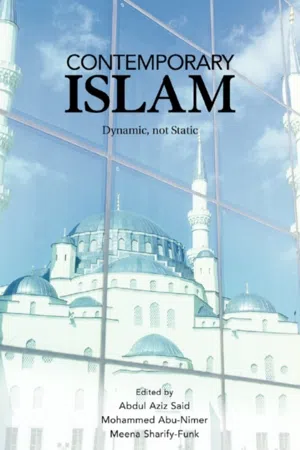
Contemporary Islam provides a counterweight to the prevailing opinions of Islamic thought as conservative and static with a preference for violence over dialogue. It gathers together a collection of eminent scholars from around the world who tackle issues such as intellectual pluralism, gender, the ethics of political participation, human rights, non-violence and religious harmony. This is a highly topical and important study which gives a progressive outlook for Islam's role in modern politics and society.
eBook - ePub
Contemporary Islam
Dynamic, not Static
- 274 pages
- English
- ePUB (mobile friendly)
- Available on iOS & Android
eBook - ePub
About this book
Information
Part I
The Many Voices of Islam
Cultivating Intellectual Pluralism
1 The Many Voices of Islam
Cultivating intellectual pluralism
Mustafa Ceric
Grand Mufti of Bosnia and Herzegovina
Grand Mufti of Bosnia and Herzegovina
Islamic Civilization as a Wheel
The phenomenon of the Islamic civilization may be seen as a wheel that is turning on the axis of a continuous divine message from the first human, Adam, to the last Messenger, Muhammad. This divine axis of the Islamic civilization has remained the same because it has the same meaning of the living spirit and because it is the same logic of the transcendental truth. The code of the axis is such that it moves the wheel of the Islamic civilization in different directions, but it remains in the vicinity of the axis. The dynamics of the movement of the wheel is faster at its edge than at its center. The axis of the Islamic civilization is the divine gift, which unfolds itself in the continuity of life and history. The wheel of Islamic civilization is the divine gift as well, but its movement is due to the human direction and speed.
Hence, the question is: Whither will the wheel of the Islamic civilization go? And with what speed will the wheel of the Islamic civilization move? But before dealing with these two questions, let me say that a civilization is more than a situation of urban comfort. A civilization, I believe, is an effort of human spirit to balance the memory of the past by the memory of the future time, to express the meaning of life, and to present the nature of human soul both in its hope and in its fear. Indeed, civilization is the state of mind which Ibn Khaldun called the ‘aÒabiyyah’, i.e. the passion1 for a decent human life as it progresses from one stage to another with a purpose of self-actualization in history. Very important forces of the passion for human life are the freedom of human spirit and the strength of human mind.
The attribute “Islamic” to civilization should lead us to the notion of the coexistence of continuity and change in history and life.2 That, I believe, is the crucial point whereby the course of the Islamic civilization has been determined in the past – its ability to comprehend the essential continuity of tradition with possible changes in history. It is, then, in this ever-demanding challenge – the appreciation of the continuity of tradition and the acceptance of changes in history – that I see as the real test for the future of the Islamic civilization both in terms of its spiritual boldness and its intellectual creativity. In fact, the idea of the coexistence of continuity and change is the major idea and the one which had provided the Islamic civilization with an unprecedented success in world history. The strength of it lies in the notion of affirmative (hiero) history3 and the notion of guilt-free origin of man.
Affirmative History
The affirmative (hiero) history comes as the most convincing proof that the Qur’an is the culmination of an inclusive divine Message and that the Prophet Muhammad is the universal divine Messenger. In other words, the revelation of the Qur’an does not come as a surprise, it does not break the rules of the God-Man communication, and it does not begin from nowhere:
And before this, was the Book of Moses as a guide and mercy: and this book affirms it in the Arabic tongue; to admonish the unjust, and as Glad Tidings to those who do right.
(46:12)
God! There is no god but He, – the Living, the Self-Subsisting, Eternal. It is He Who sent down to thee in truth, the Book, affirming what went before it and He sent down the Tawrat (the Law of Moses) and Injil (the Gospel of Jesus) before as a guide to mankind, and he sent down the Criterion of judgment between right and wrong.
(3:1–3)
Consequently, the Prophet Muhammad is not the first, but the last Messenger of God. The history does not begin, nor does it end with Muhammad. He is not a rebellious revolutionary who negates everything that came before him.4 The Prophet Muhammad is the Messenger of God who has come to affirm all the good things which preceded him, but also he is here to teach people how to avoid bad things in life and history from the experience of far-gone people and nations.
Thus have we sent you amongst a people before whom (long since) have other peoples gone and passed away in order that you may rehearse unto them what We send down unto you by inspiration. Yet do they reject him the Most Gracious. Say: ‘He is my Lord! There is no god but Him! On Him is my trust, and to Him do I turn’.
(13:30)
The notion of the affirmative history (or hiero-history) has enriched Muslims with the idea of an inclusive approach to history5 as a whole and, in turn, freed the Islamic history from an exclusive possession of it. Of course, the Muslims did take their consequential role as the heirs of hiero-history very seriously, but they have never denied the role of the others, especially the role of Ahlal-kitab (“People of the Book”), namely, the Jews and Christians.
The Holy Qur’an and Critique
While reading the Holy Qur’an, a Muslim cannot but feel the presence of the People of the Book, in almost every page of it. Similarly, Jews and Christians cannot read any relevant book of world history without recognition of the Muslim presence in all fields of human life. Surely, the Qur’an criticizes some Jews and Christians, but it does the same with particular Muslims as well. I guess it is the Muslim moral responsibility not to take advantage of the critique of others in the Holy Qur’an in order to cover the Muslims’ own shortcomings. If nothing else, but for the fact that the Qur’an, as the word of God, is almost unique in appreciating the goodness of people of other religions, especially of the Jews and Christians, the Muslims have a duty to carry out the spirit of tolerance in the midst of religious pluralism. Here is one of many verses of the Holy Qur’an that clearly indicates to that effect:
Verily, those who have attained to faith (in this divine writ), as well as those who follow the Jewish faith, and the Christians, and Sabians6 – all who believe in God and the Last Day and do righteous deeds – shall have their reward with their Sustainer; and no fear need they have, and neither shall they grieve.
(2:62)
Religious Pluralism
Of course, it would be naïve to conclude that there are no differences between Islam and other religions, namely, Judaism and Christianity. The point here is not a vague notion of poor flattering or cheap religious propaganda, but a sincere conviction based on the most important Islamic source that teaches Muslims how to cope with religious pluralism on their own. It also teaches how to appreciate the fact that this world is not made up of one religion or one nation, because if God wanted the world to be so, He could do it, but He wanted the people of this world to be multiple in their religions and nations so that they may compete with each other in good deeds.
This idea of the competition in good deeds applies, especially, to these three world religions of the Book: Judaism, Christianity and Islam, not only because of their claim to the similar heritage of the Book, but also because of their heritage of a unique historical interaction that could not be avoided in the past and their historical responsibility that cannot be ignored in the future. It is precisely in this historical unavoidability of Judaism, Christianity and Islam that I see hope, but also, I must say, I sense a kind of fear. My hope is based on the good heart of the majority, though very often silent in its goodness, of sincere Jews, Christians and Muslims who seek their own peace in the similarity of these religions rather than conflict.
Unfortunately, there is a very loud minority in all three religions who, in fact, see in the similarity of Judaism, Christianity and Islam the very reason for conflict rather than peace. This kind of attitude leads us almost to the conclusion that the similarity, and not the difference, provokes the conflict while the difference brings the respect. We are familiar with the history of a severe debate among the similar, not different, religious groups, a debate that has often turned into a very violent conflict. I have in mind some historical conflicts between the Sunnites and the Shiites in the Muslim religion and the conflict between the Catholics and Protestants in the case of Christianity. I am sure that such examples exist in Judaism as well.
The logic of this kind of conflict among those who are similar, whatever it may be, lies in the false notion that in order for me to keep the purity of my religion the deep difference must be seen of the other who is similar to me, but, at the same time, his/her difference is not tolerated. This is, I believe, the real issue of the relationship between Judaism, Christianity and Islam today: their similarity, not the difference in their spiritual roots, their hope, not fear from each other, their love, not hate of each other, and their justice toward each other, and not oppression of each other.7
I should remind you that the glorious time of the Islamic civilization had been the time of its interaction with other civilizations. The idea of isolation is strange to the Islamic civilization because the Prophet Muhammad was sent to all mankind and thus he is the witness over the world in the sense of bringing upon it the mercy and not the curse.
It is clear, then, that the Muslims in the past knew how to interact with others who had been both similar to and different from their faith and their expectations of life and history. They had been guided by the strong belief of the conformation rather than denunciation, the belief of sharing rather than the belief of staring. Furthermore, they knew how to appreciate the different opinions amongst themselves while keeping in mind the same direction towards the glory of the Islamic civilization as a common achievement of the whole Ummah, Muslim community.
Since we are not children of the moment, we must be able to balance the memory of the past by the memory of the future time. It is in this point (i.e., the balancing of the memory of the past by the memory of the future time) that I see the difficulty in the Muslim present. In other words, the Muslims have difficulty, on the one hand, to free themselves from the guilt of some previous historical events and to take the risk of the future by, on the other hand, fresh spiritualism and creative intellectualism.
Once again, I should remind you that the idea of guilt-free origin of man is one of the most important ideas of the so-called modernity, which has led the world to a spiritual and intellectual advancement, i.e., humanism and renaissance? The slogan: “We are all born free and all men are equal before God,” is the reaction to the notion that all men are born with the sin of Adam and that some men are born as masters and the others are born as slaves. It took Europe centuries and many bloody wars to overcome these two general ideas: the idea of predetermined guilt and the idea of preordained slavery. I believe that one of the reasons why the Muslim world was in advance to the rest of the world lies in the fact that Islam had freed humanity of the guilt and had set the stage of equal chance for all to show their historical merit.
Cultural Insecurity
The current crisis of the Islamic civilization may be seen in the lack of self-confidence, which came as a result of a cultural insecurity, which was introduced with the time of losing the belief in freedom of guilt and the belief in the equal chance for a success in life and history. Consequently, generations of Muslims have lost their spiritual boldness and intellectual creativity. And instead we have seen a kind of spiritual shyness that has led the Islamic civilization into isolation, as well as an intellectual borrowing that was going to lead the Islamic civilization into assimilation. Here is a possible answer to the questions: Whither will the wheel of the Islamic civilization go? Or whither it ought to go from here? To isolation or to assimilation? Or will it make its way towards interaction and co-operation?
Neither Isolation, nor Assimilation, but Civilizational Co-operation
The Islamic civilization is not made either for isolation, or assimilation. It is made for interaction and co-operation. However, in order to go in that direction the Islamic civilization must reject the idea of historical guilt. It is being imposed nowadays upon the Muslims in the sense that the current generation of youth must correct all the mistakes of the previous generations before it thinks of correcting its immediate and long-term future of the Ummah.
In other words, the contemporary generation should hold fast to the belief 8 of freedom from past mistakes and thus take responsibility for the future of the world not in the way of isolation, nor in the way of assimilation, but in the way of equal cultural interaction and civilizational co-operation. The middle ground of historic interaction and rational co-operation is the right way out from the embarrassment of isolation and the risk of assimilation of the Islamic civilization.
It is now the time for the third historic interaction of the Islamic civilization with the rest of the world, especially the western world, after it had experienced the interaction in the time of the venture of Islam and then in the time of the great Islamic impact on both the spiritual and intellectual change in the West. This time, however, the situation is somewhat different from the two previous ones because the West does not feel the need to learn anything from the East as used to be the case.
On the contrary, the West believes that the East should imitate the West in everything, even in their strange moral behavior, which is against human decency as well as human reproduction. This situation though should not discourage Muslims from interaction with the West because of the permanent interdependence between the two worlds – the East and the West – which did not start yesterday and will not end by tomorrow.
Let me now address the second question as to: With what speed will the wheel of the Islamic civilization move? With the speed of its center? Or with the speed of its edge?
Center and Periphery
But, first is there a center of Islam? Yes, there is a center of Islam, but not so much in the sense of geographical compact, economical product, or political impact on the global development as in the sense of a universal identity, the time-space Ka’ba-Qibla orientation and of the faith-based solidarity among common Muslims all over the world. These rather abstract characteristics of the idea of the center of Islam will remain strong because the message of the Qur’an is strong in its universality and its credibility for the human salvation.
The issue here, then, is not about the obvious blessings of the Heaven, but about the use and misuse of those blessings by humans. No one can deny the bliss of the time of the Prophet and . . .
No one can deny the glory of the caliphate, the might of the Ottomans or the transformative impact of modern Europe . . . The caliphs and sultans – at least some of them – deserve their fame . . . And above all, the story of Muhammad (a.s.) and early followers has been a linchpin of Islamic identity for fourteen centuries.9
Yet, continues Richard W. Bulliet, the view from the center leaves too many questions unanswered. Where did all those Muslims come from? Why did they develop a coherent culture or civilization while Europe, despite its Christian homogeneity, was so fractious and diverse?
The view from the center portrays Islamic history as an outgrowth from a single nucleus, a spreading inkblot labeled “the caliphate.” But what other than a political label held Islam together? And why did its political cohesion evaporate after little more than two centuries, never to reoccur?
The view from the edge holds out the possibility of addressing questions like these. It starts from the fact that most Muslims outside the Arabian peninsula are not the descendents of the Arabs. Most of them learned about Islam after they entered the community, not before; an...
Table of contents
- Cover Page
- Title Page
- Copyright Page
- Biographies
- Acknowledgments
- Introduction
- Part I The Many Voices of Islam
- Part II Applied Ethics of Political Participation
- Part III Applied Ethics of Peace and Nonviolence in Islam
- Part IV Coexistence and Reconciliation
Trusted by 375,005 students
Access to over 1.5 million titles for a fair monthly price.
Study more efficiently using our study tools.
Frequently asked questions
Yes, you can cancel anytime from the Subscription tab in your account settings on the Perlego website. Your subscription will stay active until the end of your current billing period. Learn how to cancel your subscription
No, books cannot be downloaded as external files, such as PDFs, for use outside of Perlego. However, you can download books within the Perlego app for offline reading on mobile or tablet. Learn how to download books offline
Perlego offers two plans: Essential and Complete
- Essential is ideal for learners and professionals who enjoy exploring a wide range of subjects. Access the Essential Library with 800,000+ trusted titles and best-sellers across business, personal growth, and the humanities. Includes unlimited reading time and Standard Read Aloud voice.
- Complete: Perfect for advanced learners and researchers needing full, unrestricted access. Unlock 1.5M+ books across hundreds of subjects, including academic and specialized titles. The Complete Plan also includes advanced features like Premium Read Aloud and Research Assistant.
We are an online textbook subscription service, where you can get access to an entire online library for less than the price of a single book per month. With over 1.5 million books across 990+ topics, we’ve got you covered! Learn about our mission
Look out for the read-aloud symbol on your next book to see if you can listen to it. The read-aloud tool reads text aloud for you, highlighting the text as it is being read. You can pause it, speed it up and slow it down. Learn more about Read Aloud
Yes! You can use the Perlego app on both iOS and Android devices to read anytime, anywhere — even offline. Perfect for commutes or when you’re on the go.
Please note we cannot support devices running on iOS 13 and Android 7 or earlier. Learn more about using the app
Please note we cannot support devices running on iOS 13 and Android 7 or earlier. Learn more about using the app
Yes, you can access Contemporary Islam by Abdul Aziz Said,Mohammed Abu-Nimer,Meena Sharify-Funk in PDF and/or ePUB format, as well as other popular books in Theology & Religion & International Relations. We have over 1.5 million books available in our catalogue for you to explore.