- 248 pages
- English
- ePUB (mobile friendly)
- Available on iOS & Android
eBook - ePub
About this book
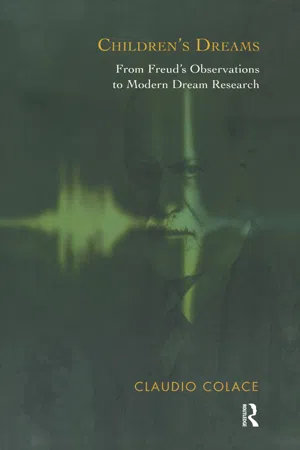
This book aims to present a study on the actuality and empirical value of Freuds dream theory, even if through the analysis of a specific part of it - the hypotheses about childrens dreams. It provides a systematic description of Freuds observations on child dreaming and presents the results obtained from four empirical studies on childrens dreams that the author conducted during the span of a decade. These studies (two conducted in school settings, one in a home setting, and one based on a questionnaire completed by parents) allow an empirical judgment on Freuds main hypotheses on child dreaming: the hypotheses on formal aspect of childrens dreams, the relationship between dream bizarreness and development of the superego functions, and the issue of wish-fulfilment dreams. The author concludes that it is possible to test empirically Freuds hypothesis on the early forms of dreaming and that this test is not irrelevant for an empirical judgment of certain more general statements of Freuds dream theory (e.g. the dream censorship hypothesis).
Information
Part I
An Attempt to Systematically Describe Freud’S Observations on Children’S Dreams
Chapter One
An overview of Freud’s writings on children’s dreams
In this first part of book, I try to give a systematic description of the observations and hypotheses developed by Freud on children’s dreams in the early twentieth century. To this end, I have reviewed all the available material on the matter, comparing and organizing it by main subjects, taking for reference the complete psychological works by Freud, as translated into Italian and published with the title Opere di S. Freud by Boringhieri. The Italian edition includes the same works and critical apparatus as the Standard Edition of Complete Psychological Works by Sigmund Freud (Hogarth Press, 1953–1974). In reporting the quotes from Freud taken from the Standard Edition, I have been helped by using the comparison table between the paging of the Italian edition and that of the Standard Edition present in the Italian version of Freud’s works (Boringhieri Editore, Torino, 1966–1980, volume 12).
In this chapter, I present a chronological and reasoned list of all works in which Freud deals with child dreams in order to provide the reader with an overview of Freud’s interest in this subject. We will see that while in certain years there are only brief notes on and/or references to children’s dreams, in other years Freud produced longer and more elaborate writings.
The references below are the sources of my attempt to give a systematic description of Freud’s ideas on this subject.
1897
In a letter sent on 31 October to Wilhelm Fliess, Freud reported a dream had by his daughter Anna (eighteen months). She pronounced a few words while sleeping: “Stwawberries, high berries, scwambled eggs, pudding”. This was Freud’s first mention of children’s dreams (Freud, 1985, p. 276).
1899
In a letter sent on 6 August to Wilhelm Fliess, Freud asked his friend whether he could include a dream had by Fliess’s son Robert among “hunger dreams of children” together with the dream had by his daughter Anna. Freud reflected here on the fact that in dreams children show a tendency to exaggerate (ibid., p. 365).
In a subsequent letter of 27 August, Freud informed Fliess that Robert’s dream would not be included among hunger dreams, but in another excerpt dealing with the “egoism in dreams” (ibid., p. 368). (These three letters are the only sources of information considered, apart from the Complete Psychological Works of Sigmund Freud.)
1900
Freud dealt with children’s dreams in The Interpretation of Dreams (1900a). This work lacks a specific chapter on the subject, which is mainly dealt with in the third chapter, “A dream is the fulfilment of a wish”, and mentioned in other parts of the work. Eleven child dreams and six child-age dreams reported by adults are given as example. Among the topics treated are: the utility of studying child dreams in order to understand dreaming; the thesis of dreams as a wish-fulfilment; the scarce presence of distortion in children’s dreams and the reason for this; the types of wishes appearing in child dreams; the dreams and the psychic system of children; dreams aroused by hunger and “childish” dreams in adults. In later years, in the numerous revisions of his principal work, Freud introduced some notes and additions on children’s dreams: I have organized these by chronological order (see below), separate from the original version of The Interpretation of Dreams, in order to highlight the evolution of Freud’s knowledge on children’s dreams.
1901
Freud treated children’s dreams in a specific paragraph of his short work On Dreams (Freud, 1901a). Here, he reported seven examples of dreams, six of which are the same as those that had already appeared in The Interpretation of Dreams. Freud tried to draw a picture of what may be considered the general characteristics of children’s dreams. He classified these dreams with respect to the relation between latent and manifest content, to degree of distortion, and to quantity of dream-work. Child dreams are distinguished from adult dreams in their intelligible (i.e., not strange) form and in the direct way in which the wish is fulfilled. Greater space is given to the issue of connections with daytime experiences and to the nature of wishes fulfilled in these dreams. Freud also dealt with childish dreams in adults. He used for the first time the subject of childish dreams to criticize medical theories on dreaming (dreams as dissociated brain activity during sleep).
1905
In Jokes and Their Relation to the Unconscious (Freud, 1905), Chapter VI, “The relation of jokes to dreams and to the unconscious”, Freud dealt briefly about children’s dreams and stated that, in children, dreams can be aroused by any wish that may remain from the awake state.
1909
In Analysis of a Phobia in a Five-Year-Old Boy (1909b), Freud described three dreams had by little Hans at three different ages and showing differences in terms of dream distortion.
In an addendum to The Interpretation of Dreams, Freud described a dream had in childhood which showed a strange content, defined “a very peculiar dream” (p. 413).
1910
On the occasion of the Five Lectures on Psycho-analysis (1910a), held between 6 and 10 September 1909 at Clark University, USA, Freud spoke about children’s dreams. In the third lecture, “Psychic determinism, dreams, and parapraxes”, about the interpretation of dreams, Freud expressed the concept that not all dreams are apparently incomprehensible, confused, or with contents alien to the dreamer, and that evidence of this might actually be seen in the dreams of young children. Freud then suggested that understanding children’s dreams does not require an interpretation technique, but merely information on what the child had experienced the day before.
In Leonardo da Vinci and a Memory of his Childhood (1910c), Freud mentioned the existence of “flying dreams” in children (p. 126).
1911
In 1911, Freud added a word and two footnotes to The Interpretation of Dreams with respect to children’s dreams.
On page 127, he limited the general assumption that the dreams of children are pure wish-fulfilment by adding the word “frequently” (Freud, 1900a, p. 127, fn. 1).
In the first footnote (ibid., p. 130, fn. 2), Freud seemed to suggest that “sexual instinctual forces, in infantile form”, being very important in the psychic system of children, may be sources for dreams.
In the second footnote (ibid., p. 131, fn. 1), he added more specific notes to die general assumption that young children have simple and transparent forms of dreams. Therefore, as an example of more complex dreams, he reported those had by little Hans and those mentioned in the work by Jung (1910).
1912
In a note, Request for Examples of Childhood Dreams (1912), published in Zentralblatt fur Psychoanalyse, volume 2, p. 680, in the column “Offener Sprechsaal” (Open Forum) (quoted in Freud, 1918b, p. 4), Freud invited his colleagues to take note of dreams that their patients recalled having had in childhood and that might appear to refer to having witnessed sexual intercourse.
1913
In the note Children’s Dreams With a Special Significance (1913), published in Internationale Zeitschrift fur ärztliche Psychoanalyse, volume 1, p. 79 (quoted in Freud, 1918b, p. 4), making reference to the previous note of 1912, Freud thanked those colleagues who had sent material. However, he postponed any opinion on the matter to the moment at which he would have further information available.
In The Occurrence in Dreams of Material From Fairy Tales Freud (1913d) described the “wolf-dream” of a young man (Freud, 1918b) as an anxiety dream dating back to childhood. Freud noticed that elements from fairy-tales may reappear and develop in dreams.
1914
In a footnote added to The Interpretation of Dreams (1900a, p. 131, fn. 1), Freud quoted ten studies performed by other authors on children’s dreams published between 1909 and 1913. Among these, the study by Wiggam (1909) suggested that children’s dreams show a tendency to wish-fulfilment.
1916–1917
In Introductory Lectures on Psycho-Analysis (1916–1917), Freud dedicated an entire lectur...
Table of contents
- Cover
- Half Title
- Title
- Copyright
- CONTENTS
- ACKNOWLEDGEMENTS
- Dedication
- ABOUT THE AUTHOR
- INTRODUCTION: FREUD’S DREAM THEORY AND MODERN DREAM RESEARCH
- PART I: AN ATTEMPT TO SYSTEMATICALLY DESCRIBE FREUD’S OBSERVATIONS ON CHILDREN’S DREAMS
- PART II: EMPIRICAL EVALUATION OF FREUD’S OBSERVATIONS ON CHILDREN’S DREAMS
- REFERENCES
- INDEX
Trusted by 375,005 students
Access to over 1.5 million titles for a fair monthly price.
Study more efficiently using our study tools.
Frequently asked questions
Yes, you can cancel anytime from the Subscription tab in your account settings on the Perlego website. Your subscription will stay active until the end of your current billing period. Learn how to cancel your subscription
No, books cannot be downloaded as external files, such as PDFs, for use outside of Perlego. However, you can download books within the Perlego app for offline reading on mobile or tablet. Learn how to download books offline
Perlego offers two plans: Essential and Complete
- Essential is ideal for learners and professionals who enjoy exploring a wide range of subjects. Access the Essential Library with 800,000+ trusted titles and best-sellers across business, personal growth, and the humanities. Includes unlimited reading time and Standard Read Aloud voice.
- Complete: Perfect for advanced learners and researchers needing full, unrestricted access. Unlock 1.5M+ books across hundreds of subjects, including academic and specialized titles. The Complete Plan also includes advanced features like Premium Read Aloud and Research Assistant.
We are an online textbook subscription service, where you can get access to an entire online library for less than the price of a single book per month. With over 1.5 million books across 990+ topics, we’ve got you covered! Learn about our mission
Look out for the read-aloud symbol on your next book to see if you can listen to it. The read-aloud tool reads text aloud for you, highlighting the text as it is being read. You can pause it, speed it up and slow it down. Learn more about Read Aloud
Yes! You can use the Perlego app on both iOS and Android devices to read anytime, anywhere — even offline. Perfect for commutes or when you’re on the go.
Please note we cannot support devices running on iOS 13 and Android 7 or earlier. Learn more about using the app
Please note we cannot support devices running on iOS 13 and Android 7 or earlier. Learn more about using the app
Yes, you can access Children's Dreams by Claudio Colace in PDF and/or ePUB format, as well as other popular books in Psychology & Developmental Psychology. We have over 1.5 million books available in our catalogue for you to explore.