- 268 pages
- English
- ePUB (mobile friendly)
- Available on iOS & Android
eBook - ePub
About this book
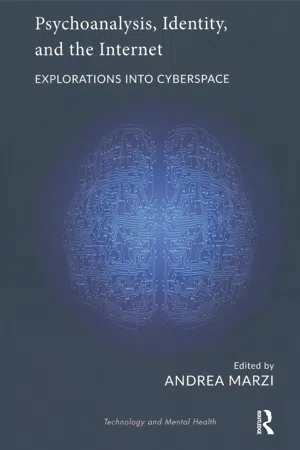
This book is comprehensive and profound, concrete and symbolic, a Herculean integration of the technical and the psychoanalytic. It explains technology and definitions of cyberspace, virtual reality, and social media, and presents the view that technology is a destructive force in psychoanalysis.
Information
Part I
Cyberspace, Cybernetics, and Society
CHAPTER ONE
Cyberspace: the metaphor of metaphors
Riccardo Sorrenti
The digital world and the cybernetic revolution
Plato, in The Republic, introduces the term “cybernetic” to identify the philosopher who, like an expert helmsman, indicates the right course to the crew of the ship.
The Greek term Κυβερνἠτης (kybernetes) literally means “the art of guiding a ship” or the “art of ruling” (Plato, 2008, p. 322).
In the modern era, the term was first introduced by Norbert Wiener (1948, p. 95), who analysed control of action and the way information is transmitted and processed in order to define a parallel between the function of a machine and that of society.
Wiener was the first to introduce the terms “analogue”, “digital”, “bit” and “feedback”, the terms that define the foundation of modern computer science.
At present the meaning of the term “cybernetics” has been extended to indicate processes concerning communication and control in animals and in machines and includes branches such as the theory of control systems and the techniques of information transmission and its processing (feedback).
The birth of the computer culture
The term “informatics” was created by Philippe Dreyfus, of the French company Bull, in 1962, and is composed of the words “information” and “automatique”. Within a few years it spread to Germany and then worldwide.
Modern informatics science anchors its theoretical pillars in mathematics and, more precisely, in the “binary” mathematics that is well suited to represent the states of the electronic circuits that form the heart of all computer equipment and, in particular, the two possible states of an electronic switch (transistor), “conduction” or current transit (on) and “non conduction” or absence of current (off).
The binary system is, in fact, built starting from only two basic elements, the integers “0” and “1”, through which it is able to represent (with a degree of accuracy that depends only on the available processing power) the logic processes and physical models of reality.
In computer terms, 0 and 1 are called “bit” and their sequences, organised in words or “byte” of 4, 8, 16, 32, 64 or more bit, represent the basic building blocks of the digital universe.
Using appropriate algorithms, namely the transposition in computer language of representative models of real functional processes, today we can recreate in the internal memory of a computer the corresponding “virtual model” of almost all aspects of the physical world that surrounds us, of the beings that inhabit it, and the interactions between these entities.
Representative limits of the digital model
It is useful, we believe, to pause for a moment in order to consider the existence of possible limits in the digital representation of physical phenomena from the real world.
As mentioned, the degree of “accuracy” of any digital model is intrinsically linked to the computing power available.
The real world is populated by physical entities that can vary their own conditions and their own representative parameters in an “analogical” way, that is, with continuity, assuming an infinite number of values.
For example, the value of a body temperature, a measure that gives us an idea of the thermal energy contained in it, could be supposedly, at a given moment, equal to 37°centigrade or Celsius and, at another time, 38°. This measure makes us understand that the body has acquired further thermal energy and its temperature has increased by 1°C.
However, if such an increase had been half as large, the temperature would have become 37.5°C and if, instead, it had been a quarter as large, the temperature would have increased to 37.25°C. This reasoning is iterable indefinitely because, in the real world, the temperature can assume an infinite number of values and, as close as any two values are, an intermediate value between them can always be found.
Representing the value of the temperature by means of a digital model, it is necessary to introduce a simplification to adapt our model to the features of the computer system that we will use. If, for example, the system is equipped with a central processing unit, or CPU that uses a basic information unit or “byte” of a length equal to 8 bit, we could represent a maximum quantity of distinct values equal to 2n where n, in this case, is equal to 8, that means 28 =256 distinct values.
If we instead use a byte of 16 bit, we will have 216 = 65.536 different values represented, in case of byte at a 32 bit we will have 232 = 4.294.967.296 different values, and so on, increasing the degree of accuracy of our digital measurement, theoretically indefinitely but, in practice, stopping at the moment when our hardware reaches its computing power limits.
Take, for example, the familiar image of a blue sky, which seems very simple, but is, in fact, extremely difficult to recreate in a digital photo or on a computer screen because of the extremely large number of shades of the same colour that are needed to represent fairly the full tonal range of variations of the same colour.
Let’s take another example that perhaps is more intuitive and familiar: music in digital format.
The digitisation of the musical signal is carried out today with sampling techniques that, depending on the format chosen, can reach the frequency of 44/48 KHz with 16-bit samples typical of the standard CD-audio, or 96 kHz with 24-bit samples of precision for a DVD-audio, up to 192KHz audio of a Blu-ray disc, or even to 2,822 KHz for “high definition” music of Super Audio CDs. Essentially, nearly three million samples of signal per second can be created and each sample is constituted by a word of 24 bit that can assume 224 = 16,777,216 different values.
This huge flow of information, requiring high processing power and specialised devices for its reproduction, is able to generate a remarkable and very high quality listening experience that, if performed on a high level audio chain (audio player, amplifier, speakers, and listening environment) is actually the best possible approximation of audio reality.
It is an approximation and not an identical copy indistinguishable from the original, because each of us can detect and perceive the differences between a real music scene and its digitised synthetic equivalent.
It is sufficient to think about a listening environment and about the tonal richness and nuances generated by countless reflections and secondary harmonic signals, the spectrum of perceivable frequencies, the involvement of all the senses in the listening experience: ultimately, the whole unique set of emotions that no digital system will ever be able to reproduce in the exact same way.
Nature operates in an “analogical” way, not giving up any of the possible values but enclosing within itself all the infinite nuances of a sound, a colour, a fragrance, a flavour, and all our senses have evolved over time just to precisely catch and appreciate such nuances.
The arguments of those who support, to the bitter end, “digital at all costs”, who say that as the operating range of our senses is limited we are unable to appreciate values that fall beyond this operating range, are regularly denied victory by new research work and studies of human psychosensorial perception which are increasingly pushing forward our understanding of the limits of their functioning.
Digitising nature implies, obligatorily, the need to “simplify” it, giving up in this way the finest elements of information and limiting our perceptions and emotions to a coarse portion of the whole.
The virtual entities and cyberspace
The ability to conceive of, and represent, objects, environment, or entire intangible or “virtual” worlds by means of computer graphics has led to the birth of a new kind of representational art that, unlike most other forms of expression, allows the deep and direct involvement of the users themselves at the centre of the representation.
This involvement, which is mainly “interactive”, determines the behaviour of the system itself as a whole, using the input information sent by the user to the system.
It is sufficient to think about the experience of a player struggling with a videogame that, through the use of a simple monitor and an input device (a mouse or a joystick), determines the existence and essence of the entire worlds or scenarios or the very life of the characters that populate them, influencing significantly the their experience or existence.
The first remarkable visual representation of “virtual reality” is the Walt Disney Corporation’s film Tron, which appeared in cinemas in 1982, where the main character, in an attempt to prove the existence of a fraud, was dematerialised and reassembled, in the form of energy, inside the circuits of a powerful supercomputer, living a fantastic experience in trying to find and defeat those responsible for the fraud, moving into the electronic cyberspace of the system, made up of circuits and countless connections of the supercomputer itself.
Thus, the concept of cyberspace exerts its centrality in the philosophical and scientific debate.
To help us better delineate this concept, and to propose further considerations on this subject, we quote several definitions of Gibson’s that we believe are particularly representative.
For Gibson (1984, p. 41), cyberspace is “The total interconnectedness of human beings through computers and telecommunication without regard to physical geography”.
And again,
Cyberspace. A consensual hallucination experienced daily by billions of legitimate operators, in every nation, by children being taught mathematical concepts . . .
A graphic representation of data abstracted from the banks of every computer in the human system. Unthinkable complexity. Lines of lights ranged in the non space of the mind, clusters and constellations of data. Like the city lights, receding.
The birth of the global network
The birth of the internet has its roots in the late 1960s when, for purely military reasons, the USA created the first real geographical network of interconnected computers, ARPAnet, as an attempt to significantly increase the level of security of its military telecommunication network in case of a nuclear war.
The birth of the concept of “electronic mail” occurs in 1971.
At the end of the Cold War, ARPAnet also became available to the scientific community and to university research laboratories.
On 27 October 1980, with the definition of network protocols TCP (transmission control protocol) and IP (internet protocol), we witnessed the birth of the internet, as an evolution of the previous ARPAnet, and the networking tools used today.
In the same year, looking for an efficient way to share documents and information between the members of the scientific community, Tim Berners Lee, a researcher at the CERN laboratories in Geneva, invented and proposed the concept of “hypertext” a text in electronic format that contains within itself the references (hyperlinks) to other texts accessible with a simple mouse click.
A few years later, in 1990, Berners Lee at CERN successfully experimented with the first communication on the internet that was using the http control (hypertext transfer protocol), which he developed. At that time he probably did not have the full perception of the real scope of his great invention.
Today, thanks to the evolution of the protocol, a hypertext document can contain various types of information and data such as images, graphics, tables, sounds, films, multi-media presentations, etc.
By virtue of these innovative tools, and thanks to the current understanding of the concepts of cyberspace and virtual reality, what was to become one of the greatest socio-technical revolutions in human history, the World Wide Web, had begun to emerge on the global scene.
The World Wide Web (the internet) is the spider web that surrounds and permeates every single entity in some way connected (individuals, groups of users, databases, activities, electronic devices of any kind and, ultimately, any kind of device that we decide to connect) to the global network: endless sequences and groupings of entities interconnected among themselves in real time, synthetic nervous systems and online digital minds that distribute huge flows of information unerringly on the threads of the web world.
This is how infinite virtual scenarios are born and die as cybernetic organisms, projections of brilliant and innovative insights, speed of light navigations in oceans of information.
Today’s global network has become irreplaceable for the conduct of a huge number of human activities: work, study, research, entertainment, social, erotic, games, with a list that now covers every sector of life, and, day by day, makes us witness to the gradual transfer of human knowledge, information, and global memory on the web, in that indistinct virtual space called the “cloud”, which is the very image of the internet and its ability to dematerialise, store, and instantly return to us any information: a planetary global mind.
Besides the loss of materiality of information, which is now sublimated into a protoplasmic digital liquid, we are also experiencing its total delocalisation, because there is no longer a close physical correspondence between the information and the system that hosts it.
The new paradigm that is behind the cloud predicts a “virtualisation” of information that is no longer stored in a single dedicated system, but in multiple interconnected systems in a mode called the “grid”. This exponentially multiplies its potential in terms of security, availability, balancing, calculation capacity, and number of simultaneous requests that can be satisfied.
The concept of the cloud, applied to the world of information, is undoubtedly something new, but we already experience that kind of model in our everyday life; just think about the basic services that we all use in our homes (the so-called “utilities”), such as water, electricity, and natural gas reaching homes through simple ducts (the cable that carries the current, the gas pipe, or the water pipe). We are aware only of what takes place at one end, but we do not know what happens at the other end. We need electricity, so we connect a plug to an outlet and use it, but we have no idea about the place where it is produced, or which system is used to create it, or where and in which form it is stored waiting to be used.
The same is true, in terms of delocalisation, when we use the gas for cooking and to warm up our homes, or when we turn on the water tap.
The storage model based on the cloud allows us, similarly, to make the information appear wherever it is needed, regardless of where and how this information has been physically created and stored, and embodies a formidable positive potential that will enable us, in perspective, to share global human knowledge; a relevant example is the Wikipedia project (the free and open encyclopedia with its various derivatives, available online), where everyone, if able, may add and share his own contribution of knowledge to let the project grow, like an immaterial and pervasive entity that evolves and expands day by day, making universal knowledge available everywhere.
The control mechanisms of the internet
In the utopias of many scientists and researchers, the internet was born at the beginning of the 1960s, but, for the rest of the world, it was officially founded in 1995.
The widespread use of technologies of the internet has allowed the dev...
Table of contents
- Cover
- Half Title
- Title
- Copyright
- Contents
- ABOUT THE EDITOR AND CONTRIBUTORS
- SERIES EDITOR'S PREFACE
- FOREWORD: People, characters, holograms
- INTRODUCTION
- PART I CYBERSPACE, CYBERNETICS, AND SOCIETY
- PART II IDENTITY IN CYBERSPACE
- PART III VIRTUAL SPACE AND CLINICAL PSYCHOANALYSIS
- INDEX
Trusted by 375,005 students
Access to over 1.5 million titles for a fair monthly price.
Study more efficiently using our study tools.
Frequently asked questions
Yes, you can cancel anytime from the Subscription tab in your account settings on the Perlego website. Your subscription will stay active until the end of your current billing period. Learn how to cancel your subscription
No, books cannot be downloaded as external files, such as PDFs, for use outside of Perlego. However, you can download books within the Perlego app for offline reading on mobile or tablet. Learn how to download books offline
Perlego offers two plans: Essential and Complete
- Essential is ideal for learners and professionals who enjoy exploring a wide range of subjects. Access the Essential Library with 800,000+ trusted titles and best-sellers across business, personal growth, and the humanities. Includes unlimited reading time and Standard Read Aloud voice.
- Complete: Perfect for advanced learners and researchers needing full, unrestricted access. Unlock 1.5M+ books across hundreds of subjects, including academic and specialized titles. The Complete Plan also includes advanced features like Premium Read Aloud and Research Assistant.
We are an online textbook subscription service, where you can get access to an entire online library for less than the price of a single book per month. With over 1.5 million books across 990+ topics, we’ve got you covered! Learn about our mission
Look out for the read-aloud symbol on your next book to see if you can listen to it. The read-aloud tool reads text aloud for you, highlighting the text as it is being read. You can pause it, speed it up and slow it down. Learn more about Read Aloud
Yes! You can use the Perlego app on both iOS and Android devices to read anytime, anywhere — even offline. Perfect for commutes or when you’re on the go.
Please note we cannot support devices running on iOS 13 and Android 7 or earlier. Learn more about using the app
Please note we cannot support devices running on iOS 13 and Android 7 or earlier. Learn more about using the app
Yes, you can access Psychoanalysis, Identity, and the Internet by Andrea Marzi in PDF and/or ePUB format, as well as other popular books in Psychology & History & Theory in Psychology. We have over 1.5 million books available in our catalogue for you to explore.