eBook - ePub
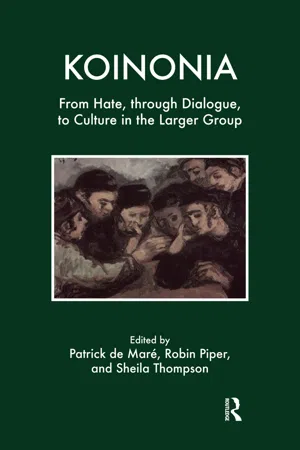
Koinonia
From Hate, through Dialogue, to Culture in the Larger Group
- 290 pages
- English
- ePUB (mobile friendly)
- Available on iOS & Android
eBook - ePub
Koinonia
From Hate, through Dialogue, to Culture in the Larger Group
About this book
A study of the larger group, focusing on the processes and dynamics whereby the group micro-culture emerges. As the initial frustrations of the group find expression in hate, this is transformed through dialogue to what the Greeks knew as 'koinonia', or the state of impersonal fellowship. Essentially, Koinonia concerns itself with an operational approach to dialogue, culture and the human mind through the medium of a larger group context, and adopts a direction similar in many ways to the groupanalytic method of S. H. Foulkes. In attempting to link the most intimate aspect of individual beings naturally and spontaneously in the socio-cultural setting of the larger group, by the very nature of its size, offers a structure or medium for linking inner world with cultural context, and is thus able to establish a unique dimension – that of the micro-culture. Until now neither psychoanalysis nor small groups have been able to handle this aspect empirically, since, in the former, the analyst represents the assumed culture, while in the small group situation the hierarchy of the family culture inevitably prevails. The larger group displays the other side of the coin to the inner world, namely the socio-cultural dimension in which interpersonal relationships take place. The exploration of this field shows how objects, including part objects of the mind, can be related to systems and structures in a manner not previously attempted, and raises the vexed question of the relationship of systems to structures and of culture to social context. In this study of the larger group, particular attention is paid to the processes and dynamics whereby the group micro-culture emerges, as the initial frustrations of the group find their expression through hate; as hate initiates, and is transformed by, dialogue; and as dialogue ultimately establishes what the Greeks knew as 'koinonia', or the state of impersonal fellowship.
Information
Chapter One
The story of the larger group approach
The introduction of large groups convened along group-analytic lines brings a new approach to our thinking about groups.
Basically, what we are doing is to apply Foulkesian group-analytic concepts to the larger situation: we are increasing the size of the group-analytic group.
The increase in size is crucial. When the group of eight becomes a group of twenty, we begin to have a different level of group activity, representing a different dimension of human experience. We have gone beyond the confines of the familio-centric group; in this larger setting the group acquires another range of meanings, and cultural context becomes the central issue.
Group analysis, building upon the foundations of psychoanalysis, made it possible to move beyond the bounds of one-to-one dyadic therapy. The large group approach, in its turn building upon the foundations of (small) group analysis, now brings the possibility of moving beyond the bounds of family-and network-centred therapy.
The particular preoccupations and methodology of psychoanalysis, and also to some extent of small group analysis, have meant that the direct consideration of cultural factors has been deferred for a long time.
In classical psychoanalysis the focus upon the individual and his personal unconscious has led to attempts to exclude the socio-cultural context as much as possible. Any introduction of cultural factors has tended to be seen as an impediment, or as resistance, hampering or deflecting the exploration of the patient’s inner world. The context of reality against which the interpretation of the transference relationship takes place has to be represented by the analyst in his own person.
In small group analysis the social context is introduced, but to an extent that is determined by the size of the group. For the most part the context is taken to mean the family; problems of interpersonal networks are evoked and transferred into the group, and interpretations and understanding tend to be formulated in family terms.
Therefore, from their very nature and purpose, neither psychoanalysis nor small groups are in a position to grapple with culturally assumptive structures. In these settings, therefore, these are so assumed as to be virtually unconscious. Only in the larger group can the increase in numbers produce a definable group context in its own right, with group features in the foreground.
Thus large groups can be said to take over where small groups leave off. They provide a setting in which we can explore our social myths (the social unconscious) and where we can begin to bridge the gap between ourselves and our socio-cultural environment, which hitherto has often appeared bafflingly beyond our reach. Context now becomes central. It is a situation that has operationally speaking remained relatively unexplored until recently.
If psychoanalysis and small group therapy are primarily concerned with pre-oedipal and oedipal matters, the larger group is involved with post-oedipal considerations, and, like social psychology, it takes the group (as distinct from the individual) as its basic unit. While small groups focus upon the psychoanalytic, biological unconscious, large groups are tilted towards socio-cultural awareness.
Citizenship is only adequately observable in a larger setting, as the small group, by its very nature, displays only the most rudimentary evidence of social as opposed to family dynamics. To apply an unmodified psychoanalytic or small group model to the larger group is like trying to ‘play ludo on a chessboard’. For instance, imprinting a family culture on the social context produced Freud’s primal horde construct, which, as Freud himself acknowledged, is a mythical caricature.
The large group potential has always been implicit within group analysis, although it was not until the Second European Symposium of Psychotherapy in 1972 that the first large group was instigated.
Foulkes himself was well aware of this dimension when he wrote that ‘group therapy is an altogether desirable contribution to people’s education as responsible citizens’ (1948). When he first introduced small group psychotherapy at Northfield Military Hospital in 1944, he also developed a group approach to the whole hospital in the form of a small co-ordination group. He himself acted as the link between these different groups, but there was no large inter-group meeting per se—that is, the small groups did not meet each other, and therefore it was left to Foulkes (like a Shaman) to represent the large group in his own person. He stood for the whole of the hospital, and to that extent Northfield did not directly represent itself.
After this experience, the next logical step would have been to consider setting up a larger group and applying Foulkesian small group principles to this larger situation, but this did not happen then or for some years later. During the interim, Foulkesian small group analysis continued to expand and develop.
After Northfield and demobilization, Foulkes gathered around himself people who continued to have an interest in group analysis. In 1949 he established weekly seminars in his consulting rooms; and three years later the Group Analytic Society (London) was founded to study and promote group analysis in both its clinical and its applied aspects.
The Group Analytic Society has always constituted the creative centre, the main tree trunk from which developments have branched out—in research and education, in the launching of the journal Group Analysis, in the application of group-analytic concepts to other disciplines, and not least in the establishment of the Institute of Group Analysis, with its general or introductory course and the qualifying course for group analysts. The Society also acted as a springboard for the development of family and marital studies, which in due course separated off to become the Institute of Family Therapy shortly after Foulkes died in 1976.
Applying Foulkesian principles to larger structures may, today, against the above historical background, appear as quite self-evident. Yet it was not until 1972, at the Second European Symposium of Psychotherapy held at the Maudsley Hospital, that the first large group, with over one hundred participants meeting in a single circle, was launched by de Maré and Lionel Kreeger. In this they were inspired by Freud’s prophecy that one day someone will venture to embark upon research into the pathology of cultural communities, and by E. Neumann’s (1954) comment that ‘the task of evolving a collective and cultural therapy adequate to cope with the mass phenomena now devastating mankind has now become the primary issue’.
It is important to realize that a larger group technique had not until that time been seriously considered. There was little recognition that this powerful but unpredictable and chaotic structure is sensitive and potentially thoughtful and requires more structuring—more, not less.
At this time, de Maré (1972) wrote:
What does the future hold? I think it is likely to be concerned not only with small and medium sized groups, not only with the controversy over therapeutic community and community therapy, but with much larger psychotherapeutic groups with a membership of fifty to a hundred, conducted by several co-conductors, non-directive and a-programmatic, with tiered circular seating arrangements reminiscent of the amphitheatre. In this situation group dynamics become extremely clearly defined; and atmospheres, attitudes, ideas and ideologies make themselves evident not as cloudy, idealistic non-sequiturs, but as definitive climates which can be seen as either impeding, coercing or promoting communication, and which themselves are the object of study. In these larger groups is more clearly seen the antithesis, the polarisation of conscious and unconscious.
The problem for the individual is the intrusion into the individual situation of the repressed unconscious. For the large group, on the other hand, it is consciousness that is in jeopardy, both for the individual and for the group’s equivalent of consciousness, namely communication and organization. The problem for the rudimentary large group is its mindlessness; not how to feel, but how to think.
The year 1975 saw the publication of a collection of papers entitled The Large Group, edited by Kreeger. It also saw the establishment of a regular weekly median group by de Maré. This group began with forty members, rapidly fell to thirty, and finally stabilized at twenty. It has continued ever since.
In 1984, under the auspices of the Institute of Group Analysis, de Maré started a seminar group to discuss more actively the theory and application of large groups, with a membership generally rather more sophisticated and more involved with theory than with therapy. This group formed the substratum for future developments and went on to establish, in 1987, the Large Group Section of the Group Analytic Society. Under its auspices a ‘Black and White’ Group was successfully established the following year. This is a group in which people of different ethnic origins meet regularly in order to learn to talk with each other and establish a dialogue through which cultural issues can be explored; it represents a specific application of large group concepts to the field of race relations.
In summary, the aims of the Large Group Section are:
to create a forum where those interested in large groups can come together;
to encourage the application of similar groups in a variety of institutional and other settings;
to provide support, information, experience, and training for potential large group convenors;
ultimately to help humanize our sociocultural context through an understanding of dialogue and culture.
In May 1985 de Maré presented the S. H. Foulkes Annual Lecture. This was, in effect, a large group experience: 350 people were seated in four concentric circles to take part in a discussion of large group issues, and a good deal of interest was stimulated.
Following this, Dr Harold Behr’s editorial in the August (1985) issue of Group Analysis discussed the advent of the large group approach. He wrote that all group analysts have had a taste of large groups, and ‘many have even conducted them; that is to say, they have sat through them as small group leaders on a course or workshop with no clear idea of how to intervene except to signal the ending of the session’. Describing de Maré as a group analyst who has done for the large group what Foulkes did for the small analytic group, he commented that the large group reflects our sociocultural environment in a way that the small group cannot possibly do, pointing out that the group is not meant to provide psychotherapy for the individual so much as to contribute towards the process of humanizing society. Large groups, ends Dr Behr, should take up the challenge and set about creating a climate in which they can form an established part of our culture.
* * *
On the basis of the experience gained over the last fifteen years, we can summarize the specific features of the large group approach as it contrasts both with psychoanalysis and with small groups.
The larger group of twenty and upwards to at least one hundred can be approached by the same principles as Foulkes used in working with small groups.
These principles consist of:
- Face-to-face single-circle seating arrangement.
- Regularity of attendance and meetings, usually once or twice a week.
- Free-floating discussion. To quote Foulkes (1948) himself: ‘The basic rule of group analysis is the group counterpart of free association: talk about anything which comes to your mind without selection. It works out in a different way in the group situation from the individual situation just as it works out differently in the analytic situation from the procedure of self-analysis. Free association is in no way independent of the total situation. The way it works out I have described after observing it for a number of years as free-floating discussion or conversation.’
- The conductor does not lead, although he/she is capable of assuming leadership. He/she refrains from setting topics or goals, is non-directive, and remains relatively disengaged as to his own person.
- There is no given task, no occupation, no programme and no goal, not even the goal of becoming a ‘good’ group.
- What happens in the group is related to Foulkes’ construct of the group matrix, which is characteristic of his approach. He described the matrix as ‘the common shared ground which ultimately determines the meaning and significance of all events, and upon which all communications, verbal and non-verbal, exist’.
In practice, we have discovered that the figure of 18 to 20 members appears to be the appropriate size for the next stepping-stone in an approach to large groups. Groups of this size can be called median groups.
A large or median group setting needs to be handled with the care to detail already conceded in psychoanalysis and small-group-analytic psychotherapy. The large group is as complex and sensitive an apparatus, in fact probably more so since it is a learning situation as distinct from an instinctual one, and involves an emphasis on meaning as distinct from gratification or reality. As it is more frustrating and less gratifying, so it is harder to establish and maintain. The emphasis is upon the socio-cultural, not on psychotherapy.
Experience has shown the concentric circles and tiered seating originally envisaged to be contra-indicated, as face-to-face contact needs to be maintained. Conducting should be confined to one or two convenors, certainly not several: this is because the use of multiple convenors leads inevitably, by the very nature of the structure it creates, to unevenness in the flow of dialogue and to the likelihood of the formation of splinter groups within the larger whole.
In psychoanalysis text takes the form of free association; in small group analysis it takes the form of group association; in large groups it becomes dialogue. The development of dialogue is central. This dialogue can be seen as an extension and expansion of the free-flowing discussion of group association, its development promoted by the permissiveness and acceptance that Foulkes encouraged.
In psychoanalysis the intrapsychic subtext and the dyadic text occur in an unchanging standardized setting, which virtually excludes context. In the larger group this context is more broadly based against the group’s own continuously emerging miniculture. Cultural issues as distinct from social play a central role. Individual symptoms become collectivized as subcultures from the subconscious, which mould the flow of dialogue. The subcultures clash with the socioculture and become transformed into growing minicultures through dialogue.
Dialogue is something that has to be learnt like a language. The avowed and only purpose of the larger group is to enable people to learn how to talk to each other, to learn a dialogue. The object is not simply talking for talk’s sake, but talk as an exchange. As dialogue becomes established, it leads on to the development of an impersonal fellowship in the group, to which we have given the Greek term Koinonia.
Dialogue marks a different way of thinking and communication—tangential and analogic, as distinct from the binary digital logic of the one-to-one dyad. It is articulate, circular, lateralized as distinct from linear, meaningful as distinct from causal. Dialogue has an enormous thought potential: it is from dialogue that ideas spring to transform the mindlessness and massification that accompany social oppression, replacing it with higher levels of cultural sensitivity, intelligence, and humanity.
If the small group situation mainly evokes interpersonal experiences first known within the family, the large group context contains a different range of meanings for the individual. These meanings are not only intrapsychic and interpersonal but also contextual, including the impact on the individual of contextual traumas and mass impersonal forces. Individual experiences recalled in the large group include traumatic experiences of all kinds and their aftereffects: from war and revolution, persecution and oppression, to job loss and redundancy, moving house and moving country, the impact of cultural change and threats to cultural identity. Topics that come up in the large group include social and macrocultural aspects that are part of the human situation—illness, death, class, race, politics, economics, philosophy, current affairs, religion, and art, the handling of universal human emotions. In the larger setting these themes can be treated in their own right as meaningful, in contrast to being trivialized as intellectual defence. Dialogue—and therefore, by the same token, psycho-sociological conceptualization—does not reflect a defensive attitude towards unconscious group processes any more than consciousness is a defence against the unconscious.
Large groups, in general, are often experienced as intimidating, inhibiting, and frustrating. Outside the more familiar small group framework, it may at first be difficult for the individual to find a voice. The central anxiety in the larger group takes the form of panic (a major issue in separation anxiety) manifested in individuals as phobia, the extreme form of mental anguish. Mass formation and packing (as in wolf pack) and the intense revenge motif of mob violence constitute the group’s equivalent to counterphobic measures.
Since the large group is by its very size frustrating, it generates hate. As long as dialogue remains rudimentary and relatively unstructured, the group continues to operate through subcultures and socio-cultural assumptions. If, on the other hand, hate can be organized through d...
Table of contents
- Cover
- Half Title
- Title
- Copyright
- CONTENTS
- THE AUTHORS
- ACKNOWLEDGEMENTS
- FOREWORD
- Koinonia
- Introduction
- CHAPTER ONE The story of the larger group approach
- CHAPTER TWO The median group
- CHAPTER THREE Dialogue
- CHAPTER FOUR Culture and Koinonia
- CHAPTER FIVE Object relations theory. Systems thinking and structuralism
- CHAPTER SIX Ecological perspectives
- Postscript
- APPENDICES
- REFERENCES AND BIBLIOGRAPHY
- INDEX
Trusted by 375,005 students
Access to over 1.5 million titles for a fair monthly price.
Study more efficiently using our study tools.
Frequently asked questions
Yes, you can cancel anytime from the Subscription tab in your account settings on the Perlego website. Your subscription will stay active until the end of your current billing period. Learn how to cancel your subscription
No, books cannot be downloaded as external files, such as PDFs, for use outside of Perlego. However, you can download books within the Perlego app for offline reading on mobile or tablet. Learn how to download books offline
Perlego offers two plans: Essential and Complete
- Essential is ideal for learners and professionals who enjoy exploring a wide range of subjects. Access the Essential Library with 800,000+ trusted titles and best-sellers across business, personal growth, and the humanities. Includes unlimited reading time and Standard Read Aloud voice.
- Complete: Perfect for advanced learners and researchers needing full, unrestricted access. Unlock 1.5M+ books across hundreds of subjects, including academic and specialized titles. The Complete Plan also includes advanced features like Premium Read Aloud and Research Assistant.
We are an online textbook subscription service, where you can get access to an entire online library for less than the price of a single book per month. With over 1.5 million books across 990+ topics, we’ve got you covered! Learn about our mission
Look out for the read-aloud symbol on your next book to see if you can listen to it. The read-aloud tool reads text aloud for you, highlighting the text as it is being read. You can pause it, speed it up and slow it down. Learn more about Read Aloud
Yes! You can use the Perlego app on both iOS and Android devices to read anytime, anywhere — even offline. Perfect for commutes or when you’re on the go.
Please note we cannot support devices running on iOS 13 and Android 7 or earlier. Learn more about using the app
Please note we cannot support devices running on iOS 13 and Android 7 or earlier. Learn more about using the app
Yes, you can access Koinonia by Patrick B. De Mare, Robin Piper, Sheila Thompson, Patrick B. De Mare,Robin Piper,Sheila Thompson in PDF and/or ePUB format, as well as other popular books in Psychology & History & Theory in Psychology. We have over 1.5 million books available in our catalogue for you to explore.