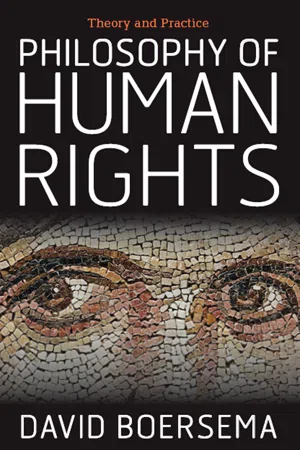
Combining the sustained, coherent perspective of an authored text with diverse, authoritative primary readings, Philosophy of Human Rights provides the context and commentary students need to comprehend challenging rights concepts. Clear, accessible writing, thoughtful consideration of primary source documents, and practical, everyday examples pertinent to students' lives enhance this core textbook for courses on human rights and political philosophy. The first part of the book explores theoretical aspects, including the nature, justification, content, and scope of rights. With an emphasis on contemporary issues and debates, the second part applies these theories to practical issues such as political discourse, free expression, the right to privacy, children's rights, and victims' rights. The third part of the book features the crucial documents that are referred to throughout the book, including the Universal Declaration of Human Rights, the Convention on the Elimination of All Forms of Discrimination Against Women, the African Charter on Human Rights and Peoples' Rights, and many more.
- 458 pages
- English
- ePUB (mobile friendly)
- Available on iOS & Android
eBook - ePub
About this book
Information
PART I
THEORY
The chapters that form Part I all focus on basic conceptual issues related to rights. These include various conceptions of what exactly rights are, what justifies the claim that people in fact have rights, what it is, broadly speaking, that people (or moral agents) have rights to, who or what is seen as a legitimate holder or subject of rights, and various criticisms that have been leveled against rights. For example, what is meant when someone says that education is a right or that education is a privilege, not a right? How could someone make the case that education is a right and not (merely) a privilege? On what grounds might someone criticize such a view? If the U.S. Constitution does not explicitly state that citizens have a right to privacy, does that mean that they, in fact, do not?
These are basic questions about the nature, justification, and range of rights. They are, simply put, about the theory of rights. The emphasis here is on the deep, underlying aspects of rights. Chapter 1 looks at what rights are (as opposed to, say, privileges), that is, at conceptions regarding their very nature. Chapter 2 considers several views of what justifies claims to rights. What makes us think that we have rights, anyway? What grounds are there for saying that we have (or do not have) a right to education? Chapter 3 deals with very broad aspects of the content and scope of rights, focusing not on specific content, such as the right to education, but rather on what kinds of obligations are put on others in terms of what they may or must do if we have rights. In addition, this chapter deals with whether the content and scope of the rights we have is a matter of what our legal systems say or of our nature as moral agents. Chapter 4 takes this last issue one step further and looks at some basic questions about what kinds of things can legitimately be said to have rights. Can animals have rights? Can groups of people, as opposed to the individuals who make up those groups, have rights? Why can certain things hold rights and not other things? Finally, Chapter 5 focuses on basic criticisms of rights—not of specific rights, such as to education or to assisted suicide, but of human rights and rights in general. In all, these chapters are concerned with broad conceptual matters about rights.
CHAPTER 1
THE NATURE OF RIGHTS
Imagine if some stranger said to you that she most liked about her native country that she enjoyed so many glubs there. No doubt you would have no idea what she was talking about. Naturally, you would ask, “What are glubs?” Furthermore, imagine that this was not just a translation issue—for example, that glubs was merely her native word for “turnips”—but that the word itself was vague or unclear. So, if it turned out that the closest translation of the word glubs was “happinesses,” you would still be puzzled by exactly what she meant when she said that she enjoyed so many happinesses in her native country. This is also true of the notion of rights. Although we use that term all the time and insist that we have numerous rights, if asked to say exactly what rights are, we find it difficult to answer. What rights are—the nature of rights—is the focus of this chapter.
WHAT RIGHTS ARE NOT
When we claim that we have rights, or even that we have some particular right, such as the right to vote or the right to think whatever we want, what exactly are we talking about? It is fairly easy to say what rights are not. For example, it is obvious that rights are not the same thing as abilities, since you have the ability to kill me or steal my property, but you do not, thereby, have the right to do either of those things. It is also obvious that rights are not the same thing as desires or wishes or wants; again, you might want to kill me or steal my property, but that does not mean that you have such a right. Rights are also not the same thing as deserts, or what you deserve; you might very well deserve some honor or reward for your wonderful behavior (or, for that matter, you might deserve some rebuke or punishment for your wicked behavior), but that is not the same thing as having a right to the honor or reward (or rebuke or punishment).
So, it is fairly intuitive that rights are not the same thing as abilities, desires, or deserts. Less intuitive or obvious is that rights are not the same as liberties or freedoms. Liberties are actions that we engage in, or may engage in, that are not required of or forbidden to us. So, I am at liberty to wear ugly clothes or to talk in annoyingly cutesy ways to my cat. I do not have to do those things; there is no duty, legal or moral, for me either to do them or not to do them. These actions might be related to rights in the sense that you do not get to prevent me from doing them, so you do not have the right to prevent me from doing them, but their nature as liberties is that they are actions I can and may perform but have no duty to perform.
Likewise, the word “freedom(s)” does not denote exactly the same thing as liberties or rights. I might be at liberty to do something, in the sense of having no duty to do or not do it, but I might not be free to do that action for various reasons. If the action is to talk in cute, annoying ways to my cat, I might not be free to do so because you have taped my mouth shut! Or if my action is to wear ugly clothes, I might not be free to do so because you have burned all of them, or you have had me thrown in jail, where I cannot access them.
So, although rights are related to liberties and freedoms, they are not exactly identical to them. The same situation holds—although it is less intuitive or obvious and, indeed, somewhat controversial—that rights are not the same thing as needs. We cover this issue in greater detail later in this chapter, as well as in Chapter 2, but for now suffice it to say that needing something is not the same thing as having a right to that thing. Of course, an important issue with respect to this point is what constitutes a need. Part of the complexity herein is that needs are relative. For example, as a biological organism, I need food to survive but not a computer. However, as a writer of textbooks I need a computer (or some other medium to write with). Where many people claim that because I need food to survive, I therefore have a right to food—many others disagree that I have a right to food just because I need it—very few people, if any, claim that I have a right to a computer, even if, as a writer, I need one. In addition, I have some rights that seem unrelated to some of my needs. As a biological organism, I do not need to be able to worship as I please, but, at least legally speaking, I do have the right to worship as I please. Again, we return to this issue of rights and needs later on, but for now let us say that rights are not the same thing as needs.
RIGHTS AS RELATIONS
Notice that above I keep remarking that rights are not the same thing as abilities, liberties, needs, and so forth. Clearly, rights are not things in the sense of objects, like tables or cats; they are instead relations between (some) things. Some philosophers have claimed that rights are properties of persons (or moral agents, if we include, say, animals or nations as having rights). These two notions of properties and relations need to be explained: An object such as my cat, Mycroft, is a thing; he is a physical object. But we can speak of his properties or characteristics. For example, he is a certain color, he weighs a certain amount, and he has reached a certain age. His color, weight, age, and so forth, are all properties of him. In addition, he is smaller than I am and younger than I am, and he sleeps more than I do. These features of being smaller than and younger than and sleeping more than are all relations that hold between Mycroft and me. They are not exactly the same thing as properties of him because “being smaller than” only makes sense when two things are being talked about or compared, so it is a relation between two things, not a property of one thing.
As mentioned above, some philosophers have said that rights are properties of certain objects. So, having a right is like having an arm or having a car; it is a property of something independent of anything else. Most philosophers do not say that rights are properties in this sense, but many assert that the justification for something having rights stems from some property or properties it has. So, one might say that something has rights because it has certain capabilities—for instance, to suffer or to make life plans. This is really a claim about what justifies something as having rights, not exactly about what rights are, and we turn to that issue later in this chapter as well as in the next one.
Most philosophers speak of rights as a relation because most of them see rights in the context of social interaction. When we normally speak of rights, we speak of them as regulating people’s behavior with respect to each other not simply as regulating any behavior, such as my making sure that I sit up straight or walk without slumping. Imagine that you were the only person in the world: Would you have rights? If rights are properties, then you might very well say that you would have rights even if no one else existed. However, if rights are relations, then it is difficult to comprehend that someone could have rights if no one else existed. You might have liberties, freedoms, needs, desires, and the like, but it is much less plausible to speak of having rights.
If rights are relations, then various questions emerge: what kind of relation (since rights are not a physical relation like “smaller than”) and relation between what (what things or kinds of things are related by rights)? A further question—how and why are things related by rights?—is really about justifying rights, and, again, we turn to that issue in Chapter 2.
So, what kind of relation is a rights relation? First, it is a relation between moral or legal agents. Moral agents are those things that can behave in moral (or immoral) ways and are part of some sort of moral system or community. Legal agents are those things that can behave in legal (or illegal) ways and are part of some sort of legal system or community. I use the term moral agent here rather than “person” because the latter is generally associated with human individuals. Some rights theorists include some nonhumans, or at least nonindividual humans, as moral agents and certainly as legal agents. For example, corporations are treated as entities that can function legally; they can own property, pay taxes, sue or be sued, and so forth. Likewise, nations or governments are often spoken of as having both legal and moral status. Chapter 4 focuses directly on the issue of just what kinds of things are said to be rights holders, so to avoid those issues here, I use the terms moral agent and legal agent, and, again, the present point is that rights are a relation between moral or legal agents. The following scenario, offered by philosopher Heather Gert, makes obvious that rights are fundamentally a relation between moral (or legal) agents: Suppose you are attacked by x (let’s call x Bertha) and injured. Would we say that your right (to bodily security) has been violated? For Gert, it depends on who or what attacked you. If a “normal” person attacked you, then, yes, we would no doubt say your rights had been violated, but if a wild bear attacked you, then, no, we would not say that your rights had been violated, even though your bodily well-being was. Or, to give another example, being struck by a person is one thing, but being struck by lightning is quite another! In the first case, perhaps your rights have been violated, but in the second case, they have not. The point, of course, is that not only what counts as an infringement on a right but also what counts as a right is not simply a matter of identifying some wrong that has occurred or some particular action or event.
In addition, rights are said to be both a descriptive and a prescriptive relation. That is, when we speak of rights, we sometimes speak in purely descriptive ways. For example, in the United States at the beginning of the twenty-first century there is, with some restrictions, a (legal) right for a woman to have an abortion on demand. One might think women should or should not have this right, but speaking descriptively, in the legal system there is such a right. However, sometimes when we speak of rights, we speak in prescriptive ways, that is, about what ought to be the case. So, some people claim that there should be a right for same-sex couples to marry. Or laws have recently been passed in various states to legalize certain victims’ rights because supporters of such rights lobbied that victims should have them recognized and established by law. Chapter 3 focuses more directly on issues related to these matters of how to understand the prescriptive aspects of rights.
The primary nature of the rights relation is, as noted earlier, to regulate behavior. When we speak of rights, we do so in order to say what we get to do (“I have the right to think what I want!”) or in order to say what others do not get to do (“You don’t have the right to make me do that!”). In the early 1900s, legal theorist Wesley Hohfeld enumerated four elements of rights, or perhaps four ways that we use the notion of rights. The first way he called a liberty. Liberties, for Hohfeld, are statements of how I may behave. I have mentioned liberties above, in the sense of actions that I have no duty to perform or not to perform; they are permitted but not required. Sometimes when people speak of rights, this is the sort of notion they have in mind (“It’s my right to wear ugly clothes if I want to!”). A second way, said Hohfeld, that we use the notion of rights has to do with how others must behave toward us and other moral agents. This sense he called a claim. For example, if you owe me money, then I have a claim on you with respect to that money, and you must behave in certain ways because of that claim; namely, you must pay me back (“I have a right to that money that you owe me!”). Hohfeld called a third way that we use the notion of rights a power. A power refers to ways that I can bring about change. This is a way of speaking of rights in the sense that, if I have a certain right, then I am empowered to do certain things, and I have that power over others. In other words, with certain property rights, I might have the power (meaning legal or moral legitimacy, not physical strength) to prevent you from walking in certain places (i.e., trespassing on my property). Finally, Hohfeld called a fourth way we use the notion of rights an immunity. An immunity refers to ways that I can resist change or your power over me. So, in a legal or moral sense, my right to worship as I please makes me immune to your attempts to force me to behave in certain ways. These four Hohfeldian notions of rights reflect two broad ways that we understand and use rights: (1) as empowerments or signs of what I get to do, and (2) as protective securities against what you (meaning any agent) might want to do to me. In an even broader sense, these two ways are meant to emphasize rights as a means of securing and preserving the well-being of whoever has those rights.
CORRELATIVITY THESIS
One final introductory word before we look at specific philosophical views of the nature of rights. That word is “duties.” Philosophers have long spoken of various kinds of legal and moral relations that agents have with respect to one another. So far, we have briefly touched on rights as one such relation, and of course, this entire book is about that. But two other important types of relations between agents with respect to regulating behavior must be mentioned, as they relate to our understanding and practice of rights as well as to our justification of them. One of these relations is the notion of duties. “Duty” probably sounds rather old-fashioned, and it is not exactly the same as obligation or responsibility, but it is the word that has stuck with philosophers. The notion of a duty connects to rights because of what some philosophers have termed the correlativity thesis, which is as follows: Rights and duties are relative to each other, meaning that they imply each other. One agent’s right implies another agent’s duty and vice versa. Now, there are two parts to this thesis: (1) every right implies some duty, and (2) every duty implies some right. Most rights theorists agree with the first part, but many do not accept the second part. Here is why:
Whenever one person has a right, that right (or at least its exercise) imposes a duty on other agents. Sometimes that duty is simply for those other agents not to interfere with the agent who has the right. For example, if I have a right to vote, then my right—or at least my ability to exercise that right—imposes a duty on you not to interfere with my voting; all you have to do is leave me alone, but the point is that you do have to leave me alone and not interfere with me (i.e., prevent me from voting). Other times, my right might impose a duty on some agent to do more than simply not interfere and actually to perform some positive act. For example, if I have a right to an attorney, then someone (i.e., the state) must provide me with an attorney; my right imposes a duty on the state to do something. Chapter 3 discusses these matters in detail. The point for now is that if one agent has a right, then that implies a duty on some other agent(s). However, as just mentioned, many rights theorists deny that every duty implies some right. I might have a duty that has nothing at all to do with any rights that you have. So, I might have a duty to pick up some litter that I find in the street or to shovel snow off the sidewalk in front of my house, but even if I do have these duties (shoveling snow off my sidewalk is, in fact, a legal duty that I do have!), it is not because someone has the right to have litter picked up or to have my sidewalk cleared of snow. Now, some rights theorists do think that these duties follow from someone else’s rights; that someone else, however, is not any particular per...
Table of contents
- Cover
- Half Title
- Title Page
- Copyright Page
- Table of Contents
- Preface
- INTRODUCTION
- PART I THEORY
- PART II PRACTICE AND APPLICATIONS
- PART III SELECTED RIGHTS DOCUMENTS
- Credits
- Index
Trusted by 375,005 students
Access to over 1.5 million titles for a fair monthly price.
Study more efficiently using our study tools.
Frequently asked questions
Yes, you can cancel anytime from the Subscription tab in your account settings on the Perlego website. Your subscription will stay active until the end of your current billing period. Learn how to cancel your subscription
No, books cannot be downloaded as external files, such as PDFs, for use outside of Perlego. However, you can download books within the Perlego app for offline reading on mobile or tablet. Learn how to download books offline
Perlego offers two plans: Essential and Complete
- Essential is ideal for learners and professionals who enjoy exploring a wide range of subjects. Access the Essential Library with 800,000+ trusted titles and best-sellers across business, personal growth, and the humanities. Includes unlimited reading time and Standard Read Aloud voice.
- Complete: Perfect for advanced learners and researchers needing full, unrestricted access. Unlock 1.5M+ books across hundreds of subjects, including academic and specialized titles. The Complete Plan also includes advanced features like Premium Read Aloud and Research Assistant.
We are an online textbook subscription service, where you can get access to an entire online library for less than the price of a single book per month. With over 1.5 million books across 990+ topics, we’ve got you covered! Learn about our mission
Look out for the read-aloud symbol on your next book to see if you can listen to it. The read-aloud tool reads text aloud for you, highlighting the text as it is being read. You can pause it, speed it up and slow it down. Learn more about Read Aloud
Yes! You can use the Perlego app on both iOS and Android devices to read anytime, anywhere — even offline. Perfect for commutes or when you’re on the go.
Please note we cannot support devices running on iOS 13 and Android 7 or earlier. Learn more about using the app
Please note we cannot support devices running on iOS 13 and Android 7 or earlier. Learn more about using the app
Yes, you can access Philosophy of Human Rights by David Boersema in PDF and/or ePUB format, as well as other popular books in Philosophy & Philosophy History & Theory. We have over 1.5 million books available in our catalogue for you to explore.