eBook - ePub
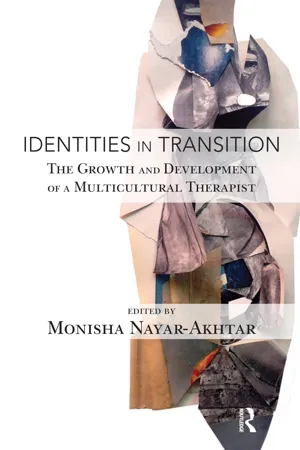
Identities in Transition
The Growth and Development of a Multicultural Therapist
- 224 pages
- English
- ePUB (mobile friendly)
- Available on iOS & Android
eBook - ePub
Identities in Transition
The Growth and Development of a Multicultural Therapist
About this book
This is a book about the growth and development of a multicultural therapist/analyst, looking at how a history of immigration and exposure to analytic training began to influence clinicians as they evolved as analytic therapists and analysts.
Information
CHAPTER ONE
The confluence of cultures: an Iranian–American story
Brilliant-hued,Deeply scarred,Skeins of goldAir,breathe in—Soul, unknownto the Western World— Ksera Dyette, Confluence
Exploring the development of one’s identity as a therapist is a journey one takes with some trepidation. It forces one to reveal aspects of themselves that they would not otherwise reveal. It also pushes them to integrate and assimilate historical and cultural contexts that have shaped them over the years. I hope to illustrate some of the factors that contributed to my identity as a therapist. So, let me begin with my life as an adult in this country.
Immigration
Reflections and recollections
I came to this country in August 1973, to attend graduate school at Tufts University. They had awarded me a full scholarship, so financially I was in fairly good shape. Graduate school was an intense experience. The classes were small and the courses challenging. Furthermore, I had to become more comfortable speaking the English language (though I had grown up surrounded by several Americans and the British, who had settled in Iran), as well as adjust to many cultural aspects of living in a foreign environment. Initially, my goal was to finish my education and go back to Iran to become a college professor. At the time that I left Iran to attend graduate school, the two countries, Iran and USA, enjoyed a comfortable relationship. My country was also beginning to enjoy the benefits that come with economic gains and we were experiencing that specifically with the oil price hikes. Procuring a visa for travel was also quite easy for both countries. Travel between the two countries had increased and at that time I had no intention of immigrating permanently to the United States.
Several years went by and I did not consider myself an immigrant; just someone who had come to study and would return to her country of origin. However, during the course of my study, certain world events changed the trajectory of my life. Iran had a revolution, there were hostage crises, and eight years of war with Iraq. These events changed the lives of many people and impacted my future decision-making. Meanwhile, I married, started a family, finished my education, and began working. My husband and I socialized with families coming from other multicultural backgrounds. Many were highly educated and were our colleagues who had also immigrated to the United States. They came from countries such as Nigeria, Iran, Turkey, India, Pakistan, Jamaica, Japan, China, Israel, Jordan, Kuwait, and more.
In addition to these world and personal events, I was also impacted by the treatment I received from my host country. My recollections of this treatment are extremely positive especially as it concerns my relationship with my university and professors. During a dire time when I was not receiving any monetary funds from Iran, my university allowed me to stay in their campus housing without paying rent and my professors where very supportive.
Over the years, several factors have influenced and informed my developing identity as a therapist, including my decision to immigrate permanently and raising my children in the United States. In the beginning, my immigration was a voluntary and temporary decision. Yet, certain realities forced me to make the decision to stay permanently and largely out of necessity. Gradually, I realized that my life had more roots in the United States than in my country of origin. My children were being raised in the US, attending school, and making friends. I became increasingly aware that uprooting them would be detrimental. As such, the decision to return to Iran became even more distant. Not surprisingly, for years I remained in denial, not recognizing that my children were actually children of immigrants. They were exposed to an entirely different cultural environment than I was when I was their age. Their daily life was markedly different from that of mine. Even as an adult, what I was exposed to was quite different than what they faced in their natural school environment. I expected them to understand and follow my culture of origin, not recognizing that their external culture was quite different. As would be expected, conflicts eventually arose. It was only slowly that I could begin to understand their experience including the fact that they felt differently about certain things, especially cultural values. They were largely different from their peers, a painful reality that forced them at times to exist in two different worlds. In a way they lived with a double identity, sometimes referred to as a bicultural identity.
Emotional refueling
I did not go back home for thirty-eight years. I think my emotional refueling (Akhtar, 1999) was provided within the community of Iranians I hung out in and the fact that my siblings and parents immigrated too. Additionally, my in-laws came to visit very frequently. I missed my country, but having loved ones close eased mourning my homeland. My tight connection to my family and friends was an important factor for my adjustment to my host country. Keeping up traditions was also helpful.
My friend who worked in a retail store had a lot of interactions with people from all walks of life. One day she told me:
“You have no idea how our children are treated or feel outside our homes. You are hanging out with more educated people, mostly college professors from around the world so you fit in and feel comfortable. You are one of them. But our children are not in the same diversified environment and they are more like a sore thumb among all American kids in the school. Especially that in our school district there are no second generation immigrants other than our kids. Even teachers do not see them the same and may treat them differently. They are foreigners after all. So we have to be careful in our expectations from them and understand their bicultural selves. We cannot expect them to feel and behave like us.”
It took me many years to understand what she said. Over the years when I noticed the conflict between my culture and my children’s external environmental culture, I tried to find ways to understand them better. So I started a new journey. I became a mental health professional and attended many lectures and seminars related to immigrants and the impact of immigration on their psychology. At one of these meetings I realized that yes indeed I am an immigrant and my children are the second generation immigrants. I tried to become more culturally competent. Over the course of treating others I became more aware of my own shortcomings and strengths and started to understand myself, my family, but also my patients and students.
The sooner the immigrant accepts that his culture is different than the host country, the best thing is to assimilate and for the better.
The immigrant has few choices; to observe and act rigidly in his culture and defy the host country’s culture, to adopt the culture of the host country fully and make obsolete his own culture, or to assimilate and use both cultures in an effort to mix and match. In each case the emotional, socioeconomic, and relational outcomes will be different. Especially when we consider that as children of immigrants we would clearly notice that the effect of these decisions would be different on our kids. With the first choice of keeping the original culture rigidly, we take a risk of creating a lot of conflict for our children inside and outside the home. With the second choice we lose our own self and create a sense of loss for ourselves. The choice of assimilation may be the best one. There are many ways to combine the two cultures and make everyone more comfortable.
Throughout my work, I have utilized the cultural knowledge and competency that I have gained in therapy. I treat Chinese patients online through ooVoo and Skype. It is interesting to see that in therapy with Chinese patients, some of my immigration and bicultural experiences become useful. Many of my Chinese patients have migrated from their hometown to other cities, living far from their families and dealing with the separation. They have to raise their children by themselves and do not have their parents support since they live in another city. Sometimes one of the parents may come and live with them to take care of the child. This may create conflict about housework, child rearing, and so on, which in a way is very similar to some of the families I have seen whose grandparents will come to live with their children and take care of their grandchildren since the parents go to school or work.
Age at immigration
Adjustment and assimilation depends on many things. Age is one of them. The age of an immigrant at the time of immigration is very important. I immigrated when I was a young adult. At that age my culture was embedded in my psychology. Most of my peers had also immigrated between the ages of twenty to twenty-two. So we all had similar memories of our childhood and early adulthood.
Many years later after the revolution in Iran and during the Iran-Iraq war, some families with children who immigrated had very different experiences. They were mostly in their thirties or early forties. They had young children who had to adjust to a new environment and language. A psychiatrist told me that a couple brought their school age child to him and believed that the child was possessed by some spirits and did not talk at all in school. The psychiatrist went to school and after some research found out that the child could not speak English well. The kids in his class made fun of him so he decided to pretend he was mute. The proposed intervention was effective. The teachers and some friends in school made the child comfortable and slowly he talked again.
Immigration has its toll on younger children who do not have the option to go back home. They may feel angry with their parents that they uprooted them and brought them to a foreign environment. They may also miss their friends and relatives and feel a lack of support. The immigrants who have left a secure job back home and have to build up a new career in a foreign environment, while at the same time taking care of a family, may have a hard time. Another problem is that the home environment will change too. Parents have to deal with new problems and their frustration, homesickness, job difficulties, and financial hardships will affect the home environment. Younger children are more vulnerable and will panic faster. Especially when and if they adjust to the environment and they hear their parents’ doubts and wonderings about their immigration status. They may feel that if the parents go back they will lose what they gained after some struggle. This may destabilize the psyche of the child.
Adolescent age immigration may also be a difficult process. This is the age at which things are hard on the child even in a stable well-known environment. In case of Mary (mentioned in a section to follow) she struggled more than her American peers with the issues of adolescence. On one hand she had conflicts at home with her mother, and on the other she had to handle the school culture, which she was not familiar with. Friendship is also challenging during this period. To be accepted is a big traumatic issue for adolescents to begin with. For second generation immigrants they constantly find themselves trying to justify the culture of their parents or become disloyal to parents and join their peers in defying their culture of origin.
Zero generation immigrants
Another age group of immigrants is the parents of the immigrants who join their children in the host country. I call them “Zero generation immigrants.” They immigrate at an older age and sometimes when they are professionally and in other respects, well settled in their own country. Some of them may already be retired. In other countries, retirement is based on years of work and not age. Many of the parents of my friends who immigrated and joined their children were in their late fifties. They moved because their adult children had immigrated and their lives became empty without their children and their grandchildren. This move results in a big toll on them. They become dependent on their grown children for various purposes such as housing, language, healthcare, entertainment, legal matters, travel, food, and so on. They may feel they have become “Zero” because their position has changed from being a capable person in their home country to a needy and incompetent person in the host country. They may become bored since they remain stuck at home more often. My Indian friend one day called me and said “I have good news, my mother got a job at TJ Maxx and I don’t have to entertain her all day.”
Maggie a young woman from China with depression complained that her parents expected too much from her. She emigrated from China with her adoptive parents when she was twelve years old.
“My parents expected me to translate and take care of documents such as the lease, insurance, and other legal and financial matters just because I could read and write and they could not. They thought since I can speak, read, and write English I could also understand the legal issues and would take care of them.”
Zero generations also have conflicts with the upbringing of their grandchildren. They often c...
Table of contents
- Cover
- Half Title
- Title Page
- Copyright Page
- Dedication
- Table of Contents
- Acknowledgements
- About the Editor and Contributors
- Foreword
- Preface
- Chapter One The confluence of cultures: an Iranian–American story
- Chapter Two Lost luggage: analytic training as search for objects lost in migration
- Chapter Three A tale of two cities
- Chapter Four Navigating our cultural identifications: individual, social, and political struggle in the therapy room
- Chapter Five De dónde eres? Finding a “from” in psychoanalysis
- Chapter Six A wound of no return: in search of self, loss, and transformation
- Chapter Seven A demand for training
- Chapter Eight Stolen freedom
- Chapter Nine Crossing the border within: migration, transience, and analytic identity
- Chapter Ten The unmatched twin: enactments of otherness and the autobiography of an immigrant clinician
- Chapter Eleven Conclusion: change is us
- Index
Trusted by 375,005 students
Access to over 1.5 million titles for a fair monthly price.
Study more efficiently using our study tools.
Frequently asked questions
Yes, you can cancel anytime from the Subscription tab in your account settings on the Perlego website. Your subscription will stay active until the end of your current billing period. Learn how to cancel your subscription
No, books cannot be downloaded as external files, such as PDFs, for use outside of Perlego. However, you can download books within the Perlego app for offline reading on mobile or tablet. Learn how to download books offline
Perlego offers two plans: Essential and Complete
- Essential is ideal for learners and professionals who enjoy exploring a wide range of subjects. Access the Essential Library with 800,000+ trusted titles and best-sellers across business, personal growth, and the humanities. Includes unlimited reading time and Standard Read Aloud voice.
- Complete: Perfect for advanced learners and researchers needing full, unrestricted access. Unlock 1.5M+ books across hundreds of subjects, including academic and specialized titles. The Complete Plan also includes advanced features like Premium Read Aloud and Research Assistant.
We are an online textbook subscription service, where you can get access to an entire online library for less than the price of a single book per month. With over 1.5 million books across 990+ topics, we’ve got you covered! Learn about our mission
Look out for the read-aloud symbol on your next book to see if you can listen to it. The read-aloud tool reads text aloud for you, highlighting the text as it is being read. You can pause it, speed it up and slow it down. Learn more about Read Aloud
Yes! You can use the Perlego app on both iOS and Android devices to read anytime, anywhere — even offline. Perfect for commutes or when you’re on the go.
Please note we cannot support devices running on iOS 13 and Android 7 or earlier. Learn more about using the app
Please note we cannot support devices running on iOS 13 and Android 7 or earlier. Learn more about using the app
Yes, you can access Identities in Transition by Monisha Nayar-Akhtar in PDF and/or ePUB format, as well as other popular books in Psychology & History & Theory in Psychology. We have over 1.5 million books available in our catalogue for you to explore.