Making Big Decisions Better
eBook - ePub

Making Big Decisions Better

How to Set and Simplify Business Strategy

  1. 72 pages
  2. English
  3. ePUB (mobile friendly)
  4. Available on iOS & Android
eBook - ePub

Making Big Decisions Better

How to Set and Simplify Business Strategy

About this book

Making Big Decisions Better is leading a global movement to equip present and next generation leaders with proven strategy tools that enable agile thinking that ignites stronger, more predictable, direct paths to profit.

No more academic theories. These are real tools and a system that enables improved strategic thinking and leadership.

This book bridges an unspoken gap in strategy thinking that until now, only provided leaders with just SWOT and Porter's 5 Forces as the language of strategy.

By using the decision making tools in Making Big Decisions Better, you'll finally remove the mystique of those you manage up to, and lead those that report to you. You will standout and have a transportable set of tools for any role or industry.

There's never been a better time to break away from the outdated, mainstream strategy planning process that misused scarce resources, burned out its leaders and never delivered the results.

It's your turn to learn and lead!

Frequently asked questions

Yes, you can cancel anytime from the Subscription tab in your account settings on the Perlego website. Your subscription will stay active until the end of your current billing period. Learn how to cancel your subscription.
No, books cannot be downloaded as external files, such as PDFs, for use outside of Perlego. However, you can download books within the Perlego app for offline reading on mobile or tablet. Learn more here.
Perlego offers two plans: Essential and Complete
  • Essential is ideal for learners and professionals who enjoy exploring a wide range of subjects. Access the Essential Library with 800,000+ trusted titles and best-sellers across business, personal growth, and the humanities. Includes unlimited reading time and Standard Read Aloud voice.
  • Complete: Perfect for advanced learners and researchers needing full, unrestricted access. Unlock 1.4M+ books across hundreds of subjects, including academic and specialized titles. The Complete Plan also includes advanced features like Premium Read Aloud and Research Assistant.
Both plans are available with monthly, semester, or annual billing cycles.
We are an online textbook subscription service, where you can get access to an entire online library for less than the price of a single book per month. With over 1 million books across 1000+ topics, we’ve got you covered! Learn more here.
Look out for the read-aloud symbol on your next book to see if you can listen to it. The read-aloud tool reads text aloud for you, highlighting the text as it is being read. You can pause it, speed it up and slow it down. Learn more here.
Yes! You can use the Perlego app on both iOS or Android devices to read anytime, anywhere — even offline. Perfect for commutes or when you’re on the go.
Please note we cannot support devices running on iOS 13 and Android 7 or earlier. Learn more about using the app.
Yes, you can access Making Big Decisions Better by Tim Lewko in PDF and/or ePUB format, as well as other popular books in Business & Business General. We have over one million books available in our catalogue for you to explore.

Information

Publisher
Routledge
Year
2017
eBook ISBN
9781317102632

Part I
Fix

The problems limiting strategy

1
The absence of shared language

Why no one is on the same page
ifig0001.webp
After 5pm
Right now in your organization, strategy has many meanings. Multiple definitions for the same word create confusion and diffusion of focus.
You need to define for your company what strategy is to remove the unseen communication gaps and disconnects that undermine your organization’s focus and effectiveness when dealing with issues.
Defining it creates focus. Not defining strategy creates chaos. Only you have the power to make the simple change in your company or area you lead.

What is your definition of strategy?

Have you ever been asked that question by your peers or a direct report? Has anyone ever raised their hand during a CEO town hall meeting and said, “Excuse me Mr. CEO, but what do you mean by strategy?”
Probably not.
And “Who cares anyway?” you might be thinking.
If you want to drive speed and profitability in your organization through better decision-making, you must start by defining what strategy is for your organization.
Today, walking the halls of your organization, each person has their own working definition of strategy. Whether they have read the latest strategy book, adopted something from experience or learned it in their MBA program, everyone has their definition but not a common one for the company. And this lack of a standard approach is a major cause of seen and unseen confusion in many companies.
Why? Because when they use the word “strategy,” they are not talking about the same thing and no one wants to admit it.
For the last 17 years, I start every new consulting engagement by asking the CEO and executive team within the first five minutes to collectively do ONE thing: take five minutes and answer the following question (see Figure 1.1) and post your answer on the wall. Make sure it is visible.
In most cases, those involved confidently stride to the wall and post their definition of strategy then gaze at their peers’ responses, and the room usually goes silent.
If you’re playing along now and wondering what happens with this exercise – here are some real responses from a recent manufacturing client executive team who collectively manage and lead over 1000 people across two continents.
Figure 1.1 What is your definition of strategy? (Side note: The question is NOT “What is your strategy?” but rather “What is strategy?”; what do you mean when you use the word in your organization and what do employees understand by it? Keep in mind, these are experienced, seasoned, educated and well-intentioned executives who are wondering why they have to answer this question for a consultant they have just met but are genuinely intrigued by the answer they themselves will come up with, along with the response of their peers. They hold the power to infuse clarity or misunderstanding in their organizations.)

Real executive responses:

1Sue:Path to the goal of making money
2Bob:A way to conquer problems
3Bill:Tools required to successfully grow the company
4Peter:A method of thinking to meet a goal
5John:Work at making a plan to meet the end goals
6Rick:A plan setting goals
7Dan:Series of steps required to get to your goal
8Sam:Commonly understood direction and goals
9Sara:Style in doing assigned tasks
10Reg:Plan to grow business and increase revenue
11Mark:Using appropriate tools to obtain goals
12Sid:Plan for future actions
13Paul:The goals and direction a company will create
14Mike:What direction to improve and grow
15Sid:How to make more money than the competition
These well-oiled, high-performing leadership team members all have different answers. When I ask them, “What’s the So What?” they consistently share the following concerns or comments when comparing responses:
  1. There are SIMILARITIES and DIFFERENCES
  2. Some talk more about the WHAT
  3. Some talk about the HOW
  4. Some define it as an END POINT
  5. Others see it as a SET of STEPS or TASKS
  6. Some view it as TOOLS
  7. Some see it as THINKING
  8. Many bring up GOALS or OUTCOMES
  9. Some see it as PROBLEM-SOLVING and DECISIONS
So at the same time they are all RIGHT and WRONG. One thing is certain: when people in the organization use the word strategy in their meetings, client proposals, customer service hotlines, purchasing department parameters, procurement negotiations and board meetings, they are NOT on the same page.
The complete list, from A to I, is full of potential for misunderstanding, conflict and confusion – all of which is readily avoidable. Yes, there are themes that align, but there is, nevertheless, too much room for ambiguity and uncertainty.
The most powerful observation that hits home for an executive team that has just completed this exercise always comes back to things they can fix to get people on the same page, including:
  1. DIFFUSION:
    When we use the word strategy in our day-to-day meetings and conversations, WE ARE PROBABLY TALKING ABOUT DIFFERENT THINGS.
  2. UNNEEDED CONFLICT:
    The SOURCE for conflict in our strategy discussions is not usually because of the content but because we are talking about DIFFERENT THINGS at DIFFERENT TIMES.
  3. TIME:
    We could SAVE TIME and channel efforts and resources FASTER and more effectively if we had a COMMON DEFINITION.
  4. STRATEGIC THINKING:
    Many of us default to operational thinking and talking, even when we are thinking strategically. We need to be aware and improve this part of our thinking and COMPETENCY in our company.
  5. GUIDANCE:
    If we are not on the SAME page for what STRATEGY is, what about the 986 people who report to us? How clear are they on what strategy is and how much guidance does our strategy and strategy process really give those on the frontlines making daily decisions?

What to do?

The best CEOs and organizations I have worked with come to the realization that they must define what strategy is for their organization rather than leave it to chance.
This is not about imposing or legislating a RIGHT definition, but rather having a common language and approach for your company that pays immediate dividends.
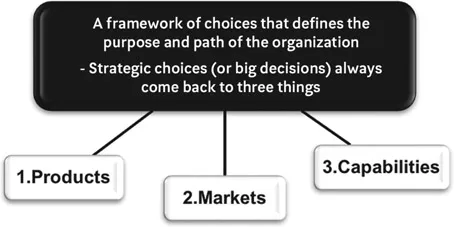
With respect to all that has been and will ever be written on strategy and the tools to create it, strategy is simply and practically defined as shown in Figure 1.2.
Figure 1.2 Definition of strategy and what the big decisions to be made are

This definition returns everyone back to the simplicity of strategy

Namely, this definition returns ever...

Table of contents

  1. Cover
  2. Title
  3. Copyright
  4. Contents
  5. List of figures
  6. List of tables
  7. Preface
  8. Introduction
  9. PART I FIX: the problems limiting strategy
  10. PART II BUILD: a simple strategy system to make big decisions better
  11. PART III USE: how to use your strategy to drive results
  12. Index