- 332 pages
- English
- ePUB (mobile friendly)
- Available on iOS & Android
eBook - ePub
About this book
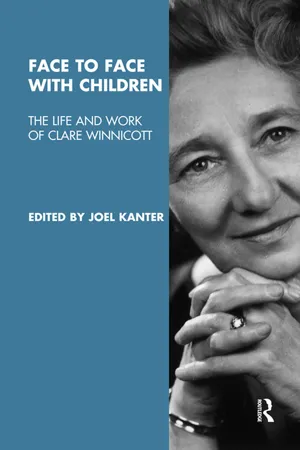
This book presents the life and work of one of the leading British social workers of the 20th century. The wife of Donald Winnicott, an analysand of Melanie Klein, a wartime innovator in helping evacuated children, a teacher and mentor to a generation of British social workers and a gifted psychoanalyst, Clare Winnicott's life encompassed a remarkable richness of relationships and accomplishments.
Information
Chapter One
Clare Winnicott: her life and legacy
We must have clicked at once—Clare was a rebel and so was I—but she was a much cleverer one than me…. A memory—it was October and I had a new tweed suit that I was longing to wear. So one morning with a chill in the air I put it on, arriving at the office first. When Clare came—wearing a thin summer dress—she stopped short and exclaimed “Gwennie, what on earth are you wearing THAT for?” I protesting, said “well, it is October and getting chilly”. “Don’t be daft”, said Clare, “look at the sun, it’s still summer and I’m going to make it last as long as possible. I’m not shedding my summer dresses ‘til I have to.”
I think I remember that because it says something important to me about Clare. She lived every part of life to the full. She took from life with both hands. No doors were closed to her. She looked in them all and usually found something to enjoy … the theatre, music, concerts, “Match of the Day”, poetry, Torvill and Dean, Wimbledon … It was because she took so much from life and enriched herself that she was able to give so much to us her friends and all whom she came in contact…. Hers was somehow a very complete life.
Gwen Smith1
Wife of Donald Winnicott, analysand of Melanie Klein, sister of distinguished academics, teacher and mentor to a generation of leaders in British social work, a wartime innovator in helping evacuated children, founder of England’s first social work programme in child welfare, awardee of the Order of the British Empire for her leadership in training child welfare workers, editor of her husband’s writings: Clare Britton Winnicott’s life encompassed a remarkable richness of relationships and accomplishments.
Yet, to most psychoanalysts and social workers, Clare Winnicott is only known, if at all, as the spouse of a prominent psychoanalyst. However, as her friend Gwen Smith suggested, Clare’s life was more than the sum of her relationships and accomplishments: these were woven into a luxurious tapestry by her unique intelligence, common sense, and passion. As the London Times commented, Clare “radiated vitality, being always intensely interested in what was happening around her, and possessed a special blend of seriousness and fun, augmented with a subtle mischievousness”.2
This volume, a collection of Clare’s papers, talks, and interviews, is an expression of both Clare’s professional work and her personal life—in many respects, the two are perhaps inseparable. Although this is most apparent in her relationship with Donald Winnicott, Clare’s professional interests were also enriched by her relationships with her talented siblings. Similarly, her personal life was enriched by the many colleagues and students who became close personal friends.
Strangely, this intriguing intermingling of the personal and the professional played a role in the belated introduction of her thinking to a contemporary audience. As an American social worker who first came to know Clare through the out-of-print and unpublished materials assembled in this volume, I found myself in a unique position as I began the editing process and learning about her life. Meeting and interviewing dozens of colleagues, friends, relatives, students, supervisees, and analysands, I almost always found that intense personal memories of Clare overshadowed a more objective appreciation of her professional contributions.
However, once this fog of affection and appreciation had lifted, these associates often acknowledged the extent of Clare’s professional influence. For example, Olive Stevenson, a student of Clare’s who became one of the leading figures in contemporary British social work, noted that “when I think how little contact I’d really had with her over the years, I’m amazed at the extent to which what she had taught me became absolutely seminal to my own thought and writing as well as my own practice”.3
Unlike her husband, Donald, and her analyst, Melanie Klein, Clare rarely conceptualized her ideas apart from the immediate challenge of the classroom, lecture hall, or supervisory consultation. Thus, the materials in this volume largely emerged from the texts or transcripts of oral presentations. Once these presentations had been completed, Clare had little motivation to conceptualize her ideas for unseen audiences. Although she skilfully managed her husband’s literary estate, apart from her memoirs of Donald she only published one paper in the United States, and she seemed uninterested in securing a wider audience for her writings in Britain. Even colleagues who worked closely with her editing of Donald’s work were unaware of her considerable written contributions.4
In these collected papers, Clare eschews professional jargon and theoretical abstractions, directly addressing the emotional turmoil of children’s experiences of loss and separation, often within the chaos and inadequate resources of the public child welfare systems. These concerns have a timeless quality: the anguish of street urchins in a Dickens novel, the suffering of a child during Britain’s wartime evacuation, or the torment of an American child of a drug-addicted mother. And the essence of the task of social workers and psychotherapists with such children endures across time and space.
In the first section of this introduction, I introduce the reader to Clare’s personal and professional life, providing a context for appreciating her contributions in this volume. Following this, I identify and discuss some of the central contributions of her work. From a historical perspective, these contributions had a significant impact on her husband’s professional work as well as on the British child care system. Similarly, her contributions can offer contemporary social workers and psychotherapists new insights into their practice.
Early life
Born on 30 September 1906 in the northern seaside town of Scarborough, Elsie Clare Nimmo Britton was the oldest of four children. Her father, James Nimmo Britton, housepainter or plumber from Glasgow, had joined the Baptist church and become a minister in that denomination. He was an energetic and creative clergyman who displayed a talent for oratory and organization.
In the years of his first ministry in Lincolnshire in his early twenties, Revd Britton increased the church’s membership from 20 to 300. After doubling the membership of another church in Lincoln, he moved to Scarborough in 1903; there he was described as an “effective preacher” who “lit up his subject with the gift of humour and got his point home” (Albemarle Baptist Church, 1965). After helping the congregation construct a new building, he moved to the London borough of Clapham in 1912, and while there, he again doubled his church’s membership.
Revd Britton’s evangelistic talents achieved fruition when he was invited to assume the ministry of the Avenue Baptist Church in South-end-on-Sea in 1922. He came to this congregation with the “reputation of being a great preacher to young people and one of the outstanding evangelists of the denomination” (Jeremy, Barfield, & Newman, 1976, p. 64). A church member described him as follows:
Mr. Britton has a manner and style of his own. He never beats around the bush. Pithy sentences and telling phrases follow one another with the weight and rapidity of hammer blows. It is good to watch his face; there is character written all over it. How quizzical it looks with its forehead lines and mobile brows. Merriment is depicted, but there are more signs of quiet, consecrated thought. There is an assurance about his utterances which communicates itself to his hearers. He believes in work among the young people. A congregation, as such, gives him little satisfaction, except as material for the formation or strengthening of a Church. [ibid., p. 64]
A church history expanded on this characterization of Clare’s father:
Avenue members quickly found that their new minister was not only a spiritual power-house, but a physical dynamo of a man, full of restless energy, who expected from himself and from his co-workers nothing less than a total commitment to the work in hand. In his first message to the church he wrote: “It is much better to make things happen than to hang back to see what is going to happen. Waiting is far more wearying than working. I was at a school sports a few days ago, and the boys who won were boys who meant to win from the first spring they took when the gun went.” [ibid., pp. 64–65]
He characteristically took the title of his first sermon at Avenue from David Livingston’s well-known saying: “Anywhere so long as it be forward.” During that opening address to his new church, Revd Britton said: “Marking time has always seemed to me to be a heartbreaking form of expending strength. Forward—at the double—accords much more with my mood” (ibid., p. 65).
Having thus given notice to his people of what they were to expect if they were going to keep up with him, he opened a ministry of 13 years during which 845 new members were added to the church and hundreds more discovered a new meaning to life. They were to be years in which it would be exhilarating to be involved in the work at Avenue, but in which anything less than exhaustion was not good enough. The challenge to greater exertion and larger sacrifice was ever-present, and not forgotten even as the Minister signed his (1927) Christmas greetings: “Yours trying hard, J. N. Britton” (ibid., p. 65).
As a teenager and young woman, Clare was more likely to have been affected by her father’s creative ministry—his facilitation of a “holding environment” for his parishioners beyond Sunday morning—than by the numerical growth of the parish. The church was especially known for the “enormous vitality of its work amongst young people”; the Sunday School met each Sunday afternoon, and over 50 teachers used “every nook and cranny” of the church to serve more than 600 children (ibid., p. 71). Boys’ Life and Girls’ Life Brigades—which offered spiritual, educational, and recreational activities for the children—were begun, and Revd Britton also encouraged the formation of tennis, football, and cricket clubs and a large children’s choir (ibid., pp. 71–72). According to Nora Calton, a friend of Clare’s from this period, Clare was an active participant and leader in Sunday School and the Girl’s Life Brigade.5
Clare also observed her father’s unique skill in facilitating the leadership skills of dozens of parishioners. For example, he encouraged one member to organize a Young Men’s Club. Within several years, the membership had grown to over 130 men, who combined worship, Bible study, and recreational and social action activities. They raised funds both to maintain their own facility and to bring groups of under-privileged children from East London for visits to their seaside community. The church history notes that “J.N.B.”—as he was known by his parishioners—was “inevitably always in the background”, ensuring “that in addition to all the fun the Club maintained its position as a source of spiritual energy” (ibid., p. 74).
The church as a whole also addressed social concerns. During the 1926 General Strike, Revd Britton “filled the Church for a special service attended by both sides of industry and challenged both management and men to live by the text: ‘What shall it profit a man if he gain the whole world and lose his own soul?’” (ibid., p. 69).
As the Depression began, the church hosted 1,500 women from the “cheerless conditions” of East London for a dinner and day at the seaside; later, as conditions worsened, Revd Britton helped the church to open a building that was to serve during the day as a “club” for unemployed men, and he appealed to his parishioners to help the unemployed find some sort of work. Then, as the threat of war increased, he “joined many members of his church in praying and working for peace” (ibid., pp. 69–70).
In the midst of this activity, Revd Britton also authored an assortment of religious publications. One booklet—To Be or Not to Be—is notable for its attempt to appeal to the rational interests of its intended audience of adolescents. Illustrating a clarity of expression seen in the writings of Clare and her brothers, the tract opens as follows:
I suppose there is not the slightest need to tell any boy or girl reading this booklet that no one ever becomes a great athlete or a good scholar by mere accident. You never suddenly wake up and find that without any effort you have become a gymnast or a scholar. To succeed at either demands, as you know, clear-cut decision, patient practice, and dogged determination. [J. N. Britton, undated, p. 3]
Like Clare’s future husband, Revd Britton “overtaxed” himself, expending “ceaseless energy” attending hundreds of meetings and functions each year. “Constantly in demand” as a “preacher, layer of foundation stones and crusader against the evils of the day”, he had to “grudgingly endure” two extended periods of sick-leave before he retired from the Avenue Baptist Church in 1935. However, in the following decade, before his death in 1945, he served as the first National Commissioner of Evangelism of the Baptist Union and as a Chaplain to an anti-aircraft battery during the war (Jeremy, Barfield, & Newman, 1982).
Clare’s mother was born Elsie Clare Slater. She was the daughter of William Slater, also a Baptist minister. During her childhood, his church was in the Nottingham area, where he was a community leader who served as County Secretary, a school board member, and a member of...
Table of contents
- Cover
- Half Title
- Title
- Copyright
- COPYRIGHT ACKNOWLEDGEMENTS
- CONTENTS
- PREFACE
- ABOUT THE EDITOR
- ACKNOWLEDGEMENTS
- FOREWORD
- FOREWORD
- 1 Clare Winnicott: her life and legacy
- PART ONE Oxfordshire
- PART TWO Working with children
- PART THREE Social work
- PART FOUR On D. W. Winnicott and psychoanalysis
- PUBLISHED WORKS OF CLARE WINNICOTT
- REFERENCES
Trusted by 375,005 students
Access to over 1.5 million titles for a fair monthly price.
Study more efficiently using our study tools.
Frequently asked questions
Yes, you can cancel anytime from the Subscription tab in your account settings on the Perlego website. Your subscription will stay active until the end of your current billing period. Learn how to cancel your subscription
No, books cannot be downloaded as external files, such as PDFs, for use outside of Perlego. However, you can download books within the Perlego app for offline reading on mobile or tablet. Learn how to download books offline
Perlego offers two plans: Essential and Complete
- Essential is ideal for learners and professionals who enjoy exploring a wide range of subjects. Access the Essential Library with 800,000+ trusted titles and best-sellers across business, personal growth, and the humanities. Includes unlimited reading time and Standard Read Aloud voice.
- Complete: Perfect for advanced learners and researchers needing full, unrestricted access. Unlock 1.5M+ books across hundreds of subjects, including academic and specialized titles. The Complete Plan also includes advanced features like Premium Read Aloud and Research Assistant.
We are an online textbook subscription service, where you can get access to an entire online library for less than the price of a single book per month. With over 1.5 million books across 990+ topics, we’ve got you covered! Learn about our mission
Look out for the read-aloud symbol on your next book to see if you can listen to it. The read-aloud tool reads text aloud for you, highlighting the text as it is being read. You can pause it, speed it up and slow it down. Learn more about Read Aloud
Yes! You can use the Perlego app on both iOS and Android devices to read anytime, anywhere — even offline. Perfect for commutes or when you’re on the go.
Please note we cannot support devices running on iOS 13 and Android 7 or earlier. Learn more about using the app
Please note we cannot support devices running on iOS 13 and Android 7 or earlier. Learn more about using the app
Yes, you can access Face to Face with Children by Joel Kanter in PDF and/or ePUB format, as well as other popular books in Social Sciences & Social Science Biographies. We have over 1.5 million books available in our catalogue for you to explore.