There is no shortage of literature about working with men in counseling and psychotherapy, but almost none of it addresses the unique issues that a female clinician can face with a male client. These women do not have a basis for a complete understanding of the impact our society's ideas about gender can have on a man, his masculinity, and his feelings toward talk therapy, in part because they are not men themselves. The contributors to this book, all female clinicians who have worked extensively with men, have set out to provide their female peers with a guide for therapeutically engaging and helping men. Chapters explore how each author became involved in men's issues, case studies and examples from her own practice that illustrate her approach, and her own assessment of what works best with male clients. Topics considered include core treatment issues, such as transference and counter-transference, beginning and ending therapy with men, and ethical dilemmas; working in different therapy modalities; and doing therapy with diverse populations of men. The book concludes with an edited transcript of a discussion amongst the authors about their personal experiences working with male clients. This will be an important book for all female therapists who work with male clients and are looking for ways to better understand and tailor their approaches to meet the needs of men in therapy.
eBook - ePub
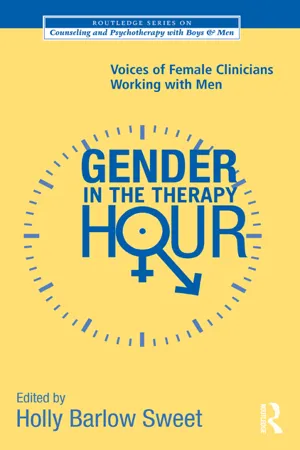
Gender in the Therapy Hour
Voices of Female Clinicians Working with Men
- 332 pages
- English
- ePUB (mobile friendly)
- Available on iOS & Android
eBook - ePub
About this book
Information
Section
1
Core Treatment Issues
Chapter
1
Women Working With Men
Challenges and Opportunities
Why Should Female Therapists Care about Men’s Issues?
Projections made on future enrollments in counseling and clinical psychology noted the fact that fewer and fewer men have been entering clinical fields. Oren and Oren (2009) found that men currently make up only 21% of graduate students in psychology, whereas 25 years ago they used to constitute 50% of that population. In a survey done by Psychology Today and a major health maintenance organization in 2004 on the gender of people in psychological treatment (Psychology Today, 2004), 37% of the total number of patients surveyed were male. When those sets of statistics are combined, it seems plausible that future clinicians are likely to be female rather than male and working with populations that will include a substantial number of men.
Although there has been a significant increase in interest in men’s studies since the early 1990s, there has been a lag in the incorporation of materials about men’s issues in counseling programs. Few academic programs currently incorporate classes on the psychology of men into their curriculum. In a survey of 52 doctoral programs in counseling psychology (Mellinger & Liu, 2006), only 17% of these programs had any classes in the psychology of men available to students. The books that do exist in reading lists on the psychology of men are almost exclusively written by male authors and do not address the needs or experiences of female clinicians who are working or will be working with men. As a result, most women go through an education in psychology without ever having studied men’s issues from either a theoretical or a clinical perspective, yet many will end up working with men in their counseling careers.
The result of this lack of knowledge may have negative consequences for both female and male clinicians and their male clients. Traditional talk therapy in general is a more female-oriented activity because of its focus on interpersonal connection, vulnerability, and emotional expression (Sweet, 2006). This focus can conflict with traditional male norms of autonomy, toughness, and emotional restriction. Male clinicians may understand those norms more directly from their own socialization and may be better able to relate to a style that might focus more on action, structure, and clear goals. Female clinicians, on the other hand, may not directly understand how powerful those norms may be because their own socialization and life experience may be quite different. Women are typically socialized to be connected and emotionally expressive. Therapy is also an intimate activity in which the client talks about personal and often emotional matters in secret behind a closed door. Such intimacy can have erotic overtones on the part of the male client as well as the female therapist.
Erickson (1993) noted the importance of female therapists taking a look at their own histories to make sure that they are not operating out of negative countertransference and to examine the value of having more information about men’s issues to better understand the male experience. For female therapists not familiar with the literature on covert depression in men, depression in their male clients may go undetected and hence untreated. Untreated depressed men may then start or continue self-medicating themselves with alcohol, drugs, or overwork or harming themselves or others (Cochran & Rabinowitz, 2000; Real, 1997). For those who do not understand the dynamics of male socialization, in which sadness may be expressed as anger or irritability, working with angry men can be challenging. It can create countertransference reactions and projections in the therapist that inhibit both positive regard for the client and the ability to create a safe place for the man to express his feelings (Erickson, 1993). Female therapists who do not understand the ways men have learned to inhibit themselves verbally and emotionally to live up to “being a man” may be impatient with men who have difficulty accessing and articulating their feelings in therapy.
Female clinicians who are informed about the range of issues facing them in treating male clients and are more knowledgeable about how other female clinicians have approached their work with men will be better able to help their male clients. In addition, knowledge of men’s issues can aid therapists in helping their female clients understand the motivations and behavior of the men they care about, including fathers, husbands, brothers, sons, friends, and colleagues. This is the “trickledown” effect of therapy: What clients learn in therapy can potentially benefit those with whom the clients are in contact. For example, if Jane understands more about how her husband’s behavior (social withdrawal, anger, or workaholism) may indicate an underlying untreated depression, she may be better able to deal with her husband in a less-defensive, more empathic way and support him in getting help. If Susan has a highly critical father, helping her learn about rigid male norms of achievement might aid her in not internalizing his negative assessments as much.
A Brief Review of Male and Female Norms in American Culture
Levant and Kopecky (1995) identified seven key norms in their book Masculinity Reconstructed: restricted emotionality, emphasis on the importance of strength and aggression, sex disconnected from intimacy (nonrelational sex), self-reliance, avoidance of femininity, pursuit of achievement and status, and homophobia. David and Brannon (1976), some of the first authors to explore men’s roles, came up with one meta-norm for men that they called “no sissy stuff.” In other words, above all, men should never act, think, dress, feel, talk, or look like women. Pollack (1998) talked about the boy code and how these roles, especially the role of no sissy stuff, are socialized in boys from early on in formidable ways. Men growing up in our culture are trained to see male role models as tough, independent, sexually active, successful professionally, and never expressing vulnerable feelings. Without perspective or alternatives in sight, many men come to see themselves as weak, wimpy, or a sissy if they do not follow normative male behavior.
Traditional male norms are not necessarily bad, especially in the workplace. Certainly, strength, self-control, self-reliance, and the pursuit of achievement and status can be positive traits that both women and men might wish to cultivate. However, rigid adherence to these roles can be problematic, especially in interpersonal relationships in which another set of skills is needed, such as the ability to be connected, nurturing, receptive, interdependent, and emotionally expressive. Other norms can be directly damaging in and of themselves. These norms include restricted emotionality, avoidance of femininity, homophobia, and nonrelational sex. What compounds the problem is the excessive emphasis on the positive sides of these norms while not seeing their drawbacks. It then becomes even harder for men to engage in behavior that counters male norms, especially in the area of showing need for others and expressing vulnerable feelings. For a man, even talking about one’s problems can be seen as a sign of weakness and lack of masculinity.
In contrast, traditional female norms are centered on being emotionally open and connected to others. In a textbook on the psychology of women (Hyde, 2007), mention is made of a survey done by Spence and Buckner (2000) in which a sample of Americans believed that female characteristics include being warm, gentle, understanding, devoted to others, helpful to others, aware of others’ feelings, and emotional (p. 87). Hyde discusses the strong and persistent socialization influences behind these traits and says that “gender socialization shapes emotions, beginning with parental socialization from infancy... girls and women are more facially expressive of emotion and talk about emotions more than boys and men do” (p. 190). In another updated textbook on the psychology of women (Matlin, 2012), a summary of research on women’s communication patterns shows that women are more likely than men to gaze more at their conversational partners, smile more than men, and are generally more accurate than men in decoding nonverbal messages that other people send (pp. 186–187). Girls are also more likely than boys to self-disclose to their friends (p. 196).
Being open, connected, and self-disclosing as a therapist is probably beneficial to many male clients for whom this style might help establish a strong therapeutic alliance and make them feel more cared for in the therapy hour. However, this style can also lead to miscommunication and confused expectations for men who adhere more rigidly to traditional male norms. The “traditional” male client may misinterpret a female’s style of connectedness (smiling, gazing directly at him, etc,) as sexual in nature. Too much openness and emphasis on emotions might be unsettling for a man who has been taught that his emotions are to be kept inside at all costs. Asking a man to speak intimately about his life in weekly sessions with a person who is there to help him might make him uneasy since it goes against the stereotype of the independent “Marlboro Man” who relies on himself and doesn’t really need others. Given the difference in gender norms and in the experience of growing up male or female in American culture, it is important that female clinicians learn about the socialization of men and how male norms might affect their male clients. In addition, female therapists need to learn about their own expectations and biases about what a “good” client should do in therapy and how therapy should be conducted. If therapy is practiced according to norms that are largely female, then therapy can end up feeling unfamiliar (or even threatening) to many men. It is no wonder, therefore, that the average man might not be inclined to think of therapy as his first line of defense against anxiety, depression, or other mental health issues.
Making Therapy More Male Friendly
Increasing attention has been paid since the beginning of the twenty-first century to the consequences of male norms for how men perceive and utilize psychotherapy. Prominent researchers in the field of men and psychotherapy (Addis & Mahalik, 2003; Good, Thomson, & Braithwaite, 2005; Mahalik, Good, & Englar-Carlson, 2003; Rochlen & Hoyer, 2005) have written about the restrictions caused by male norms to men’s help-seeking behavior. These norms include (a) being stoic in the face of personal difficulties; (b) not showing feelings; (c) striving to be independent; and (d) not relying on others. These norms have generally been seen in our culture as positive traits for a “real” man: an independent, action-oriented person with a stiff upper lip who does not have to rely on anyone and never asks for (or even appears to need) help. How often have you heard the expression “man up” as a way of saying, tough it out, or “crying is for sissies”? An ad appeared recently on television that showed a male therapist making fun of a male client who is trying to express his tender feelings. “You’re in namby-pamby land,” says the therapist, “What a wimp you are!” It is supposed to be funny since it was a take-off on a drill sergeant as therapist. However, it represents a commonly held view that real men do not cry, and that men should take care of their personal problems by themselves. If they cry or ask for help, they are seen as wimps or wusses, “girlie” men, men who are not to be respected or valued.
Where does this leave the average guy who needs some help in dealing with his emotions or situations that are difficult for him? Many men probably do not even go to therapy when they have issues. Instead, they may withdraw from others, get angry or irritable, turn to substances such as alcohol or drugs for relief, act out sexually, become workaholics, or turn violent with themselves or others. For those who try therapy (often at the insistence of a spouse or boss), it means confronting those barriers to therapy and still being able to see themselves as manly. If therapy is not male user friendly (i.e., done by a therapist who is not sensitive to men’s issues or someone who does not really like men or is angry with or afraid of men), it can actually do more harm than good. Men who are shamed, blamed, or not listened to in therapy are not likely to come back. They may even share their negative experiences of therapy, discouraging others from seeking help.
Mark Kiselica (2011) suggests that we make therapy more accessible to boys and men by changing the focus of how we view male clients as well as the style of therapy we use with them. He appreciates the new psychology of men that looks at the social construction of masculinity and has raised awareness among both professionals and the general public about the influence of masculinity on male attitudes and behavior. However, he has concerns about viewing masculinity currently in a more negative light and states that
the tendency of the new psychology of men to emphasize male pathology has resulted in a comparative neglect of male strengths and the good things that boys and men do. As a result of overlooking these strengths, psychologists have a tendency to view males as being damaged victims of flawed development…. Embracing this type of deficit model fosters the mind-set that boys and men are defective and damaged, that they need to be fixed, and that they are at fault for the problems they bring to therapy. (pp. 132–133)
He indicates we need to develop a new focus on the way we counsel boys and men that he calls “male-friendly” therapy (Kiselica, 2005) or “male-sensitive” counseling (Kiselica, 2003). He addresses how to make therapy more user friendly for boys and men, including how to attract males into therapy and how to make the actual therapy process more directly applicable to their specific needs and style.
Other authors in the field of men and therapy have reiterated the value of practicing male-friendly therapy in a variety of counseling approaches. Wexler (Men in Therapy, 2009) mentions the roadblocks to men entering therapy, including the stigma of counseling (i.e., you must be sick to see a therapist) and the fear of being changed against one’s will, not being understood, and being confused about what the whole process is all about. Wexler gives some excellent practical suggestions in his book about how to work with these roadblocks, including using guy talk, making it clear how a man can benefit from therapy, respecting resistance and the male style of relating, using self-disclosure, giving empathic responses when the client tries new behavior, setting a pace that works for the client, and advertising therapy as having specific skill-based tasks. Brooks (Beyond the Crisis of Masculinity, 2010) also focuses on the value of cognitive and behavioral therapy (CBT) for men. He indicates that the key points of CBT (here-and-now focus, action oriented, less emphasis on emotional expression, psychoeducational style, skill building, and control of client over process) may work better with a man, especially with traditional men who tend to be less comfortable in a female-style therapy world of feelings, reliance on others, and intimacy.
Pollack (2005) highlights how psychodynamic therapy can help men acknowledge the issues of grief and loss in an empathic way by highlighting the emotional wounding and trauma common in male development. Rabinowitz and Cochran (2002) use a more active style that goes beyond just talking with their clients and say that “experiential interventions that allow a man active expression of his feelings and behavior enhance the therapy process and work well in combination with traditional psychotherapeutic strategies” (p. 4). There are many other approaches (including feminist therapy, interpersonal therapy, couples counseling, and group therapy) that can be used effectively if the clinicians employing those approaches are sensitive to men’s issues and styles.
Despite some of the negative aspects (e.g., emotional restriction) of traditional male norms for a therapeutic relationship, there are also many positive aspects of male norms that should be acknowledged if possible. Kiselica and Englar-Carlson (2010) outline a positive psychology/positive masculinity model of psychotherapy with boys and men. They describe this model as drawing from the emerging literature on the psychology of human strength and see it as
a model of boys, men and masculinity that accentuates noble aspects of masculinity, including the following: male rela...
Table of contents
- Cover Page
- Half Title page
- Series
- Title Page
- Copyright Page
- Contents
- Series Editor's Foreword
- Preface
- About the Editor
- About the Contributors
- Section 1 Core Treatment Issues
- Chapter 1 Women Working With Men Challenges and Opportunities
- Chapter 2 Starting and Ending Psychotherapy With Men
- Chapter 3 Gender Matters—Transference, Countertransference, and Men A Psychodynamic/ Psychoanalytic Perspective
- Chapter 4 Ethical Considerations in Working With Men
- Section 2 Different Modalities of Treatment
- Chapter 5 Couples Counseling
- Chapter 6 Practicing Gender-Aware Therapy A New Clinician's Perspective
- Chapter 7 Coaching Men
- Section 3 Working With Different Populations of Ment
- Chapter 8 Working With Men in the Minority Multiple Identities, Multiple Selves
- Chapter 9 Counseling Depressed Men Making Darkness Visible
- Chapter 10 Strength-Based Psychotherapy With Fathers
- Chapter 11 Understanding Men's Issues Assessing and Treating Men Who Are Abusive
- Chapter 12 Working With Traditional Men in the Military Dealing With Trauma
- Chapter 13 Psychotherapy With Older Men
- Section 4 Sharing Our Experiences
- Chapter 14 Women's Voices Together
- Afterword: Understanding the Impact of Therapy With Men From a Male Perspective
- Index
Trusted by 375,005 students
Access to over 1.5 million titles for a fair monthly price.
Study more efficiently using our study tools.
Frequently asked questions
Yes, you can cancel anytime from the Subscription tab in your account settings on the Perlego website. Your subscription will stay active until the end of your current billing period. Learn how to cancel your subscription
No, books cannot be downloaded as external files, such as PDFs, for use outside of Perlego. However, you can download books within the Perlego app for offline reading on mobile or tablet. Learn how to download books offline
Perlego offers two plans: Essential and Complete
- Essential is ideal for learners and professionals who enjoy exploring a wide range of subjects. Access the Essential Library with 800,000+ trusted titles and best-sellers across business, personal growth, and the humanities. Includes unlimited reading time and Standard Read Aloud voice.
- Complete: Perfect for advanced learners and researchers needing full, unrestricted access. Unlock 1.5M+ books across hundreds of subjects, including academic and specialized titles. The Complete Plan also includes advanced features like Premium Read Aloud and Research Assistant.
We are an online textbook subscription service, where you can get access to an entire online library for less than the price of a single book per month. With over 1.5 million books across 990+ topics, we’ve got you covered! Learn about our mission
Look out for the read-aloud symbol on your next book to see if you can listen to it. The read-aloud tool reads text aloud for you, highlighting the text as it is being read. You can pause it, speed it up and slow it down. Learn more about Read Aloud
Yes! You can use the Perlego app on both iOS and Android devices to read anytime, anywhere — even offline. Perfect for commutes or when you’re on the go.
Please note we cannot support devices running on iOS 13 and Android 7 or earlier. Learn more about using the app
Please note we cannot support devices running on iOS 13 and Android 7 or earlier. Learn more about using the app
Yes, you can access Gender in the Therapy Hour by Holly Barlow Sweet in PDF and/or ePUB format, as well as other popular books in Psychology & Mental Health in Psychology. We have over 1.5 million books available in our catalogue for you to explore.