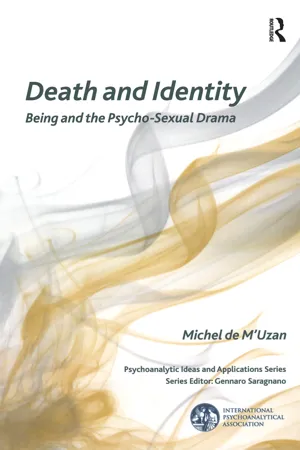
Michel de M'Uzan has derived several innovative notions from his clinical experience that are relevant not only for the psychoanalyst's status of identity, which is sometimes dramatically shaken by his or her patient's unconscious, but also for the artist who is deeply destabilized by his act of creation, as well as for the caring person who lets him/herself be caught in the nets, as it were, of someone who is dying. Such are the extreme examples of the precarious nature of the boundaries of being in which the author discerns, not necessarily a pathological disposition, but rather an opportunity for the mind to construct itself and achieve authenticity. Through this invigorating recognition of the unconscious with the emergence, at the heart of analysis, of 'paradoxical thoughts', the experience of 'blurred frontiers' characteristic of a vacillating sense of identity, the perception of an 'every man's land' in which the analytic treatment unfolds, and the elaboration of an 'original grammar' specific to the formulation of the intervention/interpretation of the analyst during the session.
- 236 pages
- English
- ePUB (mobile friendly)
- Available on iOS & Android
eBook - ePub
Death and Identity
About this book
Information
Part I
From Art to Death
Chapter One
The same and the identical* (1969)
It is worth drawing attention to a contrast that each of us can readily identify with: analysts generally agree on the clinical notion of repetition, whereas interpreting this phenomenon always stirs up controversies, not to say passionate confrontations. The ambiguities, and even the contradictions that can be found in Beyond the Pleasure Principle (1920g) which Freud in no way tried to hide, are themselves part of the situation. We know that only Ferenczi, Eitingon, and Alexander welcomed unreservedly the highly speculative views developed in this work. For his part, Freud had no hesitation in writing: "The third step in the theory of the instincts, which I have taken here, cannot lay claim to the same degree of certainty as the two earlier ones" (p. 59).
In Inhibitions, Symptoms and Anxiety (1926d), he explicitly upholds the clinical value of the previous duality of the instincts. Finally, in the 1920s, when it emerged that there was enormous disappointment about the therapeutic range of analysis—a fact we perhaps underestimate—a very agitated Wilhelm Reich personally questioned Freud, asking him if he really intended to introduce the death instinct as a clinical theory. Freud reassured him that "it was only a hypothesis", advising Reich not to let himself be bothered by it and just to continue with his clinical work (Reich, 1927, p. 138).
In making these few preliminary remarks, I already find myself going against the trend of current positions taken on the compulsion to repeat. This puts me in a somewhat delicate situation for, if I may say so, the death instinct is alive and well. However, and I want to stress this point, my intention is neither to acknowledge nor to challenge the notion of the death instinct, which, in fact, is often an act of faith. But I do want to get it out of the way before starting to examine clinical facts. In fact, the stipulated connection between the compulsion to repeat and the death instinct, which has perhaps become conventional, especially when made prematurely, is responsible, in my opinion, for quite a lot of the difficulties which often confront us. To avoid any misunderstanding and to clarify the standpoint that I am adopting here, I would say that I do not reject the existence of manifestations and forms of behaviour on the fringes of the pleasure principle. On the contrary, even in the context of a compromise, I believe there are phenomena that have nothing to do with the fulfilment of a repressed wish. For me, there are actually good reasons to distinguish repetitions governed classically by the pleasure principle, such as those found in neurotic symptoms where there is a return of the repressed, from other forms of repetition, admittedly of a different order, which should not be linked from the outset to a fundamental characteristic of the instinct, or with the activity of a death instinct, even if these repetitions have a lethal effect.
The thesis that I want to set out is based on a clinical observation that I would readily describe as an opposition between the same and the identical. Such an opposition is only artificial in appearance, for Paul Robert's Dictionnaire de la langue française already distinguishes one of the meanings of same, defined as an approximate identity in the order of similarity or of resemblance, whereas identical refers to perfectly similar objects and, according to this dictionary, constitutes a sort of superlative of the similar. We would not, for instance, confuse a situation where we go back constantly to the same text, to the same narrative, in order to rewrite it, with a situation in which, like Bouvard and Pecuchet (two characters in a novel by Flaubert, who are both copyists), we would be limited to recopying it indefinitely. In the first case the repetition always implies a change, however minimal it may be. The "perpetual recurrence of the same thing", which Freud refers to, has nothing to do with the unlimited repetition of the identical. In the analytic situation, the change that appears in the new version of what has been announced previously, even if it is extremely limited, always reveals the existence of a considerable amount of work, the insistent call of unflagging desire.
I will come back later on to the profound economic modification that occurs in the act of repetition. For the time being, I shall just recall one aspect of it, the mobilisation of the countercathexis, in other words, the objective alliance concluded between the preconscious refusal and the attraction exerted on the representation in question by unconscious prototypes. In this respect, I would suggest that this attraction should not be conceived of simply as an expression of the compulsion to repeat (Freud, 1926d, pp. 159-160). The representation does not return to the unconscious to agglutinate there with the said prototypes; it first returns to a place where energy circulates more freely in order to gain fresh momentum. We are therefore entitled to speak of a recovery of energy. This retrogressive movement, moreover, provides the necessary time for a redistribution of representations by means of condensation and displacement, which implies the presence of several terms. Faced with this distortion of the figures whose destiny it is to return in order to express the dynamics of desire, we may reasonably speak of a veritable dramatisation, entirely governed by the pleasure principle. In our practice, at least, it would be perilous to think prematurely of the situation in any other way, even in those cases where everything that we observe apparently results from those resistances which lead us to speak of a negative therapeutic reaction—resistances we attribute not to the superego but rather to the compulsion to repeat, a fact emphasised by Maurice Bouvet and Glover alike.
When clinical illustrations are absent, misgivings are expressed, but when they are supplied, they are criticised and diversely interpreted. Nevertheless, I will take the risk of presenting one. The patient in question was a young woman who had been in analysis for a long time, and who had developed a stubborn resistance of the type we are inclined to associate with the compulsion to repeat. I shall describe one aspect of it here. Constantly, or rather, repetitively, the patient would start counting inwardly: one, two, three, and so on. Sometimes she would tell me about this, but not always, far from it; and she repeated this operation indefinitely. In order to be faithful to what happened and to stress the role of the countertransference in these situations, as well as the factor of chance or luck that governs its form and intensity, I will disclose a sequence of a poem by Armen Lubin (1903-1974) that started going round and round in my head, just as repetitively. In it there is a mythical being who counts. "He counts, counts, and begins all over again," writes the poet, who then adds, "All sorrows are called absence, sorrows bearing lances" (Lubin, 1946). The repetition did not seem distressing to me at all.
One day, after this scene had been played out many times, the patient said to me, "I counted up to eight; usually, I count up to ten." This is exactly the sort of change I was referring to. I responded to her immediately, saying: "There are two missing, who are they?" "The father and the son," she replied. Now one was missing, the Holy Ghost—in the colloquial sense of the term—and I pointed this out to her. Now this young woman was expecting a baby for the second time in her analysis— a pregnancy which she had never clearly referred to. But from that point on, as you will imagine, the tempo of the session accelerated in a manner that is characteristic of such situations. The underlying fantasy became clearer: she had got pregnant through the intervention of the Holy Ghost, in other words, without any physical contact. So, in fantasy, it was the analyst who had made her pregnant. Soon after, there appeared the figure of her absent father who had died prematurely during the patient's childhood ("sorrows bearing lances").
It is not possible to dwell on the rich developments that followed this sequence, but I can say that it was a decisive turning point in the analysis. It would certainly have been regrettable if chance had confirmed the understandable feeling that what I was dealing with here was a manifestation of the compulsion to repeat. So I do not believe that we can always follow Freud when he declares that the tendency of neurotics to repeat in the transference is independent of the pleasure principle (1920g, p. 22). What we are dealing with here, then, is not, it seems to me, a pure and unlimited repetition, but rather a fresh elaboration of the same thing which, moreover, is capable of integrating a whole new section of reality within its ambit.
Another illustration of this can be found in Beyond the Pleasure Principle. To introduce this tendency which asserts itself without taking account of the pleasure principle, overriding it, Freud turns to Tasso's romantic epic, the Gerusalemme Liberata. However, when the hero Tancred slashes a tree in two in which the soul of his beloved Clorinda has taken refuge, he did not repeat, strictly speaking, what had happened before. In fact, he did both the same thing and something completely different from the murder he had committed when he killed her, not knowing she was clothed in the armour of an enemy knight. What the poet wanted to represent, more or less deliberately, through this changing of masks and mutation of substances, was a series of transformations ranging from the figure of the raw fact to the figure of its symbolic representation.
By way of concluding the first part of this chapter, I would like to emphasise that in clinical practice the domain of what is situated on the fringes of the pleasure principle must be reduced as much as possible from the outset or, better still, displaced. There are different ways of imagining this. I am thinking here, in particular, of a remark Maurice Bouvet once made: "What would we analysts do", he asked, more or less, "if we did not believe in the notion of progress, and thus of change?"
There remains, however, as I have just noted, a separate domain, an order of repetition situated beyond, or rather prior to, the pleasure principle. I will approach it without making any initial reference to the death instinct, solely from the angle of the opposition between the same and the identical. To do so, I must briefly recall the positions I presented in papers during the 1966 conference on "Analyse terminée et analyse interminable" (de M'Uzan, 1966) and the Congress for French-Speaking Psychoanalysts of 1965 (de M'Uzan, 1965) and of 1967 (de M'Uzan, 1967).
At that time, I distinguished two main orientations of the personality based on the idea of whether or not the category of the past had been solidly elaborated. By the term "past", I do not mean the sum of lived events, but their internal rewriting—as in the family romance—based on a first narrative. I use the term narrative on account of the homology of form and structure between this internal story and a novelistic elaboration. The first narrative, the first real "past" of the individual, is elaborated at the Oedipal stage; that is to say, when all the earlier stages are taken up again and reworked within the framework both of desire, which is henceforth constantly mediated, and of the castration complex. It is as though the real events, once they have been lived, have less importance than the internal narrative that is elaborated and re-elaborated from them. From then on, and throughout the greatest part of his existence, the subject continues day in day out to elaborate his "past", that is, the precedent of truth for times to come. And he does this on the basis of the description he gives, through the style of his activities, of his situation in the world as a person who desires.
This would be the natural fate of so-called normal or neurotic organisations, those that form and develop a real transference neurosis in the analytic situation, whose evolution follows a path that eventually leads to an ending. When, however, this category of the past has not been elaborated properly, and a kind of chronology has prevailed over a novelistic past, we observe, in extreme cases, those scattered island (archipelago) personalities which I have described elsewhere (de M'Uzan, 1966). In such situations we witness either sudden eruptions of conglomerates of affect-representation or the predominance of a mode of mechanical thinking (pensée opératoire), or alternatively a mixture of both. These situations are in any case unfit to enter the narrative or novel of the transference-neurosis. It is no longer a question of transference but of postponements; the analysis may then become interminable, punctuated by incidents of direct, mechanical, and reduplicative acting out, since it is always identical, with the result that one has the feeling one is witnessing a repetition of the repetition.
I think I am in a better position now to define the thesis I am defending here. I will summarise it schematically as follows:
It is useful to distinguish two types of phenomena among those that are associated classically with the compulsion to repeat. The first of these is characterised by a reproduction of the same and involves structures in which the category of the past has been elaborated sufficiently. The second is characterised by a reproduction of the identical and involves structures in which this elaboration of the past is defective.
I have already distinguished the same and the identical clearly enough to be able to pass fairly swiftly over the formal characteristics of these two sorts of repetition. So I will add just a few words before going on to examine them from a metapsychological point of view. There is no doubt that the repetitive return of what has already been formulated leads us to neglect, and even ignore, the changes that it conceals. But this repetition of the same, which, in its hidden form, involves a process of remembering that finds expression in a variety of circumstances—sometimes in subtle ways—can not be confused with the repetition of the identical. In the latter, remembering has no status at all. A strange resemblance can be detected in the tone of voice and the inflections: we find verbal stereotypes, language tics, and even the use of a strictly reproductive direct style of speech, giving the impression that the subject is permanently ready to change place with the object topographically. Notwithstanding first appearances, this form of repetition is fundamentally different from the kind that Verlaine alludes to in one of his poems which involves a dream—to be exact, a repetitive dream in which a woman constantly returns, an unknown woman whom the poet loves and who loves him; but each time she is neither quite the same nor entirely different.
It is time now to examine the situation from a metapsychological standpoint, even at the risk of presenting things somewhat schematically. I will begin with the repetition of the same. The forces in operation here give the impression of being somewhat nuanced in their intensity and, above all, variable in their direction. Those that emanate from the unconscious, encounter, as if in a dialogue, those that belong to the countercathexis. This interplay not only assumes the appearance of a developed story, but is also situated entirely in the psychic sphere. The change that is observable at the heart of this complex dynamic stems less from a simple addition than from the elaboration of a fresh narrative from two existing narratives, even though all three resemble each other closely. While the economic necessity is undoubtedly present, it does not seem spectacularly compelling and, above all, the presence of counter-cathexes gives a more complex and more progressive rhythm to the repetition, as if it were primarily in the service of temporisation. The way the tendency to discharge is handled plays a key role in the formation of repetitions, which could be seen in terms of a very discrete and progressive redistribution of cathexes.
As for the sequence of repetitions of the same, along with their inherent discharges, they follow a certain trajectory, by which I mean that we are not dealing with a simple series of perfect movements back and forth but rather with a progressive displacement that occurs with each repetition, marking out the trajectory just referred to. From one repetition to another the economic configuration is imperceptibly modified, but it is modified none the less. This somewhat and metapsychological conceptualisation is simply another reading of what can be observed clinically. Thus if I return to the clinical fragment presented above, we see that dynamic and economic redistributions can be detected in the patient's discourse and behaviour. She counted, and then either spoke about it immediately or at a later point. A few seconds or minutes before, she might have made a statement such as "I have nothing to say"; the action of counting could be accompanied or replaced by a gesture of the hand, as if to say, "Oh well", or "I don't want it". Her tone of voice, which at first seemed perfectly even and similar from one repetition to another, was in fact marked by very subtle variations ranging from defiance to resignation—variations that were so discrete that they were only noticeable after the event, for instance, when a more important variation—almost a difference—occurred. Such was the case when the patient announced: "I counted up to eight; usually, I count up to ten." As we have seen, this situation expressed a truly novelistic elaboration, the narrative of a desire in which successive figures who call each other and overlap each other had remained hidden. In short, it was a real labour of which the author, whose own volition was wholly excluded, was nevertheless the field. This is why, in order to evoke the driving force of this work, I do not hesitate to adopt the expression compulsion to symbolise, proposed by Groddeck (1969, p. 274) to define a force that truly belongs to the subject but is not available to him or her because it is the unconscious; or, as I would say, is in the unconscious.
Let me turn now to the repetition of the identical. The contrast is striking. To begin with we notice an erosion of topographical distinctions. Actually, repetition occurs here within the scope of a transference that is quite different from the transference-neurosis, which is in the realm of the repetition of the same. The repetition of the identical can be part of a denuded id, which must not be confused with the psychical unconscious, as well as part of a sort of sensible reality in which the frontier separating inside from outside remains uncertain. Repetitions may result from this which I would venture to call imitative, where a particular characteristic of the object's perceived activities is incorporated and later faithfully reproduced. In "Analysis Terminable and Interminable" (1937c), Freud speaks of resistances that can no longer be localised, but which seem to depend on fundamental relations within the psychical apparatus. I think that this remark applies particularly well to the topographical erasure to which I am referring here.
The forces at work in this repetition of the identical may be distinguished by their insistent orientation in one and the same direction. We do not find here the dynamic I described earlier in connection with the repetition of the same, namely a momentary resumption of a free circulation of energies in the higher systems, which is soon followed by a linking up with unconscious representations in a mode that ...
Table of contents
- Cover
- Half Title
- Title
- Copyright
- Contents
- SERIES EDITOR'S PREFACE
- TRANSLATOR'S ACKNOWLEDGEMENTS
- PREFACE
- PART I: FROM ART TO DEATH
- PART II: THE MOUTH OF THE UNCONSCIOUS
- PART III: AT THE FRONTIERS OF IDENTITY
- PART IV: BACK TO OBJECT-RELATIONS
- REFERENCES
- INDEX
Trusted by 375,005 students
Access to over 1.5 million titles for a fair monthly price.
Study more efficiently using our study tools.
Frequently asked questions
Yes, you can cancel anytime from the Subscription tab in your account settings on the Perlego website. Your subscription will stay active until the end of your current billing period. Learn how to cancel your subscription
No, books cannot be downloaded as external files, such as PDFs, for use outside of Perlego. However, you can download books within the Perlego app for offline reading on mobile or tablet. Learn how to download books offline
Perlego offers two plans: Essential and Complete
- Essential is ideal for learners and professionals who enjoy exploring a wide range of subjects. Access the Essential Library with 800,000+ trusted titles and best-sellers across business, personal growth, and the humanities. Includes unlimited reading time and Standard Read Aloud voice.
- Complete: Perfect for advanced learners and researchers needing full, unrestricted access. Unlock 1.5M+ books across hundreds of subjects, including academic and specialized titles. The Complete Plan also includes advanced features like Premium Read Aloud and Research Assistant.
We are an online textbook subscription service, where you can get access to an entire online library for less than the price of a single book per month. With over 1.5 million books across 990+ topics, we’ve got you covered! Learn about our mission
Look out for the read-aloud symbol on your next book to see if you can listen to it. The read-aloud tool reads text aloud for you, highlighting the text as it is being read. You can pause it, speed it up and slow it down. Learn more about Read Aloud
Yes! You can use the Perlego app on both iOS and Android devices to read anytime, anywhere — even offline. Perfect for commutes or when you’re on the go.
Please note we cannot support devices running on iOS 13 and Android 7 or earlier. Learn more about using the app
Please note we cannot support devices running on iOS 13 and Android 7 or earlier. Learn more about using the app
Yes, you can access Death and Identity by Michel de M'Uzan in PDF and/or ePUB format, as well as other popular books in Psychology & History & Theory in Psychology. We have over 1.5 million books available in our catalogue for you to explore.