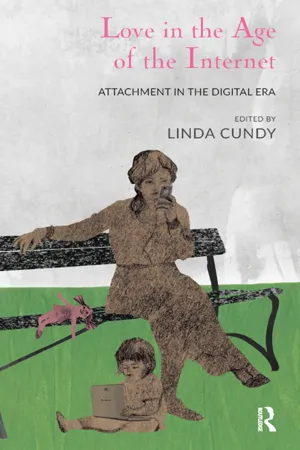
- 224 pages
- English
- ePUB (mobile friendly)
- Available on iOS & Android
eBook - ePub
About this book
This highly topical book explores the new technological environment we have created, and our adaptation to it, twenty-five years after the death of John Bowlby. In the space of just a couple of decades, the world has changed radically, and we are changing too: personal computers and smartphones mediate our lives, work, play, and love. Relationships of all kinds are now conducted through mobile phones, email, Skype and social network sites. Attachment theory is concerned with the impact of the external world on internal reality, where twenty-first century experiences encounter the powerful, primitive, and ancient instinct for attachment and survival. This book is written by psychotherapists whose practice, with individual adults and couples, is informed by attachment theory. It contains theoretical, observational, and clinical material, and will be relevant to all psychotherapists, psychoanalysts, counsellors, and psychologists interested in the profound impact of digital and communication technologies on human relationships.
Information
CHAPTER ONE
Attachment, self-experience, and communication technology: love in the age of the Internet*
Introduction
The infant’s sense of self, his patterns of defences, creativity, and social brain develop in intimate relationship with care-givers. Parental delight in, and attentiveness to, their child lay the foundations for pleasure in relating, while shared “moments of meeting” (Stern, Sander, Nahum, et al., 1998) boost vitality and the capacity for intimacy. These first relationships are internalised as a secure, or insecure, basis of the personality. Throughout life, in times of stress, we again turn to others for comfort, reassurance, and support. Is the communication technology of the twenty-first century an aid or a hindrance to secure attachment? According to Stadter, “we need to study not only what technology can do for us but also what it does to us” (2013, p. 3). This chapter explores the impact of mobile telephones and texting, communication by electronic mail, Skype, and through social network sites on the sense of self as it develops in relationship with our attachment figures, and throughout life.
Argentinean psychoanalyst Carlino writes, “Socio-cultural changes and technological innovations that settle into and circulate within society affect both reality and people’s subjectivity” (2011, p. 1). How might the ubiquity of mobile phones, email, Internet chat rooms, social networking, and blogs influence our subjectivity and shape the development of a sense of self? How are traditional boundaries between self and other affected, and what might the consequences be?
Attachment
Human beings are a social species. We have survived and flourished through social organisation, co-operation, and communication. According to Bowlby, our instincts evolved over millennia in the original environment our distant ancestors inhabited. Our primary instinct is survival, and we rely on others for protection against danger. Attachment enabled the survival of the species and maximised the chances of individuals in a potentially hostile and challenging habitat (Bowlby, 1969, 1979). We are born with innate behaviours designed to gain proximity to a protective adult; Bowlby listed grasping with the hands, suckling, moulding the body into parental arms, calling out, and babbling as earliest means of attracting the parent. Early in life we can follow, first with the eyes, later by crawling, and eventually on two feet. The infant’s smile has a special place in our relational repertoire, seducing mother into falling in love with her baby and reassuring her that she is loved and needed (Bowlby, 1958).
Modern neuroscience points to the role of attachment in structuring brain architecture.
Given our dependence on groups for our very survival, primates have evolved elaborate neural networks for interacting with others as well as reading their minds and predicting their intentions … These systems of attaching, predicting, and communicating are all functions of the social brain. (Cozolino, 2006, p. 21)
Evolutionary psychologist Andrew Whiten proposes that our species is characterised by its “deep social mind”—an extraordinary interpenetration of thoughts and feelings (2007). While Winnicott noted that there is no such thing as an infant without the involvement of another person, Cozolino suggests that “a single human brain does not exist in nature”, and that the natural environment of our species is no longer a geographical but a relational landscape (Cozolino, 2006, p. 11).
The instinct to reach out to another person in times of potential danger, anxiety, or illness persists throughout life. We may think of the emergency services and the National Health Service as meeting attachment needs for survival. The armed forces organise personnel with this instinct in mind. Certainly, communication technology promotes survival by making others readily accessible; stories appear in the press frequently—a couple lost in the Amazon jungle were found as a result of a mobile phone call to coastguards in Britain (Digital Journal, 21 September 2011), and a sailor thrown overboard by rough seas in the English Channel was rescued as a result of a desperate call to a builder’s merchant in Devon (BBC News Online, 24 May 2013). However, once survival can be more or less taken for granted, the quality of attachment has implications for psychological health, or psychopathology. Most parents manage to keep their offspring alive, but not all manage to raise stable, resilient, emotionally healthy children. “Those who are nurtured best, survive best” (Cozolino, 2006, p. 14).
Attachment is related to spatial and emotional distance. We need our protectors to be available in times of perceived danger, and we need them at a comfortable distance in order to feel a safe connection, a secure base. For some, attachment figures must always be close at hand and they are anxious when the gap is too great; they feel frighteningly alone and exposed. Others need more space, feeling suffocated by demands for intimacy. We develop psychological and behavioural defences to regulate the emotional distance between ourselves and other people, while still maintaining the connection. It is as if we are joined to our significant others with an elastic thread which is best kept slightly taught, neither slack nor overstretched. The length of the thread depends on our personal needs for intimacy and space. It is easy to observe in babies, who turn their heads away from overly intrusive attention, and toddlers who become alarmed if mum or dad is too far ahead in the park. As we grow, our tolerance of separation increases and young children parted from their families can be comforted by photographs and reassured by telephone and Skype calls. However, attachment-seeking behaviours also become more complex, more symbolic, and often distorted and disguised. This is likely to have implications for our use of communication technology.
Hungarian psychoanalyst Michael Balint, a contemporary of Bowlby, theorised that infants are stressed by contact with reality and long for moments of blissful safety and union that they experienced in the womb. They develop one of two patterns of defence as a result (Balint, 1959, 1968). Ocnophils are afraid of open expanses without human presence, and their defence is to cling to their objects or attachment figures. Conversely, philobats are alarmed by objects (people) and are drawn to the spaces between them in order to find homeostasis. The ocnophilic elastic thread is considerably shorter than that of the philobat. I postulate that the ocnophil uses mobile telephones, text messaging, Facebook, and Skype differently from the philobat. The former will rely on technology to feel closely connected at all times while the latter feels reassured by the remoteness that technology per mits. He can maintain relationships at arm’s length, and often on his own terms.
Attachment and communication technology
Attachment theory is an evolutionary psychology. Our species, homo sapiens sapiens (“wise man”), is unique in developing a wide array of complex specialist tools. Our closest relative, homo neanderthalensis, also made implements, yet the design of these did not evolve into such a diverse toolkit. Technological creativity is in our DNA. Yet, while the geographical landscape of our species has changed, with fewer life-threatening features, our primitive instincts persist. Human beings have conquered the environment in many respects (though not all), and technology has greatly increased our ability to survive and to thrive.
Arguing in favour of “distance psychoanalysis”, Carlino notes, “Today’s human being is not the same as the one Freud studied more than one hundred years ago” (Carlino, 2011, p. 7). In some respects, the twenty-first century human being is not the same as that studied by Bowlby in the middle of the past century. Bowlby was influenced by the cybernetics of his day: how the brain processes information, prioritising some knowledge provided by our senses, defensively excluding other data that is too painful to confront and integrate.
Since then, sophisticated technology has instigated an evolutionary leap. It has changed the social landscape, providing new methods of communication, new forms of language, and new metaphors for thinking about ourselves. Recent research suggests that brains are changed by excessive computer use. While this is still being debated, I suggest that digital technology is shaping our relationship to reality and self-experience.
The computer has taken on some aspects of the ego. It is becoming an external hard drive, a satellite ego with many cognitive functions, including holding, retrieving, and sifting information, containing memories, and providing affect regulation—soothing and stimulating. Professor Susan Greenfield is alarmed by the rapid changes brought about by these technological developments, linking this with a reduction in communication skills, attention span, and ability for abstract thought. Human identity itself, she warns, is facing an unprecedented crisis (Greenfield, 2008, 2012).
Are we really facing the cataclysm Greenfield fears? Currently, it is believed that around fifty per cent of adults meet criteria for secure– autonomous attachment as defined using the adult attachment interview (George, Kaplan, & Main, 1985; Main, Hesse, & Goldwyn, 2008). Features of this optimal attachment style include valuing relationships, the ability to act independently but also to communicate needs openly and without shame, and the likelihood of providing a secure base for their own children. This leaves around fifty per cent of adults who lack the self-esteem, resilience, and relational reciprocity that typifies the secure–autonomous group. Dismissing and preoccupied adults have developed different defensive strategies for coping with stress (avoidance of intimacy with others or clinging to others), while those in the unresolved or cannot classify categories, lacking coherent strategies for seeking attachment or protecting themselves from harm, show features of severe psychopathology. The former have much in common with the diagnostic criteria for personality disorders, especially borderline personality disorder, while the latter exhibit a globally fragmented discourse style, internal world, and sense of self also seen in schizophrenia (Hesse, 1996, Main & Solomon, 1986).
When we feel secure, with a sense of belonging to a social group where we are known and valued, we are better able to act with self-agency. Mobile phones, email, text, Skype, and social network sites enable communication across geographical space and time zones, maintaining emotional connections with loved ones—a virtual community. Sometimes, the technology is literally life-saving. But does it increase felt security? Are there features of modern communication technology that may actually increase insecure attachment, alienation, and psychopathology?
I begin by considering how communication technology might aid or hinder attachment in the first crucial months of life, when base levels of neurohormones are set, neural pathways are being laid down, and patterns of attachment are being internalised, all influencing brain architecture and psychological defences. This is illustrated with vignettes from a recent infant observation.
Infancy
The newborn is utterly dependent on adults for survival. His brain develops in the context of his earliest relationship with “mother”—the individual or group who provides maternal functions and relating (not necessarily the birth mother, not necessarily female). The responsibility of caring for a newborn requires the new mother to withdraw from her old life for a time. In order to attune to the baby’s needs, she is helped by the presence of an internalised secure base founded on the sensitive and reliable care she received from her own care-givers in the past. She also needs to be assured that her current attachment figures are available to support her. Communication technology can certainly provide access to the reassurance of partner, friends, and family to mitigate feelings of isolation, and emergency health services are also easily reached in case of crisis. With this safety net, a securely attached care-giver can abandon herself to enjoying contact with her baby.
The sense of self is founded on a core that is fundamentally bodily. According to Winnicott, the experience of being safely held and handled with delight leads to the baby having a body, coming to inhabit his own skin (Winnicott, 1965a). The maternal functions of holding and handling are essential for the integration of the infant’s mind and body, psyche and soma. Winnicott suggested that the mother’s pleasure in her infant’s body provides the context for “indwelling”, for his mind to take root in his body, and for the self to be experienced as an embodied entity. An infant who is not securely held, or held in mind, who is not handled with pleasure, who is overwhelmed by too much contact with the outside world, or deprived of exciting engagement with the shared world, grows with the sense of himself as lifeless, fragmented, disembodied, or depersonalised. He is not safely contained within a psychic skin.
Infant observation
Feeding was functional with no communication of warmth and affection. Baby Harry was usually fed by bottle at arm’s length, either propped against a cushion at the end of the sofa or on the floor in a baby chair. The mother made use of this time to read messages on her laptop or mobile phone, to check social networking, or make telephone calls. There was no skin contact, little eye contact, and seldom any words. The mother did not notice Harry gazing at her face as she was engaged in another activity on her screen. She would look at photographs of the baby on her computer, while the real baby in front of her was trying in vain to attract her attention.
Here is an infant deprived of bodily, emotional, or social contact, whose attachment-eliciting behaviours go unnoticed. I believe that his experience is not uncommon—we will all have seen similar scenarios enacted between carers and babies in public spaces. Communication technology is used to meet the care-giver’s attachment and affiliation needs, but it interferes with the infant’s developmental needs. This will have implications for the kind of attachment figure he internalises, the self-soothing strategies and defences that become habitual, the unconscious schema he develops of relationships, and the fate of his social brain.
In the first few months of life, base levels of neurohormones are established through relational experiences. Pleasurable skin-to-skin contact stimulates production of oxytocin, the bonding hormone, in both partners. High base levels of oxytocin boost the immune system, protect against anxiety and depression, and enhance social bonds (Cozolino, 2006). Developmentally, the physical organ of the skin also takes on a psychological function and meaning. The question of what is inside oneself and what is outside is key to healthy psychological development—the ability to experience oneself as a whole individual encompassed by a skin ego (Anzieu, 1990). The psychic skin is the semi-permeable interface between self and others. The infant experiences psychological containment through skin-to-skin contact, and “until the containing functions have been introjected, the concept of a space within the self cannot arise” (Bick, 1968, p. 484). We need a sense of what is generated and held inside us and what is external, other, in order to feel whole and real.
Winnicott also referred to the maternal function of object presenting: introducing the outside world to the infant in manageable chunks, stimulating him to an optimal level (Winnicott, 1965b, 1971). Too much too fast is impinging, traumatic; too little too rarely starves the infant of much-needed excitement which feeds his vitality. Khan (1963) describes “breaches in the mother’s role as protective shield” (her failure to recognise when the infant is overwhelmed by too much reality) as cumulative trauma. Cortisol is produced by the aroused state and is initially pleasurable; optimal arousal actually contributes to structural growth of the left hemisphere of the brain during the second year. However, high levels of stress hormones flood the infant’s vulnerable nervous system, leading to a toxic stress reaction (Cozolino, 2006; Gerhardt, 2004; Schore, 1994).
Infant observation
Harry was encouraged to hold and to watch the smartphone from around twelve months of age. It was used as a source of entertainment, as a distraction while mother busied herself or left the room, and was sometimes placed in the baby’s hands as a self-soothing object when he was distressed. The device was symbolicall...
Table of contents
- Cover
- Half Title
- Title Page
- Copyright Page
- Table of Contents
- ACKNOWLEDGEMENTS
- ABOUT THE EDITOR AND CONTRIBUTORS
- INTRODUCTION LOOKING BACK AND LOOKING FORWARD
- CHAPTER ONE Attachment, self-experience, and communication technology: love in the age of the Internet
- CHAPTER TWO A tangled web: Internet pornography, sexual addiction, and the erosion of attachment
- CHAPTER THREE Net gains and losses: digital technology and the couple
- CHAPTER FOUR Desire and memory: the impact of Internet pornography on the couple relationship, and processing of early trauma in therapy
- CHAPTER FIVE Surviving as a psychotherapist in the twenty-first century
- CHAPTER SIX The use of telephone and Skype in psychotherapy: reflections of an attachment therapist
- CHAPTER SEVEN Finding words: the use of email in psychotherapy with a disorganised and dissociating client
- CHAPTER EIGHT The ethereal m/other
- CHAPTER NINE It takes a village: co-creation of community in the digital age
- INDEX
Trusted by 375,005 students
Access to over 1.5 million titles for a fair monthly price.
Study more efficiently using our study tools.
Frequently asked questions
Yes, you can cancel anytime from the Subscription tab in your account settings on the Perlego website. Your subscription will stay active until the end of your current billing period. Learn how to cancel your subscription
No, books cannot be downloaded as external files, such as PDFs, for use outside of Perlego. However, you can download books within the Perlego app for offline reading on mobile or tablet. Learn how to download books offline
Perlego offers two plans: Essential and Complete
- Essential is ideal for learners and professionals who enjoy exploring a wide range of subjects. Access the Essential Library with 800,000+ trusted titles and best-sellers across business, personal growth, and the humanities. Includes unlimited reading time and Standard Read Aloud voice.
- Complete: Perfect for advanced learners and researchers needing full, unrestricted access. Unlock 1.5M+ books across hundreds of subjects, including academic and specialized titles. The Complete Plan also includes advanced features like Premium Read Aloud and Research Assistant.
We are an online textbook subscription service, where you can get access to an entire online library for less than the price of a single book per month. With over 1.5 million books across 990+ topics, we’ve got you covered! Learn about our mission
Look out for the read-aloud symbol on your next book to see if you can listen to it. The read-aloud tool reads text aloud for you, highlighting the text as it is being read. You can pause it, speed it up and slow it down. Learn more about Read Aloud
Yes! You can use the Perlego app on both iOS and Android devices to read anytime, anywhere — even offline. Perfect for commutes or when you’re on the go.
Please note we cannot support devices running on iOS 13 and Android 7 or earlier. Learn more about using the app
Please note we cannot support devices running on iOS 13 and Android 7 or earlier. Learn more about using the app
Yes, you can access Love in the Age of the Internet by Linda Cundy in PDF and/or ePUB format, as well as other popular books in Psychology & History & Theory in Psychology. We have over 1.5 million books available in our catalogue for you to explore.