This volume brings together Indigenous and non-Indigenous repatriation practitioners and researchers to provide the reader with an international overview of the removal and return of Ancestral Remains.
The Ancestral Remains of Indigenous peoples are today housed in museums and other collecting institutions globally. They were taken from anywhere the deceased can be found, and their removal occurred within a context of deep power imbalance within a colonial project that had a lasting effect on Indigenous peoples worldwide. Through the efforts of First Nations campaigners, many have returned home. However, a large number are still retained. In many countries, the repatriation issue has driven a profound change in the relationship between Indigenous peoples and collecting institutions. It has enabled significant steps towards resetting this relationship from one constrained by colonisation to one that seeks a more just, dignified and truthful basis for interaction. The history of repatriation is one of Indigenous perseverance and success. The authors of this book contribute major new work and explore new facets of this global movement. They reflect on nearly 40 years of repatriation, its meaning and value, impact and effect.
This book is an invaluable contribution to repatriation practice and research, providing a wealth of new knowledge to readers with interests in Indigenous histories, self-determination and the relationship between collecting institutions and Indigenous peoples.
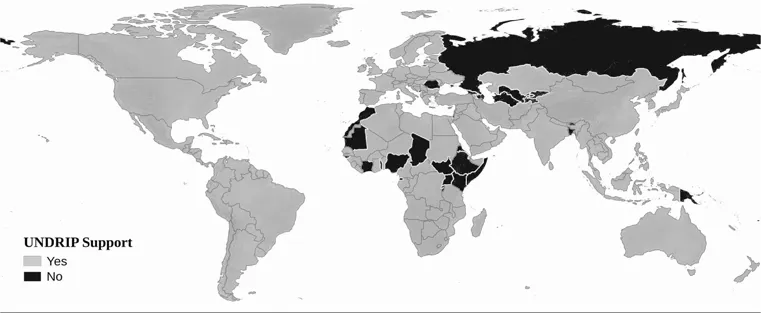
The return of human remains and ceremonial objects to their Indigenous nations of origin is today a true global movement highlighted by the 2007 adoption by the United Nations General Assembly of the Declaration on the Rights of Indigenous Peoples. The Declaration establishes minimum standards for the survival, dignity, and well-being of the Indigenous peoples of the world, and was initially adopted by 143 countries, with four votes against and eleven abstentions (United Nations 2007a). Since then, the four countries that voted against – Australia, Canada, New Zealand, and the United States – have changed their positions and endorsed the Declaration, as have three of the countries that initially abstained: Samoa, Colombia, and Ukraine (see Figure 1.1).
Article 12 of the Declaration focuses specifically on the repatriation of Indigenous human remains and ceremonial objects:
1 Indigenous peoples have the right to manifest, practise, develop and teach their spiritual and religious traditions, customs and ceremonies; the right to maintain, protect, and have access in privacy to their religious and cultural sites; the right to the use and control of their ceremonial objects; and the right to the repatriation of their human remains.
2 States shall seek to enable the access and/or repatriation of ceremonial objects and human remains in their possession through fair, transparent and effective mechanisms developed in conjunction with Indigenous peoples concerned.
(United Nations General Assembly 2007b)
Today, nearly 80 per cent of the 192 members of the United Nations have recognised the right of Indigenous peoples to access and/or repatriate their ceremonial objects and human remains, and have agreed to enable fair, transparent, and effective repatriation mechanisms. The 42 countries that have not endorsed the declaration are Azerbaijan, Bangladesh, Bhutan, Burundi, Chad, Côte d’Ivoire, Equatorial Guinea, Eritrea, Ethiopia, Fiji, The Gambia, Georgia, Grenada, Guinea-Bissau, Israel, Kenya, Kiribati, Kyrgyzstan, Marshall Islands, Mauritania, Montenegro, Morocco, Nauru, Nigeria, Palau, Papua New Guinea, Russian Federation, Romania, Rwanda, Saint Kitts and Nevis, São Tomé and Príncipe, Seychelles, Solomon Islands, Somalia, Tajikistan, Togo, Tonga, Turkmenistan, Tuvalu, Uganda, Uzbekistan, and Vanuatu.
Figure 1.1States affirming the United Nations Declaration of the Rights of Indigenous Peoples, as of 2019
The development of the global Indigenous repatriation movement did not appear fully formed on the United Nations agenda but reflects gradual shifts in fundamental legal norms of property and Indigenous rights in the 19th and 20th centuries. This chapter provides an overview of the evolution of some of these legal norms landmarked by significant legislation, litigation, and policy related to the use and control of Indigenous ceremonial objects and repatriation of Indigenous human remains in museum collections.1
The evolution of legal norms
Many of the 19th- and 20th-century legal landmarks along the evolutionary path of the Indigenous repatriation movement occurred in Australia, Canada, New Zealand, and the United States – countries sharing both a colonial expertise in subjugating Indigenous peoples and legal systems largely based on English common law. Sir William Blackstone’s four-volume Commentaries on the Laws of England (1765–1769) is the primary treatise on the 18th-century English common law traditions shared by these countries, with his second volume on the ‘rights of things’ identifying many principles applicable to repatriation. Blackstone distinguishes two types of property: real property that is permanent, fixed, and immoveable; and personal property, such as goods, money, and other moveables (Blackstone 1992 [1766]: 16). Blackstone characterised title of both real and personal property based on occupation as ‘the original and only primitive method of acquiring property at all; but which has since been restrained and abridged, by the positive laws of society, in order to maintain peace and harmony among mankind’ (Blackstone 1992 [1766]: 400). He specifically took issue with the acquisition of real estate based on conquest.
But how far the seising on countries already peopled, and driving out or massacring the innocent and defenceless natives, merely because they differed from their invaders in language, in religion, in customs, government, or in colour; how far such a conduct was consonant to nature, to reason, or to christianity, deserved well to be considered by those, who have rendered their names immortal by thus civilizing mankind.
(Blackstone 1992 [1766]: 7)
Beyond real and personal property, Blackstone also identifies a third class of items that are incapable of being subjects of property, including light, air, wild animals, and – of critical importance to the repatriation movement – the bodies of deceased human beings (Blackstone 1992 [1766]: 14, 429). The unique status of deceased human beings under English law meant that while an heir had a property interest in his or her ancestor’s gravestone or funerary objects, they had none in the body or ashes themselves and could not bring a civil action against any violation or disturbance of the dead (Blackstone 1992 [1766]: 429).
Looting the physical artifacts of a defeated people – particularly monuments, art, sacred objects, and human remains – was common military practice from ancient times. This began to change following the battle of Waterloo in 1815 when the Allies found themselves in control of a vast trove of art that had been plundered by the French forces from the Netherlands, Italy, Prussia, and Spain. Instead of seizing the collections himself, Arthur Wellesley, 1st Duke of Wellington, instead forbade his troops from looting and ordered the art collection in France to be repatriated both as restitution to the various nations of origin and in order to ‘give the people of France a great moral lesson’ (Miles 2008: 334).
Nearly fifty years later, the jurist and political philosopher Franz Lieber, who ironically had fought and been wounded at Waterloo, was asked to formalise the rules for how soldiers should conduct themselves in America’s civil war. General Order No. 100 – The Instructions for the Government Armies of the United States in the Field, also known as the Lieber Code – gave strict instructions that private property, as well as property belonging to churches, hospitals, charitable establishments, education establishments, public schools, universities, academies, and museums of the fine arts should be protected. The appropriation of money, watches, jewelry, clothing, or other valuables of prisoners was considered dishonorable and was prohibited (United States Army 1863). Lieber’s 1863 code did not address the collection by Army medical officers of specimens of ‘morbid’ (pathological) anatomy, along with projectiles and foreign bodies removed from those bodies, as was previously ordered by the US Army Surgeon General (Hammond 1964 [1862]: 12).
The Hague Conventions of 1899 and 1907 expanded the protection of private property during wartime to fifty-four nations, holding that private property could not be confiscated or destroyed, excepting arms, horses, and military papers of prisoners of war (Hague Convention 1899, 1907). The 1907 convention also included provisions requiring that, following maritime engagements, the dead of all belligerents would be protected from pillage and ill treatment. Following the devastation of the Second World War, another Hague Convention expanded wartime protections to cultural heritage – regardless of origin or ownership – including monuments, archaeological sites, buildings, art, manuscripts, books, and scientific collections (Hague Convention 1954). A blanket rule directing all belligerents in military engagements to take all possible measures to search for the dead and prevent their being despoiled was not enacted until 1949 (Geneva Convention 1949: Article 15).
Early Indigenous repatriation efforts through 1945
Despite the 19th- and 20th-century evolution in the way the property of subjugated peoples was treated, Indigenous peoples still faced many challenges in repatriating their human remains and ceremonial objects, particularly due to their lack of standing to access the courts. Repatriations during this period were largely isolated occurrences driven primarily by the persistence of Indigenous individuals.
One of the earliest efforts by Indigenous peoples to repatriate human remains from European colonists was initiated in 1830 when a Māori chief appealed for the return of the heads of fourteen Māori in the possession of the skipper of a Scottish schooner that had recently arrived in Sydney harbour from New Zealand (see Fforde et al., Chapter 19, this volume). Māori of chiefly rank traditionally marked rites of passage and significant events with facial tattoos, and upon their death their heads were preserved and kept by their families or, if taken in battle, by their enemies. With the arrival of Europeans in New Zealand, preserved heads entered into commercial trade, particularly in exchange for firearms, and the spiralling arms escalation that resulted led tribes to acquire additional heads by tattooing the heads of their slaves and prisoners as well as launching military raids on other tribes. In 1830, a crewman on the schooner Prince of Denmark acquired fourteen preserved heads in Tauranga that were reportedly taken from men slain in a battle 300 kilometres away at the Bay of Islands. One of the Bay of Islands chiefs was dispatched to Sydney to personally seek redress. On 16 April 1831, the governor of New South Wales issued a government order to stop the import of such heads into Sydney and which directed the crew member and all others in possession of Māori heads to deliver them up to be returned to the relatives of the deceased (McLeay 1831: 2 and see Fforde et al., Chapter 19, this volume). The fourteen heads were apparently returned (‘The human head trade’ 1831: 2), and the chiefs of the Bay of Islands tribes launched a retaliatory raid on the Tauranga tribes and vowed to shoot the Prince of Denmark skipper on sight (‘New Zealand’ 1831: 2).
One of the most protracted early efforts by Indigenous peoples to repatriate cultural property was initiated in the 1890s by the Six Nations Confederacy of the Cayuga, Mohawk, Oneida, Onondaga, Seneca, and Tuscarora in the United States and Canada. At issue were a number of wampum belts, woven strips of cylindrical white or purple shell beads, used by the confederacy to memorialise significant agreements and traditionally kept by a designated Onondaga leader for the confederacy as a whole. The American Revolution precipitated a split within the confederacy as groups chose to ally themselves with the American or the British causes. With the American victory, many Loyalist communities resettled from the United States to the Six Nations Reserve in Ontario, Canada, and the confederacy belts were divided between the American and Canadian communities. In 1891, the wampum keeper in New York was persuaded to sell four belts, which were ultimately acquired by John Boyd Thacher, the mayor of Albany, New York (Fenton 1971: 450). When the wampum keeper in Ontario died in 1893, his heirs assumed control of the wampum and began to sell pieces to museums. The two Indigenous communities in the United States and Canada quickly tried to recover the belts, which they believed had been illegally alienated (Fenton 1989: 403).
In New York, the Onondaga Nation filed suit in 1897 to recover the four belts that had been sold by the wampum keeper to John Thacher (‘Thacher’s wampum demanded’ 1897). The following year, anticipating a determination by the court that the tribe lacked legal standing to sue and realising eight other belts were in danger of being dismantled or lost, the Onondaga identified the University of the State of New York as the wampum keeper and, by bill of sale, sold and transferred all interest in the wampum (‘Onondaga wampum belts’ 1899). The State of New York, in turn, enacted legislation in 1899 identifying the university as the wampum keeper with authority to acquire additional wampum to which the Six Nations Confederacy was entitled. Though the university joined the Onondaga’s suit to recover the four belts, the case was ultimately dismissed, with the court ruling that while the wampum keeper had authority to sell the four belts, the Onondaga Nation did not have authority to unilaterally select the university as wampum keeper (Onondaga Nation v. John Boyd Thacher 1899).
In Ontario, the confederacy was successful in gaining the return of several belts in 1894, but others continued to be sold by the late wampum keeper’s heirs despite a reward posted by the confederacy for their return. In 1909, the confederacy requested the assistance of the governor general of Canada in securing the return of the belts, but when in 1915...
Table of contents
Cover
Half Title
Title
Copyright
Dedication
Contents
List of contributors
List of figures and tables
Foreword
Introduction
Part 1 A global movement: repatriation reflections from around the world
Part 2 Networks of removal: understanding the acquisition of Ancestral Remains in the long nineteenth century
Part 3 Repatriation methods in research and practice
Part 4 Restoring dignity
Index
Trusted by 375,005 students
Access to over 1.5 million titles for a fair monthly price.
Study more efficiently using our study tools.
Frequently asked questions
Yes, you can cancel anytime from the Subscription tab in your account settings on the Perlego website. Your subscription will stay active until the end of your current billing period. Learn how to cancel your subscription
No, books cannot be downloaded as external files, such as PDFs, for use outside of Perlego. However, you can download books within the Perlego app for offline reading on mobile or tablet. Learn how to download books offline
Perlego offers two plans: Essential and Complete
Essential is ideal for learners and professionals who enjoy exploring a wide range of subjects. Access the Essential Library with 800,000+ trusted titles and best-sellers across business, personal growth, and the humanities. Includes unlimited reading time and Standard Read Aloud voice.
Complete: Perfect for advanced learners and researchers needing full, unrestricted access. Unlock 1.5M+ books across hundreds of subjects, including academic and specialized titles. The Complete Plan also includes advanced features like Premium Read Aloud and Research Assistant.
Both plans are available with monthly, semester, or annual billing cycles.
We are an online textbook subscription service, where you can get access to an entire online library for less than the price of a single book per month. With over 1.5 million books across 990+ topics, we’ve got you covered! Learn about our mission
Look out for the read-aloud symbol on your next book to see if you can listen to it. The read-aloud tool reads text aloud for you, highlighting the text as it is being read. You can pause it, speed it up and slow it down. Learn more about Read Aloud
Yes! You can use the Perlego app on both iOS and Android devices to read anytime, anywhere — even offline. Perfect for commutes or when you’re on the go. Please note we cannot support devices running on iOS 13 and Android 7 or earlier. Learn more about using the app
Yes, you can access The Routledge Companion to Indigenous Repatriation by Cressida Fforde, C. Timothy McKeown, Honor Keeler, Cressida Fforde,C. Timothy McKeown,Honor Keeler in PDF and/or ePUB format, as well as other popular books in Social Sciences & Museum Studies. We have over 1.5 million books available in our catalogue for you to explore.