- 160 pages
- English
- ePUB (mobile friendly)
- Available on iOS & Android
eBook - ePub
About this book
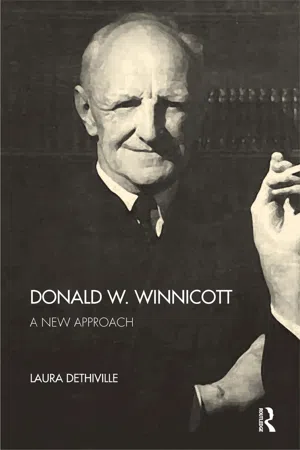
Winnicott was continually innovating, inventing, and proposing unexpected solutions in his analytical work whenever he noticed that clinical experience "didn't stick to the theory". This approach can make his work seem rather diffuse, with concepts that are sometimes confusing and needing to be clarified. Laura Dethiville has taken on the task of re-evaluating and explaining the principal rudiments of his theories, such as the transitional object, the self, the false self, the importance of environment, and dissociation. She also reveals how Winnicott showed himself to be a forerunner in the care of symptomatic illness in our society, including his innovative treatment of loss of identity, anorexia or bulimia, delinquency, psychosomatic illness, and school disorders. In this book the author has succeeded in avoiding psychoanalytic jargon and, although initially aimed at psychoanalysts, it is also accessible for educators, child carers, paediatricians, and to all those interested in early childhood, the constitution of the psyche, and the constitution of the interpersonal link.
Information
CHAPTER ONE
Winnicott today
In France there is a deep misunderstanding of Donald W. Winnicott. He is well known, in fact extremely well known, but at the same time not completely understood. His work was met with considerable interest in the 1970s, due to the success of the concept of the transitional object. But this success fell flat, not without some damage. Flat is the word, since his ideas were completely squashed. For the most part, his work was either politely ignored, or considered banal, uninteresting, and meaningless. Winnicott today is referred to even by those not hostile to his ideas as “the nice man who has worked on the mother-baby relationship, and with children, and who says that he does not need to call on the death instinct theory in his work.”
And so it was for many years, and then things changed. At the moment, Winnicott is back in fashion. His ideas are being taken up by psychoanalysts from different schools of thought, and he seems to be approved of unanimously by these different trends, which in turn poses numerous questions. Personally, I feel that most of the time his work is the object of a misunderstanding. He is forever being quoted, several of his concepts are taken up as slogans, and at the same time, it is not sure that we fully estimate the upheaval that he has brought to both the theory and the practical sides of therapy. Although reference is abundantly made to his work, it remains largely unknown. We have to admit that the essential parts of his work have only recently been translated into French, work which was published after his death, and which marks the final progress of his thought.
Winnicott died at the age of seventy-four from a heart condition, shortly after supervising the publication of Playing and Reality (1971a). He left behind an impressive amount of unpublished material, which has been gradually published by the Winnicott Trust and the Winnicott Publications Committee.
Clinical learning
Winnicott was a demanding analyst, difficult, inventive, and— which is less usual—capable of revising his ideas as a consequence of interaction with a patient, accepting it, allowing himself to be challenged in his established theoretic certainties. The dedication of Playing and Reality: “To my patients who have paid to teach me”, reveals his openness, his extraordinary faculty of acceptance. In “A personal view of the Kleinian contribution” (1962a), he recounts how he realised very early on in his consultations with children that, as opposed to the traditional theory that the origin of neurotic fixations stemmed from the Oedipus complex, “there was something somewhere which was not right”. He encountered children [infans] who showed very precocious symptoms in their life. And he confided: “I’m going to show that infants are ill very early and if the theory doesn’t fit it, it’s just got to adjust itself. So that was that” (Winnicott, 1967c, p. 575).
We have equally at our disposition a short piece, written in 1967: “D.W.W. on D.W.W”. This text is the transcription of an informal talk given at the Club 52, a small group of analysts who used to meet far from the “Controversies” of the British Society of Psychoanalysts. We can feel Winnicott is relaxed, at ease, almost intimate, discussing with his close colleagues, having reached a time in his life when he feels calm and sure of his opinions. With great humility and simplicity he describes his experimentations and the long period of clinical proof which he needed to integrate certain facts. For example, he says, “It took me three or four years to come to the simple fact that there are two sorts of deprivation” (ibid., p. 575).
During the course of this talk, he pronounces a touching phrase concerning his formation and its course. He asks, “So when did I start to wake up a little?” (ibid., p. 575)—a phrase which alludes to the way in which he had to unlearn everything he “knew”, to be able to be himself.
He worked until his dying day to complete the theory that had emerged throughout the years from his clinical experience. It shows continually evolving, original and creative thought (just as he had the same idea of a constantly evolving subject). This is perhaps why the sense of his concepts constantly evolved between the beginning and end of his work. For this reason we should remain extremely vigilant to avoid confusion, and it is not certain that he himself was not occasionally confused.
A scattered corpus
Winnicott’s work is therefore not easy to approach. Talking about his work he observes: “it has meant that what I’ve said has been isolated and people have had to do a lot of work to get at it” (ibid., p. 575). It is a wonderful comparison that warns us that we may have to work hard at it. First and foremost his work is bitty, composed of small articles often aimed at very different audiences. He loved to address very different types of audience, and he adapted his style accordingly, refusing to use meta-psychological terms as often as possible.
The books that have been published try to put together these articles and lectures in a logical fashion. His sole attempt to standardise an atomised corpus appeared in Human Nature (1988), a large part of which he wrote in 1954, completing a second synopsis around 1957, and which he was continually reworking until his death.
Therefore we have an unfinished version at our disposal, a version complete with his handwritten notes. We really do not know exactly what he would have wished to keep.
The difficulties of translation
The paradox of this man, gifted with great inventiveness, inclined to create his own concepts, his own metaphors, skilful at invention and play on words in English, was that he could also be very “conventional”—even compliant—in his use of terminology. In particular he conforms to the psychoanalytic vocabulary in use at the time, but imparts a very subtle difference. As he explains himself, “The invention of a new word would have been less easily justified than the treatment of an already existing word with a splash of paint” (Winnicott, 1935, p. 129). But as I mentioned above, this “splash of paint”, however imperceptible, can lead to a real “misunderstanding”, if we read too hurriedly.
Last but not least, the translation of this very personal language poses great difficulty. We often have to resolve not to translate, or need to turn a phrase into something which may sound clumsy, but which is closer to the English sense. With the problem of translating from one language to another and the confusion created by Winnicott’s lack of precision, it is often difficult to make sense.
For example, take the concepts of “ego”, “self”, and false self. All his life Winnicott used “self”, “ego”, “psychic reality” or “psyche” indifferently and with little precision (this adds to the difficulties when translating his work into French), and it is only in the last ten years of his life that he really refined his position.
First we must remember that the English have chosen to translate the German ich as ego, a subjective pronoun in a dead language which does not render the subjectivity represented by the ich in German and the je in French.
In his texts Winnicott uses either ego or me in a very defined way. Me is a term he uses to indicate the idea of an internal subjective experience, whereas ego is the subject talking, the conscious “me”—and this, again, causes complications in a French text where “moi” is used in both cases.
Moreover, in a letter to his translator concerning the difficulties she has in translating the word “self”, he writes: “the self which is not the ego”, which we generally find translated as: “le self qui n’est pas le moi”. Further in the same text, he uses me in a completely different sense, and he has no option but to translate it once more as “moi”. In the face of such difficulty, certain translators chose to cite the English term in brackets. Thus in the excellent translation of Human Nature, when Winnicott mentions the differentiation between the “moi” and “nonmoi”, the translator goes to the trouble of indicating that in the text, Winnicott uses me and not-me, and not ego.
These notions of self, false self, and ego, so essential to Winnicott, are of an extremely important subtlety. When we study his work closely, and in spite of contradictions, we find that the “me”, the “ego” is an organising principle of the “self”, but only a part, the “self” being composed of interpenetrating parts. We will come back to this later.
In fact, we find that he leads us into quite another metapsychology, different from the Freudian meta-psychology, a metapsychology which shakes the classical theory. It is perhaps for this reason that it is preferable to keep to a certain approximation. Otherwise Winnicott’s observations could appear “rather shocking”.
On another level, the simplicity with which Winnicott recounts certain things makes them seem so evident that we get the impression we have always known them. This familiarity is in fact a trap.
This simple, almost concrete language can create the illusion of immediate comprehension, but it is only an illusion. In fact it is terribly complex, and we have to admit that sometimes it is difficult to understand. One of his famous phrases has been endlessly quoted. He pronounced it after a Working Party at the British Society in 1942, (and only wrote it down a decade later) when he had been particularly annoyed by what he had heard: “There is no such thing as a baby” (Winnicott, 1952a, p. 99) which can be roughly translated as “A thing that we call a baby doesn’t exist”, which is to say that we cannot speak about a baby without also considering the environment he is part of, who is carrying him, looking at him, the voice surrounding him, the transitional space he creates, etc. This will be the major originality of his findings and his important stroke of genius. He gradually comes to understand the mechanisms at work in what we call the constitution of human psyche, beginning with an infant-environment entity from which the human being can slowly develop his identity.
He thus describes the way to access subjectivity in our relationship to the other (other and the Other).
The "good enough" mother and the importance of environment
We should break off here to consider the misunderstanding of the term “a good enough mother”. I insist on this because it seems that the expression has had a prejudicial effect on the way the French approach Winnicott. It has become a kind of slogan in psychoanalytical language. And this idea of a mother who is “good enough”—Winnicott’s often talked about “good enough mother”—has altered our understanding of what Winnicott has brought to a rather silly psychologism, concerning the illusion of a possible appropriateness of the mother to the needs of the child, appropriateness which remains the ideal mother–child relationship. In this way Winnicott has been accused of making mothers feel guilty.
When Winnicott uses the expression “good enough mother” there is no problem in English. “Good enough” is that which is “just good”, “passable”,1 “just enough”, no more. For him the good enough mother is just an ordinary mother, adequate, nothing else. On the 31st July 1969 he wrote to Helm Stierlin: “You use the words good experience. It is important to me that in my writings I always say good-enough rather than good. I think that the words good-enough help to steer the reader away from sentimentality and idealisation” (Winnicott, 1987a, p. 195).
Winnicott always resists any sentimentality, since sentimentality seems to him to go hand in hand with a certain misunderstanding of hate—which risks bringing dire consequences. At the end of his life he preferred to use the term mother-environment, and he spoke generally of an environment that includes the “others” of the mother, particularly the father, but also the family, social reality, etc. The environment, the mother-environment, at that point, is for him a function even if it is also a subject. The child [infans] is not conscious of this environment. It is taken for granted. It is unknown and will probably never be known. It can only be known negatively, as something lacking.
In fact the environment only becomes apparent when it is missing. The essential principle is that by a good enough adaptation to his needs, the individual can “be” and does not have to know anything about the environment. We do not remember about being held. We keep trace in our memory of the experience of having been dropped.
What is so particular about Winnicott is that he thought about the way in which “an environment we can rely upon allows us to establish a place to retire to, to simply be” (Winnicott, 1960a, p. 37).
And he was often criticised for having reintroduced into psychoanalysis the idea of “being”, and “going on being”, in the manner of phenomenological philosophers. In an environment that holds correctly, the baby is able to accomplish a personal development according to his “inherited potential”. He experiments a “continuity of being” which eventually transforms into a feeling of existing, a sentiment of unified self, and he comes to what Winnicott calls unit-status, that is, an individual who comes to successful indwelling. Therefore the mother does not have to be “good” but simply “fair”. He states that a mother who is too good has a devastating effect on the child: “In this way the mother, being a seemingly good mother, does something worse than castrate the infant. The latter is left with two alternatives: either being a permanent state of regression and of being merged with the mother, or else staging a total rejection of the mother, even of the seemingly good mother” (Winnicott, 1960a, p. 51).
On the other hand, Winnicott always insists that the baby has his own activity. He immediately acknowledges the baby’s ability to catalogue, sort out, etc. and thus to think, a capacity to think which is present from the beginning. In this sense, he is a precursor, closely followed today, for example, by Daniel Stern and his work, and his hypotheses are currently totally confirmed.
The majority of Winnicott’s views should not be taken up in the psychological perspective of “good” or “bad” mothering, but from the point of view of a tiny human being who comes into the world endowed with the power to organise his world, a world which he is going to have to face to make it his own (according to Roustang, 1994. This is Winnicott’s “found–created” which we will come to later.) And this world (including himself) is presented to him by his environment, an environment he is part of. (It is from the other that the meaning will come. From the start, everything is mediatised.)
This relationship to the other takes place in the transitional space, a fantastic discovery by Winnicott, a space neither inside nor outside and where all we ask is to exist, a space in-between, which becomes the place to relate to the world, the place in fact of a creative perception (apperception) of the world. For there is no other relationship to the other or to the world than in this found–created space.
Ruthless/ruthlessness
Ruthless is an old English word which does not mean “cruel”, but rather “disregarding the other, having no compassion”. Winnicott uses this term when he speaks of the period before what he calls “the stage of concern”, which corresponds more or less to the “depressive position” of Melanie Klein. At that precise moment, he says, the infant is ruthless. He also talks about his ruthless love. He says that an infant can seem without regard for the other, but simply because at that moment the other has not materialised as such! Moreover Winnicott’s vocabulary here is very precise. He does sometimes use the words “cruel” and “cruelty”, but it is always in connection with adults, either in environment or observation. Therefore the newborn is not cruel, he is without regard.
This is a very important point, since we often see confusion or an amalgam with Melanie Klein’s the “cruel infant”. Winnicott’s views dissociate clearly and decisively from the Kleinian position. The infant will go from the “pre-ruth” stage to the “ruth” stage. It i...
Table of contents
- Cover
- Half Title
- Title
- Copyright
- Dedication
- Contents
- ACKNOWLEDGEMENTS
- ABOUT THE AUTHOR
- INTRODUCTION
- CHAPTER ONE Winnicott today
- CHAPTER TWO The man and his life
- CHAPTER THREE Transitional objects and transitional phenomena
- CHAPTER FOUR The importance of the environment
- CHAPTER FIVE The baby is a person
- CHAPTER SIX The self
- CHAPTER SEVEN The false self
- CHAPTER EIGHT Psycho-somatic illness and communication
- CHAPTER NINE Splitting and dissociated elements
- CONCLUSION
- REFERENCES
- INDEX
Trusted by 375,005 students
Access to over 1.5 million titles for a fair monthly price.
Study more efficiently using our study tools.
Frequently asked questions
Yes, you can cancel anytime from the Subscription tab in your account settings on the Perlego website. Your subscription will stay active until the end of your current billing period. Learn how to cancel your subscription
No, books cannot be downloaded as external files, such as PDFs, for use outside of Perlego. However, you can download books within the Perlego app for offline reading on mobile or tablet. Learn how to download books offline
Perlego offers two plans: Essential and Complete
- Essential is ideal for learners and professionals who enjoy exploring a wide range of subjects. Access the Essential Library with 800,000+ trusted titles and best-sellers across business, personal growth, and the humanities. Includes unlimited reading time and Standard Read Aloud voice.
- Complete: Perfect for advanced learners and researchers needing full, unrestricted access. Unlock 1.5M+ books across hundreds of subjects, including academic and specialized titles. The Complete Plan also includes advanced features like Premium Read Aloud and Research Assistant.
We are an online textbook subscription service, where you can get access to an entire online library for less than the price of a single book per month. With over 1.5 million books across 990+ topics, we’ve got you covered! Learn about our mission
Look out for the read-aloud symbol on your next book to see if you can listen to it. The read-aloud tool reads text aloud for you, highlighting the text as it is being read. You can pause it, speed it up and slow it down. Learn more about Read Aloud
Yes! You can use the Perlego app on both iOS and Android devices to read anytime, anywhere — even offline. Perfect for commutes or when you’re on the go.
Please note we cannot support devices running on iOS 13 and Android 7 or earlier. Learn more about using the app
Please note we cannot support devices running on iOS 13 and Android 7 or earlier. Learn more about using the app
Yes, you can access Donald W. Winnicott by Laura Dethiville in PDF and/or ePUB format, as well as other popular books in Psychology & Developmental Psychology. We have over 1.5 million books available in our catalogue for you to explore.