- 296 pages
- English
- ePUB (mobile friendly)
- Available on iOS & Android
eBook - ePub
About this book
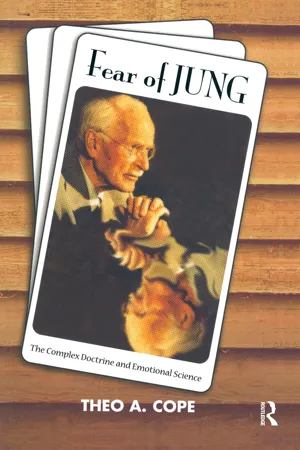
The current neuroscientific research in the field of emotion studies highlights a paradigm of scientific research that must be categorized as functional science. As functional science, the neuroscientific theory of the "neuron doctrine" combined with a Jungian theory of the "complex doctrine" hold significant potential for a natural human science and a psychological study of affectivity. Though researchers utilize psychological constructs similar to those proposed by Carl Jung, there appears to be a "fear of Jung," that is, a professional fear of invoking Jung's name or his psychological research. One familiar with Jung's works notice similar terminology, ideas, and even conclusions. The marginalization and neglect of Jung's psychological insights from a serious "empirical-scientific" approach to psychology is due to many factors. Jung did not reduce psychological experience to the body or brain; a reductive science does not consider seriously the reality of the psyche. This work is an initial contribution to a psychological and neurological study of personal emotional experience.
Information
CHAPTER ONE
Introduction
"A science which finds itself in the situation of being unable to advance without going back and revamping its principles is a science which lives at every moment. It is living science, and not simply an office, that is, it is science with spirit. And when a science lives, i.e. has spirit, the scientist and the philosopher meet in it... because philosophy is nothing but intellectual spirit and life"
(Zubiri, 1981, p. 269)
Scientific understandings with the imperative of hypothesis formation based upon empirical research have given modern humanity great insights into our world. It moves forward, some argue, by verification or falsification of hypotheses. Thoughts and ideas held by earlier generations of scientists have been set aside, rethought, revisioned, and replaced with new insights and models. The older theories do not cease; they are merely preserved as historical facts or built upon. Perhaps the authors' findings are superseded, ignored, discounted, or consigned to the periphery. They may become central ideas that spawn successive and fertile discoveries and become firmly held conclusions. Often, earlier scientific thoughts exist in functional relationship to later ones; the successors strive to support, improve, or undermine earlier theories. Some lie in obscurity to be later dredged up and re-presented for consideration. Sometimes the concepts used to understand a phenomenon undergo fundamental shifts with the development of new methods and technologies. Surely, some manners of conceiving phenomena need to be laid quietly to rest, others to be vociferously quelled.
However, a serious reconsideration of a previous understanding is sometimes mandated for scientific views. This is the case in the fields of psychology, especially that of emotion studies, post traumatic stress disorder (PTSD), and psychotherapy. There have been reconsiderations of Sigmund Freud's neurological works, and Pierre Janet's contributions to trauma. I propose to reconsider the emotional "complex doctrine" advocated by Jung. These late nineteenth, early twentieth century explorers of the human psyche knew each other and influenced each other. Their ideas erected part of the foundation of modern understanding of psychology; this was at a time that psychology referred to psyche.
Each subsequent author has her or his own motivations for such a revisiting, in part motivated by a respect for the earlier thinker, and a desire to propel psychological understanding forward by looking backward. In this, a Janus-faced stance is taken. Janus, the Roman two-faced god of doors, with one face peering forward, the other rearward, proffers an apt image for this posture. In order to move science forward, if we do not look backward we may forget the roots. The roots of psychology are in the psyche. My motivation for reconsidering Jung is not academic; it is psychological. As such, the imperative to produce clarity of thought by lucidity of expression looms clearly before me. In the fields of academic psychology, emotion studies, as well as PTSD, it appears that the mention of Jung is anathema. We find concepts that are parallel, terminology that is similar, but the mention of Jung is clearly absent, except as a relic. What is the cause of this fear of Jung? Maybe we can discern no causal reasons, but there are functional reasons.
Academic psychology to a great extent has ignored the psychological works of Jung. The reasons for such neglect are myriad. Some must be placed upon the shoulders of Jung himself, other reasons rest with his successors. Jung's approach to the science of the psyche was energic, as was Charcot's, Janet's, Wundt's, Freud's, and many of the thinkers of the late nineteenth century. Jung's psychological and intellectual forays led him into arenas of thought that many consider unscientific, even ascientific. Almost one century ago, from 1904 to 1910, Jung was an intern at the Burghölzi Psychiatric Institute in Zurich, Switzerland. His entry into the nascent field of psychiatry was by means of the Word Association Test (WAT), originally begun by Wundt. Jung performed hundreds of carefully documented empirical studies into the psychic dimension of hysteria, neurosis, dementia praecox (schizophrenia), and other psychogenic maladies. Like others during this time, Jung was following contemporary nineteenth century scientific practices and interpretive methods. Unlike many of his contemporaries, Jung never lost the energic view of psyche. Empiricism changed and the field of reference in psychology was restricted; Jung held steady and expanded his views.
His scientific undertakings encompassed many approaches; all are embedded within a broad empiricism of theoretical, experimental, and applied human sciences. His theoretical views did not remain European, though his interpretations frequently remained so. The experimental aspect was not just with the WAT, but also upon himself, prompted by the needs and experiences of his patients as well as his personal demands. The applied component was in therapeutic settings during formative stages of psychiatry. The dreams, images, and psychotic stories of his patients could find symbolic resonance with many elements of Native American, Chinese, Indian, and other Asian myths, philosophies, and religious views. The psychotic and neurotic dreams and fantasies were not just European, but human. Often he lamented his inability to comprehend the stories of his patients, and other scientists' inability to comprehend his findings. Jung's approach to psychology cannot be easily categorized and academia appreciates compartmentalization more than eclecticism.
One central feature of Jung's psychology that must be acknowledged up front is its subjective nature. While scientists of today are becoming more comfortable with the subjective factor in their scientific observations of objective phenomena, due to the impact of feminist and postmodern philosophies, Jung avowedly asserted the personal element. In 1929, he wrote:
... philosophical criticism has helped me to see that every psychology—my own included—has the character of a subjective confession. And yet I must prevent my critical powers from destroying my creativeness. I know well enough that every word I utter carries with it something of myself—of my special and unique self with its particular history and its own particular world. Even when I deal with empirical data I am necessarily speaking about myself.
[1929a: par. 774]
To acknowledge the subjective dimension of psychology serves to admit the inevitable factor: the human and personal factor. A purely objective science is an illusion, now clearly seen as such. During Jung's formative years, it was assumed to be a possibility. Jung knew the fallacy of such a proposal and admitted it frequently.
This clearly enunciated declaration, however, does have some important ramifications when we carefully scrutinize any facet of Jung's psychology. While the individual is a representative of the species, it is either the uniqueness of the individual we can focus upon or the similarity. Any personal confession has profound resonance with the species to a greater or lesser degree. We are not isolated from the environments we inhabit, or the times we develop within. Our experience is unique; the influences we receive are personal and collective. Jung was striving to forge an approach to psychology that was scientific, and at the same time trying to make sense out of his personal fragmentation and that of his many patients and clients. His development in the field of psychology was influenced by many sources. We will observe the tension in Jung's thoughts as a result of this pluralistic heritage.
What is important to grasp in Jung's (and Freud's) approach to the science of psyche was the traditional Germanic approach to science. Unlike current views, unlike English-speaking positions of natural science and a reductive empiricism, the German pioneers took a stance that was a more expansive empiricism. Bruno Bettelheim wrote Freud and Man's Soul (1982). In this important work he draws our attention to the Germanic understanding of scientific discovery. There were two approaches: natural science (Naturwissenschaften), and what can only imprecisely be translated as spiritual science, or life science (Geisteswissenschaften). This is akin to the notion of verstehen, or "understanding through empathy", advocated by the German sociologists Dilthey, Droysen, and Rickert. The natural sciences could be unempathic, while the human sciences demanded empathic connection. Both methods were "accepted as equally legitimate in their appropriate fields, although their methods hardly have anything in common" (Bettelheim, 1982, p. 41). Jung comments on these two sciences in his lectures on education given in 1946.
Freud and Jung straddled these two sciences, attempting to maintain balance between the spiritual component of psyche and the physical component; it was accomplished conceptually by the unconscious (Jung, 1935b, par. 126). Jung's psychology maintained this integrative approach, and his empiricism included not just experimentation, but also documentation. However, it is critical that we remember that for Jung the unconscious was a hypothesis, referring to the unknown psychic (1917/1954, pars 370; 382) and a psychological concept; "As a matter of fact, the concept of the unconscious is an assumption for the sake of convenience" (1938— 1940, par. 64). However, he never relinquished this hypothesis and distanced himself from those who did.
Jung called his contribution to this nascent science Analytical or Complex Psychology. This method was composed as a psychological system; in order to grasp Jung's views we need to take a systems view and see each part in relation to the entire structure. In 1927, he defined his contribution thus: "What I mean by this term is a special trend in psychology which is mainly concerned with complex psychic phenomena, in contrast to physiological or experimental psychology, which strives to reduce complex phenomena as far as possible to their elements" (1928/1931, par. 701). Moreover, it is premised upon a dialectical process that demands relationship. It is "fundamentally a natural science, but it is subject far more than any other science to the personal bias of the observer" (1963, p. 200).
This personal dimension becomes highly significant as I unfold and present Jung's experience of and understandings about emotional complexes. Emotions are complex phenomena; Jung approached them from the point of view of their complexity in the human psyche. Jung's line of inquiry was psychological.
Psychology, as an emerging discipline, had to extricate itself from philosophy. It did so in part by entering the minds of the ill: psychotics and neurotics, hysterics and paranoiacs.
Its development parallels the industrial revolution, positivism, nationalism, secularism, and all that is characterized as the "nineteenth century mind". Our language represents more specifically the academic and medical mind of the nineteenth century. Psychology and psychopathology are children of the late Enlightenment, the hopeful Age of Reason as it hardened into an Age of Matter.
[Hillman, 1972, p. 125]
Though its origin was in philosophy, the current philosophy of psychology is seldom discussed, unless the focus is such a philosophy. Beginning in philosophical speculations, then expanding into explorations of mental illness, we find two of the developmental phases of dynamic psychology.
Jung was a pioneer. From this foundational period Jung and his followers maintained the energic position; to set it aside would undermine the entire structure erected upon it. How could one talk about libido, archetypes, affect, projection, transference, psyche, or complexes without an energic concept? Complex, Analytic, or Depth Psychology, as Jung's contribution is called, implicitly views the psyche as psyche, not as mind nor brain states. This alone serves to separate Jungians from academic and physiological approaches to psychology. Perhaps detrimental to the widespread acceptance of Jungian thought is the fascination of many neo-jungians with the image: mythological, archetypal, symbolical, alchemical, artistic, and literary. These approaches to psychological understanding may have served to alienate, more than integrate, diverse views. Jungian psychology also dominantly focused upon the archetypal point of view, a construct difficult to explore or support in a reductive empirical view. It traditionally overlooked the body in its propensity to look over the image.
In 1969, eight years after Jung's death, British psychiatrist John Bowlby (1982, 1988) offered a conceptual framework that remains used today in some approaches to psychology, most especially attachment theory. "In place of psychical energy and its discharge, the central concepts are those of behavioral systems and their control, of information, of negative feedback, and a behavioral form of homeostasis" (1982, p. 18). The energic model, he asserted, prevented an integrative thrust for modem scientific understanding and served as a barrier; besides, it is untestable empirically. In addition, Bowlby replaced the psychoanalytic concept of "internal object" with a dynamic construct of "internal working model". Knox (2003) and Schore (1994) see this as a viable replacement to harmonize with the cognitive approach, and I concur. It is also conceptually homologous to Jung's complex doctrine.
Current terminology of neurobiological or psychophysiological disciplines provides new language to explain and study the same phenomena: neuromodulators, neurotransmitters, protein synthesis, neurochemical understandings of emotional processing, long term potentiation (LTP), dealing with trauma and brain. These are conceived to be information systems, also systems of energic transformation. Electrochemical energy is converted into neurochemical energy, which results in conscious awareness, another form of information and energy.
Jung himself avowed that two central constructs he used were merely "auxiliary ideas", these are the "concept of the archetype or of psychic energy ... which can be exchanged at any time for a better formula" (1952a, par. 460). Shamdasani (2003) dedicates Chapter Three, "Body and soul", to an explication of Jung's notion of libido and instinct and places it in historical relief. His explication reveals clearly how a reconnection of Jung's libido concept with instinct is warranted. Furthermore, the concept of archetype is undergoing re-thinking as well (Knox, 2001,2003,2004; Saunders & Skar, 2001; Skar, 2004), in line with Jung's own proposal. If Knox had drawn attention to this "auxiliary idea" passage, her stance might have been strengthened by Jung's own admission.
Energy exchanges in the body are electro-psycho-neuro-biochemical processes; exchanging the psychological concept of energy for a better formula is an intellective one. In this work, I shall not utilize these two auxiliary ideas of Jung much, though I acknowledge their continued usage within Jungian psychology. When I cite these ideas it is to be congruent with Jung's own schema. In fact, I affirm that Bowlby's contribution of instinctive behaviour holds great value here, in as much as Jung's notion of libido has affinity with instincts as well as affects. Jung asserts, "Thus affects are as much instinctive processes as they are feeling processes" (1921, par. 765); he affirmed, "Instincts are, however, as has been said, specific forms of energy" (1928c, par. 51). Again, "the psychological concept of energy is not a pure concept, but also a concrete and applied concept, that appears in the form of sexual, vital, mental, moral 'energy'; in other words it appears in the form of instinct..(ibid., par. 52). This rendering with "instinct" comes from the Baynes translation, while the Hull version renders these sentences using the term drive. Historically it was assumed that animals have instincts, but humans have drives, though functionally these are the same. While other psychologists linked instinct with affects as well, Jung extended instincts to include images (1947/ 1954, par. 414).
In psychoanalytic fields, Gedo (1999) highlights many thinkers who reframe or abjure Freud's concept of psychic energy as being vitalistic, dualistic, and untenable. However, Schore (1994) argues forcefully for retaining it, in as much as information theory and neurobiological discussions utilize "the energy concept [which] is purely heuristic" (p. 538).
In this work I refrain from adopting Jung's theory of psychic energy, i.e., libido; it needs reconceptualizing, I submit. It has affinity not so much with Freud's conceptualization, but more with Bergson's philosophical notion of élan vital (Jung, 1916, par. 568; Shamdasani, 2003).
Perhaps it is wise to let Jung's concept of the affective based psychological complexes remain limited to the approach that persists in following an "outdated" energic construct. Like the earlier scientific views of phrenology, phlogiston, or ether, maybe the theory of psychological complexes should be laid to rest. We have, after all, progressed so far in our empirical approaches to the brain-body connection that the field of psychoneuroimmunology has developed. Ill...
Table of contents
- Cover
- Half Title
- Title
- Copyright
- Contents
- Dedication
- ABOUT THE AUTHOR
- Overture: nature of the problem under consideration
- CHAPTER ONE Introduction
- CHAPTER TWO Philosophy first, not first philosophy
- CHAPTER THREE Ruminations on the psyche
- CHAPTER FOUR Jungian complexes in perspective
- CHAPTER FIVE Discussion of Jung's emotional complex doctrine
- Intermezzo: the complex brain nuclei
- CHAPTER SIX A complex consideration
- CHAPTER SEVEN The complex and post traumatic stress disorder
- CHAPTER EIGHT A complex integration: rethinking Jung's complex doctrine
- A functional finale. Philosophy last, not "last philosophy": towards a natural human science of psychology
- REFERENCES
- INDEX
Trusted by 375,005 students
Access to over 1.5 million titles for a fair monthly price.
Study more efficiently using our study tools.
Frequently asked questions
Yes, you can cancel anytime from the Subscription tab in your account settings on the Perlego website. Your subscription will stay active until the end of your current billing period. Learn how to cancel your subscription
No, books cannot be downloaded as external files, such as PDFs, for use outside of Perlego. However, you can download books within the Perlego app for offline reading on mobile or tablet. Learn how to download books offline
Perlego offers two plans: Essential and Complete
- Essential is ideal for learners and professionals who enjoy exploring a wide range of subjects. Access the Essential Library with 800,000+ trusted titles and best-sellers across business, personal growth, and the humanities. Includes unlimited reading time and Standard Read Aloud voice.
- Complete: Perfect for advanced learners and researchers needing full, unrestricted access. Unlock 1.5M+ books across hundreds of subjects, including academic and specialized titles. The Complete Plan also includes advanced features like Premium Read Aloud and Research Assistant.
We are an online textbook subscription service, where you can get access to an entire online library for less than the price of a single book per month. With over 1.5 million books across 990+ topics, we’ve got you covered! Learn about our mission
Look out for the read-aloud symbol on your next book to see if you can listen to it. The read-aloud tool reads text aloud for you, highlighting the text as it is being read. You can pause it, speed it up and slow it down. Learn more about Read Aloud
Yes! You can use the Perlego app on both iOS and Android devices to read anytime, anywhere — even offline. Perfect for commutes or when you’re on the go.
Please note we cannot support devices running on iOS 13 and Android 7 or earlier. Learn more about using the app
Please note we cannot support devices running on iOS 13 and Android 7 or earlier. Learn more about using the app
Yes, you can access Fear of Jung by Theo A. Cope in PDF and/or ePUB format, as well as other popular books in Psychology & History & Theory in Psychology. We have over 1.5 million books available in our catalogue for you to explore.