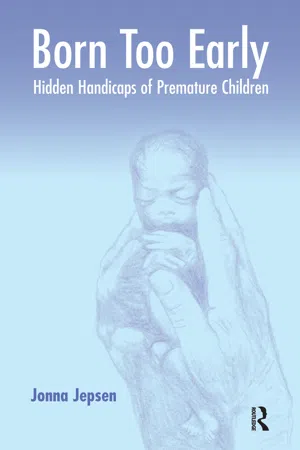
Premature children suffering consequences of their early birth do not grow out of them, and new difficulties may appear as they mature. The sum of negative influences from the time in the Neonatal Intensive Care Unit, eventual problems with interaction, and later a defective or delayed development, can cause continuous problems for premature children. These children can however be protected if we initiate the necessary support. An early effort can prevent the typical consequences of pre-term birth, so that the children will have quite a normal childhood. If the minor difficulties are identified, it is possible to take care of them before they develop into huge problems, and that is just the purpose of this book: to give parents, and professionals close to the child, a possibility to prevent, repair, and rebuild. Born Too Early does not deal with the more usual handicaps but exclusively with the less visible consequences of pre-term birth, which are rarely diagnosed.
- 256 pages
- English
- ePUB (mobile friendly)
- Available on iOS & Android
eBook - ePub
About this book
Information
Chapter One
The disadvantaged start
A child is born too early when it is born before the end of the 37th week of pregnancy. Very premature children arrive in the world before the end of the 32nd week, and extremely premature babies are those who see the light of the day before the end of the 28th week.
In order to establish categories—for research purposes, for example—the three groups above are defined by weight limits of 2,500 g, 1,500 g, and 1,000 g, respectively.
Weight is not of significant relevance for the premature child’s chances of survival and risk of hidden, or delayed, handicaps. However, the child’s maturity plays a major role, and this is directly related to the week of birth. The lungs, as well as the brain and the maturity of the nervous system, are particularly significant factors in relation to delayed handicaps.
The degree and range of inflicted stress and painful treatment are also deciding factors for both the possibility of complications in the neonatal period and consequences in the longer term.
The time-span of separation between mother and child, together with the extent of painful and unpleasant nursing and treatment, are crucially important to how traumatized the premature child will become.
The life-force the child displays immediately after birth is a very significant factor in the child’s survival chances and ability to survive through the hospitalization period without serious complications.
Children born at term may also be exposed to separation, growth retardation, shock, or fear/pain in connection with operations or other treatment, and they may in these circumstances display some of the same characteristics as those seen in prematurely born children.
The child's experience of a pre-term birth
There is broad agreement among psychologists of the newborn that the first two years of the child’s life are particularly important for the development of personality. However, newer research does show that it is always possible to carry out repairs to mental imbalance created early in childhood (Schaffer, 1990).
Being born is a violent, shocking experience, and the shock is substantially worse when this happens much too early, partly because the child is totally unprepared, partly because the birth and following examination and treatment usually take place in a stress-filled acute environment.
Children who arrive in the world much too early are generally delivered by Caesarean section, removed immediately from the mother, examined, placed into an incubator, and taken to the Neonatal Intensive Care Unit (NICU). Alone in the world, away from the only secure place they know: mother’s protective body, her smell, voice, and heartbeat. Their next experience is to have a probe inserted, be pricked with a needle, have electrodes attached, and be placed into a CPAP (Continuous Positive Airway Pressure) device or respirator.
The children cannot express their shock, fear, and pain and that is precisely why the experience is extra traumatic.
Separation from the mother
The child experiences and registers separation from the mother as a privation and a deep feeling of betrayal, which the child may harbour for a long time if nothing is done to prevent it. Many prematurely born children have an (unconscious) deep feeling of anger against their mother, which may be expressed by, for example, rejection of comforting and caresses.
Results of several investigations carried out during the last five decades indicate that there is a causal connection between loss of maternal care in early childhood and disturbed development of personality (Bowlby, 1969–80).
The premature child’s traumatic start in life stands in sharp contrast to the full-term infant’s entry into the world:
The mother’s care and presence after the birth guarantees the child’s physical and mental survival. In the postnatal period—that is, the first weeks after a full-term birth—the child sleeps much of the time, is nursed, fed, and given warmth and security. It experiences the maternal rhythmic heartbeat during feeding and when it is carried. In this condition of total satisfaction of all needs, where milk and the feeling of being securely held by, and being at one with, the mother is present in unlimited amounts, the child achieves trust in itself and in its mother. With this satisfaction of all the child’s needs, the requirements for development of the basic trust are fulfilled and emotionally solid and safe foundations for the child’s development are laid.
If the infant loses—or is deprived of—bodily contact with the mother, this can give rise to an existential fear in the child. The Swiss ethnologist Franz Renggli calls bodily contact “the universal calming medicine” for babies.
According to the child analyst Margaret Mahler, the child develops a weak “self” as a result of early separation, and it becomes vulnerable and frightened (Mahler, Pine, & Bergman, 1975). The influence of early separation on the child must be judged in connection with factors described below under “Pain and unfulfilled needs”, “Stress”, and “Parent–child interaction”. When the child is exposed to pain and stress and is at the same time separated from its secure base, the mother, these influences reinforce its fears.
Pain and unfulfilled needs
At very early birth children’s organs are immature, which means that they cannot breathe independently, eat, maintain their temperature, or resist infections. In short, they cannot survive without either use of the kangaroo method (child and parent, skin against skin) 24 hours a day, which is not used in the NICU’s, or intensive technological and medicinal intervention.
This intensive treatment means that in the first, acute phase the child is touched some 100 times every 24 hours, and later, during the neonatal progress, 70 times during the day and night (Ulvund, Smith, Lindemann, & Ulvund, 1992). Most often it is painful and unpleasant contact, carried out by many different hands. Blood samples are generally taken by means of a cut with a scalpel in the child’s heel. When a drip has to be inserted for delivery of medicine or glucose, it can be difficult to hit the hair-fine veins, and not infrequently it is necessary to puncture the skin several times before success is achieved.
If the mucous membranes are undamaged, it does not markedly hurt the child to have a probe put in place, but it is very unpleasant.
A very premature child has a parchment-thin skin and experiences pain more intensely than does a full-term child. A premature child will, at Week 28, react to a pressure on the skin of 0.25 g, whereas a full-term child will ignore pressure of less than 1.8 g. The number of pain receptors (nerve endings) is highest at a birth age of 28 weeks, and it is considered that at this time the child is unable to inhibit the pain impulse. So, the lower the age at birth, the greater the pain (Sørensen, 2001, pp. 11–13).
Children born extremely early, who are exposed to much pain, also become the victims of the phenomenon hyperalgesia: the child experiences the same stimulation as being more and more painful each time. Eventually the sensitive child’s nervous system can register just a touch as pain.
The preliminary results of research in this field indicate that there is a better prognosis in relation to neurological damage in children who are protected against pain during a course of treatment than in children who are treated without this added protection (Sørensen, 2001, p. 27).
The pain suffered in the period of infancy by children born too early is probably the reason why most of them can later bear much pain. They have become hardened. But stress can also be contributory to the development of a high pain threshold (Zlotnik, 2001), and as pain and situations of fear connected with this give rise to stress, there could be a connection between early experienced pain, stress, and a raised pain threshold.
The CPAP-system, which assists the child with breathing, blows a continual stream of air into the nose, and the child experiences this as a continuous, high blowing sound very close by. This, and other sounds, are enhanced in the closed Perspex incubator.
The child is often awakened for examination, treatment, or feeding, just as it may waken when the many alarms in the NICU are activated.
For the very premature child, despite the fact that more and more protective nursing and treatment methods are implemented, these negative stimuli, in the shape of painful treatment and unpleasant handling, are everyday experiences. When the child’s initial experiences of life and with other people are very negative, a fundamental fear is created: fear of new things, of new places, of strange people—yes, virtually everything that is new or strange.
An infant who does not have its needs satisfied during a disturbed development sequence or progress closes itself off from contact with the rest of the world in order to protect itself against the negative stimuli.
New research shows that a new-born, full-term baby can register or perceive threats and dangers against its existence. The child attempts to ward these off by means of evasive bodily manoeuvres in relation to the object that appears to come towards it. The child can mentally protect itself by freezing activity with simultaneous closure of sensory input and increased motor activity in combination with increased alertness.
But a child born too early has not developed any barriers to stimuli at birth. The child can sense and register the danger but does not have the resources to react to it or to shield itself from it.
Following an overloaded and frustrating infancy, unpleasant emotionally laden experiences are predominant, giving the child negative expectations with regard both to itself and to its surroundings and creating a fundamental insecurity.
When, after a such frustrating period of babyhood, the child has eventually built up a symbiosis with the mother, it often becomes fixated on this symbiosis and will not be able, like other children in the 5–36-month age-group, to tolerate separation and find its independence. The mother—and the father—supremely represent the child’s secure base, and it can be quite difficult for the child to feel secure when together with others.
Stress
The concept of “stress” is not used in the daily clinical work with children, and there is little research into this area. However, a great deal of the knowledge gained about stress in adults can be transferred to children because it is related to general physiological processes (Zlotnik, 2001).
Nature’s intention with the stress reaction is to prepare the organism for dangerous situations so they can be fought or avoided—that is, fight or flight. When the brain registers the danger, it sends messages, by way of the pituitary gland, to the adrenal glands to increase the production of hormones, particularly adrenalin and cortisone. The nervous system is activated, the blood pressure and the heart-beat rate are increased, the kidney function is reduced, the fat content of the blood is increased, blood sugar is increased, and extra blood is supplied to the muscles. The blood becomes thicker (coagulates slightly). These mechanisms increase people’s physical capacity (in case of battle) and reduce bleeding (in case of wounding).
However, when stress thus places the body in a state of alert, other functions are reduced. Repair of muscle and bone tissue is slowed down, and risk of bleeding in the brain is increased.
Focus is on two types of stress in the scientific area:
- — Type I stress in the shape of acute trauma or event;
- — Type II stress in the shape of daily and long-term exposure.
Researchers consider that response to Type I stress exposure will be momentary and without long-term effect and that this type of stress is a normal, positive, or constructive form of stress.
To Type II stress exposure the reaction will be weighty, negative, or destructive. The organism will be in a continual state of alarm, and in this condition stress becomes distress, which can, in some cases, develop to become symptoms and illness, including, for example, allergies (Zlotnik, 2001). The immune system is strengthened by acute stress situations, but it is weakened by long-lasting exposure. Stress of longer duration and/or strong stress exposure is damaging not only for the body but also for the psyche.
Children born too early can be judged to be exposed to both types of stress in that they, after a period of acute trauma, often have to live for many years in a non-thriving state due to the consequences of birth and hidden handicaps.
The child born too early is more sensitive to and is influenced more by stress than is a full-term child. This is due to the immaturity of the brain and the nervous system, leading to a greater risk of mental and physical effects of stress.
The premature child is exposed to stress while still in the embryonic state, when conditions in the womb are not as they should be. When the expectant woman becomes aware that there are problems with the pregnancy, her fears and unease can create stress, and her enhanced stress-hormone levels will be transferred to the foetus.
If birth begins too early—often under dramatic circumstances—the next stress-filled experience is added. Thereafter the acute neonatal environment, the physical pain, the discomfort, the fear, the lack of security, and the separation are significant factors of stress. Additionally, the child’s battle to overcome infection and to survive induces stress.
If the child is stressed early and frequently, a stress build-up will accumulate in the body, and the child will later need help to be rid of this. The more stress the body is exposed to, the more tense its muscles become.
Stress is an vicious cycle. The tense muscles make it difficult for the child to relax and fall asleep; it makes the digestive processes difficult, with accompanying pain and tears, and it increases the pain. This causes additional stress hormones to be produced and circulated in the body, and thus stress caused by external circumstances is strengthened by the child’s own organism (Rosenberg, 2002b).
Research shows that children who are exposed to early stress have difficulty in mastering stress-filled situations later, just as they will be more predisposed to illness (Milsted, 1999).
When children are exposed to chronic stress, change can occur in parts of the brain. An underdeveloped brain will be more vulnerable and exposed. These structural changes may be partly the cause as to why the child may later have problems with registering and finding meaning in patterns of perception (problems with integration of the senses), and it can have influence on the child’s short-term memory and learning ability.
As there is a connection between stress reaction and the natural growth hormones (Zlotnik, 2001), one must be aware of the influence of stress factors on premature children’s frequently occurring growth problems.
Experience from a project at Amtssygehuset County Hospital in Glostrup, Denmark (Kirkebæk, Clausen, & Storm, 1996) indicates that premature children who are protected as much as possible against stress and overloading fare...
Table of contents
- Cover
- Half Title
- Title
- Copyright
- Dedication
- Contents
- ACKNOWLEDGEMENTS
- FOREWORD
- PREFACE
- CHAPTER ONE The disadvantaged start
- CHAPTER TWO Short- and long-term consequences
- CHAPTER THREE Prevention and possible treatment methods
- CHAPTER FOUR Requirements for provision of public support
- CHAPTER FIVE Professionals involved in family support
- CHAPTER SIX Parents and siblings
- CHAPTER SEVEN Case histories
- CHAPTER EIGHT Research
- GLOSSARY
- REFERENCES AND BIBLIOGRAPHY
- ADDITIONAL RELEVANT LITERATURE AND WEB INFORMATION
- INDEX
Trusted by 375,005 students
Access to over 1.5 million titles for a fair monthly price.
Study more efficiently using our study tools.
Frequently asked questions
Yes, you can cancel anytime from the Subscription tab in your account settings on the Perlego website. Your subscription will stay active until the end of your current billing period. Learn how to cancel your subscription
No, books cannot be downloaded as external files, such as PDFs, for use outside of Perlego. However, you can download books within the Perlego app for offline reading on mobile or tablet. Learn how to download books offline
Perlego offers two plans: Essential and Complete
- Essential is ideal for learners and professionals who enjoy exploring a wide range of subjects. Access the Essential Library with 800,000+ trusted titles and best-sellers across business, personal growth, and the humanities. Includes unlimited reading time and Standard Read Aloud voice.
- Complete: Perfect for advanced learners and researchers needing full, unrestricted access. Unlock 1.5M+ books across hundreds of subjects, including academic and specialized titles. The Complete Plan also includes advanced features like Premium Read Aloud and Research Assistant.
We are an online textbook subscription service, where you can get access to an entire online library for less than the price of a single book per month. With over 1.5 million books across 990+ topics, we’ve got you covered! Learn about our mission
Look out for the read-aloud symbol on your next book to see if you can listen to it. The read-aloud tool reads text aloud for you, highlighting the text as it is being read. You can pause it, speed it up and slow it down. Learn more about Read Aloud
Yes! You can use the Perlego app on both iOS and Android devices to read anytime, anywhere — even offline. Perfect for commutes or when you’re on the go.
Please note we cannot support devices running on iOS 13 and Android 7 or earlier. Learn more about using the app
Please note we cannot support devices running on iOS 13 and Android 7 or earlier. Learn more about using the app
Yes, you can access Born Too Early by Jonna Jepsen in PDF and/or ePUB format, as well as other popular books in Medicine & Perinatology & Neonatology. We have over 1.5 million books available in our catalogue for you to explore.