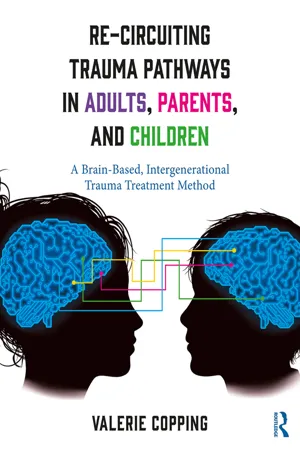
Re-Circuiting Trauma Pathways in Adults, Parents, and Children presents the evidence-informed and substantiated Intergenerational Trauma Treatment Model (ITTM), with an emphasis on up-to-date trauma theory, the development of specialized clinical skills, and the replicability of methods. Grounded in original research, experiential practice, and mathematical principles of logic, the ITTM targets and treats both the child's and the caregiver's complex trauma, providing the content and the process for supplying an effective, and brief, caregiver-first treatment option. It delivers an innovative, multigenerational approach to complex trauma treatment that strengthens the caregiver-child relationship by motivating and teaching caregivers to help their children cope with the effects of trauma.
eBook - ePub
Re-Circuiting Trauma Pathways in Adults, Parents, and Children
A Brain-Based, Intergenerational Trauma Treatment Method
- 202 pages
- English
- ePUB (mobile friendly)
- Available on iOS & Android
eBook - ePub
Re-Circuiting Trauma Pathways in Adults, Parents, and Children
A Brain-Based, Intergenerational Trauma Treatment Method
About this book
Information
Part 1
Theory
Chapter 1
Hope and Motivation: Working With Adult and Child Victims of Childhood Complex Trauma
We didn’t really escape (the trauma of residential schools)… it visited us every day of our childhood through the replaying over and over of our parents’ childhood trauma and grief which they never had the opportunity to resolve in their lifetimes… [Our mother] blames herself for not being able to protect us and not being able to help us when we were suffering.
Vera Manuel1
Indigenous author Vera Manuel and her brother were spared the residential school experience, but their parents’ childhood suffering became their own. Manuel’s memories capture the schools’ traumatic impact on the children compelled to attend: for about 150,000 Indigenous children in Canada, across all generations, for more than a century, neglect and abuse were the central motifs of their childhood experiences. Very few escaped the painful realities that shaped their own caregivers’ experiences as these manifested in their own childhoods, even if, like Manuel and her brother, they did not personally attend these schools. The continuous repetitive result of unresolved childhood trauma is a destructive pattern of intergenerational trauma transmission.
Although the specific case of unresolved intergenerational trauma in Indigenous communities—not only in Canada, but around the world wherever racist colonial practices were employed to suppress Indigenous populations—provides a textbook example of enormous magnitude, it is nonetheless evident that childhood trauma is not isolated to subjugated peoples. Popularly depicted as a lightning-bolt experience, trauma is a universal phenomenon, regardless of the singular aspects of each person’s traumatic experiences, and whether they are objectively classified as major or minor, “big T” or “little t,” by victims or by others on their behalf. In its infinite variants, trauma is likely to occur at least once, if not many times, in any individual’s lifespan. More than a distinct event, or even a series of distinct events, trauma is a process that has shifting, yet ongoing, effects on self-formation. The negative consequences of even one traumatic event obviously challenge the individual’s well-being. Just as often, however, these repercussions touch their “inner circle” of family, caregivers, and close friends.
This is especially the case when the traumatized individual is a child or adolescent. Because the trauma occurs during the most important years of self-formation, its imprint is deep and lasting. The simple fact that traumatologist Bessel Van der Kolk points out is unassailable: children are “programmed” to regard their caregivers as their principal nurturers and protectors. Thus, “if the parents themselves are the source of distress, the child has no one to turn to for comfort and restoration of biological homeostasis” (Van der Kolk, 2016, p. 267). And when the impact of trauma is carried, unresolved, from childhood into adulthood, autonomy, inter-relatedness, personal competence, and their related behaviors invariably suffer. This chapter discusses how unresolved complex trauma—or recurrent trauma—in childhood affects the critical caregiver-child-clinician relationship in terms of building and reinforcing the three bases of intrinsic motivation, or behavior motivated by the inherent value of action-taking (Dreikus-Ferguson, 2000). It focuses on the ways in which correlated treatment of caregiver and child, as the keystone of the Intergenerational Trauma Treatment Model (ITTM), can effectively address the diminished hope and motivation of both, allowing for improved and lasting outcomes.
Motivation in Trauma Treatment Theories
“Motivation” is here defined as the influence of needs and desires on the intensity and direction of individual behavior. It is an internal process that shapes the individual’s response to an external event or events (Dreikus-Ferguson, 2000, p. 7). Psychological studies on motivation generally include the evaluation of antecedents: traumatic past events experienced by an individual in conjunction with the attainment of such goals as improved personal and social functioning. More than a century past, Wundt (1902) identified three distinct dimensions of emotion: pleasurable versus non-pleasurable; exciting versus depressing; and stressing versus relaxing. Towards the close of the 20th century, psychologists such as Diener suggested that emotional intensity is a personality variable reflecting individual differences (Diener et al., 1985, p. 71–75). Others linked task variables to emotions, and emotions to effort, connecting emotion and motivation. Not surprisingly, depressed people were found to have less energy (Bandura et al., 1981), less memory, and less capacity for applying themselves to daily tasks (Ellis, 1988). More recently, Ferguson (2002) classified arousal as the energizing and intensifying aspect of motivation that is manifested both physiologically and behaviorally. An increase in energizing arousal after each treatment session, for example, is clearly more beneficial than the experience of tense arousal (Dreikus-Ferguson, 2000). Intrinsic motivation is the most significant “wellspring” of further motivation, inciting individuals to continue working toward their goals, even when there is no outside incentive to keep doing so (Ferguson, 2008).
Building motivation is at once the most important and the most challenging objective of the therapeutic professions. We know that motivated behavior is more likely to occur when specific sub-goals are defined first, securing the foundation for the attainment of larger goals. Definite short-term sub-goals are clear guidelines and immediate incentives for achievement; focusing on distant, generalized gains, such as improved functioning or a reduction in negative behaviors, can be overwhelming, with the effect of making the goal or goals seem beyond reach. Focusing on long-range goals tends to set the stage for free-floating “preparations” for a nebulous future, rather than immediate and achievable “first steps.” Treatment that works towards specific, tangible, quickly attained goals can direct the individual to quickly attainable—and consequently motivational—successes (Bandura et al., 1981).
The starting point for understanding the causal relationship between caregiver motivation and successful treatment for children is identification of the underlying factors that discourage the caregivers. Uncovering these influences will assist clinicians to implement effective tools and strategies for enhancing caregiver motivation levels, thereby increasing their hopefulness for the child. Caregivers tend to postpone seeking treatment until they are overwhelmed by the child’s problems, by which time personal and caregiving strategies have likely failed repeatedly. Their own untreated—even unacknowledged—traumatic childhood events, and their present emotional stress levels, especially in response to their child’s needs, further deplete the necessary energy to encourage healthy relationships with their children as with others. Reduced effectiveness in personal interactions, in turn, increases the risks associated with isolation. When caregivers are unable to improve their own child’s functioning, and put off referring the child for treatment, the outcome is often further impairments to already-damaged personal competence. Caregiver hope and motivation improve the prospects that caregivers will see their children’s treatment to its close.
In current practices, the initial indicator of a caregiver’s motivation is also the most easily measured: how regularly they bring their child to scheduled treatment sessions. Using consistency of attendance as a measure, however, poses problems. Mental health clinicians generally accept that if a caregiver walks through the doors of a clinic, they are sufficiently motivated to participate in treatment. Yet this is often a critical error of assumption. The pressure to quickly assess the type and direction of treatment for children at intake can’t help but take the clinician’s attention from hidden problematic motivation factors in caregivers. Yet the most common explanation for negative treatment outcomes is premature dropout, which is usually the caregivers’ decision. In short, the highest instances of negative outcomes are directly related to unmotivated, or inconsistently motivated, caregivers in bringing their child to treatment, which too often leads to stopping altogether (Willis-Shattuck, 2008).
When caregivers drop out of treatment, clinicians can conclude that the caregivers’ motivation is insufficient. The explanation for failures in caregiver motivation and follow-through is a weak or absent sense of caregiver commitment; these shortcomings that so affect their children are therefore the caregivers’ problem and responsibility, and not those of the clinician (Maclean et al., 2000). It’s often a small step to viewing those who don’t follow the clinician’s advice as “failures” themselves, negligent caregivers who nonchalantly dismiss important treatment for their child because they lose interest. Since children usually can’t pursue treatment on their own initiative, it’s the caregivers’ fault when treatment is not carried out to its necessary end. Ironically, these common assumptions about caregiver motivation often compound the problem itself.
The apparent absence of motivation is usually, and primarily, the product of the caregivers’ own long-diminished and currently weakened personal competence levels. For all human beings, of all ages, competencies are developed and integrated in direct correlation to the number and frequency of tangible successes. Aware as they are of the larger problem, a significant number of service providers request practical applications to minimize lapses and set-backs caused by sporadic attendance. Research has demonstrated that interventions producing solid evidence of success are most likely to lead to the improvement and reinforcement of competence levels. The experience of relatively quick successes raises hope in care-givers, as their personal/caregiver capacity to commit for the long term is strengthened.
Clinicians do not intentionally minimize the importance of motivation-building in treatment programs. Yet child and family trauma treatment research invariably focuses on recommendations for “what” treatment issues need to be addressed and “why” doing so is important. Often the crucial “how” aspects are scarcely touched on, or even left out. The growing need for service, as reflected in historically high caseloads and the reduced funds that commonly lead to short staffing, have also distracted clinicians from working to develop interventions that specifically encourage motivated behaviors in adults. The result is a notable paucity of motivational behavior building tools and strategies to help caregivers participating in child trauma treatment. What follows is a discussion of some of the main strategies and how the ITTM utilizes and expands upon these in order to effectively treat complex childhood trauma in both children and caregivers.
Among the most efficacious of potential motivation-building strategies is motivational interviewing (MI), a direct, person-centered style of counseling. Motivational interviewing was originally designed to be used with alcoholics, who often experience ambivalence about changing their drinking behavior (Britton et al., 2008). Its goal is to buoy the client’s healthy need for autonomy by working with them to examine their ambivalence, and then directing them in making carefully mapped, measured, behavioral changes (Rollnick, 1992). Motivational interviewers rely primarily on non-verbal listening, reflective listening, and selective reflection. Ultimately, MI is intended to help individuals define and express their own reasons for either changing or maintaining the status quo, and to understand how their current behavior affects their ability to achieve their life goals. As such, they chart their own path to recovery. As a clinical approach, however, motivational interviewing lacks the theoretical framework to describe its mechanisms and functions. Studies by Britton and associates indicate that, after providing suicidal adults with combined CBT and MI interventions within a Self-Determination Theory framework, the method’s effectiveness in improving client engagement or treatment outcomes still could not be established. This may help to explain why MI is reported to work best in increasing the client’s engagement in treatment and in improving outcomes when it is used to complement other treatments (Britton et al., 2008).
Self-Determination Theory, first described by Ryan et al. (1997), emphasizes the crucial relationship between an individual’s inner resources and their personality development and behavioral self-regulation. The three essential inner resources—autonomy, inter-relatedness, and competence—must be established before high levels of self-determination and motivation can occur (Deci & Ryan, 1985). Degrees of self-determination are relative to age, strength, and the functioning of the three specific intrinsic elements. The higher the level of each element, the higher the concentration of self-determination levels in every individual. Heightened levels of self-determination in turn spark heightened levels of hope in the personal capacity to set and achieve goals. Higher concentrations of self-determination then help to increase the frequency of intrinsically motivated behaviors.
Expanding on theories concerning intrinsic and extrinsic motivation, Deci and Ryan (1985) developed Organismic Integration Theory (OIT). This theory posits that the value of each type of motivation is dependent upon the degree to which each form of behavior is internalized and integrated into the individual’s “sense of self.” The more evidence of competence, autonomy, and inter-relatedness, the stronger the likelihood of increased value in each area. The stronger the strength of each component, the more the individual will value intrinsically motivated behavior. By these measures, a caregiver who does not refer a child for treatment despite escalating post-traumatic symptoms is situated at the lowest end of the motivated behavior continuum. Deci and Ryan (1985) characterize such a caregiver as extrinsically unmotivated and therefore unable to perceive the value of initiating treatment. The caregiver’s lack of motivation might bring about a style of non-regulatory, non-intentional behavior, demonstrating a significant absence of control and a growing experience of incompetence (Bandura, 1981).
Extrinsic motivation is the participation in activities or tasks to avoid punishment or to gain external rewards. A caregiver can be identified as extrinsically motivated if they seek treatment because they believe good and responsible caregivers want their children to experience fewer negative behaviors and symptoms and better overall health. Denying that treatment is valuable might consequently challenge their self-perception as responsible and caring caregivers. People engage in extrinsically motivated behaviors largely to mirror and valorize the behaviors of those with whom they already feel a connection, or to bring about that connection (Deci & Ryan, 1985). Of the three other levels of extrinsically based motivation, identified regulation is perhaps most applicable to caregivers who make referrals to trauma treatment. It occurs when the ...
Table of contents
- Cover
- Title
- Copyright
- Contents
- Acknowledgments
- Introduction: The Intergenerational Trauma Treatment Model
- PART 1 Theory
- PART 2 Practice
- Conclusion: Re-Circuiting Trauma Pathways
- Index
Trusted by 375,005 students
Access to over 1.5 million titles for a fair monthly price.
Study more efficiently using our study tools.
Frequently asked questions
Yes, you can cancel anytime from the Subscription tab in your account settings on the Perlego website. Your subscription will stay active until the end of your current billing period. Learn how to cancel your subscription
No, books cannot be downloaded as external files, such as PDFs, for use outside of Perlego. However, you can download books within the Perlego app for offline reading on mobile or tablet. Learn how to download books offline
Perlego offers two plans: Essential and Complete
- Essential is ideal for learners and professionals who enjoy exploring a wide range of subjects. Access the Essential Library with 800,000+ trusted titles and best-sellers across business, personal growth, and the humanities. Includes unlimited reading time and Standard Read Aloud voice.
- Complete: Perfect for advanced learners and researchers needing full, unrestricted access. Unlock 1.5M+ books across hundreds of subjects, including academic and specialized titles. The Complete Plan also includes advanced features like Premium Read Aloud and Research Assistant.
We are an online textbook subscription service, where you can get access to an entire online library for less than the price of a single book per month. With over 1.5 million books across 990+ topics, we’ve got you covered! Learn about our mission
Look out for the read-aloud symbol on your next book to see if you can listen to it. The read-aloud tool reads text aloud for you, highlighting the text as it is being read. You can pause it, speed it up and slow it down. Learn more about Read Aloud
Yes! You can use the Perlego app on both iOS and Android devices to read anytime, anywhere — even offline. Perfect for commutes or when you’re on the go.
Please note we cannot support devices running on iOS 13 and Android 7 or earlier. Learn more about using the app
Please note we cannot support devices running on iOS 13 and Android 7 or earlier. Learn more about using the app
Yes, you can access Re-Circuiting Trauma Pathways in Adults, Parents, and Children by Valerie Copping in PDF and/or ePUB format, as well as other popular books in Social Sciences & Mental Health in Psychology. We have over 1.5 million books available in our catalogue for you to explore.