Lessons Learned is an important phase in project management. This is when organizations can pave the way for future project success by documenting mistakes so they are not repeated and recording best practices so they are repeated. This book covers the important role a project management office (PMO) plays in promoting lessons learned. Project managers learn how to improve processes by applying lessons learned. The book emphasizes "actionability," or producing a process improvement that can be acted upon by anyone in the PMO or project team.
- 207 pages
- English
- ePUB (mobile friendly)
- Available on iOS & Android
eBook - ePub
About this book
Information
Publisher
Auerbach PublicationsYear
2018Print ISBN
9781032095271
9781498747776
Edition
1eBook ISBN
9780429954672
1
INTRODUCTION TO PROCESSES AND PROJECTS AS KEY FACILITATORS OF MODERN LIFE
Life is the formation, development, and integration of “biological processes.” Biological processes define us as human beings and are continuously changing as humans grow and develop. “Processes” facilitate their growth and development. All living organisms undergo major changes over time. Some of these changes may be considered “improvements” to the species, while other changes may be detrimental to the long-term viability of the species.
Individuals and organizations use “processes” and “projects” as key facilitators and tools of modern life. As we will discuss later, the ability of individuals and organizations to define and utilize processes and projects in their development is a maturity function. The same “basics” apply to both physical and biological processes. It is important to understand these basics before we tackle “lessons learned” in the context of “process improvement.”
Individuals often go about their daily lives without really understanding how important Process is to their lives and livelihoods. This book is intended to provide insights into processes that the reader will grasp and use as they develop their roles in society.
Lessons Learned from process feedback actually forms the basis for human evolution and development. This book addresses an important aspect of lessons learned from the viewpoint that humans and organizations can take initiative and develop strategies from lessons learned to improve the Processes and Projects they use in daily life to accomplish their major objectives (Figure 1.1).
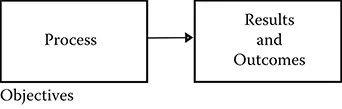
Figure 1.1 Process flow.
The Basics of Process
When you order a book from Amazon, mail a letter with the U.S. Postal Service, bake cookies at home, or withdraw some funds from your bank account, you are using Processes to help you accomplish some objective. Processes are facilitators and tools of modern life. By definition, a process is a set of “activities” or “tasks” which, when performed in a specific sequence, yields a desired result or outcome. The Activities and Tasks referred to in this definition can be complex and involve subprocesses themselves. Both individuals and organizations use processes to accomplish their objectives and functions.
The word “desired” in the definition of Process is significant because the first or even subsequent attempts to define and design a process that meets all objectives and achieves all results and outcomes is often unsuccessful. This introduces the need for Process Improvement. Understanding Process Improvement is key to the concepts of this book. It raises the questions “Where and how are process improvements identified?” and “Who is principally involved in process improvements?” (Figure 1.2).
The “Dynamics” of Processes
Time is a construct of man to give order to his environment. But Time introduces Dynamics into the concept of process. Because processes require both human and physical resources to support their function and structure, roles and inputs to the activities may change over time. Dynamics therefore introduces the need for process improvement to maintain the desired outcomes of processes.
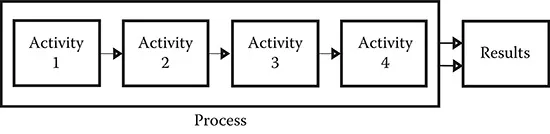
Figure 1.2 Definition of process.
The “Sustainability” Implications of Process
Processes require “resources” for implementation and value creation. How efficiently these resources are used or how the processes utilize resources have sustainability implications. The initial design of processes, as well as process improvements, can consider Sustainability in design and function.
In his book The Age of Sustainable Development, Jeffrey Sachs argues that global strategies going forward must incorporate “sustainable development” goals, practices, and initiatives as the basis for approaching global development. How resources are utilized and dedicated to process definition and implementations going forward will be keys to our continued existence as a planet.
Processes as Major Components of Individual or Organizational “Capability”
Organizations and individuals develop “capabilities” that enable them to excel at the results and outcomes they achieve from focusing on their objectives. “Distinctive capabilities” are the things they excel at doing time and time again. Processes are a major component of Capabilities. Capability is the combination of people, processes, technologies, and organization that allows an individual or organization to deliver their intended outcomes.
For some highly technical industries such as software development or biopharmaceutical development, there are also “table-stakes” capabilities, which every company in that industry must develop as a baseline for competing in the industry (Figure 1.3).
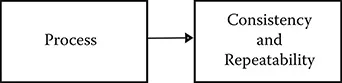
Figure 1.3 Measures of process maturity.
What Is Process Improvement?
Process improvements are introduced into the process discussion because
- Initial and subsequent process design may not meet objectives, results, and outcomes.
- Dynamics introduces the need for process improvements because of changes in resources, roles, and inputs over time.
- Lessons Learned from the operations of processes create feedback that can improve processes. Lessons learned are usually identified by the people who are actively engaged in the process itself.
- As new technologies replace old technologies, and new materials and resource types replace old, process improvement will be imperative. New process designs will be imperative for competitive and social needs.
- Changes in regulatory requirements often drive process improvements.
When process owners introduce process improvements, they generally utilize industry and internally generated “best practices” or “benchmarking” to introduce changes into the Activities or Tasks that make up a process.
Capability Maturity and the “Well-Defined” Process
In 1979, Philip Crosby introduced a maturity grid/matrix applicable to organizations in his book Quality Is Free. It was known as the “Management Maturity Grid,” and it described a progression of maturity in organizations related to management, moving from “ad hoc” activities and “quality,” to a very mature state or environment in which Quality was embraced as the norm for all employees. Feedback was employed to improve activities and ensure quality.
In the 1980s, IBM’s Watts Humphrey introduced a software development work based on the Management Maturity Grid. Over the past several decades, this work has been called “Capability Maturity Model” and has been extended from strictly software development to process development and process maturity for organizations generally.
The capability maturity model refers to the stages through which organizations evolve as they define, implement, measure, control, and improve their processes. The model provides a guide for selecting process improvement strategies. The highest state of maturity within the model is the “optimized” state in which “continuous process improvement” is the norm (Figure 1.4).
The discipline of software development also provided us with the concept of the Well-Defined process. A Well-Defined process is one which expresses and documents, for every major Activity and Task, the principal activities making up the task as well as any “entry” and “exit” criteria that add information to the Activity of Task in the form of what follow-up acts the Process Owner should expect other principal groups to take. Such topics as audit and quality control issues, regulatory issues, testing, and evaluation are often covered in Entry and Exit descriptions (Figure 1.5).
See Appendix 5 for more information about the Capability Maturity Model.
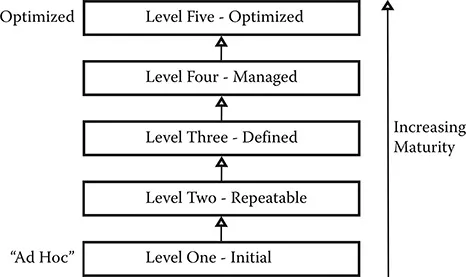
Figure 1.4 Capability maturity model.

Figure 1.5 Well-defined process definition.
The Basic Principle of Process
Continuous process improvement begins with Process Improvement, which begins with “process.” In order to talk about Process Improvement, we need a well-defined, working Process (Figure 1.6).
Familiar Impacts of Process on Business
In the movie The Founder, Ray Kroc (played by actor Michael Keaton) recognizes and acts on an innovative idea in fast food service and delivery, which was originally developed by the McDonald brothers in their San Bernardino, CA store. Tired and fed up with the poor service and food of the traditional drive in fast food restaurants in 1954, Kroc meets the McDonald brothers who used Process to revolutionize fast f...
Table of contents
- Cover
- Half Title
- Title Page
- Copyright Page
- Dedication
- Contents
- List of Figures
- List of Tables
- Preface
- Acknowledgments
- Author
- Chapter 1 Introduction to Processes and Projects as Key Facilitators of Modern Life
- Chapter 2 Understanding and Empowering the Program Management Office (PMO) and Its Influence on Project Lessons Learned
- Chapter 3 What Do I Do If My PMO Can’t Execute?
- Chapter 4 Avoiding Disruption of the PMO by Accidental Adversaries
- Chapter 5 Identifying and Applying Lessons Learned
- Chapter 6 What Is “Leverage” and How Can Project Managers Use It to Their Advantage?
- Chapter 7 The Importance of Reflection and Changing Attitudes in Lessons Learned
- Chapter 8 The Best Time to Document Project Lessons Learned
- Chapter 9 The Actual Cost to Your PMO for Not Capturing and Sharing Project Lessons Learned
- Chapter 10 Applying Project Lessons Learned as a Best Practice for Your Organization
- Chapter 11 Understanding and Using the New Project Framework
- Chapter 12 Recognizing and Using Different Perspectives
- Chapter 13 Dilemmas and Choices Faced by Project Managers
- Chapter 14 Identifying Valuable Candidates for Project Lessons Learned
- Chapter 15 Using the Project Framework to the Benefit of Enterprise Risk Management
- Chapter 16 The Tremendous Impact of Role Models on Project Management Leadership
- Chapter 17 Facilitating a Closer Connection: Lessons Learned, Risk Management, and Knowledge Management
- Chapter 18 Using the Project Framework to Facilitate Technology Development in Projects
- Chapter 19 Using Facilitation and Reframing toward Project Process Improvement
- Chapter 20 Avoiding Traps Where Structure Influences Behavior
- Chapter 21 Lessons Learned from the Application of Organizational Dynamics to the Business Continuation and Emergency Response Environment
- Chapter 22 The Sustainability Imperative
- Chapter 23 Conclusions
- Chapter 24 Summary
- Appendix 1: Project Lessons Learned Template
- Appendix 2: A Layman’s Guide to Reinforcing and Balancing Loop Behavior and the Resulting Systems Archetypes
- Appendix 3: Systems Thinking and Organizational Dynamics Example—Teen Drivers
- Appendix 4: Project Lessons Learned from the Panama Canal Experiences
- Appendix 5: Capability Maturity Model Background and Levels of Maturity
- Appendix 6: Research as a Major Process
- Appendix 7: Scenarios Where Lessons Learned Can Positively Impact Performance and Outcomes
- Epilogue
- Glossary
- References
- Author Index
- Subject Index
Trusted by 375,005 students
Access to over 1.5 million titles for a fair monthly price.
Study more efficiently using our study tools.
Frequently asked questions
Yes, you can cancel anytime from the Subscription tab in your account settings on the Perlego website. Your subscription will stay active until the end of your current billing period. Learn how to cancel your subscription
No, books cannot be downloaded as external files, such as PDFs, for use outside of Perlego. However, you can download books within the Perlego app for offline reading on mobile or tablet. Learn how to download books offline
Perlego offers two plans: Essential and Complete
- Essential is ideal for learners and professionals who enjoy exploring a wide range of subjects. Access the Essential Library with 800,000+ trusted titles and best-sellers across business, personal growth, and the humanities. Includes unlimited reading time and Standard Read Aloud voice.
- Complete: Perfect for advanced learners and researchers needing full, unrestricted access. Unlock 1.5M+ books across hundreds of subjects, including academic and specialized titles. The Complete Plan also includes advanced features like Premium Read Aloud and Research Assistant.
We are an online textbook subscription service, where you can get access to an entire online library for less than the price of a single book per month. With over 1.5 million books across 990+ topics, we’ve got you covered! Learn about our mission
Look out for the read-aloud symbol on your next book to see if you can listen to it. The read-aloud tool reads text aloud for you, highlighting the text as it is being read. You can pause it, speed it up and slow it down. Learn more about Read Aloud
Yes! You can use the Perlego app on both iOS and Android devices to read anytime, anywhere — even offline. Perfect for commutes or when you’re on the go.
Please note we cannot support devices running on iOS 13 and Android 7 or earlier. Learn more about using the app
Please note we cannot support devices running on iOS 13 and Android 7 or earlier. Learn more about using the app
Yes, you can access Project Management Lessons Learned by Mel Bost in PDF and/or ePUB format, as well as other popular books in Business & Knowledge Capital. We have over 1.5 million books available in our catalogue for you to explore.