Crisis Education and Service Program Designs, is a guide for educators, administrators, and clinical trainers who may otherwise feel ill-prepared for the complex tasks of teaching, program development, supervision, and consultation in the crisis-care arena. The book provides a framework for more systematic inclusion of crisis content in health and human-service programs. Readers will find that this book fills the current gaps in knowledge and training, and fosters a more holistic practice by all human-service professionals. It shows how effective leadership, training, and timely support contribute to crisis workers' effective practice with people in crisis.
eBook - ePub
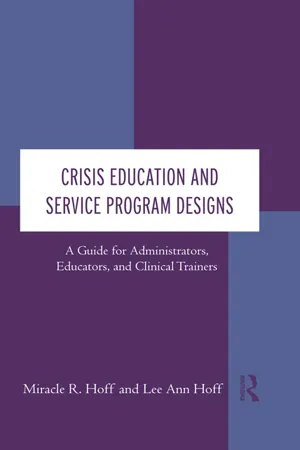
Crisis Education and Service Program Designs
A Guide for Administrators, Educators, and Clinical Trainers
- 278 pages
- English
- ePUB (mobile friendly)
- Available on iOS & Android
eBook - ePub
Crisis Education and Service Program Designs
A Guide for Administrators, Educators, and Clinical Trainers
About this book
Information
| BACKGROUND AND OVERVIEWOF THE CRISIS FIELD | I |
The two chapters in this section lay the book’s foundation in research, theory, policy, and practice arenas over several decades of development by interdisciplinary players in the field. The five life examples in Chapter 2 address key concepts and the services needed by a diverse sample of people in crisis across the array of community and clinical settings in which crises are experienced. Together, these chapters show the relevance and application of theory to excellence in crisis care practice.
Chapter 1
The Significance and Urgency of Crisis and Psychosocial Care
Chapter Outline
A Biopsychosocial Approach to Human Services
The Crisis Model in Human Services
Key Issues and Events Affecting Crisis and Psychosocial Care
Crisis Service Delivery: Differential Approaches
Evaluating the Content and Context of Training, Education, and Service
Programs
Centuries ago, Hippocrates said, “It is better to know the man who has the disease, than the disease the man has.” Yet, even in the new millennium while taking into consideration the essential interconnectedness of body, mind, emotion, and spirit and their impact on health, we continue to find ourselves swimming against the tide of biological paradigms that tend to give only lip service to the psychosocial facets of health care.
A Biopsychosocial Approach to Human Services
Although authors of most reputable texts tout a “biopsychosocial” approach to health care, the reality in practice is that the psychosocial facet of care is often shortchanged in the context of economic constraints and “managed care” service delivery models. Most health practitioners want to listen to their clients and tend to the psychosocial parameters of health, but listening takes more time than writing a drug prescription, and is poorly reimbursed. Health practitioners’ goodwill and theoretical convictions about holistic health care must be blended with policy mandates and reimbursement systems that move beyond the age-old bias against those with mental and emotional problems or illness.*
This book addresses the issues that many health professions educators and practitioners face in their attempt to balance the psychosocial and biomedical elements of health care. After discussion and illustration of these issues in the first two chapters, we present education, training, and service delivery models that facilitate moving from theoretical conviction about holistic care to implementation in various education and practice arenas. Although psychiatric emergency treatment is included, we emphasize its connection to sociocultural meanings, and the prevention of these medical and psychiatric episodes through psychosocial support and timely crisis care. Central to our approach is the smooth coordination of service components across the spectrum of agencies needed for comprehensive health care. Our experience and that of many others reveal that individualistic, competitive, profit-driven, or uncoordinated services constitute some of the greatest hazards to health care in general, and crisis and psychosocial care in particular.
The Crisis Model in Human Services
Many family members and human services professionals will be familiar with the following crisis situation.
Example: David Jones
At 11:00 p.m. a police officer calls the 24-hour telephone crisis program. The crisis team’s professional crisis workers (a volunteer and a mental health professional, both formally trained in crisis intervention) make an outreach visit to the home of David Jones, whom the police and the Jones family believe to be acutely suicidal and in need of assessment for possible psychiatric hospitalization. Mr. Jones has refused police and family recommendations for treatment. The outreach team spends nearly 2 hours with Mr. Jones and his family in their home. Mr. Jones finally agrees to go to the emergency department of a community hospital, where he will be examined by psychiatric liaison staff for treatment planning. Following the assessment of Mr. Jones and his family situ ation, he remains overnight in the emergency department crisis unit. Outpatient therapy begins the following morning for Mr. Jones and his family at the community mental health center, where follow-up of such crisis situations is provided. The family is given the telephone number of the 24-hour crisis outreach program the police had originally called on behalf of this family. (Adapted from Hoff & Wells, 1989.)
This example highlights the similarity of response to such a crisis by family members and mental health professionals, for example listening and making judgments and decisions about what to do. In situations like this one and others, the work of the “natural” (family) and “formal” (professional) crisis workers is complementary (Hoff, Hallisey, & Hoff, 2009).
However, there are some differences. In this situation, the crisis outreach workers and mental health professionals are linked to formally established programs offering crisis services. These workers possess knowledge and skills— acquired, presumably, through professional education or training—that go beyond what “everybody knows” about distressed people’s needs.
Timely responses to life crises have occurred since the beginning of recorded time (Hansell, 1976). Humans possess the capacity to create a culture of caring and concern for people in distress. Helping people in crisis is intrinsic to the nurturing side of human character. Thus, crisis intervention can be seen as natural human action embedded in culture and the process of learning how to survive through stressful life events among our fellow human beings.
In many traditional societies, assistance and support to distressed people were available through the extended family, indigenous community leaders such as a tribal chief or healer, and formal rites of passage (van Gennep, 1909/1960). A truism about the human condition is the community’s recognition that most individual members cannot manage stressful or traumatic life events alone if they are to avoid potential pathologies or fatal outcomes. As an organized body of knowledge and practice, the crisis field, although nearly a century old, continues to gain momentum with major developments in the mental health and public health arena (Agar-Jacomb & Read, 2009; Golan, 1978; Hoff et al., 2009; Parad, 1965).
Nevertheless, individuals in contemporary industrialized societies are still frequently left to their own devices when troubled, traumatized, or facing the challenge of normal life passages. There is a seeming paradox here: Because people have “naturally” been handling crises through the ages, many may think that “formal” preparation in crisis care is unnecessary despite research and clinical evidence suggesting otherwise (Joint Commission on Mental Health and Illness, 1961; Lindemann, 1944; Ross, Hoff, & Coutu-Wakulcyzk, 1998; Woodtli & Breslin, 1996, 2002). How else do we explain why decades after spending many millions of dollars instituting and demonstrating the program and cost-effectiveness of comprehensive community mental health services (including 24-hour crisis response), such services are not systematically included in the health care delivery and professional training landscape (Dorfman, 2000; Marks, 1985; Marks & Scott, 1990; Morgan & Hunt, 2008; Roberts, Cumming, & Nelson, 2005; Stein & Test, 1980)?
At the macro level, one obvious explanation is the political process in which mental health needs have rarely commanded a priority position—due in part to historic bias against those with emotional or mental health needs (Capponi, 1992; Chandler, 1990; Johnson, 1990; Levine, 1981; Ustun, 1999). And it appears that history is repeating itself (Hoff & Morgan, 2011). Another is the dominant individualistic (vs. communitarian) ethic so prevalent, especially in the American psyche (Bellah, 1985). Individualism run amok can sabotage crisis prevention programs and decrease the ability of people with insufficient psychosocial “supplies” (Caplan, 1964) to survive the trauma of critical life events. Such individuals are more vulnerable to crisis and, without well-orchestrated community supports and timely intervention, may require costly institutional care (Hoff, 1993b; Test & Scott, 1990). Although health reform efforts in Canada and the United States are in process, with continued emphasis on community-based primary care, the need for cost containment, and moves toward profit-based health care delivery, compound an already complex issue (see Hoff & Morgan, 2011; Whitaker, 2010).
Case consultations and the clinical dilemmas presented by students in formal crisis courses suggest that the following scenario is commonplace in health and mental health practice across settings, countries, and provider disciplines.
Example: Jane Warren
Jane Warren, age 54, has been widowed for 6 months. She has entered “brief therapy” for 10 sessions focused on unresolved grief and a history of excessive dependency on her husband. A mental health professional with no formal crisis care training concludes a therapy session with Ms. Warren during which she expressed suicidal ideation. Following a very brief discussion of suicide risk, a “no suicide contract” is negotiated together with a referral to the local hotline should Ms. Warren feel suicidal before the next week’s appointment. Over the weekend, Ms. Warren calls the hotline; during a 45-minute session, the telephone counselor assesses her suicide risk as low, suggests she consider a widow-to-widow local support group, and urges her to be more forthright with her therapist regarding her various concerns. When Ms. Warren returns for her next therapy appointment, she does not disclose the session with the telephone worker, and the therapist does not inquire beyond determining that Ms. Warren is at low risk for suicide this week. Several weeks later, Ms. Warren’s name is entered on the “repeat callers” list of the crisis line; in the meantime, therapy has been terminated with no record of communication or planning between the two service agencies.
With the current interest in the crisis model and an extensive knowledge base to support it, this scenario invites serious reflection by all health, psychiatric, and social service providers. For instance, the questionable practice of developing a “no suicide contract” has been popular among some but provides no legal protection to the practitioner and usually serves to help the provider feel better about the situation rather than to aid the client in resolution of suicidal feelings. The only benefit of the “no suicide contract” is that, when genuinely approached, it can communicate caring and concern for the client’s well-being and lead to a concrete safety plan. Additionally, seamless collaboration between health and mental health providers and the crisis service agencies they refer their clients to is essential (see Chapter 7). This matter is complicated by confidentiality laws and the anonymous nature of hotline services.
Development of the crisis field has been an uneven and complicated process. The growth of professionalism emphasizes the training of various experts across work settings and provider disciplines. A major outgrowth of this trend is the development of the crisis model as a distinct body of knowledge and practice, including certification of crisis workers. However, few health and other human service professionals receive more than a few hours of training regarding crisis theory and practice during their formal preparation (Cassidy, 1995; Haddad et al., 2005). Likewise, exposure to formal curricula is incidental rather than systematic (Ross et al., 1998; Woodtli & Breslin, 1996, 2002), a finding that complements an earlier U.S. national survey (Berman, 1983) revealing that few professional schools include formal coursework on crisis theory, violence prevention, and practice. As members of the human community, we all know something about helping people in crisis, so it is easy for health and social service professionals to avoid, through rationalization, the need for special training. In addition, the recent popularity of crisis practice has been fueled not only by the service needs of distressed people but also by cost containment issues. It is thus seen as an expedient and, at face value, less expensive form of “treatment,” if for no other reason than its brevity.
The language used by writers and practitioners contributes to some of the major issues and problems in the crisis field: crisis intervention, crisis therapy, crisis management, crisis counseling, solution-focused brief therapy (SFBT), emergency psychiatry, critical incident stress debriefing (CISD), crisis work, crisis service, crisis program, and “managed care.” Complementing this array of terms for services rendered are various descriptions of the people who deliver these services to people in crisis: crisis counselor, crisis therapist, crisis worker, crisis manager, professional, nonprofessional listener, and paraprofessional crisis workers. These interchangeable and sometimes confusing descriptions of the work and workers involved in the field reveal it as a young area of human service practice. For example, crisis counseling has always been brief and “solution focused” rather than psychodynamically oriented to personality change. The emergence of solution-focused brief therapy suggests that a piece of the crisis field has been excerpted and renamed partly because the body of knowledge about crisis has been addressed in piecemeal fashion.
Another example has been the use of critical incident stress debriefing—a term popularized through the work of Jeffrey Mitchell and the International Critical Incident Stress Foundation. For decades, crisis practice has included immediate support to individuals affected by the traumatic stress of disaster and other extraordinary or catastrophic events. These include war combatants, police officers, firefighters, ambulance attendants, classmates after a teen suicide or murder, rescue workers, and others witnessing or dealing with horrific events beyond most everyday experience. If practitioners of such emotional first aid are not grounded in a more comprehensive approach to the crisis resolution proc...
Table of contents
- Cover
- Halftitle
- Title
- Copyright
- Contents
- List of Figures
- List of Tables
- Foreword
- Foreword
- Foreword
- Preface
- Special Appreciation
- SECTION I: BACKGROUND AND OVERVIEW OF THE CRISIS FIELD
- SECTION II: EDUCATION AND TRAINING PROGRAM DEVELOPMENT AND IMPLEMENTATION
- SECTION III: CRISIS SERVICE ORGANIZATION, MANAGEMENT, AND DELIVERY
- SECTION IV: CLOSING THE GAP BETWEEN ESSENTIAL KNOWLEDGE, ATTITUDES, AND SERVICE DELIVERY SKILLS
- Glossary
- About the Authors
- Index
Trusted by 375,005 students
Access to over 1.5 million titles for a fair monthly price.
Study more efficiently using our study tools.
Frequently asked questions
Yes, you can cancel anytime from the Subscription tab in your account settings on the Perlego website. Your subscription will stay active until the end of your current billing period. Learn how to cancel your subscription
No, books cannot be downloaded as external files, such as PDFs, for use outside of Perlego. However, you can download books within the Perlego app for offline reading on mobile or tablet. Learn how to download books offline
Perlego offers two plans: Essential and Complete
- Essential is ideal for learners and professionals who enjoy exploring a wide range of subjects. Access the Essential Library with 800,000+ trusted titles and best-sellers across business, personal growth, and the humanities. Includes unlimited reading time and Standard Read Aloud voice.
- Complete: Perfect for advanced learners and researchers needing full, unrestricted access. Unlock 1.5M+ books across hundreds of subjects, including academic and specialized titles. The Complete Plan also includes advanced features like Premium Read Aloud and Research Assistant.
We are an online textbook subscription service, where you can get access to an entire online library for less than the price of a single book per month. With over 1.5 million books across 990+ topics, we’ve got you covered! Learn about our mission
Look out for the read-aloud symbol on your next book to see if you can listen to it. The read-aloud tool reads text aloud for you, highlighting the text as it is being read. You can pause it, speed it up and slow it down. Learn more about Read Aloud
Yes! You can use the Perlego app on both iOS and Android devices to read anytime, anywhere — even offline. Perfect for commutes or when you’re on the go.
Please note we cannot support devices running on iOS 13 and Android 7 or earlier. Learn more about using the app
Please note we cannot support devices running on iOS 13 and Android 7 or earlier. Learn more about using the app
Yes, you can access Crisis Education and Service Program Designs by Miracle R. Hoff,Lee Ann Hoff in PDF and/or ePUB format, as well as other popular books in Psychology & Education in Psychology. We have over 1.5 million books available in our catalogue for you to explore.