A central theme of this book is the gradual process of separation between parents and toddlers and the growth of autonomy in them all. The author has written with clarity, sympathy and warmth about the multiple problems children face in their toddler years and she has addressed the parents with immense empathy. The author manages to convey complex concepts and arguments in a lucid and simple style that all readers will find most helpful. Each of the authors featured has published papers and books for the academic and clinical communities; the present volumes, however, are specifically aimed at parents. The intent is not to convince but to inform the reader. Rather than offering solutions, we are describing, explaining and discussing the problems that parents meet while bringing up their children, from infancy through to adulthood. We try to provide portraits of the various stages in the child's cognitive, intellectual, and emotional development and how these unfolding stages affect not only the child's experience of himself, but also how he perceives and relates to the world in which he lives.
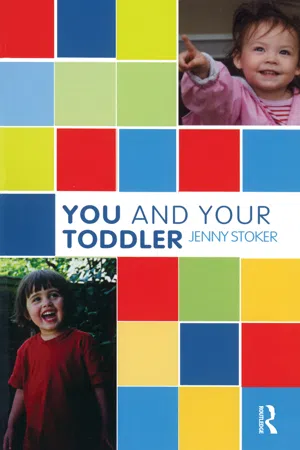
- 128 pages
- English
- ePUB (mobile friendly)
- Available on iOS & Android
eBook - ePub
You and Your Toddler
About this book
Information
1
on the threshold: from your arms to their feet
Curiosity and experimentation
Sammy (1 year 1 month)
A smiling exuberant presence, as if in love with what he was now physically capable of achieving, Sammy threw Himself Into exploring all the toys in the toddler hut. dropping many of them on the floor with delight. Although he hid shyly behind His mother on arrival. He ignored Her most of the time. He smiled at any of our contacts with him, as if Inviting as to loin in his pleasure at what Hie was doing. Constantly on the go, he moved between the room inside and the garden. He enjoyed pulling the velcroed plastic fruit apart, and the "plzza" pieces, which he then dropped on the floor. Sometimes he placed with the wooden spring pop-up figures, putting them in and out ef their holes or throwing them, too, on the floor. At other times he wandered around carrying the whole toy, with it dangling from his hand. He took a little aeroplane from another child for a few seconds and then jettisoned it, returning to the popup men.
His mother hovered a few inches behind him, anxiously picking up all the toys that had been discarded on the floor. She did not Interfere, letting him do what he wanted, laughingly Indulging him. She wondered aloud about his disruptive behaviour. though, and was clearly a little embarrassed by the debris that he left In his trail.
Katy (1 year 3 months)
Katy was very busy during the group. She repeatedly climbed onto different little chairs and rather laboriously swivelled herself round to a sitting position, with her feet not quite touching the floor. She looked very precarious as she did this, as if either she or the chairs would overbalance, but she was also very determined and resisted any attempts at helping her. No sooner would she manage to sit down and smile briefly, but with much satisfaction, at her audience than she would slide off and go in search of another chair. Later she became utterly engaged in a determined effort to lift a little shopping trolley up the two steps from the garden into the hut. Again she did this with a driven determination. It was so difficult that she had to sit on the steps to give herself enough leverage to get it through the door. Once she had succeeded, she reversed the process and repeated it several times.
Her mother stood close by patiently watching her but allowing her the space to discover what she could do. She commented on how tiring it was to have a child this age.
Sammy and Katy are typical of toddlers who have just learnt to walk steadily, and their mothers' responses are also characteristic of parents of young toddlers. Such children, so recently upright and so much more in control of their bodies now than a few weeks before, have been described as being in love with the world. Suddenly, from being helpless babies reliant on their carers to mediate between them and their environments, their upright stance allows them the capacity to control their surroundings much better and to manipulate the objects around them They can see the world from all sorts of different angles now: from above and below, upside down and inside out. They appear to spend their lives in continual experimentation. There is a whole new world before them, as they see it with the extra dimensions added. It becomes their oyster. They embrace it with frenetic activity. Much of it resembles scientific experimentation as they concentrate on the impact of their actions and as they explore. Objects are examined for their physical properties—as if the questions the toddler is exploring are: What does this thing do? What shape is it? How does it do it? Does it have an inside and outside? Is it like something I have seen before? What happens when I drop it? The world around them is full of such exciting new objects that they can still get as much pleasure out of the paper that a toy for their first birthday was wrapped in as they do from the toy itself.
At the same time, the toddlers are exploring their own bodies and what their bodies can do. We can see Katy repeatedly and with pride learning to sit on chairs as she has seen others do—she is mimicking those around her, identifying with the bigger people on whom she has been so utterly dependent for the first year of her life. Similarly she is using all her newfound strength and stability to manoeuvre the shopping trolley through the doorway. We can see Sammy's pleasure in controlling the little pop-up men—putting them in and out of the holes, carrying the toy around with him—and in manipulating the velcro fruit.
They are utterly driven by curiosity. It has more intensity than an infant's searching. It is sourced by the newly acquired motor skills and by a fundamental quest we all share to know about our origins and about our place in the world: where do I come from, where do others come from, where and how do I fit in the context I find myself in?
Omnipotence: the master of the universe
In their exploration of the world around them, Sammy and Katy show considerable disregard for any possible constraints or, indeed, for other people, including, much of the time, their mothers, whom they treat as compliant servants. And indeed, their mothers seem to collude in this disregard, indulging them and supporting them in their quest. Here we are witnessing the intense narcissism of the child in transition from infancy to toddlerhood. Where does this imperious single-mindedness originate?
As babies, our toddlers experienced wishes mostly for food, comfort, or relief from physical discomfort to which, from their point of view, their parents have responded almost magically. Their cries of distress have produced, within a short period of dme, some satisfaction of their need. They were hungry, and their feed appeared.
It is not surprising perhaps, then, that the newborn begins to feel that his surrounding environment, particularly in the form of his main caregivers, is there to answer his beck and call. His earliest experiences have taught him that his parents exist for him and for him alone and that he has utter control over them. He learns that there are predictable patterns of response to his actions: he learns over weeks of interactions with his mother that one action on his part will produce another in her, and this gives him a great sense of power over his world. Such self-centred optimism lasts beyond the first birthday. Fortunately it is very seductive. It is hard to resist a 1-year-old's beaming expectation that you will admire his first steps or be delighted to receive from him a chewed and mangled toy when he passes it to you. We encourage his delighted interactions with us, delighting in them as well, and reinforcing his pleasure. His exuberance about what he can do is infectious. He radiates a sense of elation and pride. And, indeed, that elation is almost as rewarding as the knowledge of the first steps themselves. As with so much parenting, it is the shared emotional experience that is as important as the event itself.
Research confirms that this is a period when parent-child interactions are indeed very positive. Scientists have identified the period around the time of learning to walk as being a time of high excitement and exuberance, with generally very positive interactions between parents and their children (only 5% prohibitory). They have also confirmed it as a period marked by the onset of exploratory behaviour in toddlers. It is thought that the intensity of this exploratory pattern of the early toddler's play, with its accompanying excitement, gives the toddler an enriched experience that in itself contributes further to his development. Interestingly, it seems that children who walk earlier, and are physically more mobile from a younger age, experience greater levels of excitement at this stage than children who walk later. Here we can see how the influence of the physical constitution intertwines with and reinforces emotional experiences in complex ways that in turn influence subsequent development. What happens when, to what, and in which context mingle together to produce the complicated little person growing up so fast in front of your eyes.
Your young toddler's mind
Although Sammy's and Katy's mothers stand back in these observations and let their children get on with their fun in their exploration on their own, both children are aware of their audience. Sammy comes into the room beaming, clearly anticipating our pleasure at seeing him, and Katy looks for her audience and smiles proudly when she sits on the chair. These toddlers know that we can share their pleasure in their experience. Usually some time before their first birthday and well before they start speaking, young children start pointing at objects and then looking at their mothers to see if they are looking too.
Johnny (age 11 months) was being pushed by his mother in the swing. An aeroplane flew overhead. Johnny kicked his feet excitedly and stretched his arm up, pointing up to the sky. and then looked at his mother. She looked up. "Yes. It's an aeroplane", she said, smiling, Johnny continued to look from his mother to the plane and back again, laughing as he did so.
This "joint-attention-seeking" behaviour happens as children begin to understand that their parents can have an interest in something they are interested in, that this interest, as well as the pleasure derived from it, can be shared, and that this sharing of pleasure in itself generates pleasure. It also shows the infant that his mother or father can recognize and respond to his wish for him or her to participate in the experience. In this way, the infant begins to learn about, interpret, and predict the behaviour of others. He is at the very beginning of the long and important process of learning about other people's minds as well as his own. With only a few, if any, words at his disposal at this stage, he is nevertheless beginning to learn about communication through language as well. He very quickly learns that if he points at an object, his mother will look at it too and share his interest and pleasure and that she may even make a predictable sound to go with it. He also soon learns that if he offers her something she will take it, and she may even offer it back to him in return. In this way, social games develop in which the young child is very much in control. In these repeated experiences he is building his own sense of agency— that is, the sense of his own capacity to make things happen, as well as a sense of the "otherness" of the others around him. We look further at these developments in chapters 3 and 4.
Despite the development of these skills in the early stages of learning about his parent's minds, it is important to realize that his understanding of others remains at a basic level. He confidently expects others to cooperate with his wishes as his experience has taught him so far. He does not anticipate any obstacles in the way of getting what he wants. In his interactions with other children, he will take, grab, walk over, and push without any concern for the consequences. In fact, it almost seems as if he treats others as mere objects to be used in whatever way he likes. If he sees a young baby, he will approach it like most other things—as an object to explore.
Johnny (11 months) was sitting in the middle of the laid-out wooden train set that his older brother was playing with. Suddenly Johnny's attention was caught by the noise of another child playing with a tambourine. He crawled towards the musical instruments, oblivious of the train set, knocking it apart as he moved and pushing his brother over in the process, and he laboriously and unsteadily stood up and took the tambourine from the child's hand. Both his brother and the other child looked stunned by Johnny's actions. His brother then broke into a fury, while the child who had been holding the tambourine turned to another toy. Shortly afterwards, Johnny dropped the tambourine and moved away, utterly oblivious to the distress his actions had caused.
It is easy to see that Johnny has yet to think of these other children in these circumstances as anything other than objects that are in the way of what has caught his attention. Unlike older children, he has yet to understand the others as thinking, feeling creatures with desires and wishes of their own. Because they are not able to anticipate that someone else might also want what they have, these young toddlers are not able to understand what sharing means—instead, they just grab what catches their fancy and often immediately discard it. They can be easily distracted by something offering an even more novel and vivid opportunity to explore. Children just a little bit older than them with a more developed sense of others' thoughts, feelings, and intentions will find this behaviour perplexing and puzzling.
The young toddler's emotions
We have already seen how, for many children, this is a period of great exuberance and appropriate self-centredness. It is also a time when parents are needed. Your toddler, in the second half of his first year, will have shown that he recognizes his parents, and those close to him, as special to him. It is likely that he has identified them as the source of the satisfaction of his wishes for comfort and food. Increasingly, as he moves towards his first birthday, other less familiar faces will be unable to comfort him—indeed, they may frighten him. Anxiety about unfamiliar people tends to peak at this time but continues to be present to a greater or lesser extent in many children during toddlerhood. The exclusive need for the familiar face is a dominant feature of the toddler's emotional development. We return to this need in later chapters, especially chapters 2 and 6.
Sometimes, as in the snapshots of Sammy's and Katy's activities, parents are needed only to be ignored or to be left. At other times, as in the case of Johnny, they are there to reinforce the toddler's growing sense of understanding of others' minds. But the continued centrality of the toddler's attachment to and dependence on his parents and main caregivers is crucial. Their levels of pleasure in his pleasure and exuberance reinforce the experience for him and reinforce his attachment to them. And this will be contained in the numerous and subtle interactions between them. Although Sammy and Katy appear to ignore their mothers for much of the time, the presence of their mothers so close to them, recognizing and indulging their wish to explore, is a critical aspect of the scenario. Part of the experiment is "Can I manage without my mother?", but that experiment will fall apart if mother takes herself away from the child for more than a short time. It is the toddler who has to leave the mother in this experiment, and not the other way around.
Children of this age are only just beginning to learn that if someone disappears, they have not been lost forever. When, for example, his mother disappears for any length of time, the baby or young toddler is not able to hold on to an idea of her presence while she is absent. As a result, when he can no longer see his mother, the young toddler will panic, feeling completely alone and abandoned, and there will be desperation in his need to find her again.
Similarly, when things are going badly between him and his mother, it is hard for him to remember simultaneously the good loving mother he also has. It is as if the two images—one hating and one loving—are completely separate, and the one cannot be held in his mind at the same time as the other. Babies and toddlers can easily be overwhelmed and frightened by the intensity of their own fury or by their parents' anger, anxiety, depression, or distress. They easily lose sight of loving feelings at such times. As we shall see, to counter this impression they need repeated experiences of calm, less overwhelming responses from their environment in order to contain their own and what they imagine to be their parents' anger. If a parent instead is punitive and vengeful in response to his or her child's temper, it can confirm the child's sense of overwhelming panic, making him feel increasingly unacceptable and anxious.
Parents of the young toddler
For most parents, watching their child take his first steps is utterly thrilling. Parents mostly feel intense pride and joy at their child's achievements, particularly as he begins to move himself around so confidently. His explorative forays become theirs. It is almost as if they see the world anew through his eyes, and their view of it can become coloured by his enthusiasm. Such pleasure is infectious, and the child picks up on it and, in turn, revels in their delight. These intense, positively charged interactions are important for both his emotional and cognitive development, as we have seen.
But there is another side to this picture. As we can see from Sammy's and Katy's mothers, it is not human to be able to maintain that level of delight constantly, and toddlers also evoke other feelings in their parents. To be a parent of a toddler at any stage of toddlerhood is always demanding. At this stage, your child's confident expectation that you will be the attentive, admiring audience, servant, available for comfort at times of distress, giver and receiver of objects found in the course of exploration, conversationalist, verbal interpreter of his feelings and wishes, and excited participant in his discoveries about the world, as well as continuing to carry out many of the basic caring functions you have done since infancy, may be the source of delight. But it will undoubtedly at times feel like a heavy burden to bear. Both Sammy's and Katy's mothers stood patiently beside their increasingly active children, but Katy's mother articulated the reality for her and for many other parents of children this age: it is tiring.
It is unrealistic to expect parents to shadow their toddlers all the time or to be constantly aware whenever their toddlers wish to share their attention to the latest plane in the sky. Parents and caregivers have many other demands on their time. There will be many times when a parent does not meet his or her young toddler's needs in the way that has been described here—he or she may have to answer the telephone or meet a friend or go to an interview for a job—and there will be many times when, even if they try, they will get it wrong for their toddler. They will not understand what he is pointing to, or they will get exasperated or tired by the mess he creates. He will revert quickly from the delighted, seductive optimist to a tired and grouchy needy baby. He will cause havoc with others and cry when he cannot ge...
Table of contents
- Cover
- Half Title
- Title
- Copyright
- Dedication
- Contents
- about the author
- acknowledgements
- series editor's foreword
- introduction
- 1 on the threshold: from your arms to their feet
- 2 conflicting passions
- 3 learning about their mind and yours
- 4 play and language
- 5 whose body is it anyway?
- 6 separations, sleeping, and sibling rivalry
- 7 toddling no more: the move towards the wider world
- suggested reading
- index
Trusted by 375,005 students
Access to over 1.5 million titles for a fair monthly price.
Study more efficiently using our study tools.
Frequently asked questions
Yes, you can cancel anytime from the Subscription tab in your account settings on the Perlego website. Your subscription will stay active until the end of your current billing period. Learn how to cancel your subscription
No, books cannot be downloaded as external files, such as PDFs, for use outside of Perlego. However, you can download books within the Perlego app for offline reading on mobile or tablet. Learn how to download books offline
Perlego offers two plans: Essential and Complete
- Essential is ideal for learners and professionals who enjoy exploring a wide range of subjects. Access the Essential Library with 800,000+ trusted titles and best-sellers across business, personal growth, and the humanities. Includes unlimited reading time and Standard Read Aloud voice.
- Complete: Perfect for advanced learners and researchers needing full, unrestricted access. Unlock 1.5M+ books across hundreds of subjects, including academic and specialized titles. The Complete Plan also includes advanced features like Premium Read Aloud and Research Assistant.
We are an online textbook subscription service, where you can get access to an entire online library for less than the price of a single book per month. With over 1.5 million books across 990+ topics, we’ve got you covered! Learn about our mission
Look out for the read-aloud symbol on your next book to see if you can listen to it. The read-aloud tool reads text aloud for you, highlighting the text as it is being read. You can pause it, speed it up and slow it down. Learn more about Read Aloud
Yes! You can use the Perlego app on both iOS and Android devices to read anytime, anywhere — even offline. Perfect for commutes or when you’re on the go.
Please note we cannot support devices running on iOS 13 and Android 7 or earlier. Learn more about using the app
Please note we cannot support devices running on iOS 13 and Android 7 or earlier. Learn more about using the app
Yes, you can access You and Your Toddler by Jenny Stoker in PDF and/or ePUB format, as well as other popular books in Psychology & Developmental Psychology. We have over 1.5 million books available in our catalogue for you to explore.