eBook - ePub
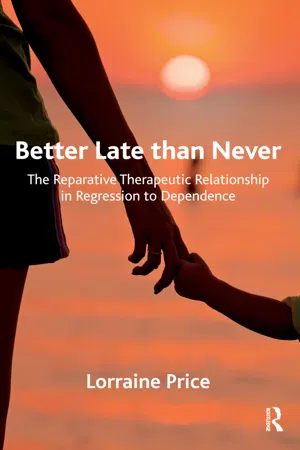
Better Late than Never
The Reparative Therapeutic Relationship in Regression to Dependence
- 238 pages
- English
- ePUB (mobile friendly)
- Available on iOS & Android
eBook - ePub
Better Late than Never
The Reparative Therapeutic Relationship in Regression to Dependence
About this book
This book is concerned with an enigmatic set of experiences which theorists in the Object Relations tradition have characterised as regression to dependence, a return to a primitive, pre-verbal relational process presenting in some clients in psychotherapy. It highlights the effects of early infantile trauma resulting in the experience of failed dependency. Clients who present with chronic anxiety, relational failures and an inner emptiness are considered, and the opportunity for a therapeutic repair is explored with recommendations for the therapeutic stance being made. Written from an Integrative Psychotherapy perspective, it addresses the current absence of writing in the field from a relational / developmental viewpoint on concepts more usually addressed in psychoanalytic writing. The insights of Winnicott are particularly highlighted in relation to failed dependency and maternal failure. This work aims to offer a way forward to successfully work with this client group.
Information
Chapter One
In search of understanding: theoretical explorations
Presenting issues
My client presented with anxiety and panic attacks. She was otherwise high functioning, intelligent, and with a good immediate family support system. As her story unfolded, I understood that she was searching for change, for something transformative and had tried to find it in her relationships with men and her children. At the beginning of therapy, she wanted an end to her anxiety at any cost. She recognised feelings of inner emptiness, which were permanently with her. In the countertransference I felt a strong maternal pull to nurture her, which I have come to recognise as being frequently present when working with clients whom Winnicott (1958a/1984, pp. 279–280) described as needing to address “the early stages of emotional development before, and up to, the establishment of the personality as an entity”. I saw the yearning in her eyes, a yearning for relationship that therapists often experience in clients with borderline process, and although some of her relational history and inner processing indicated such traits, there was no evidence of chaos in her current history, in fact she seemed overly controlled. She did not push boundaries or waiver in her committed relationships, it emerged that her “false self” and toxic shame kept her more borderline tendencies in check. She felt that there was something broken in her and she wanted help to repair this. As I got to know her I saw some of her attempts at intimacy fail and, as our relationship developed I saw her attempts at intimacy with me cause her great fear and difficulty. This client had difficulty in articulating her pain and trauma, and she was bound by shame processes. It seemed impossible for her to allow that she had needs or emotions. This client’s history and her presentation for therapy indicates the presence of infantile neglect or trauma.
Over time, I have recognised that there is no one classic presentation of such clients. Some clients may have more borderline traits, seen in the great fear of abandonment and desire for and avoidance of closeness and intimacy, while some may seem more schizoid, holding no sense of the possibility of relationship. Johnson’s (1994) description of the oral character seems to be most frequently be identified. These clients have not been allowed to fully inhabit the appropriate dependent position in their infancy because of abuse and neglect, more subtle failures of attunement, or the emotional unavailability of the caretaker and so continue to search for it into adulthood. In some clients their deep need of relationship is evident on first meeting, but for some high-functioning, adapted clients it is effectively defended against, and out of awareness, to emerge much later in the work.
The concept of regression to dependence
My theoretical model is Integrative, which brings together theories that are compatible within a relational/developmental philosophical stance. My initial training directed my interest towards object relations theorists and it was the work of Balint (1968) and his understanding of the “Basic fault” which sparked my interest. Balint described the necessity of working with the client at a level of relationship which existed prior to the development of the fault that is at the level of primary anxiety, as Winnicott (1958a/1984) would view it, in order to repair infantile wounding, so allowing the client the possibility of a new beginning. This is the concept of regression to dependence; the return to a relationship having similar characteristics to the parental relationship in order to offer a repair and to enable progression of previously fixated and unresolved relational ways of being.
Connecting theory to practice
My previous study (Price, 2014) has been concerned with finding understanding of this process and ways of applying it in my clinical work with clients, connecting relevant theory to practice and so finding ways of making meaning of the experience, such reflexive practice in psychotherapy is an act of research. This endeavour has a parallel process to the client’s need to understand and to find narrative for their experiences. Shaw (2008, p. 10) recognises the research aspect of psychotherapists in their day-to-day work. He highlights the importance of the “therapist’s body language, the counter-transference that is felt in the body, seeing it as a valuable tool which can be shared in the therapeutic encounter”.
Relevant theory
There is a lack of literature emerging from Integrative sources, yet I recognise that this is the nature of integration, that theorists and theories develop and change, and new theories emerge, becoming theorised as a new therapy rather than being integrated. I found what I was looking for within the object relations movement, offering me a base from which to begin to understand the clients’ processes. Working relationally involves the therapist as an active participant in the relationship, and so the therapeutic stance of psychoanalysis, where the therapist is positioned as a mirror reflecting the client back to themselves, would not be appropriate. The application of theories from object relations within a relational therapy enables understanding of infant developmental processes and provides a template for the identification of infantile wounding and a plan for repair. There is an increased interest in the relational component of therapy, even within theoretical orientations that have previously eschewed the importance of the relationship to the therapy, such as cognitive behavioural therapy. Mitchell (1988) calls this the “relational turn”, recognising the importance of the relationship as a healing factor. Integrative psychotherapists focus on the therapeutic relationship, but to work with regression to dependence requires a more in-depth knowledge of infant development, and of the connection of the original dyadic relationship between caretaker and infant and the therapeutic relationship between therapist and client.
Object relations theory identifies the self as developing in relation to its early environment, the caretaker, (Winnicott, 1965b/1984; Fairbairn, 1952; Mahler, 1968; Mahler et al., 1975) and others. Once the influence of this dyadic relationship is acknowledged, then theorists move towards the construction of the importance of such a relationship and the consequences when it is considered as insufficient for optimal development. It is the therapeutic relationship then which can offer a vehicle to repair those individuals whose early infantile environment has resulted in wounding to their very self.
Psychotherapists as far back as Ferenczi (1923) have understood that psychotherapy needed to be more than an intellectual reconstruction; it needed to be an emotional reliving. The problems presented by our more distressed clients occur as a result of deficiencies in early environmental provision. Love, acceptance, and nurture are essential for a child’s healthy development and such a relational stance is also essential for clients. Ferenczi (1923) considered that where there is a trauma there is always a split in the personality, whereby part of the personality regresses to the pre-traumatic state. He believed that no analysis was complete unless it had penetrated to the level of the trauma, a position that Winnicott would later also hold.
Ferenczi’s ideas were further developed by Klein, Balint, Winnicott, and others who started to construct theories about the mind, using information gathered from infant observation. Mitchell (1988) explains how theoretical traditions from object relations, self psychology, and other interpersonal theories complement each other and can be seen as being within a multi-faceted relational matrix. He makes an important point, that the basic features of an integrated relational approach were not constructed from previous theoretical traditions which were applied to clinical work; rather they were discovered within the practice of psychotherapy. It is the practice of psychotherapy, for myself and my participants, which has necessitated the search for theoretical understanding.
The metaphor of the baby
Infantilism concerns the central role played by concepts of early infantile development to psychoanalytic theory. Freud assumed the successful negotiation of early infancy, seeing the source of psychological conflict occurring later at the oedipal level, but recognising that aspects of a person’s life can be understood in the light of their infant experiences, and if they are, then puzzling and hard to understand experiences, feelings, and behaviours can be illuminated when viewing the client as having aspects of the child within. Van Sweden (1995, p. 33) considers that the primary mother/infant relationship should be dealt with in order for the adult client “to repair pathology stemming from difficulties in the early mother–infant relationship”. Ferenczi (1931) recognised the unmet needs of childhood existing within his clients, and Bollas (1987) links the mother’s provision for her infant with the therapist’s stance within the relationship. Object relations theories are concerned with the relationship of people to other people and to things which are meaningful for them and how these relationships affect our later lives. Klein (1987, p. xvi) seeks to understand what life was like in early infancy, and “what implications does this have for our later years, when we can no longer call on others in quite the same way to take care of the baby which still survives in us?” and “what does this tell us about the help which psychotherapists and psycho-analysts can give if, in later years, we find we are compulsively recreating the relationships which were first developed between the baby-self and the parent adult”. Winnicott (1958b/1984), as both paediatrician and psychotherapist, observed a correlation between his infant patients’ way of being, and his experience of his adult psychotherapy clients. He considered that where there was infantile environmental failure it was defended against by a “freezing of the failure situation” (p. 281). This resulted in an experience of a failed dependency stage, which was then seen to re-emerge within the therapeutic setting as regression to dependence. This re-emergence and its re-enactment exhibited attributes similar to those of the infants he worked with. He theorised that “in the emotional development of every infant complicated processes are involved, and that lack of forward movement or completeness of these processes predisposes to mental disorder or breakdown; the completion of these processes form the basis of mental health” (p. 159), making a link between infant development and psychiatric states. This theory, translated into clinical work, results in the concept of regression to dependence, and the possibility of relational repair facilitated by the therapeutic relationship. Recognising the conceptual correlation between the caregiver/ infant relationship, and the therapist/client relationship means that using the metaphor of the baby, that is working with the perceived infant ego of the client enables understanding and the development of a shared language for the therapeutic process between therapist and client, and begins to bridge the gap between conceptual knowing and application to practice.
Mitchell (1988, p. 127) identifies that “psychoanalytic experience has shown that the scattered and complex fragments of the analysand’s background are often powerfully integrated and illuminated by viewing them in terms of infantile experiences”. Mitchell recognises that viewing obscure and puzzling presentations in the client as if the client was a child can help to organise fragmentary experiences into “coherent, understandable patterns” identifying this as “using the metaphor of the baby”. He highlights the difference between Freud’s baby and the modern baby; Freud’s baby being riddled with conflict, the modern baby being a relational baby, where conflict only arises when there is a lack of parental provision. This is important to theories of developmental-arrest, as in Winnicott’s “deficiency disease”. Mitchell (1988, p. 139) accounts for this shift in understanding of the baby by seeing it as a product of scientific advance coming from the field of infancy research. Object relations theory considers that the primary drive of human beings is for relationship, where relationship has been deficient then the relational needs of infancy, which are necessary for developmental provision, remain active within the adult client. Having reached the concept of these needs, the work of Winnicott, Balint, and other object relations theorists begins to offer insight and understanding into the application of these conceptualisations.
The possibility of therapeutic repair
Balint (1968) and Winnicott (1958a/1984), in particular, recognised that some patients required assistance to deal with the early stages of emotional development before, and up to, the development of personality as an entity. These are the patients whose reparative need is in the dyadic relationship and who need “management” according to Balint (p. 87) and the “mother actually holding the infant” according to Winnicott (p. 279). These regressive experiences, where “talking therapy” (I believe they mean the interpretation aspect here) is neither useful nor therapeutic, offer an opportunity for reparative experiencing. The therapeutic task is simply to be in tune with the client and their developmental needs, to acknowledge and validate, to be fully present within the relationship, and to offer some appropriate gratification.
In the following chapters I will describe the process of regression to dependence in detail, addressing the possibility of repair within the therapeutic relationship.
Chapter Two
Regression to relationship: a return to dependence
I just went into complete collapse, there was a whole lot of things happening in my life […] that was like the crash point, but there was a whole lot of other stuff, that everything had just got too much, and I […]suddenly just couldn’t stop crying. I think I was anxious long before I got to therapy, I was very anxious […] literally feeling that my body doesn’t, isn’t together, that my arms and my body don’t function together, that my legs don’t function together.
[…] an overwhelming […] sense of a kind of lostness and disconnection […] of regressing to a kind of wordless state […].
[…] I couldn’t find the language, though […] and I know I knew, but I didn’t have the language for it […].
These excerpts from my research data describe a sense of disintegration and collapse that echoes theorists’ descriptions of a return to an unintegrated state (Winnicott, 1958a/1984; Van Sweden, 1995). Such regressive experience is viewed by Winnicott (1958a/1984, p. 261) as a return to infantile experiencing, which, when processed within the therapeutic relationship, offers the potential for repair, “The advantage of a regression is that it carries with it the opportunity of correction of inadequate adaptation-to–need in the past history of the patient, that is to say, in the patient’s infancy management.” A relational/developmental theoretical perspective seeks to repair early environmental failures, seeing some clients as having sustained psychological damage very early in their infant development resulting in a variety of relational difficulties throughout later life. The presentation of these clients may include:
- feelings of alienation,
- fear of emotional dependency,
- having difficult intimate relationships,
- fear of abandonment and of being alone,
- feeling that life has no meaning,
- feeling panicky and anxiety ridden,
- feeling that they are living behind an emotional façade,
- feelings of sadness and loneliness even though being a high achiever,
- omnipotent defences and avoidance of vulnerability.
It was with these clients, whose struggle I recognised both personally and as their therapist that I found myself challenged to find ways of working effectively.
As I have already mentioned in chapter one, clients who may benefit from allowing a therapeutic regression to a dependent relationship do vary in their presentation. The therapist may experience the client as having a deep yearning or hunger for relationship. Some clients fit the oral dependent picture, all are heavily defended, often with primitive defences, and are easily shamed. There may be difficulties in holding on to object constancy that is, being unable to conceive that people or objects are consistent, trustworthy and reliable especially when they are not present. This is a developmental skill, which is usually learned in infancy and results from having experiences which confirm the caretaker as reliable and trustworthy and the relationship as ongoing and sustainable.
In this chapter I will identify aspects of theory, moving through historical perspectives towards more contemporary theorists, which are relevant to working with these issues. I will explain the place of transference and unconscious process in integrative psychotherapy and describe theoretical understanding of ideal infant development, which supplies a good environment in which the innate potential of the infant can develop. I will also introduce theoretical understanding of the influence of early environmental failure upon infant development, and the potential for trauma as a result, such ideas that are now supported and informed by neuroscientific research. Having explored infant development I will then describe what I mean by “regression ” itself, and “regression to dependence”, and how this offers the prospect of psychological progression.
Seeking answers in theory
My Integrative theoretical orientation owes much to object relations theory and it was into this field that I first looked for answers. How to more effectively help such clients is an important question for me, and a question that has occupied the thoughts of practitioners and theorists for many years. The original psychoanalytic position presented by Freud viewed the mind as monadic, that is, a unit operating and developing by and of itself. Later relational theorists viewed the development of the mind as occurring in the relational matrix. Mitchell (1988, pp. 17, 19–33) considered that the “mind has been redefined from a set of predetermined structures emerging from inside an individual organism to transactional patterns and internal structures derived from an interactive, interpersonal field”. He writes that “the individual mind is a product of as well as an interactive participant in the cultural, linguistic matrix, within which it comes into being. Meaning is not provided a priori, but derives from the relational matrix. The relational field is constitutive of individual experience”. He explains that “for Kohut, as for Winnicott, the establishment of reflexive stability is the central motivational thrust in human experience, and ...
Table of contents
- Cover
- Half Title
- Title
- Copyright
- Dedication
- Contents
- ACKNOWLEDGEMENTS
- ABOUT THE AUTHOR
- INTRODUCTION
- CHAPTER ONE In search of understanding: theoretical explorations
- CHAPTER TWO Regression to relationship: a return to dependence
- CHAPTER THREE Shame in regression to dependence
- CHAPTER FOUR Terror: a sickness of spirit
- CHAPTER FIVE A relational response
- CHAPTER SIX A question of boundary
- CHAPTER SEVEN Reflections and conclusions
- APPENDIX Research findings table
- REFERENCES
- INDEX
Trusted by 375,005 students
Access to over 1.5 million titles for a fair monthly price.
Study more efficiently using our study tools.
Frequently asked questions
Yes, you can cancel anytime from the Subscription tab in your account settings on the Perlego website. Your subscription will stay active until the end of your current billing period. Learn how to cancel your subscription
No, books cannot be downloaded as external files, such as PDFs, for use outside of Perlego. However, you can download books within the Perlego app for offline reading on mobile or tablet. Learn how to download books offline
Perlego offers two plans: Essential and Complete
- Essential is ideal for learners and professionals who enjoy exploring a wide range of subjects. Access the Essential Library with 800,000+ trusted titles and best-sellers across business, personal growth, and the humanities. Includes unlimited reading time and Standard Read Aloud voice.
- Complete: Perfect for advanced learners and researchers needing full, unrestricted access. Unlock 1.5M+ books across hundreds of subjects, including academic and specialized titles. The Complete Plan also includes advanced features like Premium Read Aloud and Research Assistant.
We are an online textbook subscription service, where you can get access to an entire online library for less than the price of a single book per month. With over 1.5 million books across 990+ topics, we’ve got you covered! Learn about our mission
Look out for the read-aloud symbol on your next book to see if you can listen to it. The read-aloud tool reads text aloud for you, highlighting the text as it is being read. You can pause it, speed it up and slow it down. Learn more about Read Aloud
Yes! You can use the Perlego app on both iOS and Android devices to read anytime, anywhere — even offline. Perfect for commutes or when you’re on the go.
Please note we cannot support devices running on iOS 13 and Android 7 or earlier. Learn more about using the app
Please note we cannot support devices running on iOS 13 and Android 7 or earlier. Learn more about using the app
Yes, you can access Better Late than Never by Lorraine Price in PDF and/or ePUB format, as well as other popular books in Psychology & History & Theory in Psychology. We have over 1.5 million books available in our catalogue for you to explore.