eBook - ePub
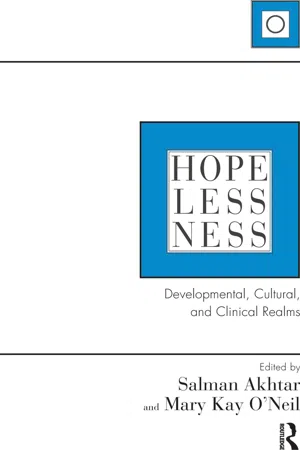
Hopelessness
Developmental, Cultural, and Clinical Realms
- 256 pages
- English
- ePUB (mobile friendly)
- Available on iOS & Android
eBook - ePub
Hopelessness
Developmental, Cultural, and Clinical Realms
About this book
Hope is the most reliable sustainer of life. It offers the promise of something good in the future, contributes to resilience, and keeps one going. However, there are circumstances when hope dries up. This book seeks to map out such dark terrain of hopelessness. While it allows for the fact that a modicum of hopelessness might help in reducing infantile omnipotence and curtailing fixation on unrealistic goals, its focus is upon severe and clinically significant shades of hopelessness. The book opens with a broad overview of the nature, developmental origins, and technical implications of hope and hopelessness, and closes with a thoughtful summary, synthesis, and critique of the intervening essays; this summary forges both theoretically and technically significant links between the experiences of helplessness and hopelessness. Sandwiched between these opening and closing commentaries are nine essays which address the ontogenetic trajectory, phenomenological variations, cultural and literary portrayals, and clinical ramifications of sustained hopelessness.
Information
Part I
Developmental Realm
CHAPTER TWO
The encounter with hopelessness in childhood
Ann Smolen
Georgie, Rose, Lizzie, Anita, Sara, and Helen are just six children of the many whom I have had the privilege to work with, and get to know over the years. They each, in their own way, exemplify what it may feel like to experience hopelessness and shared that terrifying emotion with me, yet simultaneously they all exhibited hope as they forged their way forward. The hope was always present, even in the worst of times. “Such hopelessness is, of course, not the loss of hope itself. It is the losing of hope for one’s hope” (Boris, 1976, p. 141). But before I delve deeper into the realm of hopelessness during childhood, let me introduce you to the children I have just mentioned.
Georgie lay in an orphanage crib flat on his back for the first nine months of his life. When his adoptive father came to fetch him from across the ocean, he was not able to sit up or roll over, staring with empty eyes, opened wide, toward his hands held palms up seemingly searching.
Rose, an eleven-year-old girl with the bluest of eyes and hair like Rapunzel, could no longer walk or speak. She needed to be dressed and fed by her parents and developed a chronic gagging reflex. She kept a tissue covering her mouth as she lay mute on my couch.
Lizzie, a sweet three-and-a-half-year-old girl, refused to even entertain the idea of potty training. She had undergone multiple intrusive medical interventions to alleviate severe constipation and was terrified to defecate and urinate. She seemed to want to remain an infant, terrified to grow up, her rage always threatening to erupt, but only communicated through her body.
Anita, a beautiful and gifted seven-year-old girl, was academically years ahead of her peers. She had difficulty making and keeping friends and withdrew into her books. She too was terrified of the world and enraged by her own and others’ limitations.
Sara, age two and a half, spent her first two years living on the street, her mother unable to look at her, for she only saw an image of herself staring back, and she hated what she saw. Sara sat alone in the corner of the daycare unable to connect or engage with anyone.
Helen was diagnosed with Asperger’s as a school-aged child. At sixteen, she came to me asking for an analysis with the hope of one day having a friend. Helen often felt her life was not worth living.
A quick survey of literature
Spitz (1946) shocked the medical community with his videos of “hopeless” children. He formulated the term “anaclitic depression” to describe infants after six months of age who experienced prolonged separations from their primary caregiver and developed symptoms of weeping, apathy, inactivity, withdrawal, sleep problems, weight loss, and developmental regressions. In addition, feelings of loneliness, helplessness, and fear of abandonment are now understood to be a part of the syndrome. If adequate mothering is re-established within a reasonable time period, the infant is expected to recover. Spitz (1965) also described this as an “emotional deficiency disease.” The occurrence of an anaclitic depression was linked by Spitz to the “developmental milestone of the mother’s becoming a consistent and recognized object for the infant” (Wagonfeld & Emde, 1982, p. 66). “Anaclitic” means “leaning upon,” and in anaclitic depression the infant becomes depressed because the mother is not experienced as available to lean upon. Anaclitic depression is related to the establishment of an object tie. Spitz emphasized that the children who develop anaclitic depressions are those who had once developed satisfactory object ties. A good object attachment must first be established in order for its loss to be mourned.
Many of the babies that Spitz observed died. I believe that those infants experienced hopelessness. Without hope there is no will to live and we die. In the Greek myth of Pandora’s Box, Zeus put hope at the very bottom beneath all the evils in the world. Under greed, vanity, envy, and slander lay hope. “Sometimes, hope for the right thing can be reached only through an immersion in prolonged and harrowing dread” (Mitchell, 1993, p. 228). The babies that Spitz observed had become hopeless.
Later observers confirmed what Spitz had noted. Erikson (1950) spoke of the loss of maternal love as a cause of anaclitic depression, which he described as a “chronic state of mourning.” He further speculated that infants and young children who suffer from the loss of the libidinal object during the second half of the first year might experience a depressive undercurrent for life. Bowlby (1960) wrote of the effect of maternal loss on the developing infant and observed the sequence of protest, despair, and detachment behaviors from prolonged separation. Mahler (1968) understood anaclitic depression in terms of separation-individuation. She stated that after six months, once a symbiotic relationship with the mother has been established, she is no longer transposable, and her loss produces an anaclitic depression in the infant.
Erikson (1950) and Winnicott (1956) wrote further about hope in relation to children. Erikson connected the ideas of hope and hopelessness to a basic sense of trust and a basic sense of mistrust that developmentally occurs in early infancy. If the infant’s psychological and physical needs are met within reason, he learns to trust, and within this trust lies hope. Erikson viewed hope as progressive and growth enhancing, not regressive. Winnicott, in his 1996 work with acting-out adolescent boys, understood their difficult behaviors as an expression of hope. Winnicott too viewed hope as constructive and progressive. Winnicott saw regression as a vital characteristic of the therapeutic process.
Besides these early writings, there is very little in the psychoanalytic literature about hope and hopelessness. Boris (1976) and Mitchell (1993) are among the few who have explored this topic. Boris stated: “If one searches the literature hope itself is nowhere to be seen. This is no accident. Psychoanalysis is primarily a theory concerning desire and its vicissitudes” (p. 139). He conceived of hope as a psychological space where the self may find a new beginning. In Boris’s theory, hope must first be given up within the analytic experience, in order to experience despair. In Boris’s mind, only then can one truly experience desire. Mitchell (1993) pointed out that psychoanalytic theory has approached hope from two opposing angles. The more traditional view regards hope as essentially progressive and facilitating of richer experiences. The opposing viewpoint is that hope, especially when excessive, is regressive and obstructs maturation and gets in the way of enjoying one’s life experiences.
The children
The following clinical vignettes demonstrate how hopelessness and hope are represented and communicated within the psychoanalytic treatments of six children.
Georgie
At nine months old, he was developmentally more like a three-month-old infant and deteriorating quickly. He could not hear due to untreated ear infections, did not smile, and stiffened when held. His adoptive father was horrified as this was not the infant son he had fantasized holding in his arms, but he could not turn around and fly back across the world without him or he would feel like a murderer. Once in the States with his adoptive parents, Georgie quickly caught up developmentally. His hearing returned to normal, he developed an infectious smile, and he became a very energetic toddler and preschooler. However, by kindergarten, Georgie began to exhibit some disturbing behaviors that caused his private school to recommend psychological testing. Georgie was unable to maintain friendships, urinated on the floor, hoarded food, ran out impulsively into parking lots and, as his father put it, refused to listen or be affectionate with his father.
I have written about Georgie elsewhere (Smolen, 2009), but here I wish to focus on one small portion of Georgie’s treatment. I imagine that as an infant Georgie felt annihilation anxiety—or as Winnicott (1987) poetically described it—like “falling and falling and falling.” I assume that that feeling is as close to hopelessness as one can get without dying. Georgie was an imaginative and creative little boy always engaging me in elaborate and sometimes convoluted dramas. Together we were many characters. What was strange and different about Georgie’s imaginative play was that we were never human. Sometimes we were two marbles, or matchbox cars, or magnetic sticks, or magic markers. We were never living figures such as animals or dolls from my dollhouse. A few months into his analysis, Georgie told me that he was never born, never had a mother, and in fact had evolved from a bug. Shortly after this interchange, Georgie began to play with a small toy transformer that transformed from a bicycle into a boy. The only problem with this toy was it was extremely fragile and would fall apart easily. Georgie named it “Fragile” as he cupped it tenderly in his hands telling me over and over how difficult it is to not fall apart, how very fragile he felt and so very broken. Georgie’s sessions were first thing in the morning before school. He would run up my stairs eager to begin where he had ended the day before, but first would curl into the fetal position in front of the heater, warming himself as he tenderly held onto Fragile. As we sat together in front of the heater, I imagined him as an infant in a barren hospital ward, cold and alone.
Georgie and I confronted many intrapsychic conflicts, and worked on several areas where he had become stuck developmentally; however, most problematic was Georgie’s relationship with his father. After much deliberation, Georgie’s father began to attend one of his sessions each week. The following vignette is from that first triadic session.
I was quite anxious about bringing Georgie’s father (Herb) into the treatment. I was concerned that he might feel criticized by me. I somehow wanted to help both of them view their conflicts without causing Herb to feel incompetent. This first joint session was filled with tension. Herb was immediately intrusive into Georgie’s play, asking questions that demanded a correct answer. Georgie regressed to his very first interaction in the playroom and began to play basketball. Herb commented on all correctly thrown balls. Finally Georgie told his dad that he did not wish to be watched.
G: Don’t look at me!
DAD: Are you worried I will judge you? I love you. Does it feel like I don’t love you?
[Georgie becomes very silly and falls to the floor.]
A: Um, Georgie has become very silly. I’m wondering if something feels uncomfortable? Dad, what do you think about these silly feelings Georgie is having right now?
[Georgie hides.]
D: I see he is hiding now. [He jumps out of his hiding place with a loud “Boo!”]
A: I’m thinking that maybe you don’t want Dad to look at you and you do want Dad to look at you all at the same time. Something got uncomfortable and you told Dad not to look, then the silly feelings came, then the hiding feelings. But you jumped up with a loud “Boo” and a big smile. I think you want Dad to look and not look.
[Georgie agrees and puts his head down, visibly upset and begging his father to leave the room.]
G: I don’t want you here. It feels very bad.
D: But, Georgie, I want to be part of your life. I want to know what you do in here.
G: It doesn’t mean you aren’t part of my life if you don’t come in here. I don’t want you here. Please leave.
Herb refused to leave, so Georgie ran out of the playroom and out of my waiting room. Herb ran after and carried him back, allowing him to come alone with me but he was angry. Once upstairs and safe in the playroom, Georgie was quite agitated and explained that his dad “is the busiest man in the world and does not know how to play.” I wondered if we could work together to help Dad learn how to play. Georgie gathered up Fragile, and, cupping it in his hand tenderly, carried it down to the waiting room and explained to his father why Fragile had to be handled with care. Dad came back into the playroom where Georgie destroyed Fragile, and he and Georgie, head-to-head, gently and carefully put him back together. Later that afternoon, I processed the session with Herb who was moved by my interpretation of “Fragile.” Herb opened up and spoke at length about his own painful childhood experiences and spoke of his identification with his young son. Georgie was showing his father, through his play, how broken and helpless he has felt, and at times continues to feel, but he can be put back together and he can be a human boy, if handled with care. Georgie was full of “hope.”
Rose
Rose, an eleven year old extremely bright and beautiful girl, was referred to me with a diagnosis of conversion disorder. She was no longer able to eat solid food, could not speak or walk without heavily leaning on a parent, and even stated that she had lost cognitive function. For example, when her mother asked her to use a spoon in order to eat her ice cream, she responded that she no longer knew what a spoon was.
The first time I met with Rose, her father practically carried her into my office and laid her down on my analytic couch. I pulled my chair away from behind the couch to sit facing her. Rose appeared extremely distressed with a towel pressed against her mouth as she chronically gagged and spit saliva. After telling Rose what I knew about her condition and acknowledging her parents’ frustration and worry, I suggested we write a story together. I was seeing Rose every day so for the first week she dictated the narrative and I typed. Rose quickly grew tired of my slow typing skills; by the second week she was sitting up in a chair and typing the story as I sat beside her, commenting on the drama that unfolded. The following is what Rose dictated to me in her first session:
Setting: An orphanage 100,000 years in the future.
Main character: Five-year-old girl with long blue curly hair and beautiful violet eyes. She has no name. Her parents gave her away. They kept her older brother and sister. She was two years old when she was given away to the orphanage. Robots operate her orphanage. The children are the only humans in the orphanage. There is no love.
This is a world in the sky. They live on the clouds.
When they leave the orphanage they go to the government and are given a name. They do not leave the orphanage until age fifty, but they live until age 1000.
In this world you can’t be sick. When you are born, you are given all of the medicine in the world in a vaccine. But if the government doesn’t like you, they kill you. They throw them off the clouds. The government doesn’t know that you don’t die when thrown from the clouds. Instead you fall into the past. You fall into now.
The only way you can get thrown off the clouds is if you are different from everyone else.
The ending: The reason why we have all different people NOW is from the different children thrown off the clouds into NOW.
Her parents gave her away because she was different. They didn’t want to be sad when she was thrown from the clouds. It is really bad. They were only thinking of themselves, not her. They were thinking of their other children.
She is different because she is super smart. That is how they knew she was different. When she was two she could read and write and had a huge vocabulary.
Over the next fourteen months, Rose continued to write her story. The main character (Different) experienced jealousy, envy, sadness, rage, physical illness, and injury; she fell in love with her teacher (a much older man); she experienced difficult relationships with a sister-like character, and a mother-character. Within her writing of her story, Rose worked through separation issues and her conflict about growing up. She quickly let go of her symptoms, did well in school, had good friendships, and went off to overnight camp.
Rose communicated her feelings of hopelessness through a total regression into infancy where she needed to be fed, dressed, and carried by her parents. Within her regression was hope.
Lizzie
Lizzie became severely constipated when only six weeks old and was encopretic by the time she was two and a half. There were multiple occasions when her stomach would become distended and she experienced terrible pain. She began to withhold bowel movements for up to two weeks and eventually was admitted to the hospital where she underwent three days of intrusive medical procedures. Once home again, her parents were instructed to insert a rectal tube at night to allow drainage. This took place over a three-month period. The family was referred for outpatient cognitive-behavioral therapy that Lizzie attended for just under a year.
I first met Lizzie when she was three and a half years old, when her parents became frustrated with her current treatment and sought out a child psychoanalyst. At home, Lizzie fell into terrible tantrums at the slightest frustration; she refused to even attempt to use the toilet, and was terrified of bodily harm. If she fell and scraped her knee, she decompensated and could not be comforted for a prolonged period of time. After meeting with her highly intelligent, warm, and caring parents several times, it became apparent that they were terrified and paralyzed by Lizzie’s rage, which in turn, caused Lizzie to be petrified of her own aggression.
When I met with Lizzie she appeared babyish, well behind where she needed to be in her psychological and physical development. In her first three sessions she spoke very little, did not seem interested in exploring my playroom or in me, and seemed shut down and depressed. In her fourth session, the following took place:
Lizzie showed an interest in my sandbox. I uncovered it and got her a stepstool so she could reach the sand. She played silently for several minutes, absentmindedly pouring sand from one hand to the other. Then her eye caught a small plastic container. She picked it up and shook it, discovering that there was a tiny something trapped inside of the container.
L: There is something in here.
A: Umm, is it stuck?
L: Yes I can’t get it out and it is stinky.
A: Oh my there is something very stinky in there and you can’t seem to get it out.
[She became animated and excited]
L: Yes! Yes! It won’t come out, I can’t get it out, and it is getting stinkier and stinkier!!
A: This is a problem. What are we going to do about this very stinky thing in this container?
L: Do you have paper towels?
[I pointed to the top of my toy shelf to show her my large roll of paper towels]
L: If this thing stays in here the whole weekend, it is going to make a very big mess!! You can never have enough paper towels for this mess! You better go to the store and buy a hundred million paper towels for this big stinky mess!
At this point Lizzie was so excited her body was shaking. She dumped out the tiny stinky thing and flushed it down my dollhouse toilet. However, this was not a big enough toilet for her huge mess and she insisted that we leave my office and go down the hall to the bathroom to flush it down a real toilet. She asked me to help her and together we flushed it down the toilet. When she went back to my playroom, she was ravenous and pretended to eat up all the food in the world and then said: “We got rid of Mr. Stinky!!!” Six weeks later, with parent education, Lizzie was toilet trained.
Lizzie terminated her analysis shortly before entering second grade. She had worked through her fear of bodily intrusion, was coping with separating and growing up, and was able to take risks. She had many friends, tried new foods, learned to ride her bike, perform in her ballet recital and all the other activities appropriate for seven-year-old children. When I first met Lizzie, she had been successful in remaining an angry baby by staying in diapers and demanding that her parents care for her as such or else!! There was painful anguish in this and she seemed hopeless, but like Rose, there was great hope in her hopelessness.
Ani...
Table of contents
- Cover
- Half Title
- Title
- Copyright
- Dedication
- Contents
- ACKNOWLEDGEMENTS
- ABOUT THE EDITORS AND CONTRIBUTORS
- INTRODUCTION
- PROLOGUE
- PART I: DEVELOPMENTAL REALM
- PART II: CULTURAL REALM
- PART III: CLINICAL REALM
- EPILOGUE
- REFERENCES
- INDEX
Trusted by 375,005 students
Access to over 1.5 million titles for a fair monthly price.
Study more efficiently using our study tools.
Frequently asked questions
Yes, you can cancel anytime from the Subscription tab in your account settings on the Perlego website. Your subscription will stay active until the end of your current billing period. Learn how to cancel your subscription
No, books cannot be downloaded as external files, such as PDFs, for use outside of Perlego. However, you can download books within the Perlego app for offline reading on mobile or tablet. Learn how to download books offline
Perlego offers two plans: Essential and Complete
- Essential is ideal for learners and professionals who enjoy exploring a wide range of subjects. Access the Essential Library with 800,000+ trusted titles and best-sellers across business, personal growth, and the humanities. Includes unlimited reading time and Standard Read Aloud voice.
- Complete: Perfect for advanced learners and researchers needing full, unrestricted access. Unlock 1.5M+ books across hundreds of subjects, including academic and specialized titles. The Complete Plan also includes advanced features like Premium Read Aloud and Research Assistant.
We are an online textbook subscription service, where you can get access to an entire online library for less than the price of a single book per month. With over 1.5 million books across 990+ topics, we’ve got you covered! Learn about our mission
Look out for the read-aloud symbol on your next book to see if you can listen to it. The read-aloud tool reads text aloud for you, highlighting the text as it is being read. You can pause it, speed it up and slow it down. Learn more about Read Aloud
Yes! You can use the Perlego app on both iOS and Android devices to read anytime, anywhere — even offline. Perfect for commutes or when you’re on the go.
Please note we cannot support devices running on iOS 13 and Android 7 or earlier. Learn more about using the app
Please note we cannot support devices running on iOS 13 and Android 7 or earlier. Learn more about using the app
Yes, you can access Hopelessness by Salman Akhtar, Mary Kay O'Neil, Salman Akhtar,Mary Kay O'Neil in PDF and/or ePUB format, as well as other popular books in Psychology & Clinical Psychology. We have over 1.5 million books available in our catalogue for you to explore.