- 584 pages
- English
- ePUB (mobile friendly)
- Available on iOS & Android
eBook - ePub
About this book
Program management is a rapidly emerging offshoot of project management. So much so that AT&T, IBM, and other organizations, both large and small in all sectors, have initiated a push to certify program managers. And, although universities offer courses in program management, there are few books available to guide program managers through this
Information
1

Achieving Business Advantages through Program Management

Kai Schüler, PMP, PgMP
CONTENTS
Introduction
The Case for Program Management in Business
How Did Program Management Originate?
What is a Program, and What Should be Managed as a Program?
Why Program Management Is Important?
What is Program Management’s Place in the Organization?
Competitive Advantages through Program Management
A Starting Point
The Next Step—Shaping the Structure
What Is a PMO?
Scalable Structure and Processes
How Does Program Management Close the Gap?
An Introduction Path for Program Management
Specific Business Benefits of Program Management
Program Management Focuses on Complexities
Summary—The Bottom Line
References

INTRODUCTION
Why is program management important for business? Should program management be used only just for software development? Is program management just a technical thing to manage complicated projects?
Those are some of the questions that may be asked when discussing program management with organizations. The perception is that program management is a technical function, mostly used in information technology (IT), and something that is entirely optional.
However, the fact of the matter is: it is optional. It is chosen by organizations that seek to differentiate themselves from increasing competition. Advanced organizations and companies that want to stay ahead of the competition have embraced program management as a means to deal with increasing complexity and competitive pressure in the business environment. It provides them with triple win advantages over the competition. But what are those triple advantages?
• Predictability and reliability of technical and project execution.
• Increased customer satisfaction because of better project performance
• Increased return on investment (ROI) because initiatives of large scale, high complexity and substantial risk potential are constantly aligned to overall organizational strategy.
This chapter seeks to shed light on these triple advantages and will explain how organizations can increase their project performance through program management. It will explain how organizations can improve their customer satisfaction by delivering higher quality programs and projects at a reduced overall cost. And last not least, it will explain how businesses can shape more dynamic and more flexible organizations to adapt to shifting environments.
THE CASE FOR PROGRAM MANAGEMENT IN BUSINESS
Before considering program management as a tool to advance an organization’s bottom line, it is important to understand where it came from and how it fits into the overall organization. To understand what it is, and what it is not, will help understand what it can do for businesses.
How Did Program Management Originate?
Program management (programme management in British terminology) as a business discipline is relatively young. Even though its roots go back to the 1950s (the development of a U.S. underwater missile launcher system is often mentioned as the first application of program management practices), it really developed in the 1980s on the civilian side and sought to increase target and financial orientation in government initiatives.
What is a Program, and What Should be Managed as a Program?
A program is defined by the Project Management Institute (PMI®) (PMI®, 2008) as: “a group of related projects managed in a coordinated way to obtain benefits and control not available from managing them individually” (p. 5). Benefit, as used in this context, is the combined outcome of component projects and initiatives that aggregate to a common product, advantage or capability. Examples of benefits could be increased profits, improved operations, or growth.
According to the International Association of Project Management (IPMA) (IPMA, 2006), a program: “consists of a set of related projects and required organizational changes to reach a strategic goal and to achieve the defined business benefits” (p.130). The change character is apparent, as many organizational change initiatives are successfully implemented as programs.
Program management, as defined by the PMI® (PMI®, 2008) is “the centralized coordinated management of a program to achieve the program’s strategic objectives and benefits. It involves aligning multiple projects to achieve the program goals and allows for optimized or integrated cost, schedule, and effort” (p. 6).
While there is truth in all of these statements, an underlying benefit cannot be stressed enough: program management is all about business results.
In analyzing the roots of program management, there is a strong tie to project management. Frequently, both terms are used interchangeably in error. A key reason why they are not the same, and in fact why program management was developed in the first place, was the fact that project management is mainly a technical discipline, which can easily get detached from the business. While project management is tactical in nature (‘doing things right’), program management is highly strategic and more closely aligned with portfolio management with a focus on (‘doing the right things’).
WHY PROGRAM MANAGEMENT IS IMPORTANT?
Organizations with some degree of proficiency and experience in project management can fall into a complexity trap as the size of the project, the size of the organization, and business risk increases. For example, envision a project that was started to achieve technical or other highly measurable goals. This project can run for a long period of time, even years. The financial and risk exposure can be substantial. While the project team, led by its project manager, does a good job steering the project goals of time, quality and budget (the triple constraint), the environment might have shifted since the project’s kick-off meeting. Even though the project meets its originally set targets, it may no longer be relevant to the changing business needs of the performing organization. Resources are spent in a way that is not optimally aligned with business strategy. Program management can be an excellent choice for an organization to avoid the described trap.
WHAT IS PROGRAM MANAGEMENT’S PLACE IN THE ORGANIZATION?
It is important to consider how things fit together. There are several pillars in business, some of the most important are:
• Strategic Business Planning
• Portfolio Management
• Program Management
• Project Management
• Operations Management
These pillars jointly form a networked support structure for project-oriented organizations. Operations own resources, skills and capabilities that are applied to drive project work. Projects create deliverables, as outlined in their charters and scope of work. Programs generate business benefits by governance and ownership of projects and other initiatives. These benefits help achieve top-level organizational strategic goals, that might be grouped and organized with help of portfolio management, see Figure 1.1.
Portfolio management is established to support strategic business planning in an ongoing fashion. As mentioned earlier, benefits are combined deliverables that leverage against each other, and together provide a larger gain to the organization than just the simple sum of those deliverables.
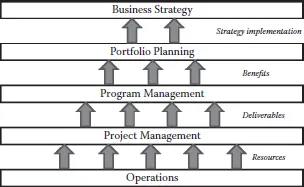
FIGURE 1.1
Program management in the organization.
Program management in the organization.
Whether a program has to run for a finite period is in question. There are different views relative to the finite nature of a program (in contrast a project always has a finite duration). In reality, program durations may not always be known at the outset; however, a program can and will eventually reach the end of its useful life cycle. At that point, as a strategic business decision, the program should be terminated.
COMPETITIVE ADVANTAGES THROUGH PROGRAM MANAGEMENT
Organizations are embracing program management in order to improve their bottom line. Consider how this works, and how organizations can get started with the process of implementing program management for greater returns.
A Starting Point
Originally a technical function, project management was developed as a means to deal with complexity. As a byproduct, it became also a competitive advantage of organizations. By applying project management, the success rate of projects typically increases for organizations. The percentages of goal achievement in time, budget and quality tend to increase. These achievements allow organizations to better predict their costs and help minimize risk and uncertainty. In a competitive bid situation, the organization with better control of its project delivery often wins the order. Reduced contingencies are only one area where organizations specifically can reduce their cost, and reduced cost can help win orders.
The Next Step—Shaping the Structure
As projects and initiatives increase in scale (higher cost, longer durations, and increased complexity), advanced project management techniques and processes allow organizations to balance risks and rewards. Multi-project management, sometimes supported by a Project Management Office or a Program Management Office (PMO) within the organization, increases the likelihood of success and furthermore of not getting overwhelmed by the more demanding business environment.
The PMO can be either a Project or Program Management Office, depending on the individual level of experience and maturity of the performing organization. Since this chapter has its focus on program management; therefore, the PMO is viewed in a program context.
WHAT IS A PMO?
For many organizations a PMO is the preferred way to organize processes and procedures, everything that has to do with program and project implementation. Whether an organization has two different types of structures for program and project management greatly depends on its size and industry. For many smaller- to medium-sized organizations, a PMO can support both programs and projects at the same time. Often the head of program management is also (directly or indirectly) in charge of all program and project managers within the organization. This delivery-oriented approach works well for many organizations.
Some of the key goals and duties of a PMO include:
• Provide a formal and administrative infrastructure for programs and projects
• Define program and project management processes for the organization
• Ma...
Table of contents
- Cover
- Title Page
- Copyright
- Dedication
- Contents
- Preface
- About the Editor
- About the Contributors
- Acknowledgments
- Chapter 1 Achieving Business Advantages through Program Management
- Chapter 2 Strategic Planning and Program Management: Implementing an Organizational Strategic Vision through a Disciplined Program Management Approach
- Chapter 3 Change Management: The Good, the Bad and the Ugly
- Chapter 4 Communication, Complexity Theory, and Programs
- Chapter 5 Program Initiation
- Chapter 6 Benefits Management
- Chapter 7 The Earned Benefit Method for Controlling Program Performance
- Chapter 8 Demystifying Stakeholder Management: The Science and the Art
- Chapter 9 Closing the Expectations Gap: Setting and Managing Expectations
- Chapter 10 Communication and Its Power at the Program Level: Managing Power Brokers with Effective Communication
- Chapter 11 Program Governance: Toward a Conceptual Framework
- Chapter 12 Decision Gate Discipline for Programs
- Chapter 13 Mobilizing the Organization: The Discipline of Execution
- Chapter 14 The Program Management Office (PgMO)
- Chapter 15 Program Management Office: Role and Challenges
- Chapter 16 Program Risk Management
- Chapter 17 Program Manager Competencies
- Chapter 18 Information Structuring “Methodology”: Tools and Techniques for Effective Program Management
- Chapter 19 The Influence of Consortiums in Developing and Developed Countries
- Chapter 20 The Increasing Importance of Social and Business Media in Program Management
- Chapter 21 Portfolio, Program, and Project Management as Enablers of Innovation
- Chapter 22 Organizational Maturity: Managing Programs Better
- Chapter 23 Sustainability Program Management
- Index
Trusted by 375,005 students
Access to over 1.5 million titles for a fair monthly price.
Study more efficiently using our study tools.
Frequently asked questions
Yes, you can cancel anytime from the Subscription tab in your account settings on the Perlego website. Your subscription will stay active until the end of your current billing period. Learn how to cancel your subscription
No, books cannot be downloaded as external files, such as PDFs, for use outside of Perlego. However, you can download books within the Perlego app for offline reading on mobile or tablet. Learn how to download books offline
Perlego offers two plans: Essential and Complete
- Essential is ideal for learners and professionals who enjoy exploring a wide range of subjects. Access the Essential Library with 800,000+ trusted titles and best-sellers across business, personal growth, and the humanities. Includes unlimited reading time and Standard Read Aloud voice.
- Complete: Perfect for advanced learners and researchers needing full, unrestricted access. Unlock 1.5M+ books across hundreds of subjects, including academic and specialized titles. The Complete Plan also includes advanced features like Premium Read Aloud and Research Assistant.
We are an online textbook subscription service, where you can get access to an entire online library for less than the price of a single book per month. With over 1.5 million books across 990+ topics, we’ve got you covered! Learn about our mission
Look out for the read-aloud symbol on your next book to see if you can listen to it. The read-aloud tool reads text aloud for you, highlighting the text as it is being read. You can pause it, speed it up and slow it down. Learn more about Read Aloud
Yes! You can use the Perlego app on both iOS and Android devices to read anytime, anywhere — even offline. Perfect for commutes or when you’re on the go.
Please note we cannot support devices running on iOS 13 and Android 7 or earlier. Learn more about using the app
Please note we cannot support devices running on iOS 13 and Android 7 or earlier. Learn more about using the app
Yes, you can access Program Management by Ginger Levin in PDF and/or ePUB format, as well as other popular books in Business & Management. We have over 1.5 million books available in our catalogue for you to explore.