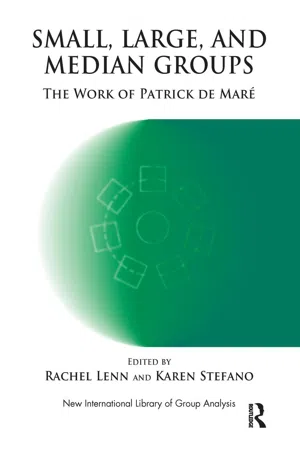
eBook - ePub
Small, Large and Median Groups
The Work of Patrick de Mare
- 224 pages
- English
- ePUB (mobile friendly)
- Available on iOS & Android
eBook - ePub
Small, Large and Median Groups
The Work of Patrick de Mare
About this book
'This book is a remarkable tribute to the memory of Pat de Mare. You will find in these pages a selection of his work that represents his new and different understanding of groups, both large and small, that has not only had a significant impact on the practice of group therapy in his lifetime, but also a potential for revolutionizing current thinking both now and in the future. The editors are owed a great debt of gratitude for putting so much important work together. They have organized the book around three sections on the small, median and large groups. What is particularly moving is that each section is introduced by some of Pat's closest friends and colleagues. These introductions are not only invaluable preparation for reading the articles by Pat that follow, but are also a poignant tribute to the writers' lives, work, their thinking and much happiness that came from their close relationship with Pat.
Information
PART I
SMALL GROUPS
“Group-analytic psychotherapy is a method of group psychotherapy initiated by myself from 1940 onwards in private psychiatric practice and out-patient clinics. It grew out of, and is inspired by, my experience as a psychoanalyst, but also it is not a psychoanalysis of individuals in a group. Nor is it the psychological treatment of a group by a psychoanalyst. It is a form of psychotherapy by the group of the group, including its conductor. Hence the name ‘Group Analytic Psychotherapy’.”
(Foulkes, quoted in de Maré, 1983, p. 229)
“Basically the contribution of Foulkes and Northfield was the handling of a new dimension; the social, the cultural and the political in relationship to neurosis … I realize today that what I witnessed there was a man vitalized by the discovery of this crucial issue, of the link between the deepest ‘vertical’ levels of the intrapersonal psychoanalytic with its ‘horizontal’ transpersonal social context.”
(de Maré, 1983, pp. 228-229)
Reference
De Maré, P. (1983). Michael Foulkes and the Northfield Experiment. In: M. Pines (Ed.), The Evolution of Group Analysis (pp. 218–231). London: Routledge & Kegan Paul.
Introduction to small groups
Pines Malcolm
I have always regarded Patrick de Maré as a man ahead of his time, able to envisage and then to pull together the skeins of wide ranging psychological, philosophical, and historical ideas. The two main papers in this section are written in the 1960s and there is still much to be learnt from our gleanings from his theoretical fields.
The paper “Non-transference elements in group psychotherapy” is undated. It is a more than adequate account of Foulkes’ model of group psychotherapy given to an international congress where many different approaches are being debated. The originality of de Maré’s own thinking appears when he is giving the wider context: the first and second scientific revolutions; Lewin’s field theory; cybernetics and information theory; the transference from energy to information. This paper, which conveys de Maré’s wide-ranging intellect and interest, is invaluable, as it conveys more clearly than did Foulkes himself the pulse of the time. His own language begins to appear when he writes, “Ego training is an active and a corrective experience, not by the analyst but by the slowly emerging group network, which becomes progressively more complex, sophisticated and affiliative as distinct from hierarchical”. “A profound modification takes place in the superego once it becomes, as it were, the property of the group, which is then translated from the primitive archaic authoritarian institution by communication to a socialising group matrix”. His capacity to range widely and then hold things together is evident in the many diagrams, which he later on was able to draw.
De Maré’s freedom to range widely can be attributed partly to his not signing on to the psychoanalytic movement after his personal analysis with Dr Karen Stephen, who, with her husband, Adrian Stephen, were early members of the Psychoanalytical Society.
There is much of interest in the paper, “Some theoretical concepts in group psychotherapy”, from 1963. His opening sentence has a bold ring:
The salient feature of group analytic psychotherapy lies in the introduction of a manoeuvrable social dimension, in the form of the group matrix, into the fabric of the actual technique itself. Any approach to group therapy that fails to do this not only fails to do justice to the therapeutic potential of the group, but might, indeed, become actively anti-therapeutic.
He introduces the term, “group locus”, which nowadays we term the “group setting”, and indicates that it will undergo various fantasy meanings but still remain “a suspended transitional ‘proxy’ entity”. He introduces us to plurality: to the relative freedom with which the individual-in-the-group and his inner perspective can gain expression. This plurality acts like a sounding board, enhancing the latent discursive potentials of the group members, gradually evolving into the total communicative network, the group matrix.
His next paragraph is a thoughtful account of the evolving change processes as individuals emerge as foreground figures against the evolving group matrix. He finds more use than does Foulkes for Freud’s group psychology of the primal horde, that group analysis can bring about a social resolution of the family constellation and the Oedipus complex.
The primitive authoritarian conductor-centred configuration of the initial phases with the leader-group cleavage gradually gives way and is taken over by the emerging group matrix, the social solution to the Oedipal conflict. . ..
When the group, then in its initial phases of a family configuration, combines with the help of the binding power of the matrix to take over its social, as opposed to family, function, the decision is guilt free and represents a reduction in tension and hostility between the members themselves, also between themselves and the conductor, who is then seen in his socially “real” role. This also occurs intrapersonally between the ego and superego, which, in the course of this steady take-over, become mutually modified in such a way as to function syntonically.
The steady take-over then from the rigidly authoritarian/chaos quality by a progressively evolving matrix that permeates intrapersonal as well as intragroup (transpersonal) dimensions represents the very essence of the therapy.
I do not know of anyone else who has so thoughtfully pondered over and illuminated the gradual evolution of the therapeutic potential of the group, eloquently summarising and giving us much to ponder over.
These papers were written before Yalom’s major work, The Theory and Practice of Group Psychotherapy (1970), which since then has gone into five editions. During these years, psychoanalysis has evolved with Kohutian self-psychology, relational psychoanalysis and attachment based theory and practice. It has moved from being based, in John Rickman’s terms, on one body psychology towards two and multiple body psychologies. Close scrutiny of transference-counter-transference processes has established the importance of the intersubjective essence of the human psyche. Psychoanalysis is indeed now much more founded on a group psychology. What all this is leading to is well represented in a paper by Lyons-Ruth (1999). She writes that psychoanalytic theory moves increasingly towards a relational intersubjective and social constructivist stance. The subjectivities of patient and analyst contribute to the form and content of the dialogue that emerges between them. There is a shift to a more fluid and neutral view of therapy processes; therefore, there is also a need for a psychology model of development that converges with this. Psychoanalysis now studies non-interpretative mechanisms of change. Knowing how to do things with others, that is, integrate a semantic and affective meaning with behavioural and interactive procedures, is the essential process of developing a sense both of the mind of the self and the mind of the other. “Theory of mind” is a subject of intense interest and research. Whether starting in early childhood or adulthood, one must first elaborate an awareness of how one’s own mental life is both similar to and different from that of others, to elaborate further in understanding of how to make these similarities and differences explicit in dialogue, to construct procedures for negotiating with the other(s) in the face of differences, which are all essential features of the group analytic situation.
I think it is a feature of the time in which these papers were written that the concept of empathy is not discussed. Empathy weaves a web of connection that supports and contains our mental and emotional lives. De Maré was a member of Foulkes’ original group of colleagues, which included Norbert Elias. Norbert pointed out that we live our lives in chains of interdependency, figurations, as he called them, and that we need each other if we are to survive physically, mentally, and effectively. The strength of empathy arises from commitment to truthful self-knowledge and truthful understanding of others. Through this search for truth, we protect ourselves from self-deception and from deception by others. Group analytic psychotherapy gives to us and to our patients opportunities to see ourselves more clearly, to understand others more accurately, to communicate our perceptions in sensitive and tactful ways.
In 1998, thirty-five years after de Maré’s paper titled “Non-interpretative mechanisms”, Daniel Stern and the Boston group for the study of change published an important paper, “There’s something more than interpretation: non-interpretative mechanisms of psychoanalytic theory”. Its opening sentence is, “It is by now generally accepted that something more than interpretation is necessary to bring about therapeutic change”. They are applying learning from infant observation and emphasise that in infancy mutual state regulation between infant and care-giver is a fundamental vital process, involving attunement, apprehension, and recognition, which will “among other factors determine the nature and coherence of the infant’s experience”. They then apply this model to the process of psychotherapy, where regulation arises out of mutual efforts, constant struggles, negotiating, missing, and repairing, and mid-course correcting, scaffolding, processes with which we are familiar in the group setting, where there is always an intersubjective process in mutual recognition, mutual empathy, and mutual empowerment. The model that they apply to these processes of moving along and moments of meeting is that of non-linear dynamic systems that produce emergent properties. The “open space” presents new possibilities, openings to new levels in intersubjectivity. Moving along consists of sequences of now moments arriving at the kairos moments, the propitious moment from which change can emerge. These moments of meeting are moments of healing connection; the rhythm of connection, disconnection, pause, reconnection; connection, pause for thought, and feeling; reconnecting on a new basis. Foulkes foresaw these developments with his emphasis on mirroring, resonance, the primacy of communication over interpretation, the mutual processes of introjection and projection, internalisation of experience in relationships, and the group as matrix of the individual’s mental life.
In one of his final papers, Foulkes writes that, “The therapist is akin to a poet, who finds a way to recognise and express deeper meanings as does the poet express his motives in society”. These words fit so well to the work of Patrick de Maré, who is, in so many ways, a poet of group analysis, a far-seer throughout his life as a psychotherapist.
His other two papers, on Northfield and Major Bion, are valuable, sensitive vignettes of Northfield, where both Foulkes and Bion forged their theories from the intense experience of an army at war. Patrick de Maré and James Anthony are our witnesses to these founding moments.
References
Lyons-Ruth, K. (1999). The two person unconscious: intersubjective dialogue, enactive relational representation, and the emergence of new forms of relational organization. Psychoanalytic Inquiry, 94(19): 576-617.
Yalom, I. D. (1970). The Theory and Practice of Group Psychotherapy. New York: Basic Books.
CHAPTER ONE
Some theoretical concepts in group analytic psychotherapy*
Patrick de Maré
The salient feature of group analytic psychotherapy lies in the introduction of a manoeuvrable social dimension, in the form of the group matrix, into the fabric of the actual technique itself. Any approach to group therapy that fails to do this not only fails to do justice to the therapeutic potential of the group, but might, indeed, become actively anti-therapeutic.
Group analysis offers us a field in which the interplay between the part and the whole with the emergent evolution of the new can be seen in continuous operation. Gestalt theory took the view that the wholeness property is given rather than evolved from the combination of simpler elements. In group analytic psychotherapy, we see an extension of this, which is first the existence of relatively autonomously functioning individuals; second, their interaction with each other, and finally, as a result of this, the laying down of a network of communication that establishes the contours of a discrete “whole” group identity, which Foulkes has called the group matrix. This matrix comes to play a highly significant role in the therapeutic process. Development then follows along the lines of a chaos-logos-cosmos cycle of events roughly equivalent to the structure, process, and content of the group.
Foulkes adopts an inductive approach and avoids arriving at premature formulations. It favours a tentative orientation, admittedly less easy to define, but preferable to more facile models that bring distortion in their wake. The fact that the group continues to elude adequate definition stands us in good stead, for it acts as a reminder that concepts of group analysis “must be independent and not borrowed ones”. In this respect, it is refreshing to note, in an article, published by Foulkes as early as 1944, that he tentatively pointed out the therapeutic factors as being:
- the social and group situation
- a collection of factors which can be conveniently grouped under the inclusive heading of communication, for example, mirror reaction, activation, and exchange.
These foreshadowed much of what later became further elaborated, with the notable exception of the concept of the group matrix, which was not actually described in publication, I think I am correct in saying, until 1957, when it was acknowledged as being “at the centre of all our thinking about groups”.
In the group analytic situation, in which group psychotherapy is observed in its “purest and least contaminated form, the accent is entirely on the free and spontaneous action and interaction within the group with as little interference, interpretive or other, as possible”. There is the triad of, first, the small primary group itself with its “T” set of factors, which is distinguished not so much by “the presence of certain unique factors but a particular combination of several factors and the way in which they are used”; second, of the process of communication of “all observable responses”, and third, of the group matrix, “the total communicationable network”.
The group analytic situation is best reserved as a comprehensive term covering all three constructs of the triad. To date, most of our attention has been taken up by attempts to understand the first of the triad, the small group itself, in its initial phases, its establishment, its framework, selection, procedure, to observe its special features, etc. To cover all these aspects, I should like to introduce two main headings under which it is (I hope) possible to reduce and clarify the complexities of the small primary group itself.
The first heading is the group locus. It consists of the basic matters of general group arrangements, size, selection, and procedure. It is, in fact, the relatively standardised and unchanging framework. Once established, the group locus exercises considerable influence upon all subsequent events, reducing interference from outside sources (including the conductors) to a minimum. It takes on various phantasy meanings at various stages, depending on changes in the configuration of the matrix at any particular moment, for instance, the family, the stage, the forum, the community. It remains a suspended, transitional, “proxy” entity, quasi-fantasy, quasi-real, equivalent to the analyst in the psychoanalytic situation. With its a-programmatic occupation, the locus can be compared to a stage, but without a set play, or a law court without a legal code.
The group locus is constantly faced by the dilemma of having to remain sufficiently encapsulated to provide protection from the usual social involvements, which enables the members to feel they can afford to drop their defensiveness. On the other hand, it has to borrow some of the authority of the outside community to give the group sufficient weight to stand up to the censorious and predatory nature of neurosis.
The boundaries of the group locus have been compared to a semi-permeable membrane, which protects the group both from the disturbing influences within the surrounding environment and from the endopsychic phantasmagoria of the individual members. Within this locus the members should feel free to adopt, shed, assign, and test out various social or, alternatively, phantasy roles, various personifications of impulses, trends, or traits in free speculation.
The second heading, also referring to the small group itself, is its plurality, covering specifically the more “chaotic” collective nature of the group. In a recent paper, Dr Salomon Resnik talks of “the constitutional plurality of the group situation”, and comments that “any group implies plurality of objects which is what characterises the group as such”.
This is more than a play on words, for it not only counters any tendency towards a too facile reductive rendering of the group-as-a-whole, such as regarding “the total material produced by all the members of the group as if it had been produced by one member in an individual session”, or anchoring the group to over-simplified models such as the family, the breast, ...
Table of contents
- Cover
- Half Title
- Title Page
- Copyright Page
- Dedication
- Contents
- Acknowledgements
- About the Editors and Contributors
- Preface
- Introduction
- Part I Small Groups
- Part II Large Groups
- Part III Median Groups
- Addenda
Trusted by 375,005 students
Access to over 1.5 million titles for a fair monthly price.
Study more efficiently using our study tools.
Frequently asked questions
Yes, you can cancel anytime from the Subscription tab in your account settings on the Perlego website. Your subscription will stay active until the end of your current billing period. Learn how to cancel your subscription
No, books cannot be downloaded as external files, such as PDFs, for use outside of Perlego. However, you can download books within the Perlego app for offline reading on mobile or tablet. Learn how to download books offline
Perlego offers two plans: Essential and Complete
- Essential is ideal for learners and professionals who enjoy exploring a wide range of subjects. Access the Essential Library with 800,000+ trusted titles and best-sellers across business, personal growth, and the humanities. Includes unlimited reading time and Standard Read Aloud voice.
- Complete: Perfect for advanced learners and researchers needing full, unrestricted access. Unlock 1.5M+ books across hundreds of subjects, including academic and specialized titles. The Complete Plan also includes advanced features like Premium Read Aloud and Research Assistant.
We are an online textbook subscription service, where you can get access to an entire online library for less than the price of a single book per month. With over 1.5 million books across 990+ topics, we’ve got you covered! Learn about our mission
Look out for the read-aloud symbol on your next book to see if you can listen to it. The read-aloud tool reads text aloud for you, highlighting the text as it is being read. You can pause it, speed it up and slow it down. Learn more about Read Aloud
Yes! You can use the Perlego app on both iOS and Android devices to read anytime, anywhere — even offline. Perfect for commutes or when you’re on the go.
Please note we cannot support devices running on iOS 13 and Android 7 or earlier. Learn more about using the app
Please note we cannot support devices running on iOS 13 and Android 7 or earlier. Learn more about using the app
Yes, you can access Small, Large and Median Groups by Rachel Lenn, Karen Stefano, Rachel Lenn,Karen Stefano in PDF and/or ePUB format, as well as other popular books in Psicología & Historia y teoría en psicología. We have over 1.5 million books available in our catalogue for you to explore.