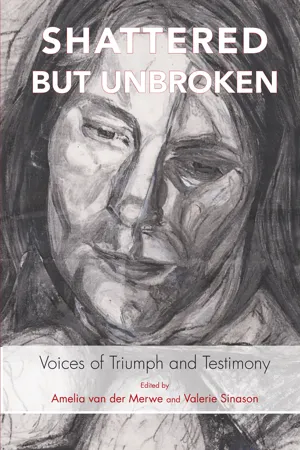
Shattered but Unbroken is an edited volume focusing on Dissociative Identity Disorder (DID), which combines the narratives of survivors of ritual abuse with academic contributions on the causes, correlates and interventions applicable to DID. The book is divided into two distinct parts. Part 1 begins with the missing memoir of Anna, a survivor of ritual abuse. Anna chose not to publish her memoir for fear of retribution from her perpetrators. The plight of Anna is interwoven between all the contributions in the book, be they life writing or academic contributions. So too are the life writings of Annalise, writing under pseudonym. Instead of using Anna's memoir, the politics of anonymity is addressed by a range of survivors of ritual abuse, who write about their decision to use their real name in their narratives, or to use pseudonyms. Part 2 of the book contains academic contributions, which deal with the causes, correlates and interventions applicable to the most common response to ritual abuse, DID.
eBook - ePub
Shattered but Unbroken
Voices of Triumph and Testimony
- 310 pages
- English
- ePUB (mobile friendly)
- Available on iOS & Android
eBook - ePub
Shattered but Unbroken
Voices of Triumph and Testimony
About this book
Information
Part I
Voices
Chapter One
Remarks on the publication of detailed case studies
Richard P. Kluft
As originally conceptualised, the fulcrum and organisational focus of this book was to be a detailed case study. Stellenbosch University reviewed this proposal and declined to support it. This decision must have been difficult; both for the courageous woman who was prepared to share her personal experiences to facilitate the learning of others, and for Dr. Van der Merwe, who dedicated considerable time and effort to realising the book in that form.
Dr. Van der Merwe asked me to comment, knowing that my sympathies, however conflicted, concur with the university’s decision. Granted, many have shared or permitted the use of their stories without apparent (or acknowledged) adverse effects. Their accounts have been invaluable in creating a more sympathetic environment for traumatised individuals and their treatment. It has been an honour to encounter many of these brave and generous individuals.
Sadly, I have met too many whose “going public” has had unwanted consequences, whose efforts to forge something constructive from the shambles of their tragic experiences became painful misadventures. In their zeal to tell their truths and achieve the praiseworthy goal of helping others, they often denied, underestimated, or misunderstood the risks associated with doing so.
The originally envisioned plan and format raise thought-provoking concerns which flow from extending “first, do no harm,” the Hippocratic axiom, beyond the professional encounter between patient and healer to encompass a compassionate concern for the patient’s overall future and quality of life. America’s National Institute of Mental Health (NIMH) reviewed the problems associated with both giving and obtaining informed consent from a person suffering dissociative identity disorder (DID). The conclusion was reached that with regard to participation in a particular research project, if informed consent were given by any personality of a DID patient deemed competent by standard criteria for competence, that competent personality’s informed consent would constitute sufficient legitmisation, across all personalities, for that DID patient’s participation in that particular project (Putnam, 1984). That being said, I have profound concerns over the ecological validity of such consents for other matters and over time.
To explain further, the consent to participate in a research project rarely raises the risk of compromising confidentiality. Participation begins and ends within a discrete period of time. Usually, research results are expressed in pooled data. Individuals are described (if they are described at all) with no more than basic demographic data. In contrast, when one gives informed consent to expose a more detailed portrait of one’s self to the professional and/or lay public, even skilfully disguised material may prove surprisingly revealing under certain circumstances. Further, once published or otherwise promulgated, it is public (or at risk for becoming public) forever. Many a DID patient looks back with severe regret and/or profound conflict upon a decision regarding personal privacy that seemed so straightforward and uncomplicated at the time it was made.
For example, a participant in a research project became worried that her taped interview would not be destroyed after scoring. Her tape was destroyed in front of her and her data expunged from the study. In contrast, a patient who had given informed consent for publication of some of her experiences as a victim of sexual trafficking in a professional publication told a trusted colleague that her treatment had been described in an article. Over time, that colleague and she had a parting of the ways. Litigation ensued. The colleague informed the colleague’s lawyer, who claimed to have found her in the literature and attempted to intimidate her.
Hence, the ecological validity of the NIMH approach to informed consent when disseminated into clinical practice is questionable, and the capacity of DID patients to give informed consent in terms of understanding the possible future consequences of decisions to forfeit some or all of their personal privacy remains a matter of debate.
In the argument that follows, I am not terribly concerned about the possible conflicting opinions of various personalities. Conflict is a universal phenomenon. The clash of alters is only one manner in which conflict may be expressed.
Instead, my concerns encompass: 1) the cognitive distortions often concomitant with DID; 2) the transferential pressures toward compliance with the perceived demands inherent in the situation and toward enacting wishes to please particular individuals/types of individuals; 3) the difficulty many dissociative patients have in understanding the implications/passage of time; 4) the toxic impact of shame, often more devastating than the pain and hurt of a patient’s actual traumatisation; 5) the fact that the patient who gives consent at one point in time may change significantly, and be very different from the more thoroughly treated patient who must live with the consequences of that consent; and 6) my distrust, based upon painful experience, of the judgement and discretion of third parties. My remarks here cannot do justice to the complexity and gravitas of these concerns.
Cognitive distortions and misunderstandings
A patient with dissociative identity disorder (DID) agreed to be interviewed by a prestigious television programme. Intoxicated by the prospects of appearing on national television, and grandiosely and/or altruistically and/or masochistically convinced that what she was doing would help others better understand DID, she dismissed her therapist’s cautionary advice. She discussed her mistreatments in detail on camera and then informed her entire family, abusers included. Processes were set in motion that destroyed the social fabric of her life. She dwindled into a regressed and dysfunctional state, which has persisted for twenty-five years.
In comic counterpart to that tragedy, a DID patient of mine who was also a colleague gave me informed consent for the use of well-disguised verbatim notes on her sessions to teach a workshop at a conference she did not plan to attend. As I began my remarks, I saw her sitting in the front row of my audience. The trance logic inherent in her condition left her blind to the incompatibility of her firm statement across all alters that she would not attend with some alters’ later decision to do so. I could not make my planned presentation. My desperate management of this dilemma is described elsewhere (Kluft, manuscript in preparation).
Another DID patient prepared an account of her experiences, including intrafamilial abuse and her sexual exploitation by a mental health professional, for publication. She understood herself to be an aggrieved victim entitled to tell her story. Her excellent manuscript was accepted for publication, but as her publisher’s legal consultants researched the project, they learned that many easily identifiable others disputed her recollections. The mental health professional threatened legal action. Her book was never published. Feeling invalidated, she became flooded with guilt, shame, and uncertainty. She suffered years of profound turmoil.
Transferential contaminants to free will/informed consent
In conversations with several DID patients or patient/therapist dyads about going public, all too often it seemed that despite all other motivations and rationales, the patients were influenced by wishes or perceived needs to please their therapists (even if denied or unconscious). Once the endeavour gathered momentum, some patients, and even some therapists, feared rejection if they did not go forward. Sometimes both ultimately suffered serious consequences. Rarely the appearance of ostensibly successful therapies camouflaged boundary violations that would be omitted from the published accounts.
Difficulties understanding time (another cognitive distortion)
Traumatised individuals often have difficulty organising a meaningful understanding of their futures, a basic fact often overlooked by DID patients, therapists, and the media alike. Time itself is a difficult concept for the highly dissociative patient. Alters become inured to time loss, to being simultaneously in the past and the present, to making what is unpleasant go away and becoming amnestic for the missing time, and so on.
Dozens of my patients have uttered the same simple but profoundly important remark: “I don’t do time.” How can one give meaningful consent to the revelation of the intimate details of one’s private life if one cannot anticipate the future as well as the current implications of such material’s being in the public domain, however well disguised? One integrated DID patient’s engagement was broken when her fiancé learned of the extent of her past sexual exploitations from an account she had written. The adolescent granddaughter of another came upon old tapes she had made and was devastated by what she learned. The children of another, to whom her abusive parents were adored and idealised grandparents, severed their relationship with their mother when she admitted that she was the patient described in a scientific article in which she had depicted her own parents as horrible people.
Consistent with their characteristic defences, DID patients often believe that their revelations belong to a moment in time that they can leave behind. But permanent records do not dissociate. Over time, some DID patients have recanted. Others have forgotten their revelations, redissociating both their experiences and the fact that they have revealed them. Unless a DID patient can think through the possible long-term consequences of the revelations that might be made in current moment, or grasp them with the help of an advisor, a powerful argument can be made that going public, anonymously or not, may be premature.
Shame
In addition to the pain and betrayal associated with traumatisation itself, the psychological sequelae, both immediate and delayed, must be considered. Not uncommonly, all the layers of pain and distress are not accessible at one time. Circumstances may require reprocessing and considerable time may elapse before the full force of the uncomfortable affects of shame, disgust, and dissmell (Kluft, 2007; Nathanson, 1992), almost invariably self-directed, make their way into awareness, either as they emerge from behind defences, expressed by a long-unavailable alter that has been containing or occasioning the affect in question, or they surface as patients’ understanding of their experiences and their implications becomes more nuanced. When the patient who has gone public before these many layers have been addressed later experiences mortification and assumes that the world now knows how awful she actually is as a person (at least in the subjectivity of her own damaged self-esteem), the situation can become upsetting and fraught with peril.
Change
Simply put, the kaleidoscopic and complex mosaic that is DID must undergo profound transformations in order for those who suffer this condition to heal and enjoy an improved quality of life. Consent given when a traumatized and highly dissociated patient’s demolished self-esteem does not allow that person to envision a productive future rarely can anticipate and take into account the consequences of that consent at a later date. One patient had made a phenomenal recovery. Years later, while running for public office, rumors vaguely related to published materials made withdrawal this person’s most judicious choice.
The downside of trust
Ethical people often find it difficult to summon up and maintain sufficient suspicion to anticipate the nefarious efforts of those to whom ethical considerations are no obstacle to their pursuit of their objectives. DID patients often feel compulsive pressures to be “good”. This may encompass the paradox of trying to think positively of others, notwithstanding their histories of traumatisation.
A patient allowed me to present her history and verbatim material to a scientific workshop. Both were distributed in a written form for study. Participants were advised both orally and in writing that this material had to be returned and destroyed at the end of the conference in order to protect the patient’s confidentiality. Participants were also notified that for the same reasons, this conference would not be taped professionally, and could not be taped by individuals. Participants were also advised that there would be no discussion of the veracity of the patient’s given history because the entire presentation would be made on the basis of incidents documented in legal and other official records—the only potential inaccuracies would be in items changed to further disguise the patient’s identity.
A journalist attending the conference on a press pass surreptitiously taped the workshop. She did not return her printed materials. She included some of this material in a book purporting to be factual. She attacked me for not emphasising that the patient’s memories probably were inaccurate and made myriad other inaccurate statements. I felt obliged to share with the patient what had occurred. When she read this person’s remarks about her and the credibility of her documented accurate memories it destroyed our relationship, ended her treatment, and nearly occasioned her suicide. Confronted, this journalist became belligerent and threatened to make the confidential materials public.
While brief vignettes concerning patients offer valuable illustrations and often can advance the knowledge of the therapists who study them, my experience with more detailed and intimate accounts is that while they are far more instructive, they may have a problematic cost/benefit ratio for the patients. If an MPD patient wishes to write a first person account of her or his life, the act of authoring such a document may have profound healing power for the patient, and may facilitate treatment tremendously. But bringing that account into the public domain is a step fraught with peril, to be approached with great caution and with thoughtful consideration of possible worst-case scenarios. It may constitute a gesture of thanks to the therapist, better interpreted than enacted. Going public may constitute identification with a relatively benign aggressor, the therapist, and the effort to do something therapeutic for others. However, such identifications refer back to scenarios in which the aggressor does not have the patient’s best interests at heart, so the patient’s altruism in the moment may subsequently prove to be a sadomasochistic enactment.
My experience further suggests that if such a step is to be contemplated, it should be considered only when: 1) the treatment has accomplished its desired goals, and their stability is established; 2) the patient is strong, resilient, and well; 3) the patient has a stable life situation and a reliable support system; 4) if the patient’s career goals necessitate graduate education, a terminal degree has been won, and prerequisite postgraduate experiences have been completed; 5) the patient’s mind can engage in a diligent and searching exploration of the pluses and minuses of such a step; and 6) when private legal counsel has reviewed the situation in terms of possible negative consequences for the patient, both current and future. For example, the patient must knowingly forfeit “publication as payback”, because undocumented accusations may prompt counterattacks and/or litigation. Detailed verisimilitude in the narrative may be associated with an unacceptable cost/benefit ratio in ways too numerous to count. It is of note that the DID author of a recent first person narrative, a prominent intellectual, went public to preempt his being “outed” in a hostile and destructive manner over which he would have no control.
Please note that I make no distinction between patients going public under their own identities or under disguised identities. Given the virtual lysis of privacy engendered by newer media, it is profoundly self-deceptive to proceed as if one’s patients’ identities can be concealed indefinitely, or with any degree of certainty. The names and identities of several famous patients, accounts of whose lives were disguised to protect their confidentiality, have made their way into the scholarly and lay media.
These are the times in which we live. For the sake of our patients, we must be mindful of their vulnerability and remember Hippocrates’ sage advice.
References
Kluft, R. P. (2007). Applications of innate affect theory to the understanding and treatment of dissociative identity disorder. In: E. Vermetten, M. Dorahy, & D. Spiegel (Eds.), Traumatic Dissociation: Neurobiology and Treatment (pp. 301–316). Washington, DC: APA.
Nathanson, D. (1992). Shame and Pride. New York: Norton.
Putnam, F. W. (198...
Table of contents
- Cover
- Half Title
- Title
- Copyright
- Dedication
- Contents
- ACKNOWLEDGEMENTS
- ABOUT THE EDITORS AND CONTRIBUTORS
- PROLOGUE Anna and the missing memoir
- INTRODUCTION
- PART I: VOICES
- PART II: TESTIMONIES
- EPILOGUE
- INDEX
Trusted by 375,005 students
Access to over 1.5 million titles for a fair monthly price.
Study more efficiently using our study tools.
Frequently asked questions
Yes, you can cancel anytime from the Subscription tab in your account settings on the Perlego website. Your subscription will stay active until the end of your current billing period. Learn how to cancel your subscription
No, books cannot be downloaded as external files, such as PDFs, for use outside of Perlego. However, you can download books within the Perlego app for offline reading on mobile or tablet. Learn how to download books offline
Perlego offers two plans: Essential and Complete
- Essential is ideal for learners and professionals who enjoy exploring a wide range of subjects. Access the Essential Library with 800,000+ trusted titles and best-sellers across business, personal growth, and the humanities. Includes unlimited reading time and Standard Read Aloud voice.
- Complete: Perfect for advanced learners and researchers needing full, unrestricted access. Unlock 1.5M+ books across hundreds of subjects, including academic and specialized titles. The Complete Plan also includes advanced features like Premium Read Aloud and Research Assistant.
We are an online textbook subscription service, where you can get access to an entire online library for less than the price of a single book per month. With over 1.5 million books across 990+ topics, we’ve got you covered! Learn about our mission
Look out for the read-aloud symbol on your next book to see if you can listen to it. The read-aloud tool reads text aloud for you, highlighting the text as it is being read. You can pause it, speed it up and slow it down. Learn more about Read Aloud
Yes! You can use the Perlego app on both iOS and Android devices to read anytime, anywhere — even offline. Perfect for commutes or when you’re on the go.
Please note we cannot support devices running on iOS 13 and Android 7 or earlier. Learn more about using the app
Please note we cannot support devices running on iOS 13 and Android 7 or earlier. Learn more about using the app
Yes, you can access Shattered but Unbroken by Valerie Sinason, Amelia Van der Merwe, Valerie Sinason,Amelia Van der Merwe in PDF and/or ePUB format, as well as other popular books in Psychology & Abnormal Psychology. We have over 1.5 million books available in our catalogue for you to explore.