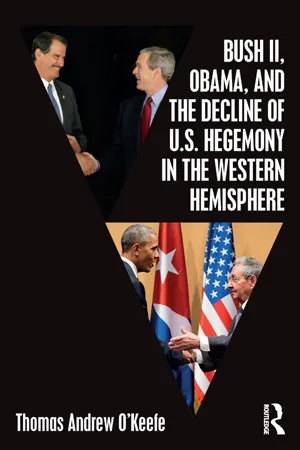
Bush II, Obama, and the Decline of U.S. Hegemony in the Western Hemisphere applies competing definitions and conceptions of hegemony to various foreign policy initiatives and events during the administrations of George W. Bush and Barack H. Obama to test whether they manifest a decline in traditional United States dominance and leadership in the Western Hemisphere. In particular, the book examines the continued relevancy of the Inter-American system, the failure to establish a Free Trade Area of the Americas (FTAA), and the stillborn Energy and Climate Partnership of the Americas (ECPA). It also discusses the implications of the People's Republic of China becoming a major trading partner and important source of financing and investment capital throughout Latin America and the Caribbean. The book provides critical reviews of Plan Colombia, the Merida Initiative, Pathways to Prosperity in the Americas, the Central American Regional Security Initiative (CARSI), the Caribbean Basin Security Initiative (CBSI), 100,000 Strong in the Americas, and the restoration of normal U.S. diplomatic relations with Cuba. There are extensive analyses, unusual for a work in English, on the Alianza Bolivariana para los Pueblos de Nuestra América (ALBA), Comunidad de Estados Latinoamericanos y del Caribe (CELAC), and Unión de Naciones Suramericanas (UNASUR).
eBook - ePub
Bush II, Obama, and the Decline of U.S. Hegemony in the Western Hemisphere
- 200 pages
- English
- ePUB (mobile friendly)
- Available on iOS & Android
eBook - ePub
Bush II, Obama, and the Decline of U.S. Hegemony in the Western Hemisphere
About this book
Information
1 What Is Hegemony and When Has the United States of America Been a Hegemon?
Introduction
The genesis for this book is the flurry of discussions in the media and academic circles on the purported decline of U.S. hegemony in the Western Hemisphere that coincided with the start of the twenty-first century. These assertions blossomed following the September 2001 terrorist attacks in the United States, as the administration of George W. Bush concentrated its attention on eliminating Al Qaeda and other extremist Islamist cells in Afghanistan, the Middle East, and Somalia. There was a widespread sentiment that because of this new focus, the United States was “ignoring” Latin America and the Caribbean. This period also coincided with the election of leftist governments in many Latin American countries that frequently adopted policy positions that were blatantly hostile to the agenda long promoted by Washington, DC. Unlike the response that might have been seen in the past, the United States now seemed to acquiesce to the new status quo in the Americas. This book tests the thesis of whether there has indeed been a decline in the hegemony traditionally exercised by the United States in the Western Hemisphere since at least the end of the nineteenth century.
At the outset, it is important to underscore that this book is about hegemony and not about power per se. Although the United States emerged as the sole superpower after the end of the Cold War, with cumulative economic, military, and other capabilities, preponderant capabilities across the board do not guarantee effective influence in any given arena.1 For one thing, American dominance in the international security arena no longer translates into effective leverage in the international economic arena, as the United States faces rising economic challengers with their own agendas and with greater discretion in international economic policy.2 Accordingly, this book focuses on those international relations theories where the concept of hegemony is a key component for explaining United States foreign policy and actions. It also addresses the conception of hegemony as developed by the Italian sociologist and neo-Marxist Antonio Gramsci. Furthermore, this book does not attempt to wade into the lively debate within the international relations field over which conception of hegemony is more valid, or to propose yet another theory of international relations, for that matter. Instead, its goal is less ambitious. It utilizes existing definitions and notions of hegemony to answer the question of whether its exercise by the United States in Latin America and the Caribbean objectively declined under the administrations of George W. Bush and Barack H. Obama.
It is also important to emphasize the distinction between imperialism and hegemony. The fact that both terms are often used interchangeably to describe the United States’ behavior in the Western Hemisphere leads to much confusion, even in academic circles. Although the precise definition of imperialism may be as contested as that of hegemony, imperialism reflects a geopolitical arrangement whereby one state extends its dominion—frequently through use of force—over populations beyond its borders that are culturally and ethnically distinct from its own.3 While an imperial power attempts to control both the internal and external affairs of a client state, a hegemon respects a subaltern’s domestic sovereignty but impinges on its autonomy to conduct an independent foreign policy.4 Without a doubt, the forcible annexation of the Kingdom of Hawaii in 1898 against the clear wishes of its monarch and of the overwhelming majority of its indigenous population provides an egregious example of U.S. imperialism. A similar case can be made for the U.S. annexation of Puerto Rico and the Philippines, where, following the defeat of Spanish forces in 1898, the U.S. refused to recognize, and in the Filipino case ruthlessly crushed, a vibrant independence movement. On the other hand, labeling as imperialistic the U.S. invasions and subsequent occupations of Haiti, the Dominican Republic, and Nicaragua in the earlier part of the twentieth century would be debatable, given that there was never an expressed intention by U.S. government officials to hold on to these countries indefinitely. In fact, the delays in restoring sovereignty often came about because U.S. efforts to implement “reforms” and make a hasty exit were complicated by the fierce armed resistance to American occupation that arose.
This work utilizes four case studies to test whether there has indeed been a decline in U.S. hegemony in the Western Hemisphere since the January 2001 inauguration of George W. Bush. These include the inter-American system centered on the Organization of American States, the Free Trade Area of the Americas, the Energy and Climate Partnership of the Americas, and the expanding role of China as a major trade and investment rival to the United States in Latin America and the Caribbean. In addition, the book also examines other illustrative foreign policy initiatives under Bush and Obama to support or debunk the notion that there has been a decline in U.S. hegemony. In particular, the book examines: (1) Plan Colombia; (2) the Mérida Initiative; (3) the Central American Regional Security Initiative (including the subsequent Alliance for Prosperity of the Northern Triangle of Central America); (4) the Caribbean Basin Security Initiative; (5) Pathways to Prosperity; (6) 100,000 Strong in the Americas; and (7) the re-establishment of normal diplomatic relations between the United States and Cuba.
The Theoretical Underpinnings of Hegemony
Though the concept may be traced all the way back to ancient Greece, the term “hegemony” first emerged as a conceptual and theoretical tool in the mid-twentieth century as a consequence of the dissemination of the work of Italian revolutionary and neo-Marxist sociologist Antonio Gramsci.5 In ancient Greece, the term “hegemon” meant the leader of a voluntary military alliance of various city-states, either permanent or temporary, created in order to respond to a particular military threat. This description evokes an interstate system wherein a given state exercises power and leadership over an alliance of reciprocally consenting states.6 In practice, however, the Greeks also recognized that such an alliance could lead to a situation in which a state attained preeminent military and political leadership and thereby transformed itself into an imperial power.7 The Ancient Greeks also associated the concept of hegemony with the notion of a guiding or governing principle or idea.8 Accordingly, Athens—as the generator and organizer of moral, intellectual, cultural, and educational ideas—was viewed as the logical and natural hegemonic leader of all ancient Greece.9
In current international relations theory and analysis, while the concept of hegemony lacks settled definition, its terms of debate have revolved largely around two principal meanings: domination and leadership.10 Domination refers to the dominance of one state over others, or a nation’s standing within a hierarchical order of great powers, and is usually measured by the aggregate resources possessed by a single actor across a wide range of material capabilities—including military and economic—as well as the degree of concentration of these resources in terms of their international distribution.11 By contrast, leadership derives from the capabilities underlying the claim or from what others see in the hegemon in terms of perceived attributes.12
Classical realism is based on the simple assumption that states are led by human beings who have a “will to power” hardwired into them at birth.13 John Mearsheimer, who labels himself an “offensive realist,” believes that the international system forces great powers to maximize their relative power because that is the optimal way to maximize their survival.14 Mearsheimer admits that such an outlook leads to a gloomy assessment of international relations because no state is likely to achieve global hegemony, and therefore the world is condemned to perpetual great-power competition.15
Realism is based on three key assumptions:
(1) the most important actors in world politics are territorially organized entities (i.e., states);
(2) state behavior can be explained rationally (i.e., states are guided by the logic of the “national interest”) and is influenced mainly by their external characteristics;
(3) states seek power and calculate their interests in terms of protecting, if not maximizing, power, relative to the nature of the international system they face: anarchy.16
The central aspects of the international system, which in turn cause states to fear one another, are the absence of a central authority that sits above states and can protect them from each other, the fact that states always have some offensive military capability, and the fact that states can never be certain about other states’ intentions.17
Realism argues that the key interest of states is not individual well-being: rather, it is survival.18 Accordingly, the overriding goal of each state is to maximize its share of world power, which means gaining power at the expense of other states, and thereby to achieve hegemony and become the only great power in the system.19 Power, traditionally understood as resources or capabilities, has been used as an indicator for the strength of actors, and consequently the capacity to affect or control outcomes.20 Even though a realist such as Mearsheimer would acknowledge that states, on occasion, may cooperate with each other, at root they have conflicting interests.21
Realism, or realpolitik, dominated U.S. foreign policy during World War II and the Cold War. It is most associated with exponents such as John H. Herz, George F. Kennan, Walter Lippmann, Hans J. Morgenthau, and Henry Kissinger. Following the end of the Cold War, realism lost credibility due to its inability to explain and predict international developments such as the demise of the Soviet Union and the subsequent wave of democratization and adoption of market-based economic policies that swept the planet.
Kenneth Waltz is a neo-realist who focused on the structure of the international system and the balance of power in order to get around realism’s limitations in explaining why states are not in a position of constant warfare as each tries to protect or maximize power. Neo-realists, rather than viewing power as an end in itself, see it as a useful means for achieving their ultimate concern: security.22 Security “is understood as one state’s position relative to other states’ positions, and as being a function of one state’s aggregate capabilities vis-à-vis others.”23 For Waltz, understanding the structure of an international system facilitates explaining patterns of behavior, since states determine their interests and strategies based on calculations about their own positions in the system.24 “Structure is invisible, a purely theoretical construction” and “has to do with the fundamental organization of the system: anarchy or hierarchy and the distribution of capabilities across the units.”25
Similar to realists, neo-realists reduce hegemony to the single dimension of dominance.26 While neo-realists incorporate the realist concept of an anarchic world, they believe states behave defensively in response to that reality to maintain rather than upset the balance of power, so that preserving power, rather than increasing it, is the main goal of states.27 Accordingly, neo-realists accept that states will...
Table of contents
- Cover
- Half Title
- Title Page
- Copyright Page
- Dedication
- Table of Contents
- Acknowledgments
- 1 What Is Hegemony and When Has the United States of America Been a Hegemon?
- 2 The Inter-American System under the Aegis of United States Hegemony
- 3 A Post-Hegemonic Inter-American System
- 4 The Emergence and Collapse of the Free Trade Area of the Americas
- 5 The Energy and Climate Partnership of the Americas
- 6 China in Latin America and the Caribbean
- 7 The Record on Other Major United States Foreign Policy Initiatives in the Western Hemisphere under George W. Bush and Barack H. Obama
- 8 The Current State of Affairs and Future Ramifications
- Index
Trusted by 375,005 students
Access to over 1.5 million titles for a fair monthly price.
Study more efficiently using our study tools.
Frequently asked questions
Yes, you can cancel anytime from the Subscription tab in your account settings on the Perlego website. Your subscription will stay active until the end of your current billing period. Learn how to cancel your subscription
No, books cannot be downloaded as external files, such as PDFs, for use outside of Perlego. However, you can download books within the Perlego app for offline reading on mobile or tablet. Learn how to download books offline
Perlego offers two plans: Essential and Complete
- Essential is ideal for learners and professionals who enjoy exploring a wide range of subjects. Access the Essential Library with 800,000+ trusted titles and best-sellers across business, personal growth, and the humanities. Includes unlimited reading time and Standard Read Aloud voice.
- Complete: Perfect for advanced learners and researchers needing full, unrestricted access. Unlock 1.5M+ books across hundreds of subjects, including academic and specialized titles. The Complete Plan also includes advanced features like Premium Read Aloud and Research Assistant.
We are an online textbook subscription service, where you can get access to an entire online library for less than the price of a single book per month. With over 1.5 million books across 990+ topics, we’ve got you covered! Learn about our mission
Look out for the read-aloud symbol on your next book to see if you can listen to it. The read-aloud tool reads text aloud for you, highlighting the text as it is being read. You can pause it, speed it up and slow it down. Learn more about Read Aloud
Yes! You can use the Perlego app on both iOS and Android devices to read anytime, anywhere — even offline. Perfect for commutes or when you’re on the go.
Please note we cannot support devices running on iOS 13 and Android 7 or earlier. Learn more about using the app
Please note we cannot support devices running on iOS 13 and Android 7 or earlier. Learn more about using the app
Yes, you can access Bush II, Obama, and the Decline of U.S. Hegemony in the Western Hemisphere by Thomas Andrew O'Keefe in PDF and/or ePUB format, as well as other popular books in Politics & International Relations & Political Economy. We have over 1.5 million books available in our catalogue for you to explore.