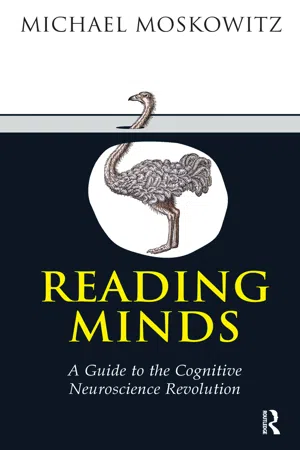
Reading Minds is a practical guide to the cognitive science revolution. With fascinating descriptions of studies of the mind, from the brain scans of lovers and liars in London to the eye movements of babies in Budapest, this book takes the reader into the laboratories of the most innovative psychological researchers around the world. Using anecdotes from everyday life and his clinical practice, renowned psychotherapist and academic the author shows how to use the insights of science to better understand and relate to others.
- 256 pages
- English
- ePUB (mobile friendly)
- Available on iOS & Android
eBook - ePub
About this book
Information
CHAPTER ONE
Reading minds
A Svengali in geek's clothing
On Monday 21 July 1980, in his cluttered new office in suburban Seattle, twenty-four-year-old Harvard-dropout computer-geek Bill Gates answered his phone in sleep-rumpled clothes. It was Jack Sams, a mid-level middle-aged IBM executive, calling from Boca Raton, Florida. He wanted to meet. Gates offered a time the following week. Sams pushed for the next day and Gates agreed. On Tuesday, Sams appeared at Gates’s office, flanked by two corporate watchdogs. Waiting in the reception area in their conservative blue suits and wing-tipped shoes, they looked as out of place as friars at a fraternity house.
“I knew Bill was young,” Jack Sams recalls, “but I had never seen him before. When someone came to take us back to the office, I thought the guy who came out was the office boy. It was Bill.”
Sams’s first order of business was to have Gates sign IBM’s infamously one-sided non-disclosure agreement. Gates recalls, “IBM didn’t make it easy. You had to sign all these funny agreements that sort of said IBM could do whatever they wanted, whenever they wanted, and use your secrets however they felt” (Cringely, 1996). Most business people consult their lawyers. Gates didn’t hesitate; he signed immediately. IBM was just checking out the scene, Sams explained, and without revealing anything more, he pumped Gates for ideas and information. Gates talked freely. At the end of the meeting, Sams told Gates not to expect anything, not even a phone call.
At the time, personal computers were in their infancy. Breadbox-sized microcomputers had just been transformed from near impossible-to-use nerd toys to affordable home appliances. Radio Shack led the way, soon followed by Apple, but there were dozens of other companies. There was no compatibility between systems and each required different software.
Bill Gates’s expertise was computer languages. Computer languages are the codes programmers use to write software for all the applications we use like word processors and spreadsheets. Each language has to be adapted to work on each new kind of computer. Most of us do not know what language our programmes use and could not care less. Tweaking languages takes place in an esoteric arena populated by maths whizzes and puzzle freaks. Bill Gates was both. He had spent most of his two years at college pirating the Harvard mainframe computer to write code he could sell to small companies. Microsoft Basic was his baby.
Had Bill Gates stayed in computer languages, you probably would have never heard of him. Like some Silicon Valley pioneers, he might have made a few million and retired, or, like many others, he might have been supplanted, gone bankrupt, and faded from the scene. Before the IBM deal, he had said no to several proposals from other small companies, and had turned down a multi-million dollar buyout offer from Ross Perot, the then reigning software king. Perot—best known as an eccentric billionaire presidential candidate—had made his fortune computerizing the US government’s Medicare records. Bill’s mother wanted him to consider Perot’s offer but, as she recalls, “I don’t think he gave it any serious thought at all.”
Gates says about the meeting with Perot, “I was very bowled over by their size and everything, but when we talked about the product vision it was very strange. They weren’t really thinking about it” (ibid.).
One month after his first visit, Sams was back in Seattle, this time with three associates, including a lawyer. IBM did not want to be on the sidelines of the personal computer explosion. Sams told Gates about IBM’s top-secret project to bring out a cheap personal computer that would blow away competitors and dominate the market. It had to be out in less than a year. To meet the deadline, Sams, the head of the project, was breaking with IBM’s do-everything-itself tradition and contracting with outside suppliers for hardware and software. Sams asked Gates if he could provide an operating system.
Gates immediately saw an opening. It was no secret that Microsoft’s niche was computer languages, not operating systems. Either Sams had not done his homework and did not know this about Microsoft, or he did not want to know it. Maybe he felt comfortable with Gates and was intent on working with him no matter what. In either case, Gates felt confident enough of his position to make a bold move: he told Sams that someone named Gary Kildall had an operating system ready to go.
Then, with Sams looking on, Gates phoned Kildall: “Gary, I’m sending some guys down. . .. Treat them right, they’re important,” he said (ibid.).
A programming legend, Kildall was a brilliant, bearded, longhaired, pot-smoking academic. When the IBM contingent arrived at his home office, he was not there. Distrustful of authority, not interested in making deals, he left it to his wife to run the company, and the meeting. One of the IBM executives recalls, “It was an unfortunate situation—here you are in a tiny Victorian House, it’s overrun with people, chaotic.” After hours of uncomfortable discussion, Kildall’s wife refused to sign IBM’s non-disclosure agreement. Sams claims that subsequent phone calls to Kildall went nowhere. Kildall claims he never got any. Sams never wanted to deal with Kildall or his associates again. The feeling was mutual.
The IBM crew returned to Microsoft. Sams was desperate. Competition was mounting daily and he feared IBM developers would take too long to come up with an operating system. Sams practically begged Gates to take it on and pledged his full support. Could Gates and Microsoft do it? Gates said yes.
On 30 September, just two months after the initial meeting, a characteristically scruffy Gates and two colleagues, after flying all night from Seattle, changing in the Miami men’s room, and stopping to buy Bill a tie, arrived thirty minutes late to a meeting with IBM at Boca Raton. The meeting changed corporate history. Following a stunning technical presentation, Gates confidently proposed a new deal: there would be no sale of software to IBM. Instead, IBM would pay a substantial upfront fee for a non-exclusive licence. In addition, they would pay a royalty of $1–$15 dollars for each computer or software package they ever sold (Manes & Andrews, 1994, p. 162). IBM could not sub-license the languages or operating system, but Microsoft would be free to make similar deals with anyone else.
Did Gates know that Sams would return on bended knee? I think he did. Bill Gates’s real expertise is reading minds, knowing what people want, and knowing what he could get away with giving them. He had no doubt that he had to sign the IBM nondisclosure agreement in order to establish a relationship, and he knew signing immediately without consulting a lawyer made him seem trusting, egg-headed, and naïve; a persona reinforced by his rumpled, geek-scientist appearance and distracted demeanour. His appearance belied his background. Gates’s father was a prominent corporate lawyer; his mother sat on the boards of corporations and philanthropies. Gates grew up with people like Sams. He knew that Kildall and Sams would mix like oil and water. He knew Sams liked him and wanted to treat him like a son. Gates read Sams’ mind and took advantage of it. Sams, on the other hand, misread Gates: completely blind to Gates’s ruthless, competitive side, he ended up giving away what could have belonged to IBM, dominance of the personal computer software market.
To most observers, Gates’s proposal in Boca Raton might have seemed like a wild gambit. But he understood the IBM corporate world and the kinds of minds that made it home; and he understood the new silicon valley cyberworld and its creative, eccentric characters. Most importantly, in arranging the meeting of Sams and Kildall, he understood there could be no meeting of minds, no possibility of connection. Gates knew each would run from the other, and Jack Sams path would be straight back to his door.
What Sams and IBM did not know was that Microsoft did not yet have an operating system, and had no plans to write one. Gates knew that besides Kildall’s there was only one usable system out there. He knew there was little chance IBM would know about it, but to be certain, just before the Boca Raton meeting, Gates paid a few thousand dollars for an option to buy it. In total, he paid its unsuspecting developer, Tim Paterson, $75,000 for an operating system called DOS. DOS became industry standard, and Windows was later built on top of it. For nearly thirty years, Bill Gates has received a royalty on every computer sold with his operating system installed—more than 95% of the computers ever made.
Bill Gates has been described as coming late to the party and then making himself the centre of attention. It’s true. Gates did not become the richest man in America by brilliant technical innovation. Microsoft’s products, while competent, are often technologically rather humdrum and sometimes badly flawed. Gates’s genius is in reading minds, knowing what people want, and providing them with something close enough. Even if he cannot provide it when they want it, he holds their attention with promises; and if what he provides is not great, he convinces them it is as good as they will get.1
In both business and personal relationships, Gates has flirted with the edge. He has manipulated good friends, but most remained friends. He rarely reads people incorrectly and has carefully selected and surrounded himself with some of the brightest and most loyal people to be found anywhere. To be fair, there is no evidence Gates treats his friends or family the way he treats his competition. Quite the opposite; his personal relationships have been caring and long lasting. He is devoted to his family. This seems all the more reason to marvel at the flexibility of his mind.
Bill Gates is celebrated as a computer genius, and he is, but his real brilliance is his ability to grasp quickly and accurately what others are thinking. A Svengali in geek’s clothing, Bill Gates is a master mind-reader. How people like Bill Gates read minds so well and how we can all learn to do it better is one subject of this book.
Reading minds is in our nature
Though we often do not think about it consciously, we read minds every day. Before we pass another car, we read the intentions of the driver; before we leave a tip, we read the expectations of the waiter; and before we allow a child who says she is sick to stay home from school, we read her motive—is she really ill, or is she trying to avoid a test she hasn’t studied for?
Real mind reading is no parlour trick. It is an essential skill. Mind reading is a form of social communication like language; and, like language, unless something goes obviously wrong and we experience a mind-reading stammer or block and feel totally lost, or suffer the consequences of an obvious mind misread, we take this remarkable gift for granted.
Other social animals understand each other in limited ways, but they do not read minds. A chimp can read another chimp’s expressions or gestures and anticipate its behaviour. If it is hungry, it will look for food. If it is angry, it is likely to fight. People look at another person and wonder, “Why is she angry? Why is she hungry? What is on her mind?” That is because what a person does is determined by what she is thinking: Maybe she looks angry because she failed a test; maybe she looks hungry because she is on a diet. How we respond will depend on what we think is on her mind, and the success of all of our relationships will depend on how accurate we are in thinking about what others are thinking, in reading their minds.
Social cognition is the scientific study of our ability to read minds. Researchers in social cognition have determined that a “theory of mind” is the main ingredient in mind reading. It is called theory of mind because we try to understand each other by coming up with a theory of what is on another person’s mind. Theories of mind are very similar to scientific theories. In scientific theories, scientists make a best guess—in technical terms, formulate a hypothesis—to explain something they observe. The force of gravity explains why objects fall to earth. The structure of DNA explains how traits are inherited. People’s private thoughts, their minds, explain their behaviour. A “theory of mind” is an explanation of behaviour based on thoughts, motivations, and beliefs. The better our theories, the more accurately we can predict what others will feel, do, and say.
Even infants think about other minds. By fourteen months, they have some important ideas about other minds, but it is not until they are around five that they know the basics of mind reading, in other words, have a theory of mind. Psychologists test a person’s theory of mind by describing or illustrating a particular kind of social situation: a boy is sitting on the couch and eating cookies. He hides the cookies under the couch before running outside to play. While he is outside, his mother finds the cookies and puts them in the cupboard. When the boy comes back, where will he look for the cookies?
If children younger than around five are asked, they will answer, “In the cupboard.” The reason: young children are incapable of entering another person’s mind and taking another person’s point of view. If asked, “Why do you think the boy will look in the cupboard?” A typical four-year-old will answer, “Because they are there!”
The great psychologist Jean Piaget described the young child’s thinking as egocentric, meaning she or he is incapable of taking another person’s point of view. Before the age of around five, children think everyone thinks just like they do. If confronted with the fact that others think differently they cannot explain it and may become frustrated. Then a major transformation occurs, a preprogrammed developmental advance (Wellman, Cross, & Watson, 2001). At around age five, a light goes on and children suddenly understand, “other minds are different from mine”.
This understanding, bringing with it the ability to read minds, is part of our evolutionary heritage. All primates are social animals, but humans are far more social than others. For chimps, the typical group size is less than ten. The average chimp has three close chimp friends. How does that compare to the number of people you regularly see—neighbours, co-workers, family, fellow worshippers, friends? Think of all the people you deal with only occasionally, all the people you interact with only once. Some of those occasional and singular social contacts can be quite important—such as the doctor in the emergency room, or the stranger on the dark street—and these contacts are unique to human social groups. Chimps maintain social connection by grooming each other. They are in nearly constant physical contact. People maintain social connection by reading minds.
The complexity of human social life rewards good mind reading. From the time we venture beyond our immediate family, we interact with people we do not know. Who is safe and who is dangerous? Who wants to help and how? Understanding what others think and feel provides a great adaptive advantage both in leading us into beneficial experiences and in avoiding painful ones.
Please explain
Why is the sky blue? Why do people die? Why are boys and girls different? Where did I come from? Why do I have to go to bed? Why are you arguing? Starting around the age of three, children ask for explanations. Often they question incessantly and will not stop until their curiosity is satisfied. Some of their questions can be simply answered, but many of their questions—for instance, about love and death—have no easy answer, and are asked and answered repeatedly in different ways over the course of a lifetime. When children’s questions are met with evasions, they make up their own fantasy-filled explanations.
This drive to understand the world, to demand and invent explanations, is at the core of human nature and paved the way for humankind’s greatest cultural achievements: theories—theories that help us navigate the physical world, which I call theories of matter, and theories that help us navigate the social world, theories of mind.
Reading minds is in the brain
Queen Square is at the epicentre of the new science of the mind. Here, at University College London, researchers at the Institute of Cognitive Neuroscience first demonstrated that mind reading is not a magician’s trick or sleight of hand, but, rather, an innate property of the human brain (Gallagher et al., 2000). In 1999, a dozen mostly twenty-something graduate students came to the Institute for a brain scan—but one with an unusual twist. Researchers would not be using the MRI to look for a problem, a disease, or disorder. Researchers would be looking to locate the very centre of our social being, the area in our brain responsible for our ability to know what others are thinking and feeling, the place in the brain where we read minds.
At a pre-scan briefing, the volunteers were told that during the experiment two stories would appear on screens inside the MRI machines. They were instructed to read the stories to themselves and to answer the question at the end of each—once again, to themselves. The first tale, about a nervous burglar, was specifically designed to elicit a mind-reading response. To answer the question at its end, volunteers would have to step inside the burglar’s head and try to understand his motivations during the incident described in the story, which read as follows.
A burglar has just robbed a shop and is making his getaway. As he runs to his car, a policeman, unaware of the robbery, sees the burglar drop a glove. “Hey, there—stop!” shouts the policeman, thinking he is helping an absent-minded passerby. To his astonishment, the burglar throws up his arms and abruptly blurts out, “I surrender!”
Why did the burglar confess?
The second story, about a battle between two mythical armies, was followed by a question that called for a different intellectual response: analysis. Thi...
Table of contents
- Cover
- Half Title
- Title
- Copyright
- Contents
- ABOUT THE AUTHOR
- INTRODUCTION
- CHAPTER ONE Reading minds
- CHAPTER TWO Rock, paper, scissors: it pays to have a theory
- CHAPTER THREE What the brain tells us about the mind
- CHAPTER FOUR Trauma: how events shape the brain and the mind
- CHAPTER FIVE Ways of understanding
- CHAPTER SIX Bad feelings
- CHAPTER SEVEN Look me in the eye
- CHAPTER EIGHT Intimate relationships: reading your family, friends, and lovers
- CHAPTER NINE Why we don't know what we know
- REFERENCES
- ACKNOWLEDGEMENTS
- INDEX
Trusted by 375,005 students
Access to over 1.5 million titles for a fair monthly price.
Study more efficiently using our study tools.
Frequently asked questions
Yes, you can cancel anytime from the Subscription tab in your account settings on the Perlego website. Your subscription will stay active until the end of your current billing period. Learn how to cancel your subscription
No, books cannot be downloaded as external files, such as PDFs, for use outside of Perlego. However, you can download books within the Perlego app for offline reading on mobile or tablet. Learn how to download books offline
Perlego offers two plans: Essential and Complete
- Essential is ideal for learners and professionals who enjoy exploring a wide range of subjects. Access the Essential Library with 800,000+ trusted titles and best-sellers across business, personal growth, and the humanities. Includes unlimited reading time and Standard Read Aloud voice.
- Complete: Perfect for advanced learners and researchers needing full, unrestricted access. Unlock 1.5M+ books across hundreds of subjects, including academic and specialized titles. The Complete Plan also includes advanced features like Premium Read Aloud and Research Assistant.
We are an online textbook subscription service, where you can get access to an entire online library for less than the price of a single book per month. With over 1.5 million books across 990+ topics, we’ve got you covered! Learn about our mission
Look out for the read-aloud symbol on your next book to see if you can listen to it. The read-aloud tool reads text aloud for you, highlighting the text as it is being read. You can pause it, speed it up and slow it down. Learn more about Read Aloud
Yes! You can use the Perlego app on both iOS and Android devices to read anytime, anywhere — even offline. Perfect for commutes or when you’re on the go.
Please note we cannot support devices running on iOS 13 and Android 7 or earlier. Learn more about using the app
Please note we cannot support devices running on iOS 13 and Android 7 or earlier. Learn more about using the app
Yes, you can access Reading Minds by Michael A. Moskowitz in PDF and/or ePUB format, as well as other popular books in Psychology & Cognitive Neuroscience & Neuropsychology. We have over 1.5 million books available in our catalogue for you to explore.