- 300 pages
- English
- ePUB (mobile friendly)
- Available on iOS & Android
eBook - ePub
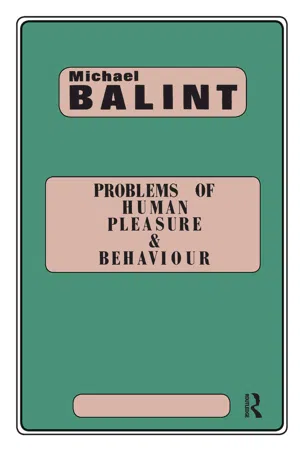
Problems of Human Pleasure and Behaviour
About this book
Michael Balint addresses himself to a variety of subjects of interest to both the layman and the practicing clinical psychologist or psychiatrist: among others, sex and society, masturbation, discipline, menstruation, punishment, aging, and parapsychology.
Information
Part One
The Individual and the Community
1
Sex and Society1 (1956)
1
IT is taken for granted nowadays that,psycho-analysis deals with and has something to say about the sexual problems of man. This assumption is rather surprising, considering that psycho-analysis was originally, and still is, a method for the treatment of certain so-called psycho-neurotic disturbances. How did it happen that this psycho-therapeutic method came to investigate the instinctual life of man? Neither hypnotism, nor suggestion, nor any of the other numerous methods of treatment for neuroses and psychoses have been concerned with this field of research. And what, after all, has a therapeutic method to do with instincts? Text-books of general medical therapy or of pharmacology do not contain a chapter dealing with instincts; but psycho-analytic therapy led inevitably to this field of research.
The method used in this treatment is called free association', that is, we analysts ask our patients to tell us everything, without exception, which comes into their mind. A natural consequence of this technique was that patients began to report about their troubles, worries and complaints, and then it emerged—amongst other surprising facts—that in reality no one is fully satisfied with his or her sexual life. While feelings of general frustration and privation with regard to other instincts, e.g. eating, drinking, etc., are comparatively rare, discontent with one's sexual life is the rule. All of us, it appears, are living in sexual privation; the overwhelmingly greater part of our sexual desires must remain for ever unsatisfied. The contrast between this feeling and those relating to other instincts is really striking.
The statement that we all suffer from sexual privation is a very bold one, and a ready answer to it will be that while it may perhaps be true of neurotics, it is certainly not so for us, healthy men and women. This answer may appear a strong argument against my thesis, and for the time being I intend to leave this issue undecided. As the controversy is about a false problem which will be the subject of my address anyhow, I trust that you will be able to decide it for yourselves without further discussion at the end of my lecture.
My plan is to review a number of unquestionable facts. None of these facts has anything directly to do with psychoanalysis, so that there is no need for methodological discussions. On the other hand, it is true that before psycho-analysis the facts which I am going to put before you had not been connected with each other, neither had they been seen in their proper relation as cause and effect, and still less were the natural inferences arising from them drawn.
Let us then return to my thesis, that all of us live in a state of more or less severe sexual privation. The cause of this unsatisfactory state of affairs is that society demands of us a great number of sacrifices and restrictions. These restrictions are imposed on us; they are enforced by society and defended by tradition, law, customs, institutions, and so on. Let us discuss some of them in greater detail.
The first restriction is well known and universal. There is no society which is not subject to it in some form. Although this restriction has often been bitterly attacked, it has just as often been fiercely defended and declared to be indispensable. You will certainly have guessed that the restriction I am speaking of is marriage. What does marriage mean? What are the underlying suppositions connected with it? We can see three main aspects: (1) no sexual life before marriage; (2) after a more or less elaborate ceremony society permits the sexual union; (3) after that ceremony sexual satisfaction is restricted for life to what can be provided by the socially recognised partner. We find none of these restrictions in any other living creature apart from man.
The second institutional restriction is much less well known in modern society, though it is similarly universal: I mean initiation. Again, the three main aspects are: (1) children have no sex life in its proper sense, or if they have it is not to be taken seriously; (2) at a certain age a more or less elaborate ceremony is performed by which society admits the individual as one of its full members; (3) after this ceremony, society acknowledges the sexual rights of the individual, whereas before the ceremony no such rights were recognised. The ceremony of initiation differs in form in the various societies, but in general we meet the following two main elements: (1) a fair amount of knowledge has to be acquired, mainly traditions that concern adult men only; (2) in a rather severe trial the candidate has to prove that he is up to the expected standard (knowledge, character, manners, qualities such as courage, etc.).
These ceremonies can best be studied in primitive societies because there is little class stratification, the adolescents have all to undergo the same procedures at about the same age. Similar ceremonies are held in some primitive societies for girls as well, but they are less elaborate and less universal.
These initiation rites can also be observed in modern civilisation. In our culture, especially in democratic England, there are numerous classes and a highly elaborate stratification. Each class of course has its own rituals. In our own, i.e. the professional, class, the initiation is graduated into several steps. The many rituals and trials are disguised as examinations; all the steps, however, show the three identical factors: (a) one has to learn a good deal; (b) then one has to go through a more or less severe trial; (c) after the successful trial new rights and privileges are granted to the individual.
What are these steps? Fust, the general certificate of education, after which the young man is officially allowed to smoke, even in the presence of his tutors, and may have a latchkey. The next step is being enrolled as an undergraduate at a University. There sex life is tolerated though not officially admitted, e.g. female visitors are not allowed in the bedrooms, but only in the common rooms downstairs, or if allowed in the studies they have to leave, say, at 7 or 9 or 10 p.m. And, lastly, the graduates, though free from sexual supervision, are not supposed and certainly not encouraged to marry and to have children till long after graduation. For girls the restrictions are similar or even stricter.
Two important consequences result from these restrictions: first, in our civilisation complete or partial sexual abstinence both for male and female is enforced by society till long after sexual maturity. Second, the more the individual has to learn, the longer the period of this enforced abstinence. In the working classes it is not unusual for a man of about twenty-two years of age to be married and to have children, while with students this is very exceptional.
If we compare different forms of culture we find that, in general, the higher, i.e. the more complex, the culture is, the more has to be learned by the child and the adolescent. In consequence the period of abstinence is prolonged pari passu. Nothing of this kind can be observed in animals. When an animal reaches the stage where it is sexually excitable, it is then sexually excited, and only irresistible brute force can hinder it from having the proper outlet: intercourse.
Apart from the two restrictions just mentioned—marriage and initiation—we have to consider yet another form of restrictive influence, equally universal, though hardly ever openly discussed. This restriction concerns the free choice of a partner. Certain individuals are strictly prohibited, and if anyone should trespass against these laws, automatically he will be persecuted, ostracised, or severely punished by society.
Every human society on earth unconditionally forbids sexual intercourse between some persons, although the forbidden persons vary from society to society. The punishment for breaking this law is always very severe, varying from expulsion to death. In Britain an elaborate list in the Book of Common Prayer, containing about twenty-four items, enumerates the forbidden persons; they are called blood relations. But even in this list we find some uncertainty; for instance, by the laws of the church marriage with the deceased wife's sister is forbidden, while the state permits such unions. Other societies have similar though not identical lists.
The main idea is that persons of common descent shall not mate; the breaking of this law is called incest and is considered as one of the gravest sins or crimes, abhorrent, abominable and disgusting. Sexual life outside marriage is objectionable to society, it is called immoral; sexual life before puberty appears to us strange and unnatural, but trespassing against the incest taboo provokes disgust and horror. No sympathy is felt with the lawbreaker; we feel that some hideous, repulsive outrage has been committed. While abstinence before marriage has to be enforced by an external authority, we consider the incest taboo an internal law which needs no external sanction.
No such restrictions exist among animals. On the contrary, it is common practice for breeders to mate brothers with sisters, parents with children and even grandchildren. Curiously enough, our myths and legends tell us that the gods enjoyed similar privileges. Gaia and Uranos are mother and son, so are Isis and Osiris; Jupiter and Juno are brother and sister, and even some kings—regarded as divine beings—had the same privileges, as for instance the Pharaohs in Egypt. But it is still more curious that our own children are allowed the same rights, although only in fantasy. According to most family chronicles each boy is in love with his mummy and wants to marry her, and each girl is eager to marry daddy and no one else. It is true that this is only reported of children up to the age of about three to six years.
A fourth class of restriction which is similarly universal is shame which is provoked by sexuality, especially by sexual excitement and of course by the sexual act itself. Nothing like this can be observed with animals, but human beings are ashamed of almost every one of their sexual activities. This connection between sexuality and shame is so strong and universal that one can be almost certain that if someone is extremely ashamed of his actions they must have some sexual implication.
Everything sexual must be kept secret and hidden. In consequence, we are also ashamed of our own bodies. Here again we find the same inconsistency; different societies have very different rules about the various parts of the body of which one ought to be ashamed, and even within the same society these rules vary with the times. Changes of this type can be easily observed in fashions, e.g. in bathing-costumes, length of skirts, etc. Furthermore, the rales vary with the occasions: a bathing-costume, though perfectly proper on the beach, would be impossible in an office. On the whole, it may be said that in our Western society almost every part of the body is permitted to be shown at certain times and occasions with the exception of the genital organs and the women's breasts. Even this custom is not always and everywhere the same; there were times not so long ago when it was considered decent for a woman to have a decollete reaching just below the nipples, whereas in the same epoch the skirt had to cover even the feet. While anthropologists tell us that primitive children are frightened by our dolls which have no sex organs, we can observe that our children after a certain age show strong anxiety if they see primitive wood-carvings or statues showing the sex organs openly. No such fear can be observed in animals; on the contrary, they are most interested in those parts which are forbidden to us civilised people, as is demonstrated every day in the street by dogs.
Although I have mentioned so far only a few restrictions, this may be sufficient to prove that there are laws which limit fundamentally our sexual gratification. These limitations make it understandable why everybody is dissatisfied with his or her sexual life. Too much is forbidden to us which is natural to all other animals.
2
This leads us to the question: Is it right that there should be so many and so severe restrictions on our sexual life? With this question we leave the fields of pure, and enter those of applied, science, in our case, unfortunately, ethics, education and politics. It is very difficult to remain objective in these fields, everybody has his own subjective and biased opinion. I shall try, as far as I can, to discuss facts only. I propose that as a first step we examine the two answers which are usually given to our question; the two answers, of course, contradicting each other in every point.
Answer A demands that we abolish all restrictions altogether or at least reduce them to a minimum; it advocates free sexual life before marriage; some form of marriage on approval; easy divorce, especially if there are no children of the marriage; free use and sale of contraceptives, even obligatory training at schools in their use; equality of rights for both sexes; abolition of prostitution; no distinction between legitimate and illegitimate children; and so on.
Answer B demands a tightening and reaffirmation of all the existing restrictions, and so advocates: complete chastity before marriage for both sexes, but especially for girls; no divorce at all or only in quite exceptional cases; no contraceptives; prohibition of immoral, i.e. openly sexual, books, shows, pictures, etc.; no ddcolletage, 'decent' clothes even for sports; possibly no mixed-bathing facilities; and so on. The B side admits tacitly that with boys one cannot take everything quite so strictly; perhaps some sort of prostitution must be reluctantly tolerated, although under firm control by the authorities.
Both sides have grave arguments in favour of their opinions: the progressive side emphasises the importance of biological needs, the respect for human freedom and everyone's right to happiness.
The conservative side points out that our culture will be certainly endangered if we weaken those restrictions which form the very foundations upon which our ancestors have built up all our spiritual values, such as morals, ethics, religion, social traditions, arts, learning, etc. Although admittedly the restrictions demand effort and moderation from everyone, yet religion, decency and culture, which depend on these restrictions, are certainly more valuable than the petty pleasures of the flesh.
In passing, it is worth noting that whenever and wherever problems concerning sex are under discussion, these two types of argument are invariably produced.
It would be quite natural to ask which side is right. But that would amount to taking part in a political discussion. Instead, let us first enquire into the true reasons for those restrictions. Is there biologically any difference between man and other animals which makes it necessary for us to endure all this while the animals may remain free? The answer is not too difficult. Most animals perform the sexual act only once in their life and then die. It is true that vertebrates may perform the sexual act several times, but with them there is a marked periodicity in their sexuality. For the greater part of the year the animals live peacefully together and show no excitability at all. It is only for a few weeks, once or twice a year, that they are sexually exciting and excitable; this time is characteristically called heat. At such times the animals are quite mad, almost unaware of external dangers, they are intoxicated and violent, they do not seem to care for their own welfare or that of others. Man knows about this sudden change of behaviour and exploits it. Herrings, salmon, grouse, deer are caught and hunted during this period.
Man is quite different. From puberty at least till sixty or even much longer, man is permanently excitable and certainly desirous to be exciting; but he is hardly ever quite as mad as the animals. He has learned to control himself. And what happens if he cannot control himself? He becomes mad of love and neglects his duties to society; he is likely to cast everything aside, respect for authority, love for his country, consideration for his honour or for his duties; he may cease to be a law-abiding citizen, he may cheat, bully, defraud, or commit adultery and even murder. This means that a man in love may become a danger to social order unless he has learnt to control his excitement. It is only natural that society should have developed some defensive, self-preserving measures against this danger.
One of these defences is ostracism. Individuals in love are suspicious creatures, just as are great reformers or great geniuses. Any of these people is a likely candidate for the role of a tragic hero; in this respect there is no difference between Romeo, Caesar, Coriolanus, Richard III and Prospero. Every o...
Table of contents
- Cover
- Title
- Copyright
- Acknowledgments
- Contents
- PART ONE THE INDIVIDUAL AND THE COMMUNITY
- PART TWO CLINICAL PROBLEMS
- PART THREE MEN AND THEIR IDEAS
- Index
Trusted by 375,005 students
Access to over 1.5 million titles for a fair monthly price.
Study more efficiently using our study tools.
Frequently asked questions
Yes, you can cancel anytime from the Subscription tab in your account settings on the Perlego website. Your subscription will stay active until the end of your current billing period. Learn how to cancel your subscription
No, books cannot be downloaded as external files, such as PDFs, for use outside of Perlego. However, you can download books within the Perlego app for offline reading on mobile or tablet. Learn how to download books offline
Perlego offers two plans: Essential and Complete
- Essential is ideal for learners and professionals who enjoy exploring a wide range of subjects. Access the Essential Library with 800,000+ trusted titles and best-sellers across business, personal growth, and the humanities. Includes unlimited reading time and Standard Read Aloud voice.
- Complete: Perfect for advanced learners and researchers needing full, unrestricted access. Unlock 1.5M+ books across hundreds of subjects, including academic and specialized titles. The Complete Plan also includes advanced features like Premium Read Aloud and Research Assistant.
We are an online textbook subscription service, where you can get access to an entire online library for less than the price of a single book per month. With over 1.5 million books across 990+ topics, we’ve got you covered! Learn about our mission
Look out for the read-aloud symbol on your next book to see if you can listen to it. The read-aloud tool reads text aloud for you, highlighting the text as it is being read. You can pause it, speed it up and slow it down. Learn more about Read Aloud
Yes! You can use the Perlego app on both iOS and Android devices to read anytime, anywhere — even offline. Perfect for commutes or when you’re on the go.
Please note we cannot support devices running on iOS 13 and Android 7 or earlier. Learn more about using the app
Please note we cannot support devices running on iOS 13 and Android 7 or earlier. Learn more about using the app
Yes, you can access Problems of Human Pleasure and Behaviour by Michael Balint in PDF and/or ePUB format, as well as other popular books in Psychology & History & Theory in Psychology. We have over 1.5 million books available in our catalogue for you to explore.