eBook - ePub
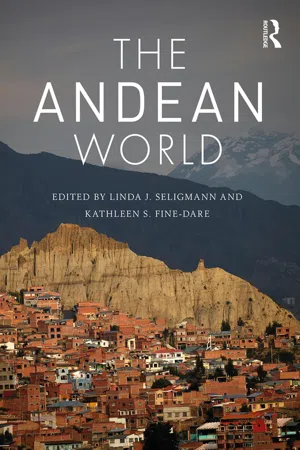
The Andean World
- 692 pages
- English
- ePUB (mobile friendly)
- Available on iOS & Android
eBook - ePub
The Andean World
About this book
This comprehensive reference offers an authoritative overview of Andean lifeways. It provides valuable historical context, and demonstrates the relevance of learning about the Andes in light of contemporary events and debates. The volume covers the ecology and pre-Columbian history of the region, and addresses key themes such as cosmology, aesthetics, gender and household relations, modes of economic production, exchange, and consumption, postcolonial legacies, identities, political organization and movements, and transnational interconnections. With over 40 essays by expert contributors that highlight the breadth and depth of Andean worlds, this is an essential resource for students and scholars alike.
Information
PART I
GEOGRAPHIES, LANDSCAPES, AND ENVIRONMENTS

CHAPTER ONE
STRATEGICALLY RELEVANT ANDEAN ENVIRONMENTS
Gregory Knapp
STRATEGICALLY RELEVANT ENVIRONMENTS
Geographers understand that there are no objectively given environmental parameters, but that humans throughout history, in the Andes and elsewhere, have evaluated their environment in accordance with the strategic and cultural norms of their respective societies. These norms do not necessarily separate altitude, latitude, slope, soil, or climate, but integrate all of these as strategically relevant (Knapp, 1991, pp. 19–52) to such cultural goals as crop yields.
Thus, the relevant environmental zones for early foragers and specialized hunters would have included the ranges of seasonally important game animals and food plants. For later agricultural societies, fertile soils and optimal temperatures and precipitation (or access to irrigation) would have been important; these optima would of course vary by crop. Relevant mineral resources also changed with cultural history. Salt and raw materials for tools would have been important early. During colonial times, gold placer deposits and silver lodes were decisive for economic development and location of such major cities as Potosí. More recently, industrial minerals such as copper, tin, and lithium, along with hydrocarbons such as the coal deposits of the Colombian Andes, have assumed importance and shaped demographic patterns and environmental practices.
In addition to providing resources for human projects, Andean environments have also presented challenges and hazards. Easily predictable challenges, such as the normal dry season, can result in effective human adaptations, such as seasonal adjustment of sowing dates. Other challenges, such as earthquakes, volcanic eruptions, and El Niño events are less predictable and can be termed “natural hazards.” Hazards should be considered in terms of their strategic importance to prevailing adaptive strategies. A drought that is devastating to an agricultural civilization may therefore not matter as much to a foraging society or an urbanized, industrial society
Research by geographers and others has shown that, despite a range of variation in their responses, individuals and societies cope less well with hazards than with more predictable events. All too often, attitudes of optimism or fatalism, or excessive confidence in technological solutions, get in the way of more effective policy solutions such as hazard mapping, land use zoning, and promotion of resilience. Recent anthropogenic climate change presents similar challenges.
Finally, many Andean environments have been appreciated in aesthetic and ideological (including religious) terms, and this too varies by society. Mountain peaks, springs, caves, and even individual trees may be seen as important, in shamanism, organized religions, or other folk beliefs. Modern Andean travel and tourism is often oriented around the beauty or sublimity of natural features such as mountain peaks, lakes, high grasslands, and waterfalls, for example. Ever since the day when the Enlightenment era naturalist and explorer Alexander von Humboldt (1769–1859) traversed the Andes, the importance of combining scientific and humanistic methodologies, avoiding ethnocentrism, and appreciating the interconnectedness of life has been understood as necessary to make sense of the environmental dynamics of the Andes (Wulf, 2015).
These observations complicate the notion of “environmentalism” or “conservation,” which are always socially constructed. What is seen as valuable, hazardous, or ethically worth preserving by traditional agricultural villagers may be very different than what is defined in these terms by representatives of modern industrial societies in the global north. These different perceptions can result in misunderstandings. In the worse case scenarios, scientists and representatives of environmental NGOs or state agencies may be seen by local people as practicing a sort of neo-colonialism, imposing their views in ways that disempower local people and silence local voices.
Given these considerations, it is still possible to provide an overview of Andean environments in terms of characteristics that have proven to be strategically significant to multiple societies. A distinction between the tropical and non-tropical Andes is useful, for example. Elevation is of broad relevance, but needs to be complemented with a recognition of slope, aspect, and soil. Precipitation—amount and timing—is of great importance for agriculture, but needs to be seen in light of the availability of sources for artificial irrigation. Major hazards include earthquakes and volcanic eruptions, as well as El Niño events. Climate change is certainly relevant as well, including changes in glaciers.
LANDFORMS, GEOLOGY, AND SOIL
The Andes are a continuous chain of mountains extending from northern Venezuela to southern Argentina and Chile (Troll 1988; Caviedes and Knapp, 1995, pp. 86–96; Veblen, Young, and Orme, 2007; Borsdorf and Stadel, 2015). These mountains are relatively young in geological terms, primarily created as a result of the ongoing collision of the South American continent and its underlying “plate” with neighboring oceanic plates, including the Nazca plate. The resulting overriding (subduction) has resulted in uplift and the injection of material, including the creation of volcanoes, past and present (Lamb, 2004). Although much of the Andes contains volcanic rocks and even active volcanoes, other parts of the Andes contain older rocks lifted up by the general thickening of the continental crust. Thus, in some areas sedimentary and metamorphic rocks and exposed batholiths are found in the high Andes.
The Andes are almost uniformly high in elevation; some of the lowest passes are found in far northern Peru, but these are still above 2,000 meters. As is the case with other mountains, the prevailing steep slopes have presented problems for surface transportation, which only recently have been partially overcome with the development of railways, air transport, and modern paved highways and tunnels. The steep slopes may easily erode, resulting in poor soils for agriculture; this problem can be addressed with terracing, but terraces may be difficult to construct and maintain. Finally, air pressure decreases at higher elevations, potentially causing transitory altitude sickness in humans.
Usually the tropical Andes consist of two or more high ranges separated by intermontane valleys or more extensive high plains (altiplanos). Since prehistoric times, the valleys and altiplanos have often been favored sites for settlement and agriculture. Often the altiplanos are high in elevation, but some valleys are deeply incised and their bottoms are tropical in climate.
In northern Venezuela, the initial part of the Andes includes two ranges, a Coastal Range and the Cordillera Interior. Between these two ranges is the valley containing Caracas, the capital, and Lake Valencia. Farther west, the two ranges come together to form the high Cordillera de Mérida, which continues into Colombia as the Cordillera Oriental.
A spur range, the Cordillera de Perijá, extends to the north, forming the boundary between modern Colombia and Venezuela. Nearby Lake Maracaibo is rich in oil deposits, and rich coal deposits are also found in this region. To the west of this spur range, in far northern Colombia, the Sierra Nevada de Santa Marta is a separate high uplifted block of metamorphic and intrusive rocks, with elevations exceeding 5,700 meters close to the Caribbean coast.
In the rest of Colombia, the Cordillera Oriental continues as the easternmost Andean range, with rounded topography and few high peaks. It contains many high, flat-floored basins between 2,500 and 3,000 meters in elevation, including the Sabana de Bogotá, locations of major pre-Hispanic chiefdoms and present-day large cities, including Bogotá and Pasto.
The Cordillera Oriental is complemented by two additional mountain ranges, the central Cordillera Central and the western Cordillera Occidental; these three join together at the Nudo (“knot,” or transverse ranges) of Pasto just north of the Ecuadorian border. The Cordillera Oriental is separated from the Cordillera Central by the deep Magdalena River valley. The Cordillera Central contains numerous active volcanoes, and as a result has rich volcanic soils which have long supported productive agriculture, such as recent coffee farms. To the west of the Cordillera Central is the Cauca River valley, with large flat areas of rich alluvial soils suitable for farming tropical crops. The westernmost range in Colombia is the Cordillera Occidental; it is relatively low (3,000 meters) and receives high rainfall amounts.
South of the Nudo of Pasto, in Ecuador, there are two major Andean ranges, a western Cordillera Occidental (or Cordillera Real) and an eastern Cordillera Oriental. Between the two can be found a series of isolated high valleys, in some cases containing small high plains, which have been the sites of dense population from pre-Hispanic times to today. These high valleys (hoyas) include, for example, the Hoya del Guayllabamba (containing Quito), and the Hoya del Paute (containing Cuenca). The hoyas are separated by transverse ranges (nudos). Both ranges include numerous volcanoes, which have resulted in extensive areas of rich volcanic soils. To the east of the Cordillera Oriental there is another set of isolated active volcanoes, while near the coast there are the much lower Coastal Ranges topped by uplifted sedimentary rocks; between these ranges and the Cordillera Occidental can be found the fertile alluvial valley of the Guayas River and its estuary.
In southern Ecuador the ranges again combine in the complicated Nudo of Loja, before re-organizing in northern Peru as three separate ranges: the eastern Cordillera Oriental (Cordillera Real), the central Cordillera Central (Cordillera Blanca), and western Cordillera Occidental (Cordillera Negra). The western Cordillera Negra borders (and partially causes) the Peruvian Coastal Desert; its western flanks are typically dry at lower elevations. Some rivers originating further east (such as the Chicama and Santa) slash through this range, but scores of additional rivers originate in the Cordillera Negra itself. These rivers create a series of oases on the Peruvian coast that have been important centers of settlement for millennia.
Between the Western and Central Cordilleras are a series of valleys, including the Callejón de Huaylas. The Central Cordillera or Cordillera Blanca contains high peaks and substantial glaciers. In central Peru, the western and central Cordilleras merge; farther south in Peru, there can be found a complex array of ranges and high basins, incl...
Table of contents
- Cover Page
- Half Title
- Series Page
- Title Page
- Copyright Page
- Table of Contents
- List of Figures
- List of Maps
- List of Tables
- List of Contributors
- Abbreviations
- Introduction: The Andean World
- Part I: Geographies, Landscapes, and Environments
- Part II: Engaging With Ancestral Legacies
- Part III: Andean Cosmologies
- Part IV: Conquest, Invasion, and Resistance
- Part V: Sustenance
- Part VI: Social, Political, and Religious Organization and Resilience
- Part VII: Postcolonial Legacies in the Andes
- Part VIII: Identities
- Part IX: Aesthetics, Communication, and Performance
- Part X: Writing, Education, and State Power
- Part XI: Landscapes of Contemporary Andean Worlds
- Part XII: Collisions and Kaleidoscopes
- Reflections and Projections: Andean Worlds
- Index
Trusted by 375,005 students
Access to over 1.5 million titles for a fair monthly price.
Study more efficiently using our study tools.
Frequently asked questions
Yes, you can cancel anytime from the Subscription tab in your account settings on the Perlego website. Your subscription will stay active until the end of your current billing period. Learn how to cancel your subscription
No, books cannot be downloaded as external files, such as PDFs, for use outside of Perlego. However, you can download books within the Perlego app for offline reading on mobile or tablet. Learn how to download books offline
Perlego offers two plans: Essential and Complete
- Essential is ideal for learners and professionals who enjoy exploring a wide range of subjects. Access the Essential Library with 800,000+ trusted titles and best-sellers across business, personal growth, and the humanities. Includes unlimited reading time and Standard Read Aloud voice.
- Complete: Perfect for advanced learners and researchers needing full, unrestricted access. Unlock 1.5M+ books across hundreds of subjects, including academic and specialized titles. The Complete Plan also includes advanced features like Premium Read Aloud and Research Assistant.
We are an online textbook subscription service, where you can get access to an entire online library for less than the price of a single book per month. With over 1.5 million books across 990+ topics, we’ve got you covered! Learn about our mission
Look out for the read-aloud symbol on your next book to see if you can listen to it. The read-aloud tool reads text aloud for you, highlighting the text as it is being read. You can pause it, speed it up and slow it down. Learn more about Read Aloud
Yes! You can use the Perlego app on both iOS and Android devices to read anytime, anywhere — even offline. Perfect for commutes or when you’re on the go.
Please note we cannot support devices running on iOS 13 and Android 7 or earlier. Learn more about using the app
Please note we cannot support devices running on iOS 13 and Android 7 or earlier. Learn more about using the app
Yes, you can access The Andean World by Linda J. Seligmann, Kathleen S. Fine-Dare, Linda J. Seligmann,Kathleen S. Fine-Dare in PDF and/or ePUB format, as well as other popular books in Social Sciences & Anthropology. We have over 1.5 million books available in our catalogue for you to explore.