Observing young children at play is an everyday and often fascinating and pleasurable experience for many of us. It also has a great pedigree in the development of psychoanalysis from Freud's observation of his grandson's game with the cotton-reel onwards. This book describes the practice of observing young children in home and nursery settings in a systematic and non-intrusive way in order to expand our understanding of their emotional, cognitive, and social development. It uses a psychoanalytic lens to enrich the meaning of what is seen. How do minds and personalities take shape? How can we train people to see what is most relevant in helping children to develop? The chapters range from classic papers by famous practitioners of an older generation to observations completed in recent years in the UK, Europe, and the US. Observation of this sort has also spread to Latin America, India, Australia, Africa, and the Far East. The differences and continuities with Infant Observation are the starting point.
eBook - ePub
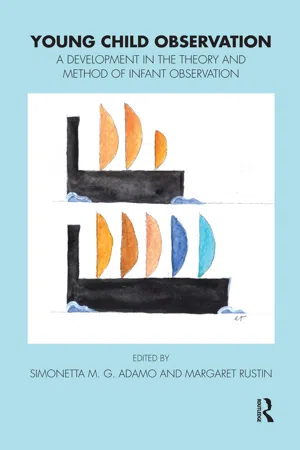
Young Child Observation
A Development in the Theory and Method of Infant Observation
- 384 pages
- English
- ePUB (mobile friendly)
- Available on iOS & Android
eBook - ePub
Young Child Observation
A Development in the Theory and Method of Infant Observation
About this book
Information
Part I
Developmental issues
The first part contains four chapters, which explore developmental issues in more than one sense. These contributions relate to the historical development of the practice of Young Child Observation and to the psychoanalytic understanding of development in young children, as a process that reactivates infantile anxieties and provides opportunities for further psychological growth. The key role of Martha Harris and Isca Wittenberg in developing the whole field of psychoanalytic observation was rooted in the contribution of their imaginative empathy with young children and their grasp of how psychoanalysis could enrich our understanding.
Chapter 1, written by Isca Wittenberg under her maiden name, is based on more occasional but very careful observations made by parents and nursery teachers. The paper was originally written for the opening conference of a training programme for nursery teachers. These observations are more similar to those conducted by sensitive and psychoanalytically informed parents and professionals in the early days of psychoanalytic direct observation (A. Freud, 1951). Going to a nursery school is, for a child, a crucial transition, similar in impact to the first major transition of birth. Particularly poignant are the author’s comments on sensory over-stimulation. The noise that a child experiences in this new environment can be felt as an unbearable bombardment, perhaps not so very different from what happens to a baby leaving intrauterine life to enter into the new world outside. Attention and comparison of the child’s different behaviour and moods at home and at school can help parents and professionals go beyond a superficial picture and enable them to differentiate real integration from compliance, resignation, depression, or adhesive adjustment.
In chapter 2, we enter the more familiar realm of observation proper. It is a pleasure to include this chapter, which shows how Martha Harris and Donald Meltzer approached material from the observation of a 3-year-old undertaken by Romana Negri. The chapter has the lightness of a fairy tale, and this adds to its originality and does not diminish its depth. The story starts with a reconstruction of the initial condition of the foetus. The accent here is mainly upon the “friends” a child can encounter in his developmental journey. The narcissistic, omniscient parts of the personality offer themselves as allies to the child confronted with the struggles and the losses of growth, and fight with the dependent aspects of personality. This conflict is heightened at all times of change, as is shown by the observation of the child just beginning nursery school. Simone had been observed for a long period at home (Negri, 1988) before the school observation took place. We have therefore here (as in chapter 10, by Elisabeth Dennis), an example of a mixed observation—that is, an observation usually taking place either at home or at school, which includes occasional visits to the other context. In such cases, the observer represents a link between home and school, and the way the child relates to her provides evidence of his capacity for or difficulty with linking. In the situation described by Romana Negri, Simone totally ignored the observer, probably because, as Martha Harris suggested, he was “trying to keep at bay his feelings or thoughts concerning home and being away from home”. The observer was used by the child in order to split and project upon her the “bad mother, who sent him to school”, in order to protect the good mother, who was “left at home”.
We see a very different situation in Elisabeth Dennis’s chapter (chapter 10), and the continuity of the observation allows us to follow the evolution of the child’s relation to the observer. The little girl’s fear of being forgotten, or even abandoned, by her parents prompted her to stick close to the observer, whom she had first met at home and who therefore represented a kind of umbilical cord, or a safety belt, against the fear of being lost in an empty space, “in a no-man’s land of affection” (A. Freud, 1943) and feeling, as a 5-year-old boy expressed himself, “nobody’s nothing” (A. Freud, 1943).
“Young Child Observation is itself a second-born”—this is one of the opening sentences of chapter 3, by Simonetta M. G. Adamo and Jeanne Magagna, on “Oedipal Anxieties, the Birth of a Second Baby, and the Role of the Observer”—the first published paper specifically devoted to Young Child Observation as now generally practised. This partly accounts for the wide range of aspects that the chapter explores. These include some historical information on the place of Young Child Observation in the Tavistock training, based on the personal communications of some of the child psychotherapists who contributed to it, the movements in the relationship to the mother and to the father that the birth of a second baby sets in motion, theoretical considerations on the role of the father, and some technical issues linked to the role of the observer of a child of this age. The projection onto the observer of aspects associated with the father’s role is a relevant issue in this chapter. In fact, this observation allowed the child to have a special, “private” space to which she could move when she felt overwhelmed by the high temperature of feelings associated with the relationship between the mother and the newborn. This “private” space, contiguous with yet separate and distinct from the realm of primary relationships, is the space of symbolic representation, where play can take the place of enactments. In this way, intense, ambivalent, primitive anxieties could be approached, be available for inner and outer communication, and be initially explored.
Maggie Fagan’s original chapter (chapter 4) introduces a fresh perspective in noting the particular way in which the childhood family experience of observers is evoked by their experience of observing a young child. Whereas in Infant Observation the “memories in feeling” (Klein, 1957) that are often stirred are at an unconscious level, closeness to young children at play in family and nursery settings provokes conscious as well as unconscious recollections and can shape powerful identifications. In addition, the fact that for most observers the Young Child Observation begins subsequent to a year or more of Infant Observation, and usually lasts for a shorter time, can have the effect of giving it a diminished status or lead to observers experiencing the two observations as rivals, with Young Child Observation seen as the intruding and unwelcome new baby. She discusses the special responsibility the seminar leader carries for awareness of these potential dynamics in the group. She also has some interesting reflections on the place of theory in observation seminars, made even more complex by the expanding research literature on child development. The risk of a focus on the norm and hence also on pathology rather than the sympathetic attention to individual complexity is highlighted.
Chapter One
The transition from home to nursery school
This chapter was written as a talk for a group of nursery teachers in Naples at an opening conference of a new project of ongoing workshops for nursery staff. It presents a lucid and evocative account of the problems young children encounter in facing the first substantial separation from mother and home and provides a fitting introduction to a collection of papers arising from observations of young children at home and in nursery settings. It is a reminder of a natural link between child psychotherapists and those involved in education in the early years. The upsurge of commitment to and investment in preschool education in Great Britain and elsewhere provides a new opportunity for such fruitful encounters.
Embarking on something new—a course of study, marriage, having a baby, moving to a new house—all such events tend to arouse hope of increasing our knowledge, pleasure, and fulfilment. It is such hopeful expectations that lead us throughout life to continue to seek out new experiences. The young child beginning to go to nursery is also filled with hope, expecting to find interesting toys to play with, to learn to do things that the older children he admires are able to do, and to meet children who might become his friends. Unless previous experiences have been too deeply disappointing, we continue throughout life to hope that some new event might bring us nearer to the fulfilment of what we desire. We may invest it with hope and indeed idealize it, but at the same time we are also likely to harbour fears and dread about what this unknown new situation will bring with it. We may be afraid that the new place or person will be frightening, the new child be unmanageable, unlovable; that the new teacher will be harsh, punitive, too demanding. We may be afraid that we will not have the physical, mental, or emotional capacity to live up to the new challenge; we may feel lost in new surroundings, confused and disturbed by new ideas. We may fear to be judged by others, thought to be stupid, ignorant, lacking talent; we may be afraid that we will be made to feel inadequate, laughed at, disliked, thrown out. All these thoughts tend to arise when we are faced with a new situation.
We do not usually speak about having such disturbing emotions. We may be ashamed of them and think that we should have outgrown such fears, that they are childish. They are childlike only in as far as their origin dates back to early childhood. The psychoanalytic study of the mind has shown that all our experiences, right from the very beginning of infancy, leave memory traces, and the emotions connected with the events remain in the depth of our minds throughout life. Very early experiences are not consciously remembered but reappear in the form of what Melanie Klein (1957) called “memories in feeling”—that is to say, in bodily and mental states and phantasies. These are re-evoked in us whenever the present situation in one way or another resembles an earlier one. Thus, the feeling states we experienced in infancy and childhood remain within us, they are never outgrown. Being in touch with these child aspects of ourselves helps us to understand and tolerate our own and other people’s more infantile fears and desires. And such understanding is essential if we are to appreciate what goes on in the minds of young children. Unlike us, most 2- or 3-year-olds cannot put their thoughts into words, and when they feel lost in strange surroundings they cannot ask someone to show them the way home; they do not even know where home is. All they can do is communicate through their behaviour how they feel.
Robert, a child of 2½, was excited at the thought of going to nursery. He liked the company of other children and had been told that there would be many new toys to play with. When he arrived at the nursery with his mother, he at first stayed close to her but then began moving a little further away from her and sticking coloured shapes onto a piece of paper. An hour after their arrival, mother thought that he had begun to settle down happily and got up to leave. Robert rushed to her, started crying but, encouraged by the teacher, mother went out, saying she would be back when she had done her shopping. When she rang the nursery an hour later, she was told that Robert had stopped crying and was fine. The next day, when after a little while Robert had started happily to use the paints at the nursery, mother left, but when she phoned later, she could hear her child crying. On the third morning, Robert was reluctant to leave home; he asked for another drink, then another biscuit, then for another cuddle and another. By the weekend he was running a slight temperature and seemed generally unwell. When the parents took him for a walk in the park, he did not run ahead as usual. When he saw his grandmother, he greeted her without his usual enthusiasm, and when his parents went to the canteen to fetch a drink, he would not, as he had always done on previous occasions, stay happily with her but kept pulling her in the direction his parents had gone, asking repeatedly: “Where is mummy, I want to go to mummy”. On Monday morning he did not want to get dressed and cried all the way to the nursery. He screamed when mother tried to leave him there, as the teacher suggested. The teacher said, “Maybe it’s just bad temper”, but because he had been disturbed all weekend and was now looking very frightened and would not settle, mother eventually took him home. She said she had never seen him in such a state before except sometimes when strangers came to the house. When mother went back later to speak to the head teacher, Robert clung to her, crying so intensely that the adults could barely carry on a conversation. The teacher told mother that she had been over-protective of Robert and that was why he had a problem separating from her. The parents acknowledged that there could be some truth in this but felt hurt at being blamed. They in turn criticized the nursery staff for not helping the child sufficiently. Such mutual blaming is not uncommon but helps no one. Let us, rather, try to understand the situation. What sense can we make of the extent of the child’s distress? How could the beginning at nursery have been made more tolerable for him? Robert’s mother decided that he was too young to start nursery, that she would wait another four months before taking him back. But is it really going to be very different then?
Let us start by examining what feelings are aroused in a young child when he finds himself left by his mother in strange surroundings with people he does not know. To understand the depth of the emotional distress, we have to turn our attention to the very beginning of life, to the event of birth itself. And here we note that being born is both a beginning and an abrupt ending. The infant loses the world he has lived in for nine months. As he leaves mother’s body, never to return, he exchanges a fluid environment where he was automatically fed and held within the warmth and protective layer of the womb for a new existence in aerial surroundings. He is exposed to the cold, to the impingement of harsh lights and sounds. Life within the womb may have become restricting, but now he suddenly finds himself in boundary less space. Furthermore, the human newborn lacks the mobility to support his body, to reach the source of food, warmth, shelter, and protection from danger. This extreme helplessness leaves him terrified, afraid to fall, to die. The French doctor Leboyer (1975) demonstrated how the dramatic experience of entering this new world can be made less traumatic by trying as far as possible to re-create the conditions operative in utero during and immediately after the baby’s birth, thus providing some degree of continuity of experience for the baby. This includes keeping the lights dimmed, putting the baby on the mother’s stomach before the umbilical cord is cut, allowing the baby to suck at the breast as soon as possible, immersing him in a warm bath, and gently massaging his body. When this procedure was followed, the infant’s cry soon subsided, his cramped posture relaxed, and he began to explore the world around him.
Infant Observation has shown that throughout the early weeks, a baby only feels safe if the link with the placenta is substituted by a readily available nipple in the mouth, and the physical holding within the boundary of the wall of the womb replaced by his feeling closely held and enveloped. The infant’s state of bliss when connected with the breast and held securely within mother’s arms and loving attention quickly gives way to screams and disjointed movements whenever he feels cut off, uncontained, disconnected from the source of life. Here we witness the epitome of the terror of separation. Wilfred Bion called this terrifying state catastrophic anxiety. It threatens to overwhelm us whenever we face change. Clearly, the further we are removed from our home base, the more frightened, the more lost and disorientated we tend to feel. We fear that we will again experience such helplessness and terror as we did in our infancy. We are afraid to be alone, abandoned, left to die. We see reflections of this at all the stages in our life that involve major changes. Thinking about children, the younger the child, the more helpless he in fact is, and hence the greater the anxiety he is likely to experience when faced with what is new and unfamiliar. The way anxiety is dealt with also has resonance with the way he could be comforted in babyhood. We saw, for instance, how Robert, afraid of being left by mother, held onto her body, asked for drinks, food, and cuddles, clinging onto all these vital connections with the source of life and security he had learnt to depend on. And just as we saw that the provision of some continuity of experience helped the newborn to become interested in the totally unknown environment of the external word, so the continuity of the mother’s presence and the gradual handing over to the teacher when he has become used to her can greatly facilitate the child’s transition into the world of the nursery. That such factors as the noise level in the nursery may be as disturbing to a child coming from a quiet home as loud sounds are to a baby was brought home to me when I was told that Robert had complained that his ears hurt and said, “I can’t hear the music, there’s so much noise.”
So far, we have looked at the residues of the impact of the abrupt ending, which is part of being born. But the child coming to nursery will, of course, have also experienced many less extreme separations. Every ending of a feed, every putting the baby down in his cot, every time mother goes out of the room is a separation, making the baby aware of being not at one with but separate from his mother. As Winnicott (1964) pointed out, it is important to “introduce the world to the baby in small doses, otherwise being separate is too terrifying”. Mother–infant observations show that only through many repeated experiences of loving attention from a mother who is readily available when he feels frightened, hungry, or in pain can the infant come to feel that there is someone who will be there when needed. Together with the taking in of the milk, he takes in a picture of being mothered and gradually establishes a mental concept of a mother who is reliably loving, comforting, and able to respond to his communications of pleasure and pain. Gradually these memory traces of good experiences in mother’s presence enable him to have short periods of lying awake by himself, holding onto and re-creating in his mind his pleasurable, sensual interchanges with his mother. When he is put down, he may at first cry, but he can increasingly call on this inner picture to provide him with a feeling of being held and comforted. It is the task of parents to learn to judge what their baby can tolerate, how long he can be left without getting into a state of panic. There are parents who put their baby out of earshot so as not to be disturbed by his ongoing crying; if the baby is left too often for too long, trust in a reliable, good mother may never be securely established. At the other extreme, there are parents who cannot bear their baby to cry for a minute: they pick the baby up at the slightest sign of upset. This undermines the development of the child’s learning to draw on his inner resources—such children become dependent on mother being always there to help. I think this might have been so in Robert’s case. It is often difficult for parents to discover what is right for their child because in looking after the baby and later the child, their ...
Table of contents
- Cover
- Half Title
- Series Page
- Title
- Copyright
- Dedication
- CONTENTS
- SERIES EDITOR’S PREFACE
- ACKNOWLEDGEMENTS
- ABOUT THE EDITORS AND CONTRIBUTORS
- Introduction
- PART I Developmental issues
- PART II Observing in the home
- PART III Observing in a nursery
- PART IV Applications
- PART V Research
- Epilogue
- REFERENCES
- INDEX
Trusted by 375,005 students
Access to over 1.5 million titles for a fair monthly price.
Study more efficiently using our study tools.
Frequently asked questions
Yes, you can cancel anytime from the Subscription tab in your account settings on the Perlego website. Your subscription will stay active until the end of your current billing period. Learn how to cancel your subscription
No, books cannot be downloaded as external files, such as PDFs, for use outside of Perlego. However, you can download books within the Perlego app for offline reading on mobile or tablet. Learn how to download books offline
Perlego offers two plans: Essential and Complete
- Essential is ideal for learners and professionals who enjoy exploring a wide range of subjects. Access the Essential Library with 800,000+ trusted titles and best-sellers across business, personal growth, and the humanities. Includes unlimited reading time and Standard Read Aloud voice.
- Complete: Perfect for advanced learners and researchers needing full, unrestricted access. Unlock 1.5M+ books across hundreds of subjects, including academic and specialized titles. The Complete Plan also includes advanced features like Premium Read Aloud and Research Assistant.
We are an online textbook subscription service, where you can get access to an entire online library for less than the price of a single book per month. With over 1.5 million books across 990+ topics, we’ve got you covered! Learn about our mission
Look out for the read-aloud symbol on your next book to see if you can listen to it. The read-aloud tool reads text aloud for you, highlighting the text as it is being read. You can pause it, speed it up and slow it down. Learn more about Read Aloud
Yes! You can use the Perlego app on both iOS and Android devices to read anytime, anywhere — even offline. Perfect for commutes or when you’re on the go.
Please note we cannot support devices running on iOS 13 and Android 7 or earlier. Learn more about using the app
Please note we cannot support devices running on iOS 13 and Android 7 or earlier. Learn more about using the app
Yes, you can access Young Child Observation by Simonetta M.G. Adamo,Margaret Rustin in PDF and/or ePUB format, as well as other popular books in Psychology & Developmental Psychology. We have over 1.5 million books available in our catalogue for you to explore.