eBook - ePub
Resilience, Suffering and Creativity
The Work of the Refugee Therapy Centre
- 224 pages
- English
- ePUB (mobile friendly)
- Available on iOS & Android
eBook - ePub
About this book
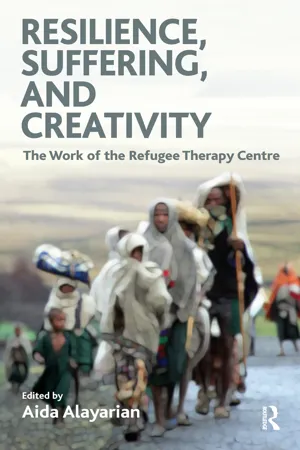
The trauma of refugee status is particularly corrosive. It does the usual harm of devastating our own self-image and sense of permanence in the world, but it does more. It is a dislocation from our familiar domestic geography and culture, and that must wrench from our grasp all the external markers by which we know ourselves and our worth. The threat of persecution, torture, and death is aimed at a complete destabilization. The result is a complex of anxieties that add up to far more than simple suffering. If therapy is primarily aimed at the gentle exposure of one's worst fears, then what purchase can it have on this most ungentle process of becoming a refugee?
Information
Chapter One
Trauma, resilience, and creativity
Aida Alayarian
“Resilient: adj. 1 able to recoil or spring back into shape after bending, stretching or being compressed. 2 able to recover quickly after difficult conditions”
(Oxford English Dictionary, 2001)
Introduction
Resilience has been defined as the ability to experience severe trauma or neglect without a collapse of psychological functioning or evidence of post traumatic stress disorder. It differs from well-being or positive mental health, which assumes an acceptable environment and effective psychological functioning. Such positive mental health requires, as well as resilient qualities, the creation of a protected inner space.
The ideas in this and the following chapter derive from two principal sources: my own personal experience and my experience of working with refugees who, in my view, possess the art of living, who have suffered traumatic events such as death camps or labour camps, imprisonment, torture, hiding, fleeing, leaving behind everything familiar in order to stay alive. I am focusing on people who have been able to move on in life after their traumatic experiences, to re-create a reasonably happy atmosphere for their family, to integrate into a new society, to work effectively in their profession or occupation, and to love and contribute to the life of the community they live in.
Background
My choice of examples is highly personal, in the hope that such reflections may generate wide interest and further discussion.
Although psychoanalysis is a form of treatment that enhances resilience, there is surprisingly little psychoanalytic literature directly about human resilience. Traditionally, psychoanalysis has been a method of psychological investigation, a method of treatment for certain psychological difficulties, and a body of theory concerning the functioning of the human mind (Freud, 1923b). Currently, psychoanalysis is under considerable pressure to change, because of trends in Western culture that have influenced psychoanalysis and because of changes in the broader field of mental health, such as the search for cost-effective treatments and cross-cultural changes that provide a rationale for research and evaluation.
Resilience and the psychoanalytic approach
In working with people, I focus on enhancing resilience as well as exploring vulnerabilities. This is intended to help maintain a focus on the healthy parts of the patient’s life while I am working on the disturbed parts in order to achieve integration. The psychoanalytic approach, in many ways, creates resilience in people and provides opportunities for discovering what it means to be the survivor of massive traumas.
Working with refugees is of deep personal significance for me. The crossing of antagonistic and threatening political and geographic boundaries, from infancy well into adulthood, has shaped my life as it shaped the lives of my parents and grandparents. I was brought up, educated, and employed in a country that did not provide a secure environment for those who disagreed with the authorities. In the absence of a politically secure environment, military forces, terror, and violence are part of daily life. This creates all sorts of psychological pain, which a person would feel both as an individual and as a member of his or her community, and this in turn affects boundaries and identity in personal and public life.
I will give an example from my training as a clinical psychologist, during which we were required to seek therapy for ourselves. During my analysis I was involved in organizing a women’s demonstration against the compulsory veil. This was of course associated with anxiety in my mind, but I had to think carefully about whether or not I could talk about my anxiety and fear with my analyst, both for our safety and for the safety of others. So, free association was limited by a political boundary. I was always wondering how successful my analysis could be when, in certain areas of my life, I had to hide my true feelings from my analyst. Trust between myself and my analyst was not only a private and personal issue but also a political issue involving responsibility for others. Both of us undoubtedly needed a good deal of resilience to make the process work without endangering anyone. All this, in addition to my formal training, certainly shaped my clinical practice, helping me to be more flexible, balancing psychoanalytic practice with the external reality that patients are living in.
I wonder whether, because it may seem strange for us to see our patient as resilient, we sometimes prefer to seek out the contrasting characteristic of vulnerability.
What are the characteristics of resilience? How do we identify and recognize it?
When life is suddenly and tragically interrupted by traumatic events, resilient people seek to rebuild.
Resilient people are more often able to assess what needs to be dealt with: they tend to possess a good cognitive capacity and adequate emotional stability. For resilient people, things are seen as they are and are not easily dismissed; there is a clear distinction between fantasy and reality. This enables them to respond more effectively in difficult situations, and not be paralysed by anxiety.
Other characteristics are a strong capacity for self-reflection, a sense of identity, self-awareness, and an awareness of others, characteristics that create self respect and protection. The capacity for empathy enables the resilient person to tolerate difficult and abusive situations by focusing on making connections with others, identifying the issue and resolving it in a positive manner, thereby avoiding hostility. This ability seems to create a cushioning effect against overwhelming aggressive feelings and wishes, and allows a person to function without falling apart.
The possession of a good sense of humour is another feature of resilience; it enables people to gain perspective and provides some helpful light-heartedness. Clear ego-boundaries, another feature of resilience, protects people from becoming perplexed by other people’s pathology, and enables them to maintain good ears for listening, and an empathic attitude.
Resilient people can, to some extent, control the impact of their environment by using strategic withdrawal and activity or passivity, internally as well as externally. In a dysfunctional family, for example, resilient children are the object of abuse less often than their siblings. Another example, seen in work with children and adolescents, is what I call a “reversal of rules and responsibilities”; a situation where the child is taking on the responsible role in relation to a parent or older sibling, or a child is caring for a dysfunctional parent, cooking for the family or taking care of younger siblings. This is not uncommon among refugee and asylum-seeker families, where children learn the language much quicker than their parents and adopt the host culture also more rapidly. The same can be said of resilient people in prisons or detention centres, in comparison to other inmates.
Resilient people are more aware of and more tolerant of their negative feelings. They find their guilt more manageable, and usually very little neurotic or unconscious guilt distorts interpersonal relationships. This enables them to take care of themselves more adequately and realistically, and not get swallowed up in someone else’s narcissistic or sadistic needs. Resilient people may experience less of the survivor’s guilt so common among people who witness the killing of close family members or friends. A resilient person’s guilt may more often be channelled into helping others, by working in a caring profession or getting involved in charitable or political activities.
Resilient people may have a sense of confidence about the outcome of doing good and living peacefully. They often have the ability to find safety among people they trust. Related to this is the ability to bring into their lives people who can help them without pitying them, people who have a strong sense of morality, a social and political consciousness, are of good character and have genuine human concern.
Another characteristic of resilient people is their positive thinking. Creation gives a sense of fulfilment, growing plants for example, or involving oneself in charitable or humanitarian organizations, making positive changes wherever one is living. It is certainly the case that some resilient people get satisfaction from being involved with good causes and making positive changes in their environment, even very small ones.
Resilient individuals often have a need to prove that adversity can be overcome: they do not want to be identified as victims.
A brief example of resilience
In one prison for political offenders, everything was geared by the authorities towards making the inmates lose their identity, their hope, their reason for living, and their sense of agency. But the prisoners with a resilient character adopted a strategy of teaming up with one other or with a few other inmates to look out for each other and especially for vulnerable young prisoners. It is known that they supported each other physically and emotionally in the almost symbiotic ways that were necessary in such extreme circumstances. Through their relationships, the resilient prisoners created an island of sanity, and confirmed each other’s identities as human beings. In this way resilient people might attempt to survive challenging and insecure circumstances by adopting a positive attitude, helping others more vulnerable than themselves to survive the unbearable situation.
Here, in a prison, not in a consulting room, we may recognize processes of projection, introjection, and projective identification and, more importantly, a kind of disassociation, used as a defence by resilient people.
Resilient people can take responsibility for what has to be done and can take charge in difficult situations without feeling victimized. If something has to be done they do it, and if for some reason they are not able to do it, they will say so without guilt or embarrassment. They see no point in attaching a negative thought to this; it would only make them feel miserable and prevent them from being productive and enjoying the result of their activity.
The next chapter, “Resilience—a case history”, will provide an extensive example of a person who had the foundations for resilient reactions, which failed her temporarily because of early inner conflicts, and which she was able to employ again after considerable psychoanalytic work.
Countertransference and resilience
As clinicians, our aversion to resilience might be due to uneasiness about our patients’ demonstrations of strength and independence. We might think they are resisting our help and being defensive towards our interpretation, denying their pain and guilt. It is often difficult for us not to interpret resilience in this way. Focusing on the patient’s positive ability is not easy when our training instructs us to focus on vulnerability and the daunting effect of trauma and post traumatic stress.
I believe that there is a fundamental difference between people who, from early childhood, had a deprived and traumatic upbringing and people who describe their childhood as reasonably happy and loving, and who felt protected, experiencing healthy early attachments. In my training in child observation, and also in my personal experiences with my own children, I have realized that infants show a range of strategies for coping with their environment, and varying levels of interest and effort and degrees of flexibility in their attempts to find gratification. These capabilities may be discerned at birth, but the infant’s positive holding and containing environment can foster them in hostile circumstances; in the absence of such an environment, the development of these positive traits may be stunted.
Resilience involves a complex combination of qualities of temperament and other features. Yet, the significance of self-identity, that intimate space where we live and talk to ourselves and where we have multiple identifications or introjections from the distant past, suggests that early relationships are an important factor. Overcoming even minor adversities can call into action a child’s potential for resilience and in important ways increase the strength of the ego to deal with stress.
Resilience and recourse to retreating
Resilient individuals are able to build a safe intrapsychic space in which they live and talk to themselves to regulate pain and protect themselves from too many vulnerable feelings. This almost unbreakable part of the self protects one from collapsing emotionally when the external world is unpredictable, overpowering or life-threatening. It is clear that, as a means of self-protection and to maintain this safe inner space, one has to employ the defence mechanisms of denial and disavowal, and consciously cut oneself off from the situation.
There is a fine line between being resilient on the one hand, and oppressing one’s feelings on the other hand. A boy of twelve from Central Africa told me that when he was eight years old he saw his father and brothers shot by officials. His mother took him and his younger sister into the bushes. His mother joined the rebels for the sake of her own survival and that of her children. Four months into therapy he told me that his mother had impressed upon him two rules: that he must always smile and not complain, and that he must never tell anyone that his father and brothers were killed. His mother was later raped, tortured, and killed by the rebels.
Although this patient was coming to therapy and was aware that he was extremely depressed, he continued to follow his mother’s wishes. He always smiled and would not talk about his past. He would talk about school, his teachers and fellow students, and social services with gratitude and would report that everything and everybody around him was good; it was just that he could not get up in the morning, could not study, did not pay attention to his teacher, and was letting everyone down. He said that he was “bad” and I could see that he felt guilt, which he was never able to talk about. In listening to him, I often felt that how he presented did not correspond with his true level of depression.
After six months in therapy, he broke down and had a period in hospital, resuming therapy after his discharge. Seven months later, he opened up for the first time and talked about the losses that he had experienced, the feelings of loneliness, of being strange and different, and of missing his mother so much. He felt that his memories were haunting him and he could not escape them. He had the feeling that no one understood him or knew what he had been through, and he wondered what the point of talking about all this was. I was aware that he was frustrated; he was weeping and howling with despair in that session. I did not want us to lose this moment, so I encouraged him to talk further. He said that even if he wanted to tell me more, he did not know what to say. I said I wondered whether it was hard for him to find the right words for his memories and his feelings about them. He nodded with agreement and relief. I said that we could think about them together and try finding words for them, and asked him whether he would like to picture the scenes in his mind so that together we could try to find the right words for them. He agreed and smiled for the first time, and we started working on his experiences more systematically. As his experience was so overwhelming, we agreed to focus on the past for the first thirty minutes of each session, and for the last twenty minutes we would focus on his daily life here. We also agreed that we could skip the first part of our session whenever he wished. He agreed with a big smile and it seemed to me this was the first real smile since I had been working with him.
However, as the therapy progressed and he gained the ability to put his experience into words, his anger started flaring up. This young patient had complaints about everyone he had encountered in Britain. He felt that people did not care about him; he viewed his social worker as sadistic, irresponsible, and careless; his teacher as picking on him for the mistakes of others who had nothing to do with him; his fellow students bullied him and no one wanted to be his friend; his foster parents only kept him for the money and did not care if he died tomorrow.
He had strong feelings of being a bad person, of not being loved or wanted, and many other feelings associated with these. He had mixed feelings towards me, sometimes showing anger and hatred, at other times being clinging and idealizing.
It is challenging to work with patients with such traumatic stories, who are disaffected for...
Table of contents
- Cover
- Half Title
- Title
- Copyright
- Contents
- ACKNOWLEDGEMENTS
- ABOUT THE EDITOR AND CONTRIBUTORS
- FOREWORD
- INTRODUCTION
- CHAPTER ONE Trauma, resilience, and creativity
- CHAPTER TWO Resilience: a case illustration
- CHAPTER THREE Memory for trauma
- CHAPTER FOUR The therapeutic needs of those fleeing persecution and violence, now and in the future
- CHAPTER FIVE Does it matter how much can be put into words? Complexities of speech and the place of other forms of communication in therapeutic work with refugees
- CHAPTER SIX Loss of network support piled on trauma: thinking more broadly about the context of refugees
- CHAPTER SEVEN Hearing the unhearable, speaking the unspeakable: original wounds, trauma, and the asylum seeker
- CHAPTER EIGHT How I became a psychoanalyst
- CHAPTER NINE My experience of clinical work with refugees and asylum seekers
- CHAPTER TEN Boundary problems and compassion
- CHAPTER ELEVEN Reflections on alternative organizational structures for charitable agencies
- INDEX
Trusted by 375,005 students
Access to over 1.5 million titles for a fair monthly price.
Study more efficiently using our study tools.
Frequently asked questions
Yes, you can cancel anytime from the Subscription tab in your account settings on the Perlego website. Your subscription will stay active until the end of your current billing period. Learn how to cancel your subscription
No, books cannot be downloaded as external files, such as PDFs, for use outside of Perlego. However, you can download books within the Perlego app for offline reading on mobile or tablet. Learn how to download books offline
Perlego offers two plans: Essential and Complete
- Essential is ideal for learners and professionals who enjoy exploring a wide range of subjects. Access the Essential Library with 800,000+ trusted titles and best-sellers across business, personal growth, and the humanities. Includes unlimited reading time and Standard Read Aloud voice.
- Complete: Perfect for advanced learners and researchers needing full, unrestricted access. Unlock 1.5M+ books across hundreds of subjects, including academic and specialized titles. The Complete Plan also includes advanced features like Premium Read Aloud and Research Assistant.
We are an online textbook subscription service, where you can get access to an entire online library for less than the price of a single book per month. With over 1.5 million books across 990+ topics, we’ve got you covered! Learn about our mission
Look out for the read-aloud symbol on your next book to see if you can listen to it. The read-aloud tool reads text aloud for you, highlighting the text as it is being read. You can pause it, speed it up and slow it down. Learn more about Read Aloud
Yes! You can use the Perlego app on both iOS and Android devices to read anytime, anywhere — even offline. Perfect for commutes or when you’re on the go.
Please note we cannot support devices running on iOS 13 and Android 7 or earlier. Learn more about using the app
Please note we cannot support devices running on iOS 13 and Android 7 or earlier. Learn more about using the app
Yes, you can access Resilience, Suffering and Creativity by Aida Alayarian in PDF and/or ePUB format, as well as other popular books in Psychology & History & Theory in Psychology. We have over 1.5 million books available in our catalogue for you to explore.