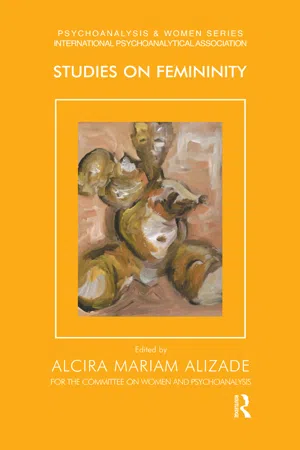
Studies on Feminity is the second volume in a unique series edited by the author for the Committee on Women and Psychoanalysis of the International Psychoanalytical Association. Providing a forum for exploration and discussion of diverse issues relating to gender constructs, sexuality, and sexual identity, the series brings together an internationally renowned group of contributors trained in the psychoanalytic tradition.Studies on Feminity discusses gender roles, femininity and motherhood. The various stages in a woman's life (adolescence, adulthood and menopause) are all examined. In this volume, the reader will find not only papers from different essentialist, constructivist and culture-based standpoints, but will also note the existence of theoretical and clinical intersections where psychoanalysis borders on closely-related disciplines.
- 190 pages
- English
- ePUB (mobile friendly)
- Available on iOS & Android
eBook - ePub
Studies on Femininity
About this book
Information
Chapter One
A particular kind of anxiety in women—it’s nothing at all, really … (and doubly so)
When I was studying a particular kind of vertigo in analysands of both sexes, the idea of a female equivalent of castration anxiety began to take shape in my mind. I had observed that “competition-related vertigo” (reflecting anxiety about surpassing a rival) was linked to castration anxiety in men (Quinodoz, 1994), and I wondered whether female analysands might have a similar kind of feeling. I then found myself faced with a dilemma: both male and female analysands do indeed seem to experience competition-related vertigo, yet, according to Freud, women can have a castration complex, but cannot experience castration anxiety. The question then began to take on a much more general significance that went far beyond the idea of vertigo: do women in fact experience anything that could be regarded as amounting to castration anxiety?
Freud’s point of view: castration anxiety does not exist in women
In his lecture on “Anxiety and instinctual life”, Freud discusses castration anxiety, and makes one very sensible comment: women do not have to fear losing an organ which they do not possess.
Fear of castration is not, of course, the only motive for repression: indeed, it finds no place in women, for though they have a castration complex they cannot have a fear of being castrated. Its place is taken in their sex by a fear of loss of love, which is evidently a later prolongation of the infant’s anxiety if it finds its mother absent. [1933, p. 87]
Thus the anxiety felt by women, when faced with the internal demands of their libido, would not appear to imply an external danger—the threat of being castrated—because, since they do not possess a penis, they cannot fear that someone may come along and cut it off.
Is the castration complex in women influenced only by penis envy?
Freud claims that the castration complex exists in both girls and boys, but that its content differs according to the child’s sex—the young boy’s experience is influenced by castration anxiety, while for girls it is penis envy that plays the major role.
[G]irls hold their mother responsible for their lack of a penis and do not forgive her for their being thus put at a disadvantage. [1933, p. 124]
Girls sometimes think that the desired penis will one day grow, or that they may obtain one by some other means.
[S]he continues to hold on for a long time to the wish to get something like it herself and she believes in that possibility for improbably long years; and analysis can show that, at a period when knowledge of reality has long since rejected the fulfilment of the wish as unattainable, it persists in the unconscious and retains a considerable cathexis of energy. [ibid., p. 125]
Analysis shows that the quest for success—for example, the wish for a prestigious career—may sometimes be identified in such patients as “a sublimated modification of this repressed wish” (ibid.).
The castration complex does not destroy the Oedipus complex in girls
According to Freud, awareness of the fact that she does not have a penis makes the young girl feel she is of less value than her male counterparts. This low self-esteem is then extended to women in general—and in particular to her mother. She then de-cathects the love she felt for her mother, thus allowing oedipal hostility to emerge. Disappointed at not having been given a penis by her mother, the young girl turns to her father in the hope that he will give her a baby, representing a substitute penis. “With the transference of the wish for a penis–baby on to her father, the girl has entered the situation of the Oedipus complex” (ibid., p. 129). The mother becomes the girl’s rival, who receives from the father the penis–baby he refuses to give his daughter.
Freud then goes on to show that the development of the Oedipus complex in girls is, in some ways, the opposite of that in boys.
The castration complex [in girls] prepares for the Oedipus complex instead of destroying it; the girl is driven out of her attachment to her mother through the influence of her envy for the penis and she enters the Oedipus situation as though into a haven of refuge. In the absence of fear of castration the chief motive is lacking which leads boys to surmount the Oedipus complex. Girls remain in it for an indeterminate length of time; they demolish it late and, even so, incompletely. [ibid.]
According to Freud, the man who turns away from his mother and towards his wife is relieved of his castration anxiety, while the woman who turns away from her father and towards her husband is not relieved of her penis envy; she still wants her husband to give her the penis–baby she used to demand from her father—the man’s castration anxiety has disappeared, but not the woman’s penis envy.
The female equivalent of castration anxiety
In my opinion, Freud’s analysis of penis envy is important, as long as we bear in mind the fact that it is only a partial account. I am not the first person to think that Freud’s analysis of the masculine complex and penis envy in girls focuses on only one aspect of feminine sexuality (Klein, 1928, 1932b; Chasseguet-Smirgel, 1964, pp. 129–130; McDougall, 1964, pp. 221–274; and many other psychoanalysts). Freud’s account could give the impression that the absence of a penis is a typical feature of every woman’s self-identity; this would lead us to think of a woman as being “a-man-without-a-penis”, a sexless person who—as some women analy-sands put it—“has nothing”. That would be tantamount to ignoring the fact that a woman cannot be defined simply as someone who does not have a male sex organ—she does possess a sex organ of her own, a female one. Of course, she may still experience penis envy, just as a man may feel envious with respect to the female sex organs and manifest a desire to give birth to children. However, a woman may also feel anxiety over losing her female sex organs, just as a man can experience castration anxiety.
In my view, though the young girl may not experience castration anxiety stricto sensu—anxiety about having a male sex organ removed—she does feels something similar: anxiety about losing her female genitals.
The girl’s very intense anxiety about her womanhood can be shown to be analogous to the boy’s dread of castration, for it certainly contributes to the checking of her Oedipus impulses. [Klein, 1928, p. 195]
It’s nothing at all, really … and doubly so
If the analyst fails to take into account the woman analysand’s anxiety about losing her female sex organs, he may well put her in a difficult situation on two counts. Like every human being, she has to accept the fact that she cannot possess the “other” sex organ—this is the basic requirement for discovering one’s own sex; but in addition, if her anxiety about losing “the sex organ she does have” is not taken into consideration, it is as though the very existence of these genitals were being denied or attributed to some negative hallucination or other. As Freud pointed out, we cannot lose something we do not possess; consequently, the failure to recognize that a woman might feel threatened as to the integrity of her female sex organs is equivalent to calling into question their very existence, thereby constituting just as much a threat of amputation as castration is for men. A woman may thus have the distressing experience of having “nothing at all, really … and doubly so”: no male sex organ, but no female sex organ either.
In the course of psychoanalytic treatment, it becomes quite obvious just how serious are the consequences of denial or negative hallucination of the female sex organs in women analysands, who have the impression that human sexuality is defined in a positive sense purely by the presence of a penis. When such patients discover, in analysis, that, though they may not have a penis, they do have female genitals, they experience an enormous feeling of relief: they realize then that the fact of not having a penis gives them the advantage of having female organs and of desiring to receive (not possess) their partner’s penis. They can at last admit how discredited they felt, given that “being without a penis” implied they were ripped apart, empty, a kind of nonentity.
The fact that the female sex organs are invisible (or only slightly visible) does not mean that the young girl is unaware of them. In addition to the possible role of proprioceptive perception of invisible organs, it is important to point out that there is a fantasy awareness of one’s body image supported by the parents’ reverie and by the kind of contact the immediate family has with the child. We are not talking here, of course, of a rational anatomical or physiological model based on external reality; it is a matter of internal representations of the body linked to unconscious bodily fantasies. These fantasies appear in adult analyses, and are expressed in a vivid way in the course of child analyses too.
I quite deliberately talk of threats to the female sex organs rather than to women’s sense of self-identity. My purpose in so doing is to emphasize the fact that the sense of identity is anchored in the body, particularly in the sex organs and their functions. As Freud himself pointed out (1923, p. 26): “The ego is first and foremost a bodily ego”. In every human being mental and bodily aspects are indissolubly linked and interdependent. This connection echoes Feud’s idea of anaclisis (1905, pp. 181–182), when he emphasizes the close relationship between the sex drives and certain bodily functions. I should, all the same, make it clear that when I say “the body”, I am in fact referring to fantasies and representations of the body, not to the actual body itself as an object of anatomical and physiological study.
That is why one’s self-identity, as a woman or as a man, does not depend on the concrete existence of female or male sex organs. For each of us, it depends on how these organs are experienced in psychic reality, backed up by our fantasy knowledge of our body. If, because of some accident or illness, the sex organs of analysands have had to be operated on or amputated, these patients are no less men and women and still experience themselves as such. Similarly, a woman’s self-identity is maintained, even after the menopause; indeed, often quite the opposite can be observed—a patient will have a better menopausal experience if her self-identity as a woman corresponds to her psychic reality rather than to her concrete anatomical and physiological one.
Some psychoanalysts prefer to use the term “phallus” to designate the symbolic character of the male sex organ, reserving the word “penis” for the anatomical and physiological organ itself. I myself prefer the word penis (and, mutatis mutandis, vagina and uterus) even when I am referring to symbolic functions and the bodily fantasies that accompany them. I quite deliberately avoid the term phallus since, for some psychoanalysts, it evokes the narcissistic omnipotence that can be ascribed to people of both sexes—hence the risk of generating misunderstanding whenever the term phallus is used. I accept that it is always possible to reach agreement on the symbolic sense we attach to any word in the language; but the word “phallus” is not neutral—in the original Greek, phallos designates a figurative representation of the male sex organ. In my view, were we to use the word to refer to what Lacanian analysts call “the signifier of desire”, attributable indiscriminately to people of both sexes to indicate a narcissistic dimension, neither its original sense nor the precise bodily representation it echoes would be taken into account. By using the words I use, my idea is to emphasize the fact that drives, desires, and the whole of sexual and emotional life in general are ultimately rooted in the body.
The mother–daughter conflict
One of the consequences that anxiety about losing the female genitals brings in its wake is the twofold hostility that women analysands feel towards their mother for having failed to provide them with either male or female sex organs. The young girl feels not only her own self to be of little value, but also the image she has of her mother.
This mother–daughter conflict, which is both oedipal and pre-oedipal in nature, influences how the patient will come to see herself as a mother. She will tend to look on her children—real or symbolic, present in actual fact or only a future prospect—as penis–babies, as substitutes for her absent manliness and as narcissistic extensions of her self. The point at which children leave such a mother to live their own lives is a moment of high drama: she feels a part of her is being cut off, so that henceforth she will be without a penis. When the children are seen as independent human beings, their departure is a completely different experience: since the mother does not need them to buttress her feelings of self-identity, she does not lose a part of herself when they leave home—the sadness that accompanies any separation is of course still present, but there is much less anxiety in the mother about losing part of herself and consequently much less guilt in the child.
Once the analyst acknowledges the young girl’s anxiety concerning her feminine riches, the oedipal situation can be seen from a different angle from that which Freud envisaged: girls find themselves in much the same situation as do boys. In her competition with mother to conquer father, the young girl does indeed feel threatened that, in revenge, something will be taken away from her—but this “something” is her female sex organs, not a penis. The anxiety is that of being amputated by the oedipal rival, the mother. The threat to her femininity can come in various guises, more or less psychic, more or less bodily.
Different ways of attacking the female genitals
I have observed, in my patients, that what unconsciously poses the worst threat to their self-identity as women is not, in fact, the possibility of having their sex organs amputated—because in this case there is at least a representation of the female genitals. Anxiety is much more intense when women are unaware of the existence of their sex organs: these are not felt to be in danger, because the patient has no representation of them as a result not only of repression, but also—and above all—of denial. This is an unconscious attack that remains covert. This type of destructiveness can be found even in analysands whose intellectual knowledge of the difference between the sexes is highly developed. However, in spite of all their erudition, there is no bodily fantasy or representation of their interior to accompany their feeling of self-identity as women.
In my view, there exists another kind of covert and destructive attack—removing all form of life, in fantasy, from the female sex organs. To put it another way, they are represented as an inanimate “thing”—for example, as a vase. To make this kind of attack a little clearer, I shall show how, in analysis, male and female patients can develop their representations of the container into something gradually more integrated.
The evolution of the containing function
In analysis, developments in the psychic knowledge that men and women have of male and female sexuality (both go together) can be observed thanks to their representations of the female body; initially, it can be represented as ripped open, with the female genitals being thought of as a hole (nothing, an orifice through which the body empties itself and which has no capacity for containing anything at all), thus expressing the absence of any organ whatsoever.
That said, representations of the female body may perhaps be slightly less denigrating—though still fired with hostility: the female genitals are seen as a cavity or lifeless thing-like container, such as a pot, a hollow, or a vase. Compared to the hole-fantasy, this representation at least designates a container that can hold something inside. It is still humiliating, however, because it suppresses all liveliness and any possibility of communication with whatever is contained in it or indeed with the whole person. It is, in fact, quite pernicious in that it is sometimes conveyed via idealized images that hide the aggression under the appearance of enhancing its value. For example, a patient (male or female), who represents the female sex organs as precious vases or jewel-boxes, seems to be holding them in high esteem—yet, underneath this apparent enhancement, a female patient will be sensitive to the fact that the symbolism really expresses the loss of any form of liveliness as regards her genitals. Indeed, she may well feel all the more distressed, because the unconscious attack is made to look like flattery.
Patients’ attitudes change completely once they have a representation of the female genitals as a living hollow organ that can take inside, contain, and expel. This active organ is a far cry from the image of the vase that could only passively allow something in. We now have an organ which is an integral part of the whole person, which has a complex relationship with whatever it takes in, and which participates in creative activity. Together with these developing representations of the female genitals, the male sex organ is also represented in a more and more sophisticated way—penetration by the male organ has no meaning in terms of object relations if it is seen merely as taking place into a hole or a vase, however precious the latter may be stated to be.
The bodily fantasy that underlies the analysand’s containing function takes on an even higher degree of symbolic value when the conta...
Table of contents
- Cover
- Half Title
- Title
- Copyright
- CONTENTS
- FOREWORD
- CONTRIBUTORS
- CHAPTER ONE A particular kind of anxiety in women—it’s nothing at all, really … (and doubly so)
- CHAPTER TWO The first lipstick: the fear of femininity in parents of adolescent girls
- CHAPTER THREE “Too late”: ambivalence about motherhood, choice, and time
- CHAPTER FOUR A “pause” for changing life: climacteric change and menopause
- CHAPTER FIVE Gender and affect
- CHAPTER SIX The ambiguity of bisexuality in psychoanalysis
- CHAPTER SEVEN The woman clinician in clinical work with infants and adults
- CHAPTER EIGHT The “green continent”: the constitution of femininity in a clinical case
- CHAPTER NINE A clandestine identity: pathways of contemporary femininity
- REFERENCES
Trusted by 375,005 students
Access to over 1.5 million titles for a fair monthly price.
Study more efficiently using our study tools.
Frequently asked questions
Yes, you can cancel anytime from the Subscription tab in your account settings on the Perlego website. Your subscription will stay active until the end of your current billing period. Learn how to cancel your subscription
No, books cannot be downloaded as external files, such as PDFs, for use outside of Perlego. However, you can download books within the Perlego app for offline reading on mobile or tablet. Learn how to download books offline
Perlego offers two plans: Essential and Complete
- Essential is ideal for learners and professionals who enjoy exploring a wide range of subjects. Access the Essential Library with 800,000+ trusted titles and best-sellers across business, personal growth, and the humanities. Includes unlimited reading time and Standard Read Aloud voice.
- Complete: Perfect for advanced learners and researchers needing full, unrestricted access. Unlock 1.5M+ books across hundreds of subjects, including academic and specialized titles. The Complete Plan also includes advanced features like Premium Read Aloud and Research Assistant.
We are an online textbook subscription service, where you can get access to an entire online library for less than the price of a single book per month. With over 1.5 million books across 990+ topics, we’ve got you covered! Learn about our mission
Look out for the read-aloud symbol on your next book to see if you can listen to it. The read-aloud tool reads text aloud for you, highlighting the text as it is being read. You can pause it, speed it up and slow it down. Learn more about Read Aloud
Yes! You can use the Perlego app on both iOS and Android devices to read anytime, anywhere — even offline. Perfect for commutes or when you’re on the go.
Please note we cannot support devices running on iOS 13 and Android 7 or earlier. Learn more about using the app
Please note we cannot support devices running on iOS 13 and Android 7 or earlier. Learn more about using the app
Yes, you can access Studies on Femininity by Mariam Alizade in PDF and/or ePUB format, as well as other popular books in Psychology & History & Theory in Psychology. We have over 1.5 million books available in our catalogue for you to explore.