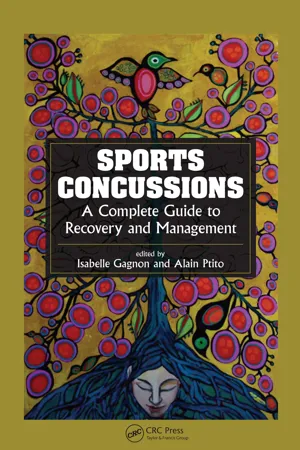
Sport-related concussions have become an increasingly important topic as evidenced by recent media attention. Due in large part to the complex nature of concussive injuries, there is great discrepancy in the effect these injuries have on individual functioning and the type and nature of services that best facilitate recovery. This book is intended as a complete reference guide dealing with sports-related concussions.
eBook - ePub
Sports Concussions
A Complete Guide to Recovery and Management
- 455 pages
- English
- ePUB (mobile friendly)
- Available on iOS & Android
eBook - ePub
Sports Concussions
A Complete Guide to Recovery and Management
About this book
Information
section one
What is a concussion?
chapter one
Introduction
The adoption of specialized concussion care has been explored in the past 5 years in North America. With an increased awareness of the condition, brought by both media and athletes themselves, individuals have willingly come forward to report their injuries. More laws mandate organizations to develop concussion management plans and establish links with health-care providers for those members who need clearance before returning to sports. To meet this requirement, health-care providers have delivered a service of various scope and quality. What constitutes optimal care remains unclear in light of the fact that concussion care is complex.
The mission of Sport Concussion: A Complete Guide to Recovery and Management is to offer the clinician, who is interested in providing concussion care, up to date, evidence-based information to help in the task of setting up or upgrading individualized treatment programs. While concussion is often a sport-related injury, it is also an injury to the brain and this implies that the practitioner involved in the management of concussions needs knowledge and understanding of neuroanatomy, neurophysiology, as well as of rehabilitation of neurological conditions.
The pathophysiology underlying concussions has been a subject of continued research. It has been suggested that the impact of aberrant metabolic, hemodynamic, neurophysiologic, or structural properties may lead to post-concussive symptoms (Barkhoudarian et al. 2016; Choe et al. 2012). The following paragraphs provide a brief outline of microstructural damage resulting from a concussion, how structural damage leads to changes in neurophysiology, and how the immune system responds to a concussion.
A main focus of research on the pathophysiology of concussion has been centered on how the microstructural environment is affected. Post-concussion symptoms have been attributed to diffuse mechanical injury, which involves a shearing stress and deformation of brain tissue (Maruta et al. 2010), producing changes at the level of the cytoskeleton and neurofilaments (Barkhoudarian et al. 2016; Johnson et al. 2013), as well as impaired axonal transport and axonal swelling (Buki and Povlishock 2006). The term diffuse axonal injury can refer to a number of processes including the breaking of the axonal cytoskeleton, transport interruptions as well as swelling and proteolysis through secondary physiological changes (Johnson et al. 2013). With more severe forms of TBI, Wallerian degeneration, a process of neuronal deterioration, may follow wherein a damaged neuron decays at a distance from the spot of injury (Chen et al. 2009). In addition, not all regions are equally affected as axonal conduction deficits have been observed in unmyelinated fibers after a closed head injury, and not in their myelinated counterparts (Creed et al. 2011). This has important implications for pediatric populations who are undergoing myelination as a part of normal development (Ajao et al. 2012). In the chronic phase, amyloid beta deposition and tau protein aggregates released from damaged cells can accumulate in response to repeated concussive events, and this process has been linked to Chronic Traumatic Encephalopathy (Jordan et al. 1995; McKee et al. 2009; see also the review by Seifert and Shipman (2015) on the pathophysiology of sport-related concussions).
Neurophysiologically, the stretching and deformation of axons caused by movement of the brain during a concussion may lead to the disruption of cellular membranes and an unregulated efflux of ions (Farkas et al. 2006). As a result of these ionic changes, a rapid depolarization occurs within cells, leading to an uncontrolled release of neurotransmitters, mainly glutamate (Faden et al. 1989). To restore the normal ionic balance, sodium-potassium pumps work excessively, causing a transient increase of glucose metabolism to generate ATP for these pumps (Giza and Hovda 2001; Peskind et al. 2011). This occurs in conjunction with reduced cerebral blood flow leading to a discrepancy between the demands and the supply of glucose stores (McKee et al. 2014). In parallel, an inefficient level of oxidative metabolism, believed to be the result of mitochondrial dysfunction (Verweij et al. 1997; Xiong et al. 1997), leads to a local increase in anaerobic glucose metabolism, which may lead to lactic acidosis and cerebral edema (Kawamata et al. 1995). Some researchers believe this mismatch in energy demand versus requirements may represent a phase of ongoing vulnerability to secondary injuries (Navarro et al. 2012). The precise pathophysiologic mechanism of decreased cerebral blood flow is unknown; however, possibilities may include the interruption of cerebral autoregulation, vasospasm, and/or disturbance of regional perfusion (Maugans et al. 2012; Prins et al. 2013; Seifert and Shipman 2015). Interestingly, there may be an effect of age as the observed cerebral blood flow alterations post-TBI may be limited to younger patients (Mandera et al. 2002). Further information regarding neurometabolic cascades occurring subsequent to an mTBI can be found in a review by Giza and Hovda (2014).
The neuroinflammatory response to concussion has been suggested to have a strong role in post-concussion symptoms (Rathbone et al. 2015). Following injury, there is an activation and infiltration of microglia (Kelley et al. 2007) and if sufficient forces are produced to damage the blood–brain barrier, circulating neutrophils, monocytes, and lymphocytes are able to leak through and release inflammatory factors that may become implicated in neuronal cell death (Ghirnikar et al. 1998). In both adult and immature rats, microarray studies report extensive up-regulation of cytokines—IL-6, IL-1ß, and TNF-α by mononuclear cells and IL-1ß by astrocytes (Holmin et al. 1997)—and inflammatory genes after TBI (Giza and Prins 2006; Li et al. 2004). However, the role of each inflammatory molecule, whether pro- or anti-inflammatory, may have positive or negative implications (see Patterson et al. 2012 for review). For example, Interleukin-1 may have a neuroprotective role in the brain being immediately upregulated in response to a brain injury (Dalgard et al. 2012; Shojo et al. 2010; Taupin et al. 1993); however, inhibition of IL-1B, a member of the IL-1 family, has been shown to reduce cerebral edema as well as the loss of tissue, improving overall cognitive outcome (Clausen et al. 2009, 2011). Indeed, the prolonged activation of neuroinflammatory mechanisms is associated with secondary damage from concussions, making this a viable target for developing treatments (Patterson and Holahan 2012). Further information regarding the role of inflammation in the brain subsequent to an mTBI can be found in Rathbone and colleagues’ (2015) review of the literature.
Together, data suggest that the brain’s response to a concussion is extensive and multifactorial. The structural injuries sustained diffuse and produce physiological challenges that the brain may be unable to meet. The immune system is directly implicated in this process as it attempts to repair neuronal damage, while itself producing further metabolic challenges for the brain. Though knowledge is increasing regarding the diversity of pathophysiology subsequent to concussion, further research is required in terms of how structural damage translates into the diversity of patient outcomes and whether neuroimaging can be used to visualize either microstructural damage or its physiological sequelae.
Fortunately, the majority of individuals with concussions will achieve rapid recovery, but it is only with a global understanding of the cerebral mechanisms involved that health professionals will be able to return athletes to function safely. Our book is divided into five parts; each chapter attempts to answer a question often raised by clinicians or by patients themselves.
Section I covers the essence of what a concussion is, starting with a historical perspective on the definition, and how approaches to its understanding have evolved. We then move on to a comprehensive portrait of the incidence and prevalence of the problem from a sport-specific perspective. This section ends with the process leading to making a diagnosis of concussion.
Section II presents management approaches from the perspective of various professionals and what they can bring to care. These chapters will contribute to the understanding of the global nature of what a concussion is and how it can be approached. Evaluations and treatments are presented, accompanied by case studies to illustrate concepts.
Section III deals with returning to life activities after having sustained one or more concussions. Specific chapters are devoted to returning to school, work, and sports, and we end with approaches to dealing with persistent difficulties when recovery does not happen as quickly as expected. Finally, we discuss long-term outcomes of one or multiple concussions.
Section IV presents special situations such as baseline evaluations and on-field assessment, as well as emerging diagnostic and treatment approaches.
The final section (Section V) proposes to put it all together to present a multilayered model of concussion care as well as additional cases illustrating simple and complex recovery courses post-injury.
References
Ajao, D. O., V. Pop, J. E. Kamper, A. Adami, E. Rudobeck, L. Huang, R. Vlkolinsky et al. 2012. Traumatic brain injury in young rats leads to progressive behavioral deficits coincident with altered tissue properties in adulthood. J Neurotrauma 29 (11):2060–2074. doi: 10.1089/neu.2011.1883.
Barkhoudarian, G., D. A. Hovda, and C. C. Giza. 2016. The molecular pathophysiology of concussive brain injury—An update. Phys Med Rehabil Clin N Am 27 (2):373–393. doi: 10.1016/j.pmr.2016.01.003.
Buki, A. and J. T. Povlishock. 2006. All roads lead to disconnection?—Traumatic axonal injury revisited. Acta Neurochir (Wien) 148 (2):181–193; disc...
Table of contents
- Cover
- Half Title
- Title Page
- Copyright Page
- Contents
- Editors
- Contributors
- Section I: What is a concussion?
- Section II: Managing a concussion
- Section III: Recovery and beyond
- Section IV: Additional considerations
- Section V: Putting it all together: Complete concussion care
- Index
Trusted by 375,005 students
Access to over 1.5 million titles for a fair monthly price.
Study more efficiently using our study tools.
Frequently asked questions
Yes, you can cancel anytime from the Subscription tab in your account settings on the Perlego website. Your subscription will stay active until the end of your current billing period. Learn how to cancel your subscription
No, books cannot be downloaded as external files, such as PDFs, for use outside of Perlego. However, you can download books within the Perlego app for offline reading on mobile or tablet. Learn how to download books offline
Perlego offers two plans: Essential and Complete
- Essential is ideal for learners and professionals who enjoy exploring a wide range of subjects. Access the Essential Library with 800,000+ trusted titles and best-sellers across business, personal growth, and the humanities. Includes unlimited reading time and Standard Read Aloud voice.
- Complete: Perfect for advanced learners and researchers needing full, unrestricted access. Unlock 1.5M+ books across hundreds of subjects, including academic and specialized titles. The Complete Plan also includes advanced features like Premium Read Aloud and Research Assistant.
We are an online textbook subscription service, where you can get access to an entire online library for less than the price of a single book per month. With over 1.5 million books across 990+ topics, we’ve got you covered! Learn about our mission
Look out for the read-aloud symbol on your next book to see if you can listen to it. The read-aloud tool reads text aloud for you, highlighting the text as it is being read. You can pause it, speed it up and slow it down. Learn more about Read Aloud
Yes! You can use the Perlego app on both iOS and Android devices to read anytime, anywhere — even offline. Perfect for commutes or when you’re on the go.
Please note we cannot support devices running on iOS 13 and Android 7 or earlier. Learn more about using the app
Please note we cannot support devices running on iOS 13 and Android 7 or earlier. Learn more about using the app
Yes, you can access Sports Concussions by Isabelle Gagnon, Alain Ptito, Isabelle Gagnon,Alain Ptito in PDF and/or ePUB format, as well as other popular books in Medicine & Clinical Medicine. We have over 1.5 million books available in our catalogue for you to explore.