- 284 pages
- English
- ePUB (mobile friendly)
- Available on iOS & Android
eBook - ePub
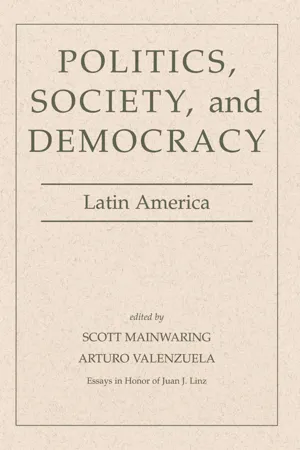
Politics, Society, And Democracy Latin America
About this book
This is the third of four volumes compiled in honor of Juan J. Linz and edited by H. E. Chehabi, Richard Gunther, Alfred Stepan, and Arturo Valenzuela. Each volume presents original research and theoretical essays by Linz's distinguished collaborators, students, teachers, and friends, as well as overviews of his enormous contributions to Spanish and Latin American studies, comparative politics, and sociology.In Volume III, leading Latin American scholars evaluate Juan Linz's contribution to the study of Latin American politics, in particular his influence on studies dealing with authoritarianism, democratic breakdown, public opinion, regime transition, and the institutional conditions needed for stable democracy.
Information
1
Introduction: Juan Linz and the Study of Latin American Politics
In December 1991, on the occasion of Juan Linz’s 65th birthday, his friends, students, and admirers gathered in New York City to honor one of the world’s great social scientists and teachers. This volume is one in a series of three – the others include one on Spain and one of comparative studies – that were organized around that celebration.1
For those who are only familiar with Linz’s scholarly writings and not with him as a teacher, there might initially seem to be little reason to organize a volume on Latin America. Relatively little of Linz’s voluminous written work has focused directly on Latin America; the vast majority of his empirical work has concentrated on Spain. Linz has never done much empirical research in Latin America, and only once has he been a member of the Latin American Studies Association. Yet despite this, Linz has had a major impact on political science and political sociology in Latin America, both through his writings and as a teacher. Indeed, although Linz would not call himself a Latin Americanist, very few scholars have had comparable impact on the study of Latin American politics.
In this introductory essay, I briefly highlight some major themes on which Linz has deeply contributed to the analysis of Latin American politics and society. I attempt to shed light on why someone who has not worked primarily on Latin America has had a decisive influence on the study of Latin American politics. I do not deal with all of Linz’s themes, mostly because this volume does not include essays on all of them.
Authoritarian and Totalitarian Regimes
In his work on Spain and in his comparative studies, Linz developed a number of themes that resonated deeply among scholars working on Latin America. First was his characterization of authoritarian regimes as a regime type with distinctive characteristics and dynamics, as distinct from democratic and totalitarian regimes. This conceptualization of authoritarianism first appeared in a seminal article, “An Authoritarian Regime: Spain,” originally published in 1964. Linz defined authoritarian regimes as “political systems with limited, not responsible, political pluralism; without elaborate and guiding ideology (but with distinctive mentalities); without intensive nor extensive political mobilization (except some points in their development); and in which a leader (or occasionally a small group) exercises power within formally ill-defined limits but actually quite predictable ones.”2
Before Linz, nobody had clearly defined what was distinctive about authoritarianism. Authoritarianism had been treated as a residual category, distinct from democracy and totalitarianism, but not as a category to explore in its own right. For Linz, authoritarian regimes had three defining features vis-à-vis both democratic and totalitarian regimes. First, in contrast to totalitarian regimes, which attempt to impose a monopolistic political system, authoritarian regimes allow for limited political pluralism. In contrast to democratic regimes, the pluralism is restricted and often not legitimate. Second, whereas totalitarian regimes create and rely on well defined ideologies, authoritarian systems employ less codified mentalities.3 Third, totalitarian systems mobilize the population, which is expected to actively support the regime; authoritarian regimes tolerate and often prefer apathy or passive acceptance. Democratic regimes allow for ample participation but generally do not mobilize the population from above.
This seminal contribution had a significant impact in thinking about authoritarian regimes. Then in a 236 page article published in 1975, Linz developed his analysis of totalitarian, sultanistic (personalistic patrimonial systems), and authoritarian regimes. He presented a typology of seven different kinds of authoritarian regimes: bureaucratic-military authoritarian regimes; organic statism, mobilizational authoritarian regimes in postdemocratic societies; competitive regimes with racial exclusions (such as South Africa until 1994); pretotalitarian regimes, and post-totalitarian authoritarian regimes.4 This typology excluded highly personalized, weakly institutionalized patrimonial regimes, which Linz called sultanistic, from authoritarian regimes – a distinction his earlier work on authoritarianism had not introduced. In his latest book, Linz also considered post-totalitarian regimes as separate from the authoritarian category.5
Linz’s works helped spawn reflections about authoritarianism in Latin America, including about the “new authoritarianism” of the 1970s. Some important contributions on authoritarianism in Latin America were influenced by Linz.6 Linz wrote only one piece specifically on authoritarianism in Latin America: his contribution to Alfred Stepan’s edited book, Authoritarian Brazil: Origins, Policies, and Future, argued that the Brazilian authoritarian regime was not well institutionalized – that it therefore should be called an authoritarian situation rather than a regime. The problem of leadership succession from one military president to the next created serious friction; the military’s initial ideology of restoring democracy constrained the extent to which it could create an enduring regime; the regime had no clear legitimacy formula; and prospects for creating a hegemonic party akin to the Mexican Partido Revolucionário Institucional (PRI) were remote.7 Although Linz was not an expert on Brazil—indeed, he claims that he had only spent perhaps 12 days in Brazil, some of them on the beach in Copacabana – his profound understanding of authoritarian regimes and his comparative breadth enabled him to develop some arguments that proved correct, and that Brazilians and Brazilianists had not understood.
Exactly as Linz had anticipated (though he did not predict the timing), one year after the publication of Stepan’s book, the military regime began the slow, gradual process of political liberalization that ultimately led to a transition to civilian government in 1985. One of the masterminds of the liberalization project, General Golbery de Couto e Silva, had read Linz’s analysis and was convinced that he was correct that the authoritarian regime was not well institutionalized or legitimate and had few chances of becoming so.8 Linz’s paper reinforced Golbery’s conviction that the Brazilian regime should liberalize. In this way, Linz’s analysis may have contributed to the military’s decision to initiate the process of political liberalization. When Linz wrote the article, the military regime had an aura of impenetrability; few scholars anticipated the regime opening. Years later, Bolivar Lamounier, one of Brazil’s outstanding political scientists, argued that Linz better than anyone had understood crucial aspects of the Brazilian military regime.9 In retrospect, Linz’s chapter stands out not only for its percipient character, but also for its theoretical contribution to our understanding of what fosters and impedes the institutionalization of authoritarian regimes. It proved to be one of the most enduring contributions in one of the best books published on Latin American politics in the 1970s.
Three papers in this volume reflect Linz’s concern with authoritarian and totalitarian regimes. Miguel Angel Centeno’s “The Failure of Presidential Authoritarianism: Transition in Mexico,” embodies many of the concerns that have guided Juan Linz’s career. In an effort to both improve our understanding of the Mexican case and illustrate the fertility of Linz’s thought, this essay offers a categorization for the PRI regime and an analysis of the consequences of extreme presidentialism. Although the Mexican system meets some of the requirements of Linz’s definition of democracy, Mexico is obviously not a democracy. At least until 1994 and especially at the local level, elections have been neither free nor fair. The systematic victories of the PRI discouraged the organization of opposition forces and generated voter apathy. The rights associated with democracy have also been restricted through informal and unofficial means. It seems best, then, to conceive of Mexico as a special kind of authoritarian regime that does not clearly fit any of Linz’s categories. Centeno argues that we should locate it somewhere between the mobilizational-authoritarian and the bureaucratic-military subtypes. This regime has eroded in recent years, and a form of “delegative authoritarianism” came to replace a more inclusive authoritarianism. Centeno claims that this regime erosion has its roots in the centralization of power and constitutional rigidities associated with presidentialism. As the office of the presidency enlarges its control, the stakes of electoral competition rise, political interactions become more conflictual, and policy articulation and implementation become more difficult. Paradoxically, the no reelection clause, a constitutional provision aimed at moderating the effects of the personalization of power, is the most infelicitous institutional feature of Mexican presidentialism. It discourages policy continuity, stimulates authoritarian control, favors the development of patronage networks, and discourages politicians from cultivating electoral bases outside the state bureaucracy. For Centeno, the elections of 1994 constitute a milestone in Mexico’s route towards pluralism and democracy. He argues that in order to make the state apparatus more responsive to society’s demands and needs, the reelection of incumbent presidents should be permitted.
Susan Eckstein’s chapter, “Communist States as Ideocracies?: Lessons from Cuba,” acknowledges Linz’s seminal contributions to understanding authoritarian and totalitarian regimes. Eckstein focuses on two aspects of Linz’s characterization of totalitarian regimes: the role of ideology and state/society relations. She argues that Cuban communism was less ideologically driven than regimes in Linz’s totalitarian category. Examining the process of ideological rectification in the late 1980s, she argues that communist states are not homogeneous, self-contained, ideologically driven compacts. The rectification campaign is an especially appropriate case study because if totalitarian regimes are not ideologically driven during their most ideological moments, then they are less ideological than Linz’s ideal type suggests. This rectification campaign involved a clampdown on market strategies tolerated earlier in the decade, a return to collective forms of organizing production and labor, and a call for volunteer labor to help out the revolution. However, many aspects of the rectification campaign cannot be understood through examining ideology: the reduction of subsidies or the pursuit of Western economic ties, for example. For Eckstein, these policies represented an effort to address the fiscal crisis affecting the Cuban state at that time. She affirms that we should focus less on ideology and more on the constraints imposed by the international context, the resistance strategies of civil society, and the conflicts of interests within the state bureaucracy itself. While challenging some aspects of Linz’s characterization of totalitarian regimes, the analysis is in the historically grounded tradition that Linz considers so important.
In light of Eckstein’s criticisms, it is interesting to note that in his recent book with Alfred Stepan, Linz refined his typology of nondemocratic regimes. He now considers post-totalitarian regimes as a distinct category that differs from both totalitarian and authoritarian regimes in crucial ways. The details of these differences need not concern us here; what does matter is that the new typology of nondemocratic regimes constitutes an innovation that would seemingly address Eckstein’s criticisms.
In “The Pinochet Regime: A Comparative Analysis with the Franco Regime,” Carlos Huneeus applies Linz’s model of authoritarian regimes to compare the Pinochet regime in Chile with the case that began Linz’s fruitful line of inquiry, the Franco regime in Spain. He focuses on three central aspects of Linz’s model: the degree of personalization or institutionalization of the authoritarian regime, including the position of the dictator and the military in the political system; the use of coercion and its connection to limited pluralism and limited synchronization; and mechanisms, based primarily on economic interests, for the cooptation and political integration of civilian groups into the regime. As Huneeus argues, Linz’s penetrating insight into the attributes of authoritarian regimes offers important tools for tinderstanding both of these regimes. At the same time, there were important differences between the two regimes that arose from each country’s unique trajectory of political development and the different strategies used by Franco and Pinochet to achieve and consolidate power. As Huneeus argues, a historically-grounded comparison based on Linz’s model of authoritarianism that highlights each regime’s uniqueness in specific areas can be a useful analytical instrument for understanding both the authoritarian period and its enduring legacy under democratization.
Democratic Breakdowns
In 1973, Linz and Alfred Stepan organized a conference at Yale on the breakdown of democratic regimes. Out of this conference grew their outstanding four volume set, The Breakdown of Democratic Regimes. The first volume was Linz’s overview, The Breakdown of Democratic Regimes: Crisis, Breakdown, and Reequilibration. One volume was on Europe, one on Chile, and one on the rest of Latin America. With distinguished collaborators and the intellectual leadership of Linz and Stepan, this project became an enduring contribution to the study of democracy.
Linz’s contributions on this theme had a significant impact on the study of Latin American politics, both because of the subject matter and his theoretical approach to it. Many books and articles had already been written on the democratic breakdowns that afflicted Argentina, Bolivia, Brazil, Chile, Peru, and Uruguay in the 1960s and 1970s.10 However, The Breakdown of Democratic Regimes even today stands as a landmark contribution.
At a time when structural analyses of politics were in vogue among Latin Americanists and in political science in general, Linz emphasized the fact that democratic breakdowns were not inevitable. Whereas dependency theory and other structural approaches saw political outcomes as determined by structural factors, Linz always emphasized the underdetermination of most political events by structures. Thus, democratic breakdowns occurred because actors made decisive miscalculations or bad decisions that, rather than inviting compromise and negotiation, had a polarizing impact. Effective or ineffective leadership, and values and behavior that were not reducible to structural situations, were decisive in leading to breakdown or in enabling democratic leaders to avoid it and achieve what Linz called democratic reequilibration.
Linz wrote that in the structural approaches to regime stability and breakdown, “social scientists…tend to emphasize the structural characteristics of societies – socioeconomic infrastrucures that act as a constraining condition, limiting the choices of political actors. They focus on the underlying social conflicts, particularly class conflicts, that in their view make the stability of liberal democratic institutions unlikely, if not impossible…. In our view, one cannot ignore the actions of either those who are more or less interested in the maintenance of an open democratic political systems or those who, placing other values higher, are unwilling to defend it or even ready to overthrow it. These are the actions that constitute the true dynamics of the political process. …[Ajctors have certain choices that can increase or decrease the probability of the persistence and stability of a regime…We shall focus on those more strictly political variables that tend to be neglected in many other approaches to the problem of stable democracy, because in our view political processes actually precipitate the...
Table of contents
- Cover
- Half Title
- Title
- Copyright
- Contents
- Acknowledgments
- About the Editors and Contributors
- 1 Introduction: Juan Linz and the Study of Latin American Politics
- 2 The Failure of Presidential Authoritarianism: Transition in Mexico
- 3 Communist States as Ideocracies? Lessons from Cuba
- 4 The Pinochet Regime: A Comparative Analysis with the Franco Regime
- 5 Political Continuities, Missed Opportunities, and Institutional Rigidities: Another Look at Democratic Transitions in Latin America
- 6 The Crisis of Presidentialism in Latin America
- 7 Juan Linz, Presidentialism, and Democracy: A Critical Appraisal
- 8 The Evolution of Latin American Party Systems
- 9 Regionalism and Federalism in Brazil, 1889–1937
- 10 Macro Comparisons without the Pitfalls: A Protocol for Comparative Research
Trusted by 375,005 students
Access to over 1.5 million titles for a fair monthly price.
Study more efficiently using our study tools.
Frequently asked questions
Yes, you can cancel anytime from the Subscription tab in your account settings on the Perlego website. Your subscription will stay active until the end of your current billing period. Learn how to cancel your subscription
No, books cannot be downloaded as external files, such as PDFs, for use outside of Perlego. However, you can download books within the Perlego app for offline reading on mobile or tablet. Learn how to download books offline
Perlego offers two plans: Essential and Complete
- Essential is ideal for learners and professionals who enjoy exploring a wide range of subjects. Access the Essential Library with 800,000+ trusted titles and best-sellers across business, personal growth, and the humanities. Includes unlimited reading time and Standard Read Aloud voice.
- Complete: Perfect for advanced learners and researchers needing full, unrestricted access. Unlock 1.5M+ books across hundreds of subjects, including academic and specialized titles. The Complete Plan also includes advanced features like Premium Read Aloud and Research Assistant.
We are an online textbook subscription service, where you can get access to an entire online library for less than the price of a single book per month. With over 1.5 million books across 990+ topics, we’ve got you covered! Learn about our mission
Look out for the read-aloud symbol on your next book to see if you can listen to it. The read-aloud tool reads text aloud for you, highlighting the text as it is being read. You can pause it, speed it up and slow it down. Learn more about Read Aloud
Yes! You can use the Perlego app on both iOS and Android devices to read anytime, anywhere — even offline. Perfect for commutes or when you’re on the go.
Please note we cannot support devices running on iOS 13 and Android 7 or earlier. Learn more about using the app
Please note we cannot support devices running on iOS 13 and Android 7 or earlier. Learn more about using the app
Yes, you can access Politics, Society, And Democracy Latin America by Scott Mainwaring,Arturo Valenzuela in PDF and/or ePUB format, as well as other popular books in Politics & International Relations & Comparative Politics. We have over 1.5 million books available in our catalogue for you to explore.