- 160 pages
- English
- ePUB (mobile friendly)
- Available on iOS & Android
eBook - ePub
About this book
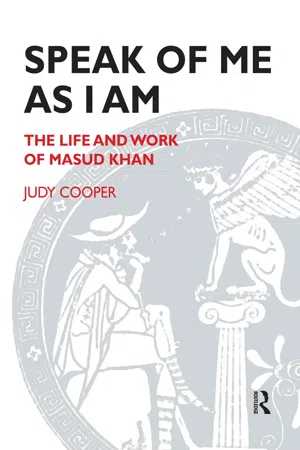
This book unravels the many enigmas and perplexities of Masud Khan's intriguing personality. It is a work of exquisite scholarship based on careful scrutiny of unpublished documents and extensive interviews with those who knew Khan intimately.
Information
Part One
I have been a Stranger in a Strange Land
Chapter One
Biography: Masud Khan, 1924–1989
Oh, East is East, and West is West, and never the twain shall meet.
[Rudyard Kipling, “The Ballad of East and West”]
My heart is in the East, and I in the depths of the West. My food has no taste. How can it be sweet?
[Yehudah Halevi, “My Heart Is in the East"]
Who was Masud Khan?
Masud Khan was a fascinating man. He was a mass of splits and contradictions. At times he led a life that was remarkable for its monastic austerity and ascetic discipline, at other times he was driven to immediate gratification and romped around with the self indulgence of a wealthy playboy.
Khan seemed to live in that “transitional space” between inner and outer experience that he understood so well. It could be said that he lived in the interface between fact and Action, truth and metaphor, reality and fantasy.
Indeed, he was given to “spinning yams” and invariably presented “fictions” (Khan, WB 1971h, p. 903) about his life and experiences, so that even those closest to him were never clear about many aspects of his past. They were never quite sure whether what he said was true (Rycroft, pers. comm., 1991; Smirnoff, pers. comm., 1991). As his colleague. Pearl King (pers. comm., 1991), told me: “He was very skilled at confusing the story.” His “yams” were repetitive, yet varied. He glossed over his past, so that you never really knew whether he was prince or pauper.
There are so many versions and stories of Khan’s early life that it is not surprising that there are even certain discrepancies between my account and that of Dr Adam Limentani in his obituary on Khan (1992). For example, Limentani (1992) mentions that Khan went to Balliol College, Oxford, for a short time, whereas Khan told me that he had been offered a place at Balliol but never took it up, as he was accepted for training at the Institute of Psycho-Analysis. This seems more likely, for on checking with Dr John Jones, the Dean and Archivist at Balliol, it seems that “Masud Khan was never admitted to Balliol and there is no trace of him here” (letter to author. 10 April 1992). It seems most probable that Khan himself was the source of some of these contradictory accounts.
Perhaps this attempt to disguise his past was not surprising in such a complicated man, coming as he did from such a vastly different culture, where, it is evident, he had undergone deeply traumatic experiences. Certainly, this would fit in with Rycroft’s view that beneath his grandiosity there was something so insecure about Khan that it was impossible for anyone to tell him what they really thought about him. Since he was so fragile, Rycroft (pers. comm.. 1991) presumes that he must have been an astonishingly deprived child.
Early years and growing up
Mohammed Masud Raza Khan was born in the Punjab in the home of his mother’s family in Jhelum, in pre-partition India, on 21 July 1924. He spent his first six weeks there, but he was brought up on his father’s vast feudal estates in Montgomery. His father, Fazaldad Khan (circa 1846–1943), although not educated, owned large tracts of land. He had a stud farm, and he bred horses and provided them for the British Army and cavalry. The British Government gave him land in compensation for services rendered, and, of course, as Khan would often stress, he also had his own inherited land. So. Fazaldad Khan was an extremely wealthy man. and Khan was brought up on his father’s estate—“bred as I was on land amidst peasants”—as part of feudal village life (Khan, WB 1968, p. 37). Thus, he wrote:
We built feudal habitats—cluster[s] of mud houses in green arable lands, husbanded by gaunt handsome hardy peasants. And we built functional little mosques for quiet private and communal prayer. [Khan, WB 1971a, p. 7831
Khan’s father was not a titled rajah or ruler of a state. According to Eastern sources, the term “Rajah” can be used simply as a name, without any grand connotations.
Masud (1924–1989) was the second child of his father’s fourth marriage. He was brought up in relative seclusion, with his elder brother Tahir (1923–1983) and his younger sister Mahmooda (1926–1942). He often made a grandiose virtue of the fact—“We were reared in an alone stance….” (Khan, WB 1971e, p. 874). The strange paradox was that although Khan apparently enjoyed a privileged position all his life, he was also, most evidently, lonely and deprived.
Khan’s father already had several middle-aged children by the time he married for the fourth time. He was 76 and Khan’s mother 17 when they married. Interestingly enough, I think Khan retained elements of both sage and adolescent throughout his life. His mother, Khursheed Begum (1905–1971), was a beautiful, illiterate singing-and-dancing-girl, possibly of Persian origin. She had already borne a son out of wedlock before she married Rajah Khan, but he was brought up elsewhere. Khan’s father had not allowed his mother much contact with this son, but he came back to live with his mother after Fazaldad Khan’s death. This seems to indicate that, despite appearances to the contrary, Khan’s mother had not wanted to get rid of her eldest son and that she could be a devoted mother in that she got her son back after all that time. This incident might also seem to illustrate a streak of cruelty in Khan’s much-adored father. In any event, Khan maintained that his mother “was utterly devoted to father and gave him the best twenty last years of his life” (Khan, pers. comm., 1988). However, considering Eastern values and traditions, life must have been difficult for Khan and his mother.
Khan’s situation was not unique in the East. It is alleged that there may have been a courtesan connection in the family of a former prime minister of Pakistan, whose father came from a prominent landed family. Despite the politician’s success and acceptance by the Pakistani ruling class, it would appear that he never came to terms with this stigma. The fact that Pakistani society has never talked about this openly only highlights Khan’s own dilemma. Not surprisingly, he never got over his anguish at this basic humiliation.
It has to be stressed that in the East the calibre of any family is judged by the virtue of the women in that family. Thus, Khan’s mother, with her free and easy background and illegitimate child, was not considered a desirable acquisition into the family. It is, therefore, more than likely that the family were genuinely distressed when Masud’s father, Rajah Khan, married this young courtesan. It could be surmised that this marriage caused considerable tension and disruption in the Khan household with the probable result that Rajah Khan’s new family became an alienated offshoot of a large, thriving and respected family in the established hierarchy of Pakistan.
Once courtesans married, they often became pious as the only way of being accepted, and Khan’s mother was no exception. She became a devout Muslim, praying five times a day. Nonetheless, it seems that Khan and his nuclear family were disapproved of by the rest of the clan, and they did not lead the usual extended family life of feudal Pakistan. The mother’s origins being considered disgraceful and shameful, it is likely that the whole family was treated as non-existent. Khan’s closeted life with his private governess and close contact with his immediate family may be seen as quite atypical. In contrast, contact with his extended family and the outside world was probably somewhat limited
Indeed, family hostility may have been the reason that Khan’s father bought a vast estate in Lyallpur, to which the family moved from their native Montgomery in 1937, when Masud Khan was 13. At that point, his father was nearing 90, and one can imagine that moving out of his extended family, at this age, even if there was an element of relief at having less tense and complicated living arrangements, must have caused him a real sense of sadness and loss.
Khan must have internalized all the values of this society. He never spoke of any of these feelings. Indeed, he could be quite open and even grandiose about the fact that his mother was “a famous singer and courtesan”. Nevertheless, one can see that his later behaviour was closely related to these issues.
Khan’s psychoanalytic theories were concentrated on the consequences of the failing early environment due to the pathogenic mother, but these intellectual ideas did not seem to provide him with any internal solution. Not only did he never resolve his relationships with women (mother), but also, however great was his longing to be accepted, in every situation he soon found himself the tormented outsider and an outcast. It is noteworthy that one of the short obituaries on Khan refers to him as a “gifted outsider” (Obituary, The Times, 21 June 1989).
Hardly surprisingly, Khan’s attachment to his mother was barely discernible: “I loved my mother, but we never got on well” (Khan, pers. comm., 1988). His obliteration of his mother was marked. But perhaps this rejection of his mother was not altogether unusual, for someone coming from a culture that reveres motherhood yet denigrates women. In fact, Khan rarely spoke of his mother, although one of the first entries in his Work Books recalls an early memory of “… the chattering anxious countenance of my mother from infancy” and of Khan’s own “… manic expertise to drown her voiceless chatter and muttering in my head” (Khan, WB 1967, p. 8). In another rare, rather emotional entry in his Work Book a few days after his mother’s death, Khan mentions both parents together and what he inherited from each of them:
I can see clearly the various paradoxical elements of my inheritance. My sensibility I inherit from my mother: very shy, over sensitive and rather phobic and extremely emotional. From my father 1 inherit an imperious capacity for work and a terrible temper. From both I inherit a deep compassion for the individual human and an uncompromising haughtiness. My personal contribution is a sharp and inexhaustible mind. All these are still not cohered into a unity of character in me. To have been endowed with so much is an awesome responsibility. And it is a lifelong struggle. [Khan, WB 1971j, p. 925]
Although one knows very little about Khan’s mother and her handling of him, there are inferences that can be made. Khan made his mother non-existent, but, as he occasionally acknowledged, he had a large part of his mother in him. He had a genuine sweetness and warmth, which could not just have come from his father. His mother’s handling of Khan was obviously more important than he was aware of, though at some level Khan did know this:
From Mother I stayed alienated, and yet there is more essentially of my mother in me than of Father and D.W.W.—I mean at the root. Only roots are such mute and hidden things. [Khan, WB 1971k, p. 9281
From the evidence, I think his mother must have been a warm, sensitive, Intelligent, seductive woman, who must have felt extremely alienated when she married Rajah Khan. I suspect Khan was a great deal like his mother: “It sounds as though Masud was like Jeffrey Masson, whose analyst told him, as a parting shot, that his secret wish had always been to be a beautiful woman” (Rycroft, letter to author, 27 December 1992). In fact, in essentials his life replicates his mother’s. As well as being a seductress, it seems likely that she was also maddening, bewitching, and maternal, and Khan internalized all these qualities. He, too, was all these things. And he chose Winnicott—arguably the greatest mother-enhancer of all times—as his analyst.
Regrettably, we know very few details about the actual quality of child-care in early twentieth-century Pakistan. Masud Khan rarely spoke about the details of his childhood, although he did talk about having retinues of servants. It would be tempting to speculate that he had one or more “ayahs” (or nannies), and one wonders how they may have treated him.
By marrying, both parents broke boundaries by infringing familial and cultural taboos. On marriage, his mother was not just an innocent girl, but a sexual young woman. Indeed, despite the fact that she was a courtesan who had even had a child, Khan’s mother had managed not only to survive but to so dazzle this rich old man that he married her despite his family’s intense opposition. From his theorizing one can see that Khan knows the seductive mother very well. However, a seductive Western mother and a seductive Eastern mother could be very different.
It should be emphasized that marriage and motherhood are of paramount importance to the Eastern woman:
For women, the greatest accomplishment is motherhood. Everything prior to marriage is preparation; everything after motherhood is reward for fulfilling her destined role. [Baig, 1976, p. 233]
Because, in the East, a woman’s status is so enhanced by being a mother, it is perhaps significant that much of Khan’s theorizing centres on the infant in terms of the mother’s need for an object. Almost certainly Khan was aware of these values and shared them. For instance, the fact that I was bom in India meant that he saw me as an “Eastern girl”, and he thought that marriage and motherhood were essential for me. But how does one conceptualize these deep cultural levels?
In contrast to his conspicuous dismissal of his mother, Khan idolized his father, and his speech was punctuated by constant references to him. There is no doubt he had “an epic sense of father” (Cooper, 1984), and his life revolved around this imago: “I have internalised my father as a tradition and not as merely a parent. Tradition has a larger holding capacity than any individual relationship” (Khan, WB 1969d, p. 87). Not surprisingly, Khan lost his sense of self at 19, when his father died: “I can vividly recall that I had this wholeness up to 1943 and after my father’s death it and I got splintered off and lost to each other” (Khan, WB 1971f, p. 901).
It could be said that Khan’s whole life was an acting out and search for his mother, even though his sense of father seemed to predominate. Perhaps the only mother he found was later in Winnicott.
* * *
At home the Khan family spoke Punjabi. Khan’s father knew very little English, but the Khan household had an Oxford-educated governess called Miss Little, possibly, it could be surmised, in an attempt to lift the status of the children and cleanse them of the putative stigma of their mother’s reputation. Khan was an intelligent and rewarding pupil. In 1937, when Khan was 13, the family moved further north to Lyallpur and settled there. As 1 mentioned before, this may have been due to the extreme opposition from the extended family.
According to Khan, his elder brother, Tahir, was their mother’s favourite child, and he was clearly their father’s favourite, with Mahmooda coming a close second. Khan himself loved his little sister. Every evening he accompanied his father on the duties pertaining to his estate: “I was a solitary child, and I loved my father” (Khan, pers. comm., 1988). The young Masud certainly internalized his father, and one can clearly see the extent of his identification: “He [father] was a very caring man but could be very cruel” (Khan, pers. comm., 1988).
Apart from his family being considered socially inferior and unacceptable. Khan had to withstand another trauma. He was bom with a slight deformity and had a “loppy right ear”, which stuck out and looked very ungainly. This may have felt like a bodily mark underlining the social stigma due to his mother’s lowly origins. In his immediate family, his disfigurement was treated sympathetically, but perhaps in the wider world he was mocked and taunted mercilessly: “My culture is very cruel about any sort of physical deformity” (Khan, pers. comm., 1988). In England, Khan tried to keep his ear in check under a beret; at other times he looked distinctly odd, and his ear marred his good looks. It was finally operated on at Winnicott’s insistence after Khan had started analysis with him in 1951.
The psychoanalyst Baljeet Mehra, who knew of Khan from some of her relatives in pre-partition India, says (pers. comm., 1992): “I heard that, as a young man, he was extremely handsome. People would turn to look at him and he was very aware of this and quite exhibitionistic too”.
* * *
From 1942 to 1945 Khan went to the University of the Punjab at Faisalabad and Lahore and gained his BA and MA degrees. He specialized in English Literature, and for his MA thesis he wrote a paper on Joyce’s Ulysses that was so brilliant that it was sent to someone in London to be assessed. There is no doubt that Khan had a remarkable mind. Academically his days at university went smoothly, but even there he could b...
Table of contents
- Cover
- Half Title
- Title
- Copyright
- Dedication
- CONTENTS
- ACKNOWLEDGEMENTS
- FOREWORD
- PREFACE
- PART ONE I have been a stranger in a strange land
- PART TWO The damaged archangel: theory, clinician, critiques
- REFERENCES
- REFERENCES TO MASUD KHAN’S WORK BOOKS
- INDEX
Trusted by 375,005 students
Access to over 1.5 million titles for a fair monthly price.
Study more efficiently using our study tools.
Frequently asked questions
Yes, you can cancel anytime from the Subscription tab in your account settings on the Perlego website. Your subscription will stay active until the end of your current billing period. Learn how to cancel your subscription
No, books cannot be downloaded as external files, such as PDFs, for use outside of Perlego. However, you can download books within the Perlego app for offline reading on mobile or tablet. Learn how to download books offline
Perlego offers two plans: Essential and Complete
- Essential is ideal for learners and professionals who enjoy exploring a wide range of subjects. Access the Essential Library with 800,000+ trusted titles and best-sellers across business, personal growth, and the humanities. Includes unlimited reading time and Standard Read Aloud voice.
- Complete: Perfect for advanced learners and researchers needing full, unrestricted access. Unlock 1.5M+ books across hundreds of subjects, including academic and specialized titles. The Complete Plan also includes advanced features like Premium Read Aloud and Research Assistant.
We are an online textbook subscription service, where you can get access to an entire online library for less than the price of a single book per month. With over 1.5 million books across 990+ topics, we’ve got you covered! Learn about our mission
Look out for the read-aloud symbol on your next book to see if you can listen to it. The read-aloud tool reads text aloud for you, highlighting the text as it is being read. You can pause it, speed it up and slow it down. Learn more about Read Aloud
Yes! You can use the Perlego app on both iOS and Android devices to read anytime, anywhere — even offline. Perfect for commutes or when you’re on the go.
Please note we cannot support devices running on iOS 13 and Android 7 or earlier. Learn more about using the app
Please note we cannot support devices running on iOS 13 and Android 7 or earlier. Learn more about using the app
Yes, you can access Speak of Me As I Am by Judy Cooper in PDF and/or ePUB format, as well as other popular books in Social Sciences & Social Science Biographies. We have over 1.5 million books available in our catalogue for you to explore.