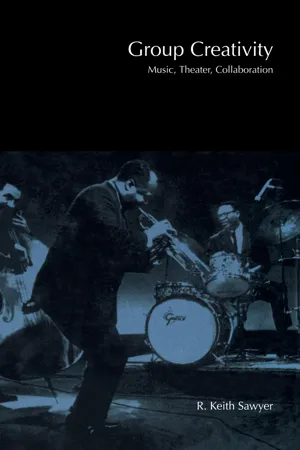
Group Creativity explores the unique form of creativity that emerges from collaborating groups. Dr. Sawyer draws on his studies of jazz ensembles and improvisational theater groups to develop a model of creative group processes. He applies this model of group creativity to a wide range of collaborating groups, including group learning in classrooms and innovative teams in organizations.
In group creativity, a group comes together to collaboratively create in real time. The creative inspiration emerges from the interaction and communication among the members, and makes the result more than the sum of its parts. The dynamic, moment-to-moment communication among jazz musicians and improvising actors is the primary topic of the book. Sawyer explores performers' close listening and sensitivity, the submerging of the ego to the group mind, and the ways that performers work together to create something better than and different from what one solitary individual could create alone. These explorations provide insight into all forms of group creativity and collaboration.
- 344 pages
- English
- ePUB (mobile friendly)
- Available on iOS & Android
eBook - ePub
About this book
Information
Publisher
Psychology PressYear
2014Print ISBN
9780805844368
9780805844351
Edition
1eBook ISBN
9781135627911
Chapter
1
Introduction
It is Saturday night, April 24, 1993, and I have arrived at this Chicago theater to watch a performance of a cutting-edge improvisational theater group called Jazz Freddy. The actors chose this name to emphasize the similarities between their free-form style of improvisation and the musical interactions of a jazz ensemble. Tonight, Jazz Freddy will perform a fully improvised 1-hour play, in two acts separated by an intermission. The lights come up and the audience applauds as we see the 10 cast members standing in a group facing the audience. Two cast members step to the front of the stage and quiet the audience. The first asks the audience to suggest "an event," and someone shouts, "The Olympics." The second actor asks the audience to provide "a location," and someone shouts, "A convent."
The lights go down; we can see the 10 cast members walking to the sides of the stage to sit in chairs that have been placed there. One of the actors pulls a chair to the center of the stage and sits in it, facing the audience, as the stage lights come up.
Example 1.1. Lights up. We see John carrying a chair to front stage right, and he sits down facing the audience. He mimes working at a desk—takes a cap off of a pen, opens a book, starts to make underlining motions as he studies the page. He stops to rub his eyes. He then turns the page, and underlines some more. The other actors watch intently from the sides of the stage; the audience is completely quiet. After about 20 seconds, Mary stands up from her position at the opposite side of the stage, and walks over to John, miming the act of carrying something in both hands, held in front of her:

In a few minutes, the actors gradually decide that this scene begins a plot associated with the "Olympics" suggestion. After about 5 minutes and three distinct scenes, the ensemble collectively transitions to a new plot line, this one taking place in a convent.
This Jazz Freddy dialogue demonstrates the key characteristics of group creativity. It is unpredictable, particularly in the timing and pacing of the interaction; the actors do not know who is going to speak next, nor when they will begin speaking. As a result, anyone can take the next conversational turn; it is impossible to know ahead of time who it will be. Even an offstage actor can walk on and take the next turn, as Bill does in turns 5 and 6. In the beginning of this performance, the actors leave unusually long pauses between their turns of dialogue, because they are just getting into the flow of the evening's performance. As the basic elements of the plot begin to emerge, the actors develop a rhythm and the pace accelerates; as the performance progresses, they leave shorter pauses and the dialogue begins to sound more like a normal conversation. The dramatic frame gradually gathers steam; in the first 30-minute act, the group creates two distinct plots, one associated with the Olympics and one taking place in a convent. In the second act, the plots begin to weave together, as several of the female athletes decide to become nuns.
Creative group performance is often referred to as "jamming." The term jamming was first used by jazz musicians; a "jam session" is an impromptu gathering of musicians with the purpose of improvising together. The term has a positive connotation; when a performance goes particularly well, the musicians might say "we were really jamming tonight." In the last several decades, the term has been widely used outside of jazz to describe any free-flowing creative group interaction (e.g., Coates, 1997). For example, actress Valerie Harper, who began her career at the Second City, Chicago's legendary improvisational theater, said "I've always found improvisation ... to be close to jazz musicians jamming—you're really listening to each other, really hearing" (Sweet, 1978, p. 319). The American Heritage Dictionary (1982) defined the jam session as both a type of jazz performance and also as "an impromptu or highly informal discussion." The Harvard Business School professor John Kao referred to work teams as jamming when they are effective and innovative (Kao, 1996; see chap. 7).
The common thread in all of these uses of the term is that they refer to the collective activity of a group creating together, and they suggest a high degree of improvisation and informality. It might seem a little odd, for example, to refer to the formal conversation at a black tie party at the Ambassador's mansion as "jamming"; and it might likewise seem odd to refer to a performance of the Chicago Symphony as a jam session. Yet in chapters 6 and 7, I argue that even these formal and rehearsed performances involve group creativity. Group creativity is found in all group performances, whether on stage or in the privacy of rehearsal. Group creativity is not only a trivial pastime or an entertainment goal; it is essential in many problem-solving groups, such as a brainstorming session at a small high-technology company, a group of teachers collaborating to develop a new curriculum, or a family working to resolve a financial crisis.
The Characteristics of Group Creativity
Performing groups are often called ensembles. The American Heritage Dictionary (1982) defined an ensemble as "a unit or group of complementary parts that contribute to a single effect" and also as "a group of supporting musicians, singers, dancers, or actors who perform together," The term derives from the Latin roots in and simul, "in (or at) the same time." The defining features of group creativity are that it involves two or more people, creating together at the same time.
In group performance genres, the creativity of the performance depends on an intangible chemistry between the members of the group. We are perhaps most likely to associate this type of group creativity with improvised musical performance, because an improvising group of musicians is one of the best examples of group creativity. In jazz, for example, no single musician can determine the flow of the performance: It emerges out of the musical conversation, a give-and-take as performers propose new ideas, respond to other's ideas, and elaborate or modify those ideas as the performance moves forward (Berliner, 1994). As bassist Chuck Israels said, "Playing with musicians is like a conversation. If when I speak, you say 'Yes,' or you look at me and blink your eyes or interject some comment of your own, that keeps me going" (Berliner, 1994, pp. 354-355).
Group creativity is also a significant feature of 20th century theater. The Screen Actor's Guild Awards gives prizes for "best actor" and "best supporting actor," but their most prestigious prizes are those for best cast and best ensemble—because "they recognize what all actors know—that acting is a collaborative art" (http://www.sagawards.org/about_unique.html; April 20, 2002). Theater historians note that the ensemble style of performance was first advocated by the French director Jacques Copeau in the early decades of the 20th century (Frost & Yarrow, 1990). Copeau was the first director to emphasize that the actors in a production should spend some time together in rehearsal to develop an ensemble feel, rather than simply diving right into the performance of the scripted play under the director's guidance. Copeau's emphasis on the ensemble was derived from his belief that the theater was a form of communion, that it was a shared creative act rather than the manifestation of the director's vision. To teach his group this ensemble feel, Copeau developed a rehearsal technique that made heavy use of improvisational exercises. The ensemble style is now a mainstream element of all modern theater, from serious drama to the comedy of Second City and Saturday Night Live.
Group creativity is particularly important in the more improvisational genres of performance: jazz and improvisational theater. Although group creativity is found in all groups, improvisation is particularly interesting because it exaggerates the key characteristics of all group creativity: process, unpredictability, intersubjectivity, complex communication, and emergence.
Process
The purpose of a jazz improvisation is not to generate a created product that will then be displayed or sold in another context; there is no goal external to the improvisation. Instead, the performance is its own goal. In improvisational creativity, the process is the product, and the researcher is forced to focus on the creative processes of group creativity.
This poses a new problem for psychologists who study creativity, because they have focused on product creativity, creative domains in which products are created over time, with unlimited opportunities for revision by the creator before the product is displayed. Product creativity is found in artistic domains such as sculpture and painting, as well as scientific domains, where the products generated are theories, formulas, or published articles. In many creative domains, this private revision process is a solitary one.
My studies of group creativity are part of a recent shift in creativity research from a focus on creative products to a focus on the creative processes that generate them. Yet this recent shift emphasizes those creative processes that eventually result in creative products (Sawyer, 1997a). In contrast, in group creativity, the process is the essence of the genre, and it must be the central focus of any scientific study.
This shift is paralleled by the recent growth of sociocuttural theory in developmental psychology (Rogoff, 1990, 1998; Sawyer et al., in press; Wertsch, 1998). Sociocultural psychologists emphasize the social and cultural contexts of child development, rather than focusing only on the mental changes within the developing child. Socioculturalists have also noted that "the process is the product," and they focus on developmental processes rather than on developmental outcomes such as the stages or stage transitions of the Piagetian approach. They use a mitogenetic methodology, closely analyzing small changes over the course of a single encounter with a more experienced partner. My studies of group creativity are sociocultural, because I focus on the interactional processes of group creativity, rather than examining the products that are created by a group.
Unpredictability
In the Jazz Freddy transcript presented in Example 1.1, no actor knows what is going to happen next. At each point in the improvisation, an actor can choose from a wide range of moves to propel the drama forward. Actors cannot know how their turns will be interpreted by the others; each turn gains its final meaning only from the ensuing flow of discourse. Bill has begun by miming various activities at a desk, but he must wait to see how Mary reacts to him before he knows exactly what he is doing at the desk. Bill's action does not fully determine the eventual dramatic meaning of that action; each turn of dialogue, although spoken by a single actor, eventually takes on a dramatic meaning that is determined by a collaborative, emergent process (Sawyer, 2003).
Group creativity ranges across a spectrum from relatively unpredictable to relatively predictable. Predictable performances are those in which the performers' actions are highly constrained by the conventions of a genre or a situation. The highly ritualized initial turns of a courtroom proceeding are almost completely scripted (although see Philips, 1992). Slightly less predictable, although still heavily ritualized, are the opening sequences at the beginning of a phone conversation (Hopper, 1992; Schegloff, 1986). Improvisational theater dialogues represent the extreme of unpredictable, relatively unscripted conversation. In chapter 6,I show how group creativity changes in relatively improvised and relatively ritualized ensemble performances.
This unpredictability and contingency results in performances that, at each moment, have a combinatorial complexity: A large number of next actions is possible, and each one of those actions could result in the subsequent flow of the performance going in a radically different direction. At each moment the performer can choose from a wide range of actions that are consistent with the performance up to that point; a performer's action cannot be predicted by the other performers because there are so many potential creative acts, and the range of potential performances that might emerge multiplies from moment to moment.
Strategy games like chess are characterized by expanding combinatorics. In chess, the combinatorics make it impossible to look ahead and mentally play out all possible ways that the game could go. Suppose that a player has 50 possible moves, and the opponent has 50 possible moves following each of the player's possible moves. This results in 2,500 possible two-move sequences; and looking ahead a third turn would require the player to consider 125,000 three-move sequences. Improv theater has even more extreme combinatorics, because the actor's possible actions come from the full range of human experience.
Several of the early and most influential Chicago improvisers drew explicit analogies with sporting events. The actor and director Del Close noted that in both improvisation and in competitive team sports, the outcome is truly unpredictable. The analogy is apt because many team sports also have expanding combinatorics, and it's why it is so difficult to predict which team will win a game simply based on their record competing with other teams. During the 2002 soccer World Cup, the United States team was not expected to do very well; coach Bruce Arena said, "On paper, it looks to be no match. However, we don't play this game on paper," and the team made it to the quarterfinals for the first time since 1930 (Longman, 2002). In advance of major sports events, bookies place a point spread on the game. The point spread predicts which team will win, and by how much.1 But this represents only a statistical probability; no bookie would bet everything on his prediction of the winner, as fans do. Rather, they are successful because they play the odds in such a way that they come out ahead regardless of the outcome.
The first people to connect improv and sports were Keith Johnstone and David Shepherd, two of the earliest improv directors. Keith Johnstone began to direct "Theatresports" tournaments in Canada in 1977. In 1980, David Shepherd (the producer of the first improv theater in Chicago, the Compass Players, in 1955) inspired by Johnstone's metaphor, returned to Chicago to create what he called the "Improvisation Olympiad" or "ImprovOlympiad" (now known as "ImprovOlympic"). These names demonstrate that actors are well aware of the parallels shared with competitive team sports—their unpredictability, their moment-to-moment contingency, and the importance of the group.
Intersubjectivity
A third defining feature of group creativity is that it is often impossible to determine the meaning of an action until other performers have responded to it. In Example 1.1, Line 1—Mary presenting Bill with papers—has several potential meanings, and these ambiguities are not resolved until the subsequent turns of dialogue. She might be a boss bringing her subordinate additional work. It is not until Bill's response in Line 4 ("I really appreciate your doing those copies for me") that we learn she is helping him. If he had responded "I can't believe you're giving me more work when it's already 7 PM!" then her action would take on a different meaning, and their relationship would be completely different. The response "It's about time, where were you?" would establish yet a third relationship.
This sort of retrospective interpretation is quite common in group creativity. Gioia (1988) noted that the jazz musician cannot "look ahead at what he is going to play, but he can look behind at what he has just played ... he creates his form retrospectively" (p. 61). The performance that emerges cannot be explained in terms of actor's creative intentions in individual turns, because in many cases an actor cannot know the meaning of her own turn until the other actors have responded. As a result, intersubjectivity is fundamentally social and collective, and must be negotiated.
The issue of intersubjectivity or "mutual understanding" was always understood to be a central problem in ethnomethodology (see Garfinkel, 1967, p. 114; Schegloff, 1992; Schutz, 1964). In group creativity, the dependence of each action on the subsequent flow of the performance results in a situation in which it is impossible for the performers to have identical mental representations of what is going on. However, although each performer may have a rather different interpretation of what is going on and where the performance might be going, they are nonetheless able to collectively create a coherent performance. To properly understand group creativity, we need to think of intersubjectivity as "a process of coordination of individual contributions to joint activity rather than as a state of agreement" (Matusov, 1996, p. 34). The key question about intersubjectivity in group creativity is not how performers come to share identical representations, but rather, how a coherent interaction can proceed even when they do not.
Because of the problem of intersubjectivity, skillful group performers try not to propose detailed and specific actions, because it makes it harde...
Table of contents
- Cover
- Half Title
- Title
- Copyright
- Dedication
- Contents
- 1 Introduction
- 2 Jamming in Jazz and Improv Theater
- 3 Interaction and Emergence: An Interactional Semiotics
- 4 Group Creativity and the Arts
- 5 Group Creativity as Mediated Action
- 6 Degrees of Improvisation in Group Creativity
- 7 Collective Ideation: Creativity, Teamwork, and Collaboration
- References
- Author Index
- Subject Index
Trusted by 375,005 students
Access to over 1.5 million titles for a fair monthly price.
Study more efficiently using our study tools.
Frequently asked questions
Yes, you can cancel anytime from the Subscription tab in your account settings on the Perlego website. Your subscription will stay active until the end of your current billing period. Learn how to cancel your subscription
No, books cannot be downloaded as external files, such as PDFs, for use outside of Perlego. However, you can download books within the Perlego app for offline reading on mobile or tablet. Learn how to download books offline
Perlego offers two plans: Essential and Complete
- Essential is ideal for learners and professionals who enjoy exploring a wide range of subjects. Access the Essential Library with 800,000+ trusted titles and best-sellers across business, personal growth, and the humanities. Includes unlimited reading time and Standard Read Aloud voice.
- Complete: Perfect for advanced learners and researchers needing full, unrestricted access. Unlock 1.5M+ books across hundreds of subjects, including academic and specialized titles. The Complete Plan also includes advanced features like Premium Read Aloud and Research Assistant.
We are an online textbook subscription service, where you can get access to an entire online library for less than the price of a single book per month. With over 1.5 million books across 990+ topics, we’ve got you covered! Learn about our mission
Look out for the read-aloud symbol on your next book to see if you can listen to it. The read-aloud tool reads text aloud for you, highlighting the text as it is being read. You can pause it, speed it up and slow it down. Learn more about Read Aloud
Yes! You can use the Perlego app on both iOS and Android devices to read anytime, anywhere — even offline. Perfect for commutes or when you’re on the go.
Please note we cannot support devices running on iOS 13 and Android 7 or earlier. Learn more about using the app
Please note we cannot support devices running on iOS 13 and Android 7 or earlier. Learn more about using the app
Yes, you can access Group Creativity by R. Keith Sawyer in PDF and/or ePUB format, as well as other popular books in Psychology & Cognitive Psychology & Cognition. We have over 1.5 million books available in our catalogue for you to explore.