The Birth of the Gods is dedicated to Durkheim's effort to understand the basis of social integration. Unlike most social scientists, then and now, Durkheim concluded that humans are naturally more individualistic than collectivistic, that the primal social unit for humans is the macro-level unit ('the horde'), rather than the family, and that social cohesion is easily disrupted by human self-interest. Hence, for Durkheim, one of the "gravest" problems facing sociology is how to mold these human proclivities to serve the collective good. The analysis of elementary religions, Durkheim believed, would allow social scientists to see the fundamental basis of solidarity in human societies, built around collective representations, totems marking sacred forces, and emotion-arousing rituals directed at these totems.
The first half of the book traces the key influences and events that led Durkheim to embrace such novel generalizations. The second part makes a significant contribution to sociological theory with an analysis that essentially "tests" Durkheim's core assumptions using cladistic analysis, social network tools and theory, and data on humans closest living relatives—the great apes. Maryanski marshals hard data from primatology, paleontology, archaeology, genetics, and neuroscience that enlightens and, surprisingly, confirms many of Durkheim's speculations. These data show that integration among both humans and great apes is not so much group or kin oriented, per se, but orientation to a community standing outside each individual that includes a sense of self, but also encompassing a cognitive awareness of a "sense of community" or a connectedness that transcends sensory reality and concrete social relations. This "community complex," as Maryanski terms it, is what Durkheim was beginning to see, although he did not have the data to buttress his arguments as Maryanski is able to do.
eBook - ePub
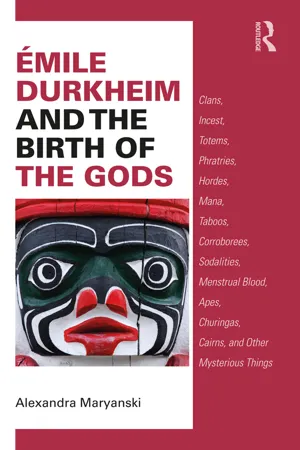
Émile Durkheim and the Birth of the Gods
Clans, Incest, Totems, Phratries, Hordes, Mana, Taboos, Corroborees, Sodalities, Menstrual Blood, Apes, Churingas, Cairns, and Other Mysterious Things
- 342 pages
- English
- ePUB (mobile friendly)
- Available on iOS & Android
eBook - ePub
Émile Durkheim and the Birth of the Gods
Clans, Incest, Totems, Phratries, Hordes, Mana, Taboos, Corroborees, Sodalities, Menstrual Blood, Apes, Churingas, Cairns, and Other Mysterious Things
About this book
Information
1
A Matter of Time
I know originality is impossible; certainly I have never claimed otherwise. I am thoroughly convinced that my ideas find their roots in those of my predecessors. Indeed, it is because they do that I have confidence in their fruitfulness.
Émile Durkheim, 1907, Revue Néo-scolastique 14: 613
Émile Durkheim’s great work, The Elementary Forms of Religious Life (1912), has always remained somewhat mystifying, especially to sociologists. True, Durkheim’s analysis of ritual and emotional arousal is one of the foundations of present-day sociology of emotions (e.g. Goffman 1967; Collins 2004). The richness and complexity of Elementary Forms has also provided fertile ground for scores of Durkheimian scholars in sociology, as well as in the humanities and social sciences in general. Yet, despite its celebrated status, the work remains an enigma for many scholars. As Robert Bellah put it:
In spite of all the excellent and persuasive reasons Durkheim gave in the introduction to The Elementary Forms of the Religious Life for choosing the Australian aborigines as the subject of his greatest book, one must still wonder at this choice. Why did this highly rational, secular, positivistic Frenchman decide sometime after 1895 to devote nearly fifteen of the most productive years of his life to the exotic cults, dancing, and blood-letting of a primitive people?
(1973: xliii)
In turn, Stephen Lukes said that when he read Elementary Forms, he had his “mind blown” and “just became totally immersed in Durkheim” (in Clark 1979: 131). Why is this last book by one of sociology’s iconic founders both baffling and beguiling?
All of Durkheim’s work reflects a fierce determination to legitimate a science of society in the academic world. Yet, to put the nascent discipline on a solid foundation, Durkheim believed he first had to solve the “gravest” problem facing sociology: what holds aggregates together? While his work on the division of labor and suicide has a strong sociological bent, unlocking the secret of social solidarity was a multiplex problem that eventually took him into the strange world of hypothetical hordes, incest taboos, and especially, the curious case of totemism—all for the glory of sociology. Elementary Forms thus exposes a wide range of Durkheim’s scholarship and, more importantly, a breadth and depth of Durkheim’s intellectual engagements in areas of inquiry not normally part of the sociological tradition.
Of course, Durkheim was also heavily influenced by two of sociology’s founders, August Comte and Herbert Spencer, who both argued for a view of societies as evolving from simple to more complex forms. Moreover, like Durkheim, both argued that sociology could be a natural science devoted to developing abstract laws and principles explaining the operative dynamics of the social universe. One of Durkheim’s overlooked mentors, Alfred Espinas, who arranged for Durkheim’s first appointment at the University of Bordeaux and the author of the little-known Animal Societies (1878), also emphasized to Durkheim other ideas from Comte and Spencer beyond their evolutionary schemes.1 Espinas argued for a much broader view of sociology (which Durkheim certainly adopted); and while Durkheim’s ideas are drawn from many sources, Espinas also handed Durkheim some early conceptual blocks for the budding science. Durkheim also considered Espinas an important forerunner of sociology, claiming that he was “the first to have studied social facts in order to make a science of them and not in order to secure the symmetry of a grand philosophical system” (quoted in Brooks 1998: 204). As social facts manifest regularities, Espinas said, a science of society is possible. And, perhaps to the surprise of some, Durkheim considered Animal Societies “the first chapter of sociology” ([1888]1978: 59).
Perhaps less baffling are Durkheim’s references in Elementary Forms to independent scholars, now long forgotten, and his active engagement of a wide range of more anthropological scholars’ respective analyses of kinship, religion, societal types, and primordial hordes. For sociologists, however, much of this analysis of kinship and religious systems revolving around naturism, animism, and totemism are often viewed as too “anthropological” and, hence, easily glossed over. Indeed, what are the details of “primitive” religions doing in a sociological analysis of religion by a sociologist? Why was Durkheim so obsessed with lineages, phraties, moieties, incest taboos, exogamy, systems of cognitive classification and, above all, totems? Moreover, why is so much of Elementary Forms taken up with tortuous rebuttals of others who had criticized Durkheim’s totemic theory in the late 1890s and early 1900s? And, to argue that the genesis of religion originated from primordial hordes seems especially odd, given that by 1912 evolutionary theorizing in the social sciences was fast becoming passé (because of the perceived racism and ethnocentrism in views of evolution as moving from “primitive” to “advanced” societies with, not surprisingly, the latter being white, European societies that had industrialized).
When Durkheim began to write Elementary Forms in the early twentieth century, his work was deeply imbued with a wide range of ideas received from early classical philosophy, early sociology and anthropology, French philosophy, and hard-science views of what the social sciences could become.2 At the same time, his work on Australian kinship and religion was under attack and seemed to fall down on the wrong side of important intellectual debates. Yet, Durkheim was supremely confident in the validity of his arguments, despite the mounting criticism. Why was he so convinced he was right? One reason was his great faith in his predecessors and in the “proving ground” of facts, especially ones collected by nineteenth-century ethnographers and kinship theorists. In a real sense, Durkheim’s aim was not originality, per se, but synthesis of known facts in order to bring truth to light. This trait was probably fostered by his mentor, Émile Boutroux ([1912]1970: 5) who wrote, “A great mind does not seek after novelty or originality; it seeks after truth … In reality, they make it their own by the way in which they use it.” Where did Durkheim go wrong in his search for the truth? Or did he? To answer this question in a satisfactory way, we need to penetrate the underlying motives and logic behind the complex analysis in The Elementary Forms of Religious Life.
As will become evident, by 1895 Durkheim had dropped much of the argument in the Division of Labor in Society (1893). Gone was the distinction between mechanical and organic solidarity. Gone was the all powerful collective conscience of “swallowed up” minds that was gradually dwindling away in the face of organic solidarity, being largely tempered by the notion of collective representations. And, gone was his focus on social evolution from simple to complex, being largely replaced by an increasing concern with the origin of religion and society and with Durkheim’s intriguing image of a pre-kinship, promiscuous horde. He also dropped naturism as the baseline form of religion that he had asserted in his 1893 stage model in The Division of Labor, very quietly replacing it with totemism in the second edition in 1902 (see Maryanski 2014: 358–359).
Thus, increasingly after 1895, Durkheim drew from many areas of expertise—especially kinship theory and ethnographic portrayals of pre-literate societies—that sociologists frequently do not realize were a central part of Durkheim’s knowledge base. But, perhaps most important is that Durkheim was fighting for his continued intellectual relevance during the early twentieth century. His ideas about religion, his analysis of Australian marriage rules and descent, and especially his views on totemic beliefs and rites were all under attack by such illustrious scholars as James Frazer and Andrew Lang [who referred to some of Durkheim’s premises as “doubly impossible” ([1905a]: 1970: 103). These critics were undermining years of Durkheim’s creative work and forcing him to devote considerable energy to defending his views in essays and commentaries, often with his nephew, Marcel Mauss, and ultimately with his very complex analysis in Elementary Forms.
This last of Durkheim’s great books, then, is so overdrawn and convoluted because he was mounting an offense in one great statement. He was sure, as noted above, that he was right, but he had to convince others of this conviction. Durkheim was thus defending and, in his mind, vindicating himself in this work. For despite Durkheim’s otherwise great fame and prestige, he felt that a lot was on the line: his continued relevance in the intellectual world, as well as his intellectual legacy to later generations.
There is, then, an interesting story to tell—indeed a kind of mystery story—about why Durkheim turned to totemism as a critical force, and indeed, why so many other leading scholars were also interested in this force during Durkheim’s lifetime. Why did Durkheim begin to sound like an anthropologist more than a sociologist; and why was he examining phenomena such as incest, hordes, the origins of society, exogamy, clans, totems, rituals, innate cognitive categories, and the like. In the short chapters of this book, one of my goals is to tell this story and unravel why the second half of Durkheim’s career, was in essence, devoted to making vindicating statements in The Elementary Forms.
Part 1 of this book chronicles the path of Durkheim’s early years to uncover why he suddenly became fixated on totemism and, then, to reconstruct the reasoning behind his sweeping generalizations on the origin of religion and society. A systematic chronology is especially important because Durkheim rejected or modified some early ideas that are still in circulation today and because of the widely differing views on what Durkheim supposedly said, or did not say. A reassessment of his thesis on the origins of religion also requires that we sort out some mystifying issues in Durkheim’s academic history—issues such as his self-described “revelation” igniting his obsession with religion, his quiet removal of naturism as primal religion after 1895 (first articulated in The Division of Labor see Chapter 5) and replacing it in the second edition of The Division of Labor with totemism as the origin of religion, his reasons for dropping his famous distinction between “mechanical” and “organic” solidarity and, oddly enough, his reasons in Elementary Forms for wanting to avoid even using the name totemism because it grossly misrepresented the social institution he was describing (Durkheim ([1912]1995: 101). If not totemism, what else did he have in mind? Did we miss something important? The answer is yes, and the objective of this book is to (a) fill in some essential gaps in the development of Durkheim’s religious sociology and (b), in Part 2 of the book, present data that will cast some new light in support of his ideas on individualism, society, and totemism.
The purpose of this chapter is to provide an essential historical context. For Durkheim’s approach to religion, his use of classic evolutionary theory, and his sophisticated application of kinship theory reflect not just late nineteenth-century thought in France but are all contingent on a matrix of ideas adopted from earlier scholars in Europe, Australia, and the Americas. Even his decision to become a sociologist was fostered by historic events before he was born. A natural starting point is sociology’s two science-minded founders—Auguste Comte and Herbert Spencer. Some background is also needed on three major nineteenth-century happenings: the great time revolution on the age of the earth, the founding of the English school of anthropology, and the discovery of kinship.
Early Sociology and Durkheim’s Sociology
Auguste Comte and the French Collectivist Tradition
After the French Revolution (1789–1797), France was faced with chronic social and political unrest. French philosophers responded with an urgent need to understand the dynamics of social order, a problem that occupied Fourier, Joseph De Maistre, Chateaubriand, and Henri de Saint-Simon amongst others. Out of this call, a revitalization movement began to unfold in French intellectual circles urging the abandonment of libertarian individualism in favor of a collective philosophy to restore a sense of social order in post-revolutionary France. The consensus was that a bold doctrine was needed for the construction of a new social order grounded in morals, religion, and ethics (Nisbet 1966: 3ff; Gunn 1922: 32; Levy-Bruhl 1903). Durkheim is often seen as continuing this tradition because of his first ideas about “the collective conscience” and his later notion of “collective representations,” but Durkheim was all too aware of what was lurking beneath the surface of the rosy portrayals of collectivism: individualism. Given the egoistic nature of humans, the submission of individuals to the collective must be achieved rather than assumed as “natural” to humans; and thus, Elementary Forms represents Durkheim’s theory outlining the mechanisms by which commitments to collective representations are generated and sustained, thereby tempering potentially disintegrative effects of human individualism.
When Durkheim began his education, Comte’s sociology was subject to ridicule. In fact, it was a banned topic in most French academic circles but, within a short span of years, his ideas were back in vogue. Indeed, the President of France and some of his cabinet of officials attended the dedication of a statue of Comte at the Sorbonne in 1902, thus marking Comte’s “rehabilitation.” But, despite the decades of obscurity, few French thinkers could avoid being exposed to Comte’s ideas; and Alfred Espinas (a pioneering French sociologist) along with others assured that Durkheim would be steeped in Comte’s key ideas, especially his ideas about the potential for a science of society. For whatever the merits or demerits attached to Comte’s “law of the three stages” and his “hierarchy of the sciences,” in which sociology is crowned “queen science,” Comte sketched a framework for a truly objective social science, calling it by default sociology—as his preferred choice, social physics, had already been claimed by a Belgian statistician (Coser 2003: 3; Thompson 1975; and see Pickering, 1993 for an intellectual biography).
Worried that his nascent science would be dismissed as modified philosophy, Comte took the bold step of portraying sociology as the sister discipline of biology. What distinguished the two sciences, he said, is the nature of their elements, calling one a “biological organism” and the other a “social organism.” Although Comte’s use of the organismic analogy led him to elaborate anatomic comparisons between his two “organic” bodies, it helped to solidify sociology’s image as the new science of society. Comte’s metaphoric imagery is also seen as laying the footings for what became functional theorizing in sociology and even for Durkheim’s statements on causes and functions outlined in The Rules of Sociological Method as they had been applied in The Division of Labor in Society.3 After 1895, Durkheim’s thinking began to change, and perhaps somewhat surprisingly, he was forced to smuggle in some neurology underlying human cognition and actions—an emphasis that is a far cry from his powerful advocacy in The Rules for sociologists to study only “social facts” rather than psychological or, heaven forbid, biological facts. And so, Durkheim seemed to be caught in a contradiction with his extreme sociologistic arguments in his early work. But, once we examine Durkheim’s work in more detail in reviews, articles, and commentaries in the post 1895 period, it is clear that while he deliberately underplayed reference to human predilections in order to promote sociology as a distinct science in its own right, when it came to his theory on religion and society he was forced to anchor his thesis in the inherent properties of human neurobiology.
Herbert Spencer and the British Utilitarian Tradition
While Comte’s positive philosophy was shunned by most French academics during his lifetime, his ideas gained a foothold in England with such luminaries as George Elliot, Henry Lewes, John Stuar...
Table of contents
- Cover
- Title
- Copyright
- Dedication
- Contents
- Foreword
- Acknowledgments
- Introduction: Why Write Another Book on Durkheim?
- 1 A Matter of Time
- 2 Points of Departure
- 3 Networks
- 4 The Young Sociology Professor
- 5 The Révélation
- 6 W. Robertson Smith and the Scottish School of Totemism
- 7 A Turn to Religion
- 8 A Blueprint for Religion
- 9 Smashing Totemic Blows
- 10 The Great Totemic March
- 11 Totemism: The Elementary Religion
- 12 Under the Microscope
- 13 The Hominoid Social Legacy
- 14 A Sense of Community
- 15 The Hominoid Mind and the Self
- 16 The Community Complex
- 17 Secrets of the Totem
- Bibliography
- Index
Trusted by 375,005 students
Access to over 1.5 million titles for a fair monthly price.
Study more efficiently using our study tools.
Frequently asked questions
Yes, you can cancel anytime from the Subscription tab in your account settings on the Perlego website. Your subscription will stay active until the end of your current billing period. Learn how to cancel your subscription
No, books cannot be downloaded as external files, such as PDFs, for use outside of Perlego. However, you can download books within the Perlego app for offline reading on mobile or tablet. Learn how to download books offline
Perlego offers two plans: Essential and Complete
- Essential is ideal for learners and professionals who enjoy exploring a wide range of subjects. Access the Essential Library with 800,000+ trusted titles and best-sellers across business, personal growth, and the humanities. Includes unlimited reading time and Standard Read Aloud voice.
- Complete: Perfect for advanced learners and researchers needing full, unrestricted access. Unlock 1.5M+ books across hundreds of subjects, including academic and specialized titles. The Complete Plan also includes advanced features like Premium Read Aloud and Research Assistant.
We are an online textbook subscription service, where you can get access to an entire online library for less than the price of a single book per month. With over 1.5 million books across 990+ topics, we’ve got you covered! Learn about our mission
Look out for the read-aloud symbol on your next book to see if you can listen to it. The read-aloud tool reads text aloud for you, highlighting the text as it is being read. You can pause it, speed it up and slow it down. Learn more about Read Aloud
Yes! You can use the Perlego app on both iOS and Android devices to read anytime, anywhere — even offline. Perfect for commutes or when you’re on the go.
Please note we cannot support devices running on iOS 13 and Android 7 or earlier. Learn more about using the app
Please note we cannot support devices running on iOS 13 and Android 7 or earlier. Learn more about using the app
Yes, you can access Émile Durkheim and the Birth of the Gods by Alexandra Maryanski in PDF and/or ePUB format, as well as other popular books in Social Sciences & Sociology. We have over 1.5 million books available in our catalogue for you to explore.