eBook - ePub
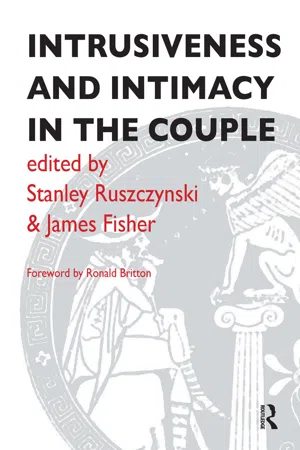
Intrusiveness and Intimacy in the Couple
- 180 pages
- English
- ePUB (mobile friendly)
- Available on iOS & Android
eBook - ePub
Intrusiveness and Intimacy in the Couple
About this book
A collection of papers, largely based on clinical work, which covers a range of concepts and mechanisms which are central to any psychoanalytic psychotherapy with children, adolescents, or adults. It addresses an issue which lies at the heart of human relationships, that of intimacy.
Information
Part One
Chapter One
Narcissistic object relating
Stanley Ruszczynski
In this chapter I consider the concept of projective identification primarily by reviewing narcissism and narcissistic object relating in the clinical situation. I discuss couple relationships that present with narcissistic features, often considered to be a particularly difficult constellation of intrapsychic and interpersonal object relations.
I also put forward the thesis that projective identification refers to a mental mechanism that is both intrusive and a form of communication. In proposing this view, I follow that put forward by Betty Joseph, amongst others, who writes that, "it is frequently difficult to clarify whether, at any given moment, projective identification is primarily aimed at communicating a state of mind that cannot be verbalized by the patient or whether it is aimed more at entering and controlling or attacking the analyst, or whether all these elements are active and need consideration" (Joseph, 1987, p. 175). She arrives at a view that, providing we can tune into it, "projective identification is, by its very nature, a kind of communication, even in cases where this is not its aim or its intention" (p. 170: italics added).
Initial presentation and clinical atmosphere
The type of couples whom I might eventually describe as narcissistic often approach the psychotherapist not with a specific problem or symptom, but, more usually, with a pervasive sense of mutual frustration, antagonism, and deep disappointment. I am often puzzled both as to what has held them together for the years of their relationship and why they are seeking treatment at this particular time. There seems to have been no sense of mutual regard or affection, but more a distancing coldness, aloofness, or self-sufficiency. Alternatively, there may be a confused togetherness, equally unsatisfactory, with no real sense of individuality or healthy separateness. Both report being dominated by the needs of the other: alternatively, each complains of being ignored by the other. Rather than concern, there is more often blame, accusation, and denigration. Alternatively, there may be an unconscious despair or terror at the thought of something going wrong between them. Sometimes this terror becomes conscious. Many such couples oscillate unpredictably between the aloofness and the confused togetherness.
Professionally, socially, and materially some of these couples may be "successful", with the frustration and sense of failure residing in the marital relationship. For others, the agitated disappointment is pervasive across all aspects of their lives. I have often been struck by the extremes of their interaction, demonstrated, for example, by a fluid combination of fixedness and volatility.
I am reminded of a couple I recently saw for a consultation. They had been together for over 30 years, having first known each other as childhood sweethearts. They had married, brought up four. now adult, children, and both had been professionally successful. They described what sounded like a very staid, lifeless, but stable relationship, based largely, it emerged, on unconscious mutual denial and sacrifice. Four weeks prior to the consultation, the wife suddenly announced that she could no longer stay in the marriage. Her husband agreed that he, too, had had enough, and within ten days the couple had amicably agreed to separate and were now living apart.
The shock at the precipitate way in which they had acted was felt, it seemed, only by me. I eventually wondered whether once the deadly status quo of their marriage had been broken, the only way of dealing with a now terrifying threat to their psychic equilibrium was to establish a new equilibrium, at any cost. The "agreed" separation, achieved so dramatically and precipitately, was the new equilibrium, it seems as if this couple are dominated by a psychic organization that requires agreement as the primary aspect of their relationship. Differentiation, ambivalence, or conflict appear to be totally unmanageable. By a process of mutual projective identification with an idealized internal image of relationships this couple seemed to create object relationships that sustained their sense of equilibrium but were unreal and destructive in their outcome. (See Meltzer's comments on what he calls "doll's-house" marriages in chapter six.)
In the consulting-room with such couples, I find myself unable to think about or address them as a couple. I am more likely to get caught up with one of them. In clinical discussion with colleagues, I also find that one or the other of the partners gets lost, the discussion focusing on just one of them.
There will often be no real curiosity about the other partner, or about me, but a sense of controlling or getting inside the other may emerge. Boundaries become confused or obscure: what belongs to the self and what belongs to the other becomes difficult to differentiate, with positive or negative aspects of the other becoming identified with and even idealized. Because of this distribution of various aspects of the self and other, through the processes of splitting and projective and introjective identification, such relationships can be very unstable if not rigidly maintained. If the mutual control and fixedness, via these schizoid mechanisms, does not take place, psychic equilibrium and even psychic survival is felt to be under threat.
With the couple mentioned above, for example, they rapidly re-established a sense of equilibrium, through mutual projective identification, by agreeing that they should separate. What was paramount was that they should be in agreement. Any conflict, ambivalence, sense of loss, or uncertainty was completely absent from their thinking both during their marriage and now in their separation.
It is often difficult with such couples to retain a capacity for appropriate separateness: I find myself caught up in some way, or controlled, or feeling very disturbed by my relationship with them. My comments or interpretations are often ignored, devalued, or attacked. Alternatively, interpretations will be hijacked and repeated later, often in a distorted way, which perverts what had been said, or I might find myself becoming the object of their idealization, sometimes even being seduced by it. My therapeutic stance and work is frequently undermined, challenged, or openly attacked.
Object relating or not?
The poverty of such couple relationships and the attendant clinical problems raise the question as to whether marital psychotherapy is the most appropriate therapeutic intervention. One or both partners could be diagnostically described as narcissistic or borderline. Some clinicians might argue that such individuals are not capable of relating and that there is no relationship with which the marital psychotherapist might work. They could therefore suggest that such individuals are better treated in intensive individual psychotherapy. All of this may, of course, be true.
However, I would like to suggest that such couples are engaged In an object relationship, but one that is pathological in its structure. Paradoxically, such a relationship is unconsciously constructed and maintained exactly for the purpose of avoiding or defeating that which would be required and would emerge in a more healthy object relationship. The relationship has purpose and meaning for both partners, although it is purpose and meaning substantially influenced by the more primitive parts of the personality.
My view is that narcissistic object relating is rooted in the anxieties, defences, and types of object relations of the paranoid-schizoid position, within which projective identification plays a crucial role. Given that there is a constant dynamic movement, in all individuals and in all relationships, between the more primitive paranoid-schizoid position and the more mature depressive position, paranoid anxieties are likely to be evoked, at times, in all individuals and all couples, therefore arousing the defences and types of object relations of the paranoid-schizoid position. This being so, narcissistic object relating—based on the processes of splitting and projective identification—should be considered to be not only a discrete and highly pathological state, but as likely to emerge, more or less, as "pockets" of interaction in all intimate relationships. So how do we begin to understand narcissistic object relations?
Narcissistic object relations
The genesis of what came to be called "object relations theory" emerged in the course of Freud's discovery of the mechanism of transference. Through his clinical work he became acutely aware of the intensity of feelings experienced by the patient towards the therapist. This "discovery" of transference placed the investigation of the patient's relationships at the centre of psychoanalytic theory and practice.
Following his first realization of transference, Freud initiated a major theoretical and clinical leap when he became interested in the clinical and theoretical problems with homosexuality and paranoid psychosis. Though based on biographical and autobiographical information rather than direct clinical experience, Freud speculated that such individuals would not be able to make a transference. He understood this to be because of "[the] diversion of their interests from the external world—from people and things", which made them "inaccessible to the efforts of psychoanalysis" (Freud, 1914d, p. 74).
In a biographical study of Leonardo da Vinci, for example, Freud suggests that Leonardo's apprentices were treated as if they represented the artist as a young boy. In addition, Leonardo identified with his mother, and he related to the apprentice boys as he wished she had related to him. Freud uses this study to illustrate how the relationship to the real external object is repressed and the self is taken as a model in whose likeness objects of love are chosen (Freud, 1910c). This state of mind Freud came to cal! "narcissism".
Freud differentiated between anaclytic (or attachment) type of love—fundamentally, a love of the object that has nourished or protected—and a narcissistic type of love—a love of what the person himself is, was, or would like to be. In doing so, he postulated a primary narcissism in everyone, which, in some cases, dominates the nature of their object-choice.
By "primary narcissism", Freud meant a primitive objectless stage of infantile development, predating object relating, in which the infant takes its own body and ego as an object of its love. This notion of a primary objectless stage of development makes it possible to speak of individuals and couples who do not form object relations, leading to the view that such patients are not capable of developing a transference. Disagreeing with this view, I would simply like to suggest that perhaps the issue is more accurately the nature of the object relating rather than whether it takes place.
As a result of her clinical work with children, Klein arrived at a view different from Freud's. Rather than an objectless primary narcissism, she came to understand that from the very beginning the young infant has a rudimentary ego that engages in primitive object relations. The infant relates powerfully to the mother—or, more accurately, to those parts or functions of the mother that it is concerned with or in need of at any particular time. This unintegrated relating creates multiple identifications and, therefore, a multiplicity of internalized object relations. (In Klein's language, this should be referred to as "part-object relations".) Though the infant may actually only be relating to a few people, it relates to them in their different aspects and with varying degrees and types of physical and emotional involvement. These are projected into the object and so colour the nature of the experiences and of the subsequently internalized object relations. As Klein puts it. "Every external experience is interwoven with . . . phantasies and . . . every phantasy contains elements of actual experience" (Klein, 1952a, p. 54). Early object relations are founded on this interplay of reality and phantasy.
Through this normal dynamic process of projection and introjection, an inner world is built up, made up of the multiplicity of now internalized object relations—good and bad, satisfying and frustrating.
This view, therefore, challenges Freud's idea that there is an initial objectless stage of development. Primitive relating to an object or a part object may, in fact, be complex and overwhelming in its emotional force. Equally, this view challenges the idea that there is no transference from patients functioning in these more primitive ways. It is more likely that the transference will be pre-verbal and, therefore, enacted, intense, precipitate, and changing.
I am reminded of another couple whom I recently saw for a consultation at the institute.
When I opened my consulting-room door to let out the couple whom I was seeing before the consultation, the new couple were standing literally outside my door. I was given an enormous shock. Once I had regained my composure, I asked who they were and then told them that they were ten minutes early and invited them to return to the waiting-room from where I would call them at their appointment time.
During the next ten minutes, I experienced a most disturbing volatility of emotions. Firstly, I experienced an enormous sense of physical intrusion, almost of violation. My breathing became very shallow, and I felt persecuted by questions to myself. How had they got past the reception desk? How did they know which my room was? How long had they been standing outside my door? Had they overheard anything of the session with the couple who were with me? What did that couple make of their experience when I opened the door to let them out? What did I say in my shocked state? Did they notice my shock? Will I be able to work with them for the appointed assessment? And so on.
Alongside these perhaps understandable feelings of intrusion, I also found myself overwhelmed by a sense of urgency that I simply had to understand the meaning of this first brief encounter before I actually saw the couple for the consultation, and that without this understanding I would not be able to conduct the consultation. Though I knew that this was a totally omnipotent aspiration, I could not dislodge it from my mind.
In the course of the consultation, the wife told me how shocked she was at her husband's affair and his desire to leave the marriage. The couple shared a view that they had had a deeply romantic beginning to their relationship—they were from different countries and had for some years courted internationally—and the sudden affair and threatened break-up had intruded into and violated their relationship.
However, what I found more interesting in relation to my countertransference was when the wife talked with pride about being able to "read" people—particularly her husband Suddenly to find that he was behaving in this totally unpredictable way terrified her, because it meant that she had not read him at all. What I eventually came to see was that she seemed almost more disturbed by this loss of her capacity to "read" her husband than by the possible loss of him.
The husband spoke with frustration and anger at being suffocated by his wife's constant claim that she understood him and knew what he wanted. He experienced this as her powerful attempts at controlling him. However, he was also made very anxious by the unpredictability of his own behaviour, which disturbed him. I suspect that though he protested at his wife's attempts to control him, he did gain some sense of psychic security and equilibrium from being read by or understood by his wife.
I use this illustration to demonstrate the enormous power and communicative potential of our experience with our patients. This brief vignette shows how in my earliest countertransference reaction, not only did I begin to become aware of some of the powerful dynamics operating within and between the couple, but also that a number of emotional experiences seem to take place alongside each other or even simultaneously.
Projective identification
To understand this multiplicity of experiences, Klein conceptualized schizoid mechanisms, paying particular attention to what she called projective identification (Klein, 1946, 1955), which she understood to be a primitive phantasy of splitting off and projecting parts of the self and internal objects and identifying with them as if located in another person. The concept has now been developed substantially, and for many writers it is central in the understanding of human interaction. Bion, for example, writes that, "the link between patient and analyst, or infant and breast, is the mechanism of projective identification" (Bion, 1959, p. 105), and he refers to the ways in which one person can induce another person to actually experience and/or behave in accord with the phantasies of the projective identification. Though there is debate as to whether the same term should be used only for the defensive evacuative process (liléin) or also for that which is understood to be at the basis of the means of communication and psychic containment (Bion). there is no doubt at all that it is a very useful concept (Spillius, 1988b, 1994).
The reason for its utility is that, for many writers and clinicians, the concept has been found to be essential in the understanding of both interpersonal and intrapsychic object relationships. The clinical study of narcissism and narcissistic object relating suggests that the apparent dichotomy, both theoretically and clinically, between the intrapsychic and the interpersonal, between the inner world and the outer world, can all too readily be overstated. Working psychoanalytically. and particularly with couples, we are constantly reminded, through our clinical experience, of the interpersonal externalization of intrapsychic images and phantasies.
I cannot, of course, review the literature on projective identification: it is e...
Table of contents
- Cover
- Half Title
- Title
- Copyright
- ACKNOWLEDGEMENTS
- Contents
- CONTRIBUTORS
- FOREWORD
- Introduction
- PART ONE
- PART TWO
- REFERENCES
- INDEX
Trusted by 375,005 students
Access to over 1.5 million titles for a fair monthly price.
Study more efficiently using our study tools.
Frequently asked questions
Yes, you can cancel anytime from the Subscription tab in your account settings on the Perlego website. Your subscription will stay active until the end of your current billing period. Learn how to cancel your subscription
No, books cannot be downloaded as external files, such as PDFs, for use outside of Perlego. However, you can download books within the Perlego app for offline reading on mobile or tablet. Learn how to download books offline
Perlego offers two plans: Essential and Complete
- Essential is ideal for learners and professionals who enjoy exploring a wide range of subjects. Access the Essential Library with 800,000+ trusted titles and best-sellers across business, personal growth, and the humanities. Includes unlimited reading time and Standard Read Aloud voice.
- Complete: Perfect for advanced learners and researchers needing full, unrestricted access. Unlock 1.5M+ books across hundreds of subjects, including academic and specialized titles. The Complete Plan also includes advanced features like Premium Read Aloud and Research Assistant.
We are an online textbook subscription service, where you can get access to an entire online library for less than the price of a single book per month. With over 1.5 million books across 990+ topics, we’ve got you covered! Learn about our mission
Look out for the read-aloud symbol on your next book to see if you can listen to it. The read-aloud tool reads text aloud for you, highlighting the text as it is being read. You can pause it, speed it up and slow it down. Learn more about Read Aloud
Yes! You can use the Perlego app on both iOS and Android devices to read anytime, anywhere — even offline. Perfect for commutes or when you’re on the go.
Please note we cannot support devices running on iOS 13 and Android 7 or earlier. Learn more about using the app
Please note we cannot support devices running on iOS 13 and Android 7 or earlier. Learn more about using the app
Yes, you can access Intrusiveness and Intimacy in the Couple by James Fisher, Stanley Ruszczynski, James Fisher,Stanley Ruszczynski in PDF and/or ePUB format, as well as other popular books in Psychology & History & Theory in Psychology. We have over 1.5 million books available in our catalogue for you to explore.