eBook - ePub
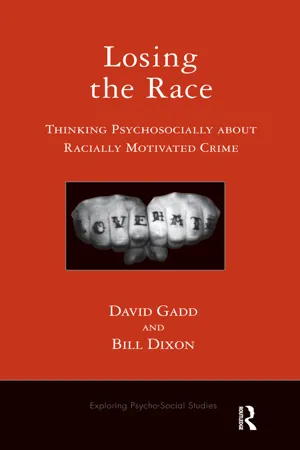
Losing the Race
Thinking Psychosocially about Racially Motivated Crime
- 288 pages
- English
- ePUB (mobile friendly)
- Available on iOS & Android
eBook - ePub
About this book
Based on a two-year research project funded by the Economic and Social Research Council (ESRC), this book explores why many of those involved in racially motivated crime seem to be struggling to cope with economic, cultural and emotional losses in their own lives. Drawing on in-depth biographical interviews with perpetrators of racist crimes and focus group discussions with ordinary people living in the same communities, the book explores why it is that some people, and not others, feel inclined to attack immigrants and minority ethnic groups. The relationships between ordinary racism, racial harassment and the politics of the British National Party are also explored, as are the enduring impacts of deindustrialisation, economic failure and immigration on white working class communities. The book assesses the legacy of New Labour policy on community cohesion, hate crime and respect in terms of its impact on racist attitudes and racist incidents, and explores how it is that racist attacks, including racist murders, continue to happen.
Information
Chapter One
Posing the "why?" question
“My heart is broken”
“The devastated mother of racist murder victim Anthony Walker said she would forgive his killers—but only when they showed genuine remorse. Special needs teacher Gee Walker, 49 . .. described Anthony as ‘the man of the house’ . .. who could defuse a family row by pointing out the humour in most situations. . .. [S]he wept as she explained the void his death created . .. Despite her obvious pain, Mrs Walker’s strong Christian faith means she cannot hate [her son’s murderers] Barton and Taylor . .. ‘Hatred is a life sentence. . .. It eats you up inside like a cancer.’ . . .
The fact that Anthony’s killers grew up in the same area—Taylor attended the same junior school—is particularly hard for Mrs Walker to accept. . .. ‘They played together, they stood in the same dinner queue. I believe that all kids are innocent and something went wrong along the way. Someone planted a seed of hate in their minds. Kids don’t decide, “I’m going to hate.” It’s got to come from somewhere and it’s down to all of us to find out where and why.’ . . . And Mrs Walker was keen to stress the comfort she had taken from the huge outpouring of public sympathy . .. ‘We wouldn’t have survived without that’.”
(The Sun, 2005)
The mushrooming literature on hate crime powerfully testifies to the harms caused by racially motivated forms of violence and harassment. Ehrlich, Larcom, and Purvis (2003, p. 158) observe that victims of “ethno-violence” are more likely to suffer a range of psychosomatic symptoms than victims of other crimes, including “nervousness, trouble concentrating or working, anger and a desire to retaliate . . . fear . . . and feeling exhausted or weak for no reason”. Bowling and Phillips (2002, p. 114) describe how “serious and mundane incidents are interwoven to create a threatening environment which undermines” the “personal safety and freedom of movement” of people from black and minority ethnic communities. Racially motivated murders may be relatively rare in relation to other forms of homicide, but the horror these evoke is associated in the minds of many people from black and minority ethnic groups with the more commonplace phenomena of racially motivated assaults, racial harassment, racist graffiti, racist joking, and discrimination on the bases of skin colour, religion, and nationality. As we shall see in Chapter Four, the harsher sentences handed down to those convicted of racially aggravated offences under anti-hate crime laws in both Britain and the United States are open to criticism, but they have been widely welcomed by practitioners and academics on the grounds that “hate crimes hurt more”, “are more likely to involve excessive violence”, and “send out a terroristic message to members of the victim’s group” (Iganski, 2003, p. 135).
Yet, as the story reproduced above suggests, better and harsher justice is not the only thing those who suffer the hurts caused by racially motivated crime want and need. Gee Walker, the mother of a black schoolboy killed when two white men wearing ski masks bludgeoned him to death with an ice axe, has talked repeatedly to the media about her desire to understand and forgive her son’s killers. Knowing what to make of such news coverage, particularly the claim that the nation’s sympathy enabled the grieving family to “survive” is not easy. Such sentiments mitigate the public’s sense of culpability and obscure from view the many racist attacks, including some racist murders, which pass without media comment (Institute of Race Relations, 2008). However, Gee Walker’s oft-repeated expressions of bewilderment at the killers’ actions merit further consideration. In asking what had planted “the seed of hate” in their minds, the parameters of Gee Walker’s own experience as both a single mother of six and a special needs teacher who successfully raised a young man emotionally adept enough to “defuse” many a family conflict come into play. Given that her son’s killers were brought up in the same neighbourhood, played with Anthony, and that one of them went to his school, Gee Walker is understandably perplexed as to how they turned out so differently from her own son. From this perspective, her conclusion that something must have “gone wrong” for Barton and Taylor seems plausible, and her insistence that we all have a duty to “find out where and why” they became so hateful entirely justified.
Walker is not alone in taking this stand. As Pumla Gobodo-Madikizela’s (2003) moving account of her interviews with Eugene de Kock, the South African police colonel who oversaw the murder and torture of many of apartheid’s opponents demonstrates, coming to terms with the humanity of perpetrators can be part of the process of overcoming the dehumanizing impact of racism and the atrocities it facilitates. In South Africa, the desire to come to terms with loss, trauma, and brutalization was so great that, during the Truth and Reconciliation Commission’s hearings, some victims offered to forgive perpetrators before they apologized for their crimes (ibid., p. 98). Gobodo-Madikizela witnessed the wife of a man murdered in a bombing orchestrated by the security forces shed tears of forgiveness for Eugene de Kock (ibid., p. 94). She further notes that, while many people find it hard to contemplate having anything to do with perpetrators, some victims need to be given the opportunity to engage with them, despite the emotionally disturbing consequences of doing so (ibid., pp. 128–129). For these victims, identifying with the perpetrators’ pain is one way of ridding themselves of the poisonous self-loathing instilled in them by victimization and oppression. Consequently, to
. . . dismiss perpetrators simply as evildoers and monsters shuts the door to the kind of dialogue that leads to an enduring peace. Daring, on the other hand, to look the enemy in the eye and allow oneself to read signs of pain and cues to contrition or regret where one might almost have preferred to continue seeing only hatred is the one possibility we have for steering individuals and societies towards replacing longstanding stalemates out of a nation’s past with genuine engagement. [ibid., p. 126]
Of course, it is not necessarily the task of academics to facilitate dialogues between perpetrators and victims. But if criminologists are to make a contribution to alleviating the problem of racially motivated violence and harassment, and/or to helping people overcome the many hurts it causes, then we cannot afford to shy away from the challenge of rendering perpetrators’ motives comprehensible, of searching for signs of pain and cues of contrition beneath the hatred, of teasing explanations out of excuses, and of finding the human within the dehumanizing. In sum, it is the job of academics to find a language capable of helping victims, perpetrators, and their wider communities to make sense of the phenomenon of racially motivated forms of crime and harassment, their most serious and apparently mundane manifestations included. In the rest of this chapter, we begin by looking at how criminologists writing from a range of different perspectives have tried to answer the “why” question. From there, we go on to summarize the findings of our research in North Staffordshire, parts of which form the empirical basis for our own attempts to answer this critical question later in this book.
Criminological perspectives
Criminological writing about perpetrators has largely shied away from attempting to answer the “why” question. The most cited works tend to be typological, or otherwise largely descriptive, profiles derived from secondary analyses of police incident data. These have enabled distinctions to be drawn between “thrill”, “defensive”, “retaliatory”, and “mission” motivated offenders (McDevitt, Levin, & Bennett, 2003); “expressive and instrumental motives” (Berk, Boyd, & Hamner, 2003); “premeditated and unpremeditated attacks” (ibid.); and “versatile”, generalist offenders tinged with “bias”, and “specialist” hate crime offenders (Messner, McHugh, & Felson, 2004). These typologies show that not all racially motivated offenders are the same, that motives and rationales vary, and that offences aggravated by the use of racist terms are not always initiated because of hateful feelings. But, in failing to grapple with how offenders’ motives resonate with the contradictory mixture of popular prejudices, historically ingrained ideas about race and belonging, and contemporary concerns about nationality, entitlement and migration, typological approaches tend to oversimplify the distinctions between perpetrators and non-perpetrators.
From this base, Barbara Perry’s (2001) attempt to apply structured action theory to the perpetration of hate crime was a radical move forward. Within western culture, Perry argues, difference is often constructed in negative relational terms as “deficiency”, so that those who deviate from the hegemonic position in social relations—currently occupied by white, economically successful, heterosexual men—are constructed as inadequate, inferior, bad, or evil (ibid., p. 48). From Perry’s perspective,
Hate crime . .. connects the structural meanings and organization of race with the cultural construction of racialized identity. On the one hand, it allows perpetrators to reenact their whiteness, thereby establishing their dominance. On the other hand, it coconstructs the nonwhiteness of the victims, who are perceived to be worthy of violent repression either because they correspond to a demonized identity, or, paradoxically, because they threaten the racialized boundaries that are meant to separate “us” from “them”. [ibid., p. 58]
Perry claims that the perpetration of hate crime serves multiple objectives. It reinforces the normality of white sexuality while punishing those who transgress, or who are imagined to have transgressed, the norm. Victims are often harassed for transcending normative conceptions of difference, for doing things white men think black and ethnic minority men are not entitled to do, but they may also be punished for conforming to relevant categories of difference, for behaving in ways whites consider to be stereotypical of non-whites. Although the process of victimizing others instils a positive sense of identity in those perpetrators who fear emasculation, and/or feel marginalized by their class position, knowledge of this victimization among the victim’s community reinstates the racialized injustices of the wider society. Grounding her work in the histories of slavery, segregation, and exploitation that initially defined white Americans’ relationships with African and Native American people, Perry’s thesis avoids the profilers’ tendency to pathologize while also attending to the way in which so many racist attacks appear to be as much about gender, age, and sexuality as they are about “race”. But in accounting for “hate” in terms of class and gender-related marginalization, Perry’s analysis, like much of the structured action theory on which she draws, has a rather “deterministic feel”, which makes it harder rather than easier to get to grips in any meaningful way with the inner worlds of the offenders in question (Gadd & Jefferson, 2007, p. 111).
In exposing the feelings of inadequacy contemporary racism so often conceals, some UK based researchers have offered a more humanizing perspective on the aetiology of hate crime. Rae Sibbitt attempted as much in her Home Office-funded study of racist victimization cases when she argued,
For perpetrators, potential perpetrators and other individuals within the perpetrator community, expressions of racism often serve the function of distracting their own—and others’—attention away from real, underlying, concerns which they feel impotent to deal with. [Sibbitt, 1997, p. viii]
Likewise, Ray, Smith, and Wastell’s (2004) study of those convicted of racially aggravated offences in Greater Manchester has drawn attention to the prevalence of racist crime in areas where white residents perceive themselves to be under threat from an expanding South Asian population, even though this population is no less affected by the decline of Britain’s manufacturing industries. Ray and colleagues’ interviews with those on probation for racially aggravated offences suggested that most (white) racially motivated offenders tend to share the values and prejudices of the communities from which they come. Deploying a framework developed by Scheff (1994), Ray, Smith, and Wastell detected unacknowledged shame in the verbal disclosures and body language of around two thirds of their thirty-six respondents. These racist offenders
. .. saw themselves as weak, disregarded, overlooked, unfairly treated, victimized without being recognised as victims, made to feel small; meanwhile, the other—their Asian victims . . .—was experienced as powerful, in control, laughing, successful, “arrogant”. (Ray, Smith, & Wastell, 2004, pp. 355–356]
But, while Ray and colleagues published many accounts of what offenders think about ethnic minorities, they provided few of their interviewees’ explanations of their offending behaviour (see also Ray, Smith & Wastell [2003a,b] for further examples). This makes it hard to gauge whether “shame” was always the “master emotion” behind racist crime, whether loss of face or unacknowledged shame was more acute for those who committed acts of racist violence than for those who simply held racist views, and what caused the more acute shame supposedly felt by hate crime perpetrators.
Our research
Our own research, conducted in and around the city of Stoke-on-Trent in North Staffordshire in the English Midlands, set out to address these shortcomings. (For census and other official purposes, North Staffordshire is generally taken to mean the local authority areas of Stoke-on-Trent [of which more below], Newcastle-under-Lyme, and Staffordshire Moorlands.) The overall aim of our project was to tease out the connections and tensions between pervasive forms of racism and xenophobia, the expression of anti-racist sentiments, and the motivations of the minority of the population who perpetrate a range of racially motivated offences (Gadd, Dixon, & Jefferson, 2005). Focus group discussions were conducted with thirteen naturally occurring groups of local people. These included people from a residents’ association, a neighbourhood watch, a working men’s club, a day centre, and two anti-racist groups. We also talked to groups consisting of young offenders, asylum seekers, and white and minority ethnic users of two local authority run youth clubs. In addition to this, Free Association Narrative Interviews were conducted with fifteen people implicated in acts of racial harassment or violence (Hollway & Jefferson, 2000). Twelve of the fifteen were accessed via probation services and youth offending teams, although only five of them had ever been charged with racially aggravated crimes. Three participants, all of whom were politically involved in racist political groups, were recruited through more direct approaches. One activist was recruited from a focus group and put us in contact with another interviewee active in a local campaign against the dispersal of asylum seekers to North Staffordshire. The third was recruited by writing to him directly. Recordings of the focus groups and in-depth interviews were fully transcribed, with particular analytic attention being given to fragments of words, overlapping speech, changes of tone, and other non-verbal cues, as well as to emerging themes and intersubjective dynamics.
Racist crime in North Staffordshire
In 2005, one in every three minority ethnic residents of Stoke-on-Trent had experienced some form of racial harassment in the previous three years: one in four had been verbally abused; one in twenty had suffered a violent racist attack. These rates of victimization were higher than those found by the British Crime Survey for England and Wales as a whole (Salisbury & Upson, 2004). Local racist incident data for Stoke-on-Trent suggested that, by 2003, refugees and asylum seekers from Afghanistan, Iraq, and Iraqi Kurdistan were experiencing even higher rates of victimization than the (themselves heavily victimized) Pakistani and Bangladeshi populations. These high rates persisted, despite a more pro-prosecution approach than evident elsewhere. Perpetrators of racially aggravated offences in Staffordshire were less likely to be cautioned and more likely to be referred for prosecution than in most other counties in England and Wales. However, there was also evidence that most racist incidents never came to the attention of the police, let alone the courts. The police in Stoke-on-Trent recorded only 468 such incidents in 2002–2003 while, in November 2003, only one person in North Staffordshire was in custody for a racially aggravated offence, and only thirteen racially motivated offenders were listed in probation caseloads.
Deindustrialization and the rise of the British National Party
By the time we came to do our fieldwork in 2003–2004, Stoke-on-Trent had endured at least three decades of economic decline. By the end of the 1990s, the area’s three major industries—ceramics, coal mining, and steel production—had almost disappeared. While other, similar cities had offset losses in manufacturing jobs by expanding service sector employment, Stoke-on-Trent had seen the workforce in financial services dwindle, forcing unemployment rates up and disposable incomes down far below the national average (Parkinson et al., 2006). With the area also experiencing greater out-migration than in-migration, these factors combined to erode the City Council’s fiscal base and reduce its capacity to sustain adequate public services (Parker, 2000). This, in turn, enabled a succession of independent councillors to blame asylum seekers and travelling people for consuming scarce resources that “belonged” to local residents. As the electorate’s long-standing support for the Labour Party ebbed away, the far right British National Party (BNP) began to benefit from the creeping racialization of social deprivation and persistent internecine rivalries between the historic “six towns” of Stoke-on-Trent and their near neighbour, the old market town of Newcastle-under-Lyme. (In strict alphabetical order, the “six towns” are Burslem, Fenton, Hanley, Longton, Tunstall, and Stoke. Although Burslem is, by tradition, the “mother town” of the area known as the Potteries in deference to the product for which it is still internationally famous, the main business district and shopping area is in Hanley. Stoke itself is only one of the “six towns”, but we will risk irritating locals by occasionally using “Stoke” as a shorthand for “Stoke-on-Trent” here and throughout the rest of this book.) In the 2004 Stoke City Council elections, the BNP secured between a quarter and a third of the vote in the wards it contested, a level of support it maintains at the time of writing, notwithstanding subsequent declines in its fortunes elsewhere in the Midlands and the North of England.
The "white" community speaks
Perhaps predictably, given the city’s increasingly straitened circumstances, white participants in our focus groups offered an overwhelmingly negative assessment of life in Stoke-on-Trent. Younger people dismissed it as a “shit-hole”, a “dump”, “crap”. Their elders compared Stoke-on-Trent today unfavourably with the city they had grown up in, though many paid tribute to the enduring friendliness of its people and could not contemplate living anywhere else. Call centres, distribution hubs, and retail outlets had replaced major industries. Skilled, relatively well-paid jobs had been lost, and stable, self-sustaining communities broken up. Mining villages and vibrant commercial centres full of hard-working, respectable people had been reduced to wastelands. At the mercy of “absentee landlords” and uncaring housing providers, respectable neighbourhoods had become “dumping grounds” for “foreigners” and “riff-raff”. Older residents believed that parts of the city had come to resemble a “war zone”, “Beirut”, “Africa”, or “Bombay”. They saw evidence of a decline in social discipline everywhere. Children respected nobody. Parents and police alike seemed to lack the will to do anything to control them. Drugs were ubiquitous, and binge drinking and viol...
Table of contents
- Cover
- Half Title
- Title
- Copyright
- Contents
- ACKNOWLEDGEMENTS AND PERMISSIONS
- ABOUT THE AUTHORS
- INTRODUCTION: Race, racism, and racially motivated offenders
- CHAPTER ONE Posing the "why?" question
- CHAPTER TWO Recovering the contradictory racist subject
- CHAPTER THREE Understanding the "racially motivated offender"
- CHAPTER FOUR Racially aggravated offenders and the punishment of hate
- CHAPTER FIVE The unconscious attractions of far right politics
- CHAPTER SIX Rethinking community cohesion
- CHAPTER SEVEN Zahid Mubarek's murderer: the case of Robert Stewart
- CHAPTER EIGHT Racism, respect, and recognition
- CHAPTER NINE Conclusion: losing the race
- REFERENCES
- INDEX
Trusted by 375,005 students
Access to over 1.5 million titles for a fair monthly price.
Study more efficiently using our study tools.
Frequently asked questions
Yes, you can cancel anytime from the Subscription tab in your account settings on the Perlego website. Your subscription will stay active until the end of your current billing period. Learn how to cancel your subscription
No, books cannot be downloaded as external files, such as PDFs, for use outside of Perlego. However, you can download books within the Perlego app for offline reading on mobile or tablet. Learn how to download books offline
Perlego offers two plans: Essential and Complete
- Essential is ideal for learners and professionals who enjoy exploring a wide range of subjects. Access the Essential Library with 800,000+ trusted titles and best-sellers across business, personal growth, and the humanities. Includes unlimited reading time and Standard Read Aloud voice.
- Complete: Perfect for advanced learners and researchers needing full, unrestricted access. Unlock 1.5M+ books across hundreds of subjects, including academic and specialized titles. The Complete Plan also includes advanced features like Premium Read Aloud and Research Assistant.
We are an online textbook subscription service, where you can get access to an entire online library for less than the price of a single book per month. With over 1.5 million books across 990+ topics, we’ve got you covered! Learn about our mission
Look out for the read-aloud symbol on your next book to see if you can listen to it. The read-aloud tool reads text aloud for you, highlighting the text as it is being read. You can pause it, speed it up and slow it down. Learn more about Read Aloud
Yes! You can use the Perlego app on both iOS and Android devices to read anytime, anywhere — even offline. Perfect for commutes or when you’re on the go.
Please note we cannot support devices running on iOS 13 and Android 7 or earlier. Learn more about using the app
Please note we cannot support devices running on iOS 13 and Android 7 or earlier. Learn more about using the app
Yes, you can access Losing the Race by David Gadd,Bill Dixon in PDF and/or ePUB format, as well as other popular books in Social Sciences & Social Policy. We have over 1.5 million books available in our catalogue for you to explore.