- 176 pages
- English
- ePUB (mobile friendly)
- Available on iOS & Android
eBook - ePub
About this book
The sense that one is living a lie is important to many and often goes with a sense that an important flame is waning. Fused with this is fear that self-discovery is sinful. Guilt, fear and shame attaches to development and to failure to develop. Fusion of opposites is the rule in psychic life. Creative theft melds with destructive dreads. Unbearable agonies prompt easeful lies and falsity to escape pain and helplessness ... Real touches real, sometimes for evil, sometimes for good, often the two indiscernible, indistinguishable. This book affirms that there is something in us that works with all its might to tip the balance towards the good.- Michael Eigen, from the Foreword
Information
CHAPTER ONE
Introduction
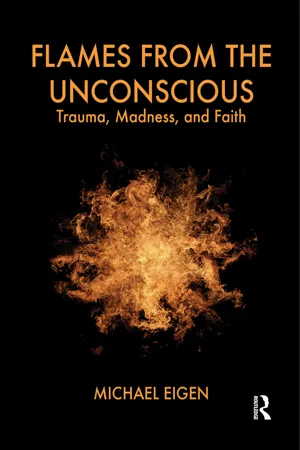
Is flames too strong a word? I want to connote fire, intensity, burning, inspiration. Our culture long associated flames with hell. Quite scary: to burn in hell forever for your sins, for the evil in you, for the evil you did. Fire, also, was associated with creativity, creative heat, in-flammation, a flame within. Poets tend to gravitate towards the latter, inner flame. For William Blake, the Devil, as well as Jesus, is important for fecundity of creative imagination. We can speak of hells of creative passion, creative work, self-creation, and discovery.
Fires of the mind, the gut, the passions, holy and hellish fires, eternal flames. I heard a great rabbi speak of “the fire that never goes out” and read saints who speak of burning away the dross of self, burning away self itself. Fire associated with purity as well as sin. The same rabbi, Menachem Schneerson, who spoke of the eternal flame within, also spoke of self-nullification. As if burning away the self lays bare the eternal flame.
I will not recount all usages of flame: fires of disaster, cooking, warmth of hearth and home, love and hate fires of all sorts, fearsome, majestic flames of nature, and our great venture to control the uncontrollable, what we gain, lose, unleash. One more will do for my purpose: theft, the Greek myth of Prometheus, who steals fire from the gods as a gift to humanity. A civilizing gift that spans physical, emotional, and mental levels. A gift that requires cultivation and growth of ability to channel dangerous energy.
Is there an Ur word or image in which all these and other meanings of fire meld? A root sign or symbol from which a spectrum of meanings develops? A compressed density that unfolds and proliferates over time with usage? The commingling of theft with gift seems of particular importance to personality, uniting fires of sin and discovery.
To feel like an impostor is a recurrent theme among artists, and to feel false as a person is a crucial theme in psychoanalysis. The sense that one is living a lie is important to many and often goes with a sense that an important flame is waning. Fused with this is fear that self-discovery is sinful. Guilt, fear, and shame attaches to development and to failure to develop. Fusion of opposites is the rule in psychic life. Creative theft melds with destructive dreads. Unbearable agonies prompt easeful lies and falsity to escape pain and helplessness.
Falsity is part of growing up (part of the reason Holden Caulfield in The Catcher in the Rye sees adults as phoney). Threads of truth remain. One longs for their development and may seek to grow in capacity to connect with and mediate them. We are all midwives to ourselves. We fear if we are too much ourselves we will destroy ourselves, but failing in this task also involves self-injury.
It may sound odd to some to hear me speak of D. W. Winnicott as a flame from the unconscious. So much of his writing seems gentle, and no other psychoanalyst goes as far as he in validating the importance of quietude. He gives expression to dialectics between quiet and excited states, the positive contributions of each. So often, quiet states get shorted. Not by Winnicott. He feels they have much to offer, gentle flames.
The fact that he so values quiet is brought home even more because he values extreme states as well. Extremes make aliveness more colourful. So much so, he created a prayer, something like, “Lord, may I be alive when I die.” He did not want to miss out on aliveness, not even (especially?) the aliveness of death. How alive can one be when one dies? Winnicott would give it his best shot to experience something as important as dying.
I do not remember flames being a big part of Winnicott’s language, but he spoke of “sparks”. Particularly, a vital spark each of us possesses, or is, or can be, a spark of aliveness that has a biography. Our vital spark undergoes vicissitudes, hardships, trauma, and also facilitating threads, support, and nourishment of many kinds. The events of life interact with our aliveness in ways that aid and hinder it and, at times, the light can grow dim indeed, for periods gone. In latter instances, therapy is like lighting matches near the mouth of a corpse, looking for signs of life, fanning sparks where embers seemed out.
My emphasis in the next two chapters is the aliveness Winnicott finds in aloneness, and the contribution aloneness makes to aliveness. The alone self gets a bad rap in our culture, where phoney outgoingness is emphasized. There is something wrong with you if you are alone. You are withdrawn, in some way disabled, missing out on real living done by everyone else.
This negative evaluation of aloneness carries over into devaluing an alone aspect of self that is with us all our lives. Winnicott adds a subtle turn to experiencing aloneness. He envisions an aloneness that is made possible by support the alone one does not know s/he has, e.g., the support an infant gets without being able to cognize it. Winnicott posits an important sense of aloneness, perhaps from the beginning of life, a precious sense that is traumatized by lack of support. Good quality aloneness depends on good quality support. Failure to support the infant’s alone self results in deformations in the sense of self. Deformations are inevitable. No one evades trauma. A certain balance is important. Much depends on the quality of support an infant does not know it has. If the balance tips overly towards too little support, or too much of the wrong kind (invasive, engulfing), self-feeling becomes skewed and taints the way life “feels” develop.
Chapters Two (“Primary aloneness”) and Three (“Incommunicado core and boundless supporting unknown”) explore aspects of Winnicott’s alone self in his writings, with my patients, and in my own life. How the self feels in infancy becomes part of a background atmosphere influencing the feel of life as it unfolds. Skews, once established, play a role in the taste of things and slant experiences that come one’s way. Winnicott speaks of early parental environment, but the spirit of the time, the tone of society, has an impact. The goodness/badness of the world around the parents has an impact, knowingly or unwittingly. As the infant is supported by the parent, so the parent gains sustenance and is subject to toxins from the world s/he lives in. Nourishment and toxins are often fused and indistinguishable (Eigen, 1999). We are permeable beings. We have psychic taste buds, psychic lungs, and are sensitive to the smell, taste, and quality of the emotional air we breathe (Eigen, 2004).
That no one is an island may be more true than we imagined. Even the feeling of aloneness that is ours all our lives depends on atmospheric conditions, including emotional atmosphere. Whatever affects our feelings, affects the tone of our existence, even our inmost relation to ourselves. As we grow, we spend a good deal of time trying to right inner skews we sense but cannot pin down. We use all the materials of the world that come our way in this labour. Too often, skews we try to right influence our efforts, throw them off, and we are left frustrated. If left undetected, warping influences spread through the social body and mushroom, perhaps reaching such a destructive climax that they finally become noticeable.
I have seen many people who feel guilty or ashamed about alone tendencies. One of the saddest things is fear of gratifying the need to be alone. The triumvirate fear, shame, and guilt permeates the self. Phrases like “I’m ashamed of myself”, “I’m guilty”, “I’m afraid” do more than express momentary states. They often intimate that shame, guilt, and fear are part of the I who speaks and the self it speaks about, and part of the subsoil I–me–self grow from. They act like an electric grid or barrier that makes fuller contact with oneself impossible. One would have to endure too much shame or guilt or fear to get closer to oneself.
On the other hand, a complementary and widespread problem is that too many people feel too little shame or guilt. People in high places of power often commit a whole nation to policies that benefit very few and hurt many. I shudder when I think of how high government officials in the USA gloried in the bombing of Iraq, celebrating “shock and awe” annihilation as if it were 4th of July fireworks. They acted as if smashing, murdering, and disrupting the life of another country was something to be proud of. They did not seem to grasp that people in the country they injured might have mixed feelings and that some of them might strike back. What kind of fantasy of dominance–submission drives such enactments? A demonstration that, for a time, grandiosity can blot out humanizing shame and guilt and render one insensitive to the pain of others.
Chapters Four (“Guilt in an age of psychopathy”) and Five (“I killed Socrates”) explore the work of guilt and related feelings in an age where an ideal of guiltless pursuit of one’s interests often prevails. The word “psychopathy” pertains to states in which conscience is compromised or undeveloped or put out of play. One’s concern is to win, be Number 1, to get one’s way without caring about the injury one causes. It is an all too pervasive attitude. I heard of a financial high roller who has a sign on his desk: “Beware of loyalty”. A warning not to be trapped by human feelings or give in to consideration of how he may hurt others in his pursuit of money and power. Affective ties corrupt the purity of his drive to stay on top unless they are ties he can use to advantage.
Chapter Four focuses on guiltless insensitivity vs. sensitive concern. We have an amazing capacity to be sensitive to ourselves and others and the world around us. We register the feelings of others and love the beauty of this world. But the will to power often trumps caring and gathers momentum that eludes direction and control. Concern about what we are doing to ourselves cannot be stamped out. Chapter Four explores tensions between sensitivity-insensitivity in therapy, film, and the world at large. Its inner focus is our make-up, tendencies, inclinations, modes of reflection, and imaginative expression that give us to ourselves and require cultivation. As poets and sages tell us, our main job is us, and if we fail to do better with who we are and what we are made of, we can kid ourselves as a group only so long before the hell to pay becomes unbearable and unbearably widespread.
Chapter Five takes exploration of positive aspects of guilt further. It delineates different kinds of guilt and ways guilt functions, from its practical role in regulating co-operation to deeper, even mystical awareness.
At the far end of the spiritual spectrum, attention to profound guilt opens unfamiliar domains of experience. Guilt becomes an instrument for taking us beyond itself into unexpected areas of inner freedom. At such moments, guilt burns a way to paths we did not notice, or perhaps did not exist before guilt illuminated them. Once glimpsed, we can leave guilt behind.
Chapter Six (“Revenge ethics”) examines an imperative that drives us to act against our best interests as individuals and as a group. I might call this a negative flame, a stubborn and compulsive inflammation of the psyche that orders the self to risk death to avenge a perceived wrong. Jesus says if you are slapped on one cheek, turn the other. This has deep meaning beyond the obvious. It allows for time between impact and response and enables the freedom to await alternative thought, feeling, and action possibilities.
Lacan (1993, p. 6) says that one possibility in face of being struck is, “Hit me, but listen!” The point is, one need not be hemmed in by a single imperative. One can give oneself time. There is divergence of reactive thought in our beings towards peace and war. This conflict is intense in Hamlet. To speak, to listen, to bear witness, to create, vs. to kill oneself and others and end the tension of development. In Shakespeare’s play, Hamlet opted for a regressive alternative, but laid out other possibilities that he could not give himself freedom to follow. He offered them to the future. The play, in ritual fashion, bequeaths hope of more creative attempts to work with ourselves (only not now? if not now, when?). Hamlet wants others to learn from his story. He wants not only to be memorialized, but to contribute to human reflection on our makeup, who we are, what we can do. We are a future long overdo. Can we at least pass along Hamlet’s hope? Murder—literal, psychological, spiritual—is a preferred solution to difficulties to this day. Can we do a little better?
Chapter Seven (“Something wrong”) and Chapter Eight (“Emily and M.E.”) are in the form of dialogues between a patient and therapist, but they are more like parallel monologues, sometimes interweaving, sometimes going their own ways, streams of reverie and reflection. They give expression to life’s impacts on many levels. They are concerned with lived experience and ways of responding to what most hits home. They dance around the world and self, as if circling prey, looking for ways in and out. The essential question is how to make contact with oneself, with life. How to let ourselves in, let life in.
To say that I wrote my guts out in these “parallel monologues” is not enough. I turned myself inside out every which way I could at the time. Time moves on, and several years later you live somewhere else that needs turning. It does not stop. Is it a comfort to know it keeps going when you are no longer here, that all you can do is give samples, and that you yourself are a sample? Comfort or not, it keeps going with or without you, and you work with what you can. A wild horse you cannot mount, certainly not tame, but you can feel its wind, and its wind tutors you.
“Something wrong” is the longest chapter in this book. It could be a little book in itself. It gives voice to something we feel and that humankind has thought long and hard on. We have called it sin, folly, madness, inner worm, something rotten, god knows what. Something off. Not right. A deformation, or warp, or toxin, somehow not being the right fit for oneself or for life. Not just something lacking or missing, but as if part of the self is never there and never will be there fully enough or long enough. It is the pea under the mattress only it is not a pea: it is you.
Einstein speaks of a warp in space. If space is warped, must not everything share the warp? Can we also say the reverse? If we are warped, must not space be warped, or appear to us to be so? A consonance or resonance, a fit of warps.
Pascal writes of disproportion. We are too big and small for ourselves, behind and ahead of ourselves. So many ways to try to find the thing that is off. In this chapter, I call it “something wrong”. We try to right it or get rid of it, solve it somehow. But to get rid of it, we would have to get rid of ourselves. It seems built into life, our life. Getting rid of or blotting out is one response to our condition. To some extent, it is part of a primitive response to pain. But, with today and tomorrow’s technological know-how and its great destructive ability, we had better establish better ways to work with pain. Getting rid of is not as good a model as working with. To find better ways of working with ourselves and each other: a naïve formulation for such an evolutionary challenge? In theory, we have thousands, hundreds of thousands, perhaps millions, of years to begin. Can we? Have we already?
“Something wrong” has two voices, a psychiatrist (Dr Z) and Grace, his patient. Grace had multiple psychotic breaks that required hospitalization at different periods of her life. Through her work with Dr Z and with herself, she became hospital- and medication-free. She lives close to her edge, but her edge has become her way of life. She has got better, used to herself, more self-tolerant. She is testimony that a psychotic individual can use psychosis to immunize herself from further breakdowns and live productively, value her existence, and keep dipping into and sharing it. There is a sacrament some stumble on that has to do with sharing existence with oneself, and Grace was lucky to find it.
“Emily and M.E.”, like the preceding chapter, is a variant of what Winnicott calls being alone together. It is a short chapter and I am explicitly a main character. Emily and I supplement each other, often without seeming to be aware of each other’s existence. Yet, it is the other mind, or psyche, or self, or being, or conscious– unconscious in the room that makes it possible for Emily and me to go where we go. Alone, very much alone, as alone as we can be, yet also with each other’s presence.
While something wrong is the focus, something right comes through. Patient–therapist couples in these chapters stay glued to disturbance, bugs in the human condition. Bugs in our life are not foreign to us. A taboo truth is that life bugs us. Aliveness challenges the capacities that it gives birth to. Yet, the range of experiences grace connotes not only sweeten the pain, but touch depths of the real that give rise to a sense of mystery.
Melanie Klein (1946; Eigen, 1996, Chapters Two–Three; Eigen, 2007, Chapter Nine) handles this by positing double nuclei at the root of experience, one “bad”, one “good”, a psychoanalytic reworking of what, in Kabala, are called good and evil inclinations. A love core and hate core. A startling, persistent element in life is that good often feels more real than evil. Is this a sugar-coating due to overextended idealization, a way of diminishing or blotting out pain?
Yet, individuals and religions give testimony to an area of grace that helps make it all worthwhile. Judaism speaks of the soul as pure and in contact with God. Buddhism speaks of compassion as a fundamental state of heart, wisdom as basic mind, and clear light as basic being. I do not believe this is merely wish. There may be many who testify to life’s basic evil, but many testify to its goodness.
One cannot use a name without going beyond it. Areas of grace remain silently operative in lands of no-name. If one goes beyond dualities, beyond good and evil, love and hate, life and death, one is more, not less, than them.
The final chapter, “Faith and destructiveness”, gives voice to basic concerns of this book and forty years of work as an analyst/ therapist. It is an interview by Regina Monte in 2006, and she was able to touch and touch deeply much that is real for me because, I think, she spoke from the depths of her own reality. Real touches real, sometimes for evil, sometimes for good, often the two indiscernible, indistinguishable. This book affirms that there ...
Table of contents
- Cover
- Half Title
- Title
- Copyright
- Contents
- Dedication
- ACKNOWLEDGEMENTS
- ABOUT THE AUTHOR
- CHAPTER ONE Introduction
- CHAPTER TWO Primary aloneness
- CHAPTER THREE Incommunicado core and boundless supporting unknown
- CHAPTER FOUR Guilt in an age of psychopathy
- CHAPTER FIVE I killed Socrates
- CHAPTER SIX Revenge ethics
- CHAPTER SEVEN Something wrong
- CHAPTER EIGHT Emily and M.E.
- CHAPTER NINE Faith and destructiveness
- APPENDIX: Something wrong: Grace
- REFERENCES
- INDEX
Trusted by 375,005 students
Access to over 1.5 million titles for a fair monthly price.
Study more efficiently using our study tools.
Frequently asked questions
Yes, you can cancel anytime from the Subscription tab in your account settings on the Perlego website. Your subscription will stay active until the end of your current billing period. Learn how to cancel your subscription
No, books cannot be downloaded as external files, such as PDFs, for use outside of Perlego. However, you can download books within the Perlego app for offline reading on mobile or tablet. Learn how to download books offline
Perlego offers two plans: Essential and Complete
- Essential is ideal for learners and professionals who enjoy exploring a wide range of subjects. Access the Essential Library with 800,000+ trusted titles and best-sellers across business, personal growth, and the humanities. Includes unlimited reading time and Standard Read Aloud voice.
- Complete: Perfect for advanced learners and researchers needing full, unrestricted access. Unlock 1.5M+ books across hundreds of subjects, including academic and specialized titles. The Complete Plan also includes advanced features like Premium Read Aloud and Research Assistant.
We are an online textbook subscription service, where you can get access to an entire online library for less than the price of a single book per month. With over 1.5 million books across 990+ topics, we’ve got you covered! Learn about our mission
Look out for the read-aloud symbol on your next book to see if you can listen to it. The read-aloud tool reads text aloud for you, highlighting the text as it is being read. You can pause it, speed it up and slow it down. Learn more about Read Aloud
Yes! You can use the Perlego app on both iOS and Android devices to read anytime, anywhere — even offline. Perfect for commutes or when you’re on the go.
Please note we cannot support devices running on iOS 13 and Android 7 or earlier. Learn more about using the app
Please note we cannot support devices running on iOS 13 and Android 7 or earlier. Learn more about using the app
Yes, you can access Flames from the Unconscious by Michael Eigen in PDF and/or ePUB format, as well as other popular books in Psychology & History & Theory in Psychology. We have over 1.5 million books available in our catalogue for you to explore.