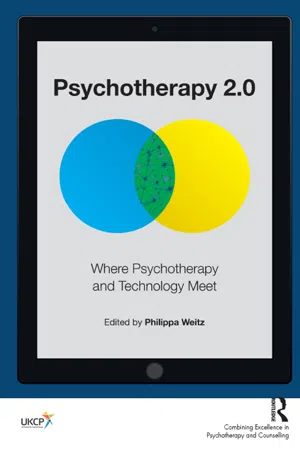
The digital age is both exciting and challenging for psychotherapy, opening the door to clients groups previously not able to access psychological help, whilst also providing the challenges caused by social media and internet abuse and how these impact on the consulting room. Psychotherapy 2.0 blows open the consulting room doors and shows successful pathways for attracting new clients to gain access to psychological help, as well as demonstrating that despite initial scepticism, working online as a psychotherapist or counsellor can be as effective as 'face2face' work: the therapeutic relationship may be different but it remains the centrally important feature for successful psychotherapy. It follows therefore that all psychotherapists and counsellors need to be fully informed about the impact of the digital age on their clinical practice. Psychotherapy 2.0 covers the key issues for psychotherapists and counsellors who are, or are thinking of, working online, include thinking about psychotherapy in the digital age, the requirements to modify training both for working online and also the digital issues as they arise within the face2face consulting room.
- 272 pages
- English
- ePUB (mobile friendly)
- Available on iOS & Android
eBook - ePub
About this book
Information
PART I
PSYCHOTHERAPY EVOLUTION IN CONTEXT
CHAPTER ONE
Psychotherapy 2.0: for better or for worse?
Psychotherapy 2.0 reflects and parallels Web 2.0 as an active participation in the digital world, providing us with new forms of social communication. Through Psychotherapy 2.0 comes the opportunity to work therapeutically in the digital world: a multifaceted virtual world, almost a parallel universe, where we communicate and are in human relationship. It is the space where psychotherapy and technology meet: technology is merely the conduit in this new world. These relationships may be rooted in the real world, or only in the online world—such as through Second Life—or may cross the borders of both. As a society, our active participation is what makes the Web 2.0 world revolve.
This book aims to engage with this rapidly changing interface to ensure that we make the most of the opportunities as practitioners, and at the same time, protect ourselves as necessary from the inevitable negative elements that go along with this new world. We must ensure, as in other parts of our practice, that we lead the way in the development of online practice through mentoring, training and research.
We are all aware of the “evils” of the digital world. Whilst this book will be focusing heavily on developing a robust online practice as well as exploring the development of the online therapeutic relationship, it will not ignore the negative elements currently at play, for example, of cyber-bullying, trolling, sexting, misuse of Facebook, abusing confidentiality, these are particularly addressed in Aqualma Murray’s chapter on protecting children and young people from online abuse. It will draw our attention to all that can go wrong, and at the same time embrace the potential for positive progress. All these “suspects” are currently making waves internationally and there is some pressure for Internet Service Providers (ISPs) and software developers to take responsibility for the “evils” that exist online. As practitioners we are likely to be confronted by these issues on a regular basis amongst our clients, whether or not we work online. We need in our practice to address issues of cybersafety as well as promoting it throughout practice and with our clients.
Given that we are where we are, in a technologically based world, it is imperative that we study in detail how we can make this work well for us and how we can overcome the limitations of this new world. These are the underlying themes of the book.
The arrival of the digital era is hugely exciting for psychotherapy, but not without its threats and challenges. This book explores our interactions, as humans, with our complex emotions; Web 2.0 and how we, as a society and as individuals, interact with this; and how Psychotherapy 2.0 can emerge successfully, vibrantly, and professionally as a new pathway in psychotherapy in the twenty-first century.
Web 2.0 is perhaps the greatest opportunity, challenge, and threat to psychotherapy since its foundation: until now psychotherapy has flourished very successfully, within western society, with the traditional tools of the “couch” and the consulting room. Many will be resistant to this challenge, citing the evidence that if it isn’t broke why fix it. This is the tension that now exists within our profession, but this tension can provide a rich opportunity for developing new ways and deep discussion about what works best and for whom.
And now to begin with some clarifications and definitions
The language we use: as English Vinglish (Gauri & Nalki, 2012), the Bollywood comedy-drama, so hilariously demonstrates, language is a fickle creature, dependent on context, culture, and a variety of verbal, non-verbal and visual cues. The English that we will be using and discussing will be standard British English (whatever that is) but those of us who read English language textbooks produced in the USA or Australia already know to be wary of the use of language … put very simply, we die in the UK, we expire in India. Even regionally in the UK the nuances of English vary … further on in this book we’ll have a wider discussion about the use of language. The digital age has changed language, and as we work across borders we will need to think about the context of, and geographical variation in, language.
What are psychotherapy, psychotherapeutic counselling, and counselling? Here’s another hornet’s nest that fills academic libraries, which we’ll need to sidestep by deferring to the professional associations’ definitions. Traditionally, both the UKCP and BACP definitions of psychotherapy have included the phrase “talking therapies”, but the digital era is resulting in its own “definition transformation” to include therapy by text, email, messaging, and other written formats, apps such as moodmeter, and CHT automated program, as well as the virtual uses of VSee, Skype, and others. It is, therefore, time to check that our way of working fits with the code of ethics and the ethical guidelines that we adhere to, and that is fit for purpose. I intend to use the word “the practitioner” in order to sidestep the nuances of differences between the different roles, styles of therapy and traditions.
The term “Information Technology” summarises the multitude of hardware, including gismos, gadgets, and telecommunications systems, computers, hand-held devices, and software including Apple and Android apps, programs and packages such as the Microsoft suite, and websites to include social media to “store, retrieve, transmit and manipulate data” (Daintish, 2009). Software and hardware need to live together as companion plants rather than one as a parasite plant feeding off the other. Just as companion planting provides a fertile environment for good growing potential, so digital companion planting can provide the same: the result is what we can produce, the relationships that develop, how “companion planting” helps us engage in our lives, and, in the context of this book, in our professional work.
The digital age describes the era in which we currently live, starting seriously in around 1985, although history shows us much earlier antecedents.
What’s in a word?—e-therapy, psychotechnologies, Psychotherapy 2.0, teletherapy, mediated technology, i-therapy, online therapy, the digital age, iDisorder … and many more expressions … I am reluctant to come down and choose any one of these expressions over another as they all have their place. Let’s see what evolves.
In other words, I am not cornering definitions per se. The world of the digital age is too fluid to be captured: it would be like trying to catch bubbles. Even “new media” is now not new!
The emergence of the digital world and its impact on society
Society has been undergoing a major revolution in its relationship to the digital world, where globalisation is just one major theme. There is a plethora of research, books, and articles on the subject of society and the Internet. As just one example, in 1978, Nora and Minc’s report—“L’Informatisation de la société” (Nora & Minc, 1978)—prepared for the French president, Valéry Giscard d’Estaing, described how computer-isation was going to change and upset our lives irreversibly, leading to a new society, where maintaining national independence would be critical, so much so that France would need to alter its strategy towards telecommunications and satellites! It was their view that the future of French democracy depended on successfully adapting. We now recognise and take for granted the strands of thinking highlighted in this report: how far we have come, whatever our nationality, tradition, and viewpoint.
To illustrate this point we are in crisis if the email server is down for more than ten minutes, the hole-in-the-wall doesn’t deliver our cash, the very simple transaction of buying some fruit in a shop fails because a till machine isn’t working, or the announcement boards at the railway station lose electricity: everyday situations which can lead to chaos and meltdown for thousands, and sometimes millions. Big Brother is alive and well!
Today we never leave home without our mobile phone and credit/debit cards. Whilst the advent of the mobile phone has changed our connectivity, the Internet too has transformed every aspect of our society. In 1980 virtually no one except a large business owned a computer. In the early eighties Alan Sinclair launched one of the first computers, the ZX Spectrum. Lord Alan Sugar is responsible in the UK for the first fully functioning computer available to the mass market at the right price: in 1985 he launched the Amstrad PCW 8256 which retailed at over £300, a fortune at the time.
I was the first woman in Kingston-upon-Thames to buy an Amstrad! The man in the shop looked astounded when I asked for one. I had to ask a nuclear physicist friend of mine to help me set it up … but I was on my way and I never looked back. This personal testimony describes the IT journey of most of us in our fifties and older. It is poignant to remind ourselves about just how far we have come in a relatively short time, and, often, without any formal training. Younger generations have never known anything different and are not afraid, in the way that I was never afraid of the telephone. We must, however, be careful not to pigeon-hole. Not all young people are adept at all things digital, and to lump them all together as digital natives can be presumptuous.
Most of us have grown up reading, watching TV, going to the cinema, playing CDs, records, writing a diary, or poetry, chatting on the phone, writing letters, sending postcards. Many of these activities already involved digital aspects and even the now-defunct telegram was a digital activity.
Nothing much has changed in what we do, but it is how we do things that has changed dramatically. We can now do all these things online, assembled within our mobile or computer. There’s nothing more exhilarating than getting good quality BBC radio programmes directly from TuneIn Radio, or The Archers podcast downloaded, whilst driving along a French motorway—an Apple app on my iphone, working via Bluetooth using my car radio as a speaker. Instead of feeling very much in foreign lands I feel connected to my home. It’s merely the medium that has changed.
The digital age has brought changes to family dynamics, some welcome and some unwelcome. Whilst we may be able to communicate freely with our loved ones in Australia on a daily basis at no cost, Buckingham (2013) points out that technology may change the family dynamics and alter the balance of power between parents and children: as an example, where there was once only one TV in the house and an evening in front of the TV would be a family activity, we all now look at what we want on our individual screens, with its subsequent impact on family dynamics. On the other hand it probably stops the “marital” about who manages the remote control! Dunn (2013) pointed out in a lecture on the therapeutic relationship that a photo of students sitting on a lawn all peering at handheld devices could be perceived as a breakdown of communication, but in fact it was precisely the opposite—they were communicating via social media. This same point is well illustrated by Chalfont in the case of Tommy (Chapter Five), whose father cannot understand how Tommy’s social community was online, leading to a serious confrontation.
Society only really works if we abide by the rules. Social networking sites themselves create their own micro-society with both implicit and explicit rules. But who creates the rules? And who abides by them? We are dependent on a convergent agreement by the majority, otherwise we have anarchy. But these rules, as in society at large, are continuously being negotiated and changed, as is the netiquette that we should contribute to and follow if we wish to fit into the online world of acceptable online behaviour. As I write, we are currently seeing the power of society and governments putting pressure on the major ISPs and search engines to manage and control pornography.
The cynic will tell us the power of the Internet and cyberspace is all about consumerism and profit. And I am sure it is certainly true in some respects. I will not be the first, or the last, to download a free app for train times only to discover that the full version is £6.99! We do need to wise up and be alert to how we are being commercially exploited and find a balance about what we can accept and also what we cannot afford both financially and emotionally. Not everyone is aware of the Big Brother aspect to this brave new world. Balick (2014) alludes to “data mining”—the exploitation of the data gathered through tracking people’s social networking habits—and the fact that most research regarding social networking is focused on “how to utilize social networking data for commercial advantage” (p. xxvii), rather than using these resources to increase our understanding of people better.
I mentioned above that I find the Internet and all my gadgets very important as a means of communication and connectivity when I am out of my comfort zone. My office and world travel with me in the smallest of bags, wherever I am in the world. Naydler (2013) sees this differently: “the virtual world may be best understood as being due to its offering an alluring counterfeit to real human relatedness and authentic spiritual experience that can long satisfy this hunger”. Counterfeit or complement … I raise this merely to show that there is not a one-size-fits-all answer. Human nature is very varied and whilst some will thrive in the online world, others will not.
In terms of the time scale of the digital age, few of these gadgets, gizmos, software, and apps are new. So why has psychotherapy been so slow to embrace the available technology? I wonder if we can see a parallel in the French attitude to the Internet. I have already mentioned Valéry Giscard d’Estaing’s vision in the late 1970s to develop the Minitel (Schofield, 2012), which was launched nationally in 1982—you could book your train, consult your bank account, register your milk results (farmers), apply to university.
The Minitel was an ugly beige machine attached to the phone. The French were the envy of the world and were proud. I remember looking at one of these machines with awe and amazement in the mid-eighties. They were supplied free by France Telecom, ensuring even the poorest households had access to information in very remote areas. Minitel closed in June 2012, but its very success made the French come late to the Internet.
Teletext in the UK was comparable to Minitel and we have recently seen its demise. The parallels with psychotherapy, where we are wedded to our successful way of working in the consulting room and see no reason to change, are evident.
It’s for your security!...
Table of contents
- Cover
- Half Title
- Title Page
- Copyright Page
- Table of Contents
- ACKNOWLEDGEMENTS
- ABOUT THE EDITOR AND CONTRIBUTORS
- UKCP BOOK EDITORIAL BOARD PREFACE
- PREFACE
- FOREWORD
- PART I: PSYCHOTHERAPY EVOLUTION IN CONTEXT
- PART II: THERAPY IN PRACTICE
- PART III: WORKING SAFELY AND LEGALLY IN THE CONTEXT OF INTERNATIONAL LAW
- GLOSSARY
- INDEX
Trusted by 375,005 students
Access to over 1.5 million titles for a fair monthly price.
Study more efficiently using our study tools.
Frequently asked questions
Yes, you can cancel anytime from the Subscription tab in your account settings on the Perlego website. Your subscription will stay active until the end of your current billing period. Learn how to cancel your subscription
No, books cannot be downloaded as external files, such as PDFs, for use outside of Perlego. However, you can download books within the Perlego app for offline reading on mobile or tablet. Learn how to download books offline
Perlego offers two plans: Essential and Complete
- Essential is ideal for learners and professionals who enjoy exploring a wide range of subjects. Access the Essential Library with 800,000+ trusted titles and best-sellers across business, personal growth, and the humanities. Includes unlimited reading time and Standard Read Aloud voice.
- Complete: Perfect for advanced learners and researchers needing full, unrestricted access. Unlock 1.5M+ books across hundreds of subjects, including academic and specialized titles. The Complete Plan also includes advanced features like Premium Read Aloud and Research Assistant.
We are an online textbook subscription service, where you can get access to an entire online library for less than the price of a single book per month. With over 1.5 million books across 990+ topics, we’ve got you covered! Learn about our mission
Look out for the read-aloud symbol on your next book to see if you can listen to it. The read-aloud tool reads text aloud for you, highlighting the text as it is being read. You can pause it, speed it up and slow it down. Learn more about Read Aloud
Yes! You can use the Perlego app on both iOS and Android devices to read anytime, anywhere — even offline. Perfect for commutes or when you’re on the go.
Please note we cannot support devices running on iOS 13 and Android 7 or earlier. Learn more about using the app
Please note we cannot support devices running on iOS 13 and Android 7 or earlier. Learn more about using the app
Yes, you can access Psychotherapy 2.0 by Philippa Weitz in PDF and/or ePUB format, as well as other popular books in Psychology & Education in Psychology. We have over 1.5 million books available in our catalogue for you to explore.