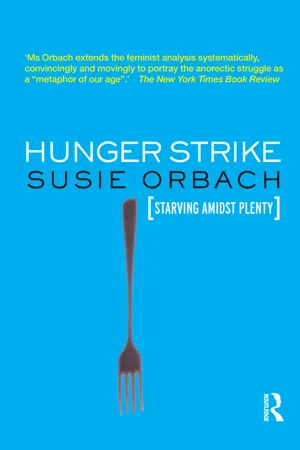
- 224 pages
- English
- ePUB (mobile friendly)
- Available on iOS & Android
eBook - ePub
About this book
Susie Orbach is a psychotherapist arid writer. With Luise Eichenbaum she co-founded The Women's Therapy Centre in London in 1976 and in 1981 The Women's Therapy Centre Institute in New York. She lectures extensively in Europe and North America, is a visiting Professor at the London School of Economics, and has a practice seeing individuals and couples and consulting to organizations. She is a frequent contributor to newspapers and magazines, as well as to radio and television programmes. Her other books on eating problems are Fat is a Feminist Issue (1978), Fat is a Feminist Issue II (1982) and On Eating (2002). With Luise Eichenbaum she has written Understanding Women: A Feminist Psychoanalytic Account (1982), What do Women Want (1983) and Between Women (1988). She is also the author of What's Really Going on Here (1993), Towards Emotional Literacy (1999) and The Impossibility of Sex (1999).
Information
Part I
1 Anorexia: Metaphor for our Time
Every morning hundreds and thousands of women wake up worrying about whether it is going to be a 'good day' or a 'bad day' in relation to food. They feel remorse for what they ate yesterday and hope that they will have more control today. They approach the day with dread or hope according to how in control of food they feel. That food routinely plagues women is an acknowledged and discussed aspect of everyday life. An obsessive involvement with food flows out of a cultural insistence that what they eat, how much they eat, and how they cook for others, is their especial domain. Food is the medium through which women are addressed; in turn, food has become the language of women's response.
The preoccupation with food is linked with a fetishizing of the female form. Women wish to acquire that elusive, eternally youthful body beautiful. A woman's body becomes the subject of scrutiny, the recipient of enormous amounts of attention, and the vehicle for the expression of a wide range of statements. Women find themselves obsessively engaged with both their food and their bodies. A woman's body is the beneficiary of hours of attention, worrying and fretting. But at the same time, the pain of being caught up in a never-ending battle to get one's body right (and the eating behaviours that follow from this) is somehow muted. Women are constantly engaged in trying to mediate the harrowing effects of culturally induced body insecurity. This preoccupation is both a hidden and a public state of affairs. Women accept – at some level – the importance of self-presentation, and so obsession with the body is a permitted form of self-expression and self-involvement for them. But this publicly sanctioned private activity hides the deeply anguished relationship that so many women come to have with their bodies. Women repress the knowledge of how damaging and hurtful this obsession is.
Anorexia nervosa is perhaps the most dramatic outcome of the culture's obsession with regulating body size. In the last ten years this psychological syndrome has risen to epidemic proportions.1 The potential reader may well demur and ask, 'What has all this to do with me? What could there be of possible wide interest in a cultural and clinical study of anorexia?' The same reader may well go further and admit to an active disinterest in, perhaps even a revulsion for, the subject. But although the anorectic response to our cultural conditions may strike one as extreme, perhaps off-putting and bizarre, the very extremeness of the response illuminates the experience of women today. Anorexia nervosa – self-starvation – is both a serious mental condition affecting thousands upon thousands of women, and a metaphor for our age. Like the psychological symptom of hysteria that Freud described so well in late nineteenth-century Vienna, anorexia nervosa is a dramatic expression of the internal compromise wrought by Western women in the 1980s in their attempt to negotiate their passions and desires in a time of extraordinary confusion. But whereas hysteria was an 'imagined' physical response to emotional distress caused by the imprisoning feminine role of the Victorian period, what occurs in anorexia nervosa is the excruciating spectacle of women actually transforming their bodies in their attempts to deal with the contradictory requirements of their role in late twentieth-century America and England.
Such psychological symptoms are the understudies for the unspeakable. They express both the rebellion and the accommodation that women come to make in the context of a social role lived within circumscribed boundaries. The starvation amidst plenty, the denial set against desire, the striving for invisibility versus the wish to be seen – these key features of anorexia – are a metaphor for our age.
Psychological symptoms and the meanings sought in them by analysts and analysands render alive the unconscious world of the individual in her time. Decoded, these symptoms allow us to enter, in the most detailed way, women's everyday experience. As windows into generalizable experience they call attention to deeply painful but salient aspects of women's existence which are so often obscured.
The most commonly held view of anorexia is that it is the female's refusal to be an adult.2 It is a disorder of puberty, an attempt to stay a girl, a denial of femininity. If we examine the implications of this perspective, we can see that it has two aims, both of which distinctly infantilize the woman. For, once seen as a child, the anorectic woman becomes much less of a threat – the meaning of her symptom is delegitimized. It becomes mere unacceptable behaviour, to be dealt with summarily, and the sufferer's opinions become discountable because, like herself, they are immature.
Behind the notion that this is a disorder of puberty, lies another unquestioned assumption. Grown-up femininity is assumed to be unproblematic. The anorectic's refusal to accept her culturally defined role is seen to be per se pathological, not an extremely complicated response to a confusing social identity. Even the most forward-thinking of practitioners who proffer help to anorectics use this model as a basis for their work. Inevitably they are caught up in a dilemma as they find themselves engaged in a power struggle with a very persistent and tenacious person. They become enmeshed in a paradox, for on the one hand they describe the anorectic as weak and childish, and on the other hand they experience her as a crafty, strong and unyielding opponent. Trying to reconcile their view of her as childlike with her relentless pursuit of incomprehensible aims, they end up involved in what can only be described as a struggle for power over who is to control the individual woman's body. Force-feeding, enforced bed rests, forcing women to be taken by wheelchair to the toilet and supervised once there, may at first glance seem benevolent. The 70-lb patient is weak and she requires the utmost care and attention.3
A more serious consideration of such treatment procedures, however, draws uncomfortable parallels with general cultural attitudes towards women's bodies. For these measures in reality reflect a kind of rape par excellence of the female body – an intrusion so brutal and invasive that in seeking an explanation I am forced to posit the existence of a need, albeit an unconscious one, to control women. Such measures, though startling, are simply a by-product of accepted cultural practices which run the gamut from the seemingly innocuous dictating of a female aesthetic, or the routine blaming of women for male sexual assaults, to practices more generally regarded as horrifying, such as foot-binding and clitorectomies.
Such a need to control the female body is not new. Indeed, contemporary medical attitudes towards anorexia have much in common with the attitudes of nineteenth-century physicians to the debilitating feminine occupation of hysteria. Hysteria was a condition assigned to women in the same way that eating problems today are considered endemic to women's existence. Although we are accustomed to thinking of hysteria as the disease of the bourgeois woman, it cut across class lines in both the United States and England. In the earlier part of the nineteenth century imprecise nosology meant that hysteria gathered into itself all manner of distress symptoms. Some of these by definition cancelled each other out, others meant that 'hysteria' became a convenient catch-all for any kind of physical or mental stress experienced by women. While working-class women with hysteria were considered shirkers, treating the middle-class woman became the (financial) backbone of the gentleman doctor's practice. Contemporary accounts reveal a striking similarity between the attitudes of the nineteenth-century doctors and those who treat anorectics today.4 Indeed, even the actual language in which Weir Mitchell, the most famous and respected American woman's doctor of the 1880s, describes the 'deceitfulness' of hysterics, is chillingly close to that used in describing the wilful, intransigent anorectic.5 But it is not simply the congruence of attitudes towards women's disorders that should concern us. More striking and more worrying are the parallels that can be seen in the treatment of the nineteenth-century hysteric and today's anorectic.
Weir Mitchell recommended a strict 'rest cure' accompanied by 'fattening up'.6 His prescriptive measures would not be out of place in a large number of hospital divisions dedicated to the treatment of anorexia today: a rich diet, attention from the doctor, and the acceptance of the wisdom of the doctor's interventions. The nineteenth-century feminine ideal of frailty and romance which found such marked expression in the literature and the illnesses of Victorian women, rests on a view of women as the inherently inferior and weaker sex. The fainting, pains and state of immobility that the 'hysteric' achieved in a number of ingenious ways were responded to with the demand that she accept her weakness and take to her bed.
While such treatments were hardly barbaric in the nineteenth-century context they failed to address the deeper causes of a woman's listless malaise. As the Women's Movement was to demonstrate emphatically, the problem of hysteria was not so much the result of over-activity as the result of inactivity or a regimen of sequestered and limited activity. As Freud would discover, the hysterical stance covered a voice of protest. Hysteria was the exaggeration of idealized womanliness, but in its very caricature of femininity it contained an implicit indictment.
Current treatment programmes in which anorectics are fattened up at the rate of 5,000 calories a day and required to endure total bed rest7 are merely old wine in new bottles. But it is old wine that was medically suspect when first bottled and has proved to have even less beneficence when recirculated.
If the scope of the problems, the way they are conceived, and the treatment attitudes that flow from such a perspective are so similar, what is illuminated by situating hysteria and anorexia in their separate social contexts? Carol Smith-Rosenberg argues that in the midst of a situation of enormous social and structural upheaval and change in the nineteenth century, opportunities for women remained essentially domestic, and within that sphere, the roles were few and rigid. From this perspective hysteria can be seen as an alternative role option for particular women incapable of accepting their life situation. Hysteria thus serves as a valuable indicator both of domestic stress and of the tactics through which some individuals sought to resolve them.8
Eventually, a public response on the part of women to this state of affairs emerged. It was evidenced by the appearance of a boisterous and energetic suffragette movement. This political movement was not marked by the niceties of nineteenth-century convention surrounding women's activities. Indeed, as their cause was refused so the tactics they employed to achieve their ends extended to law breaking which in turn led to imprisonment. Once imprisoned, the suffragettes refused the silence of their new confines and forced a public awareness of their presence and hence their aims. They went on hunger strike and in so doing entered into a struggle with representatives of the state – the prison governors and Home Office officials – about the consequences of the government's attempt to control their minds. A new battle ensued in which control of food became the expression of deeper political power. Women contested the legitimacy of the government by their refusal to eat. The government's response to this protest in the form of force-feeding is yet another example of the notion that control of the female body is not something that resides with its owner, the individual woman, but is an area to be contested.
By contrast, and of course due in no small measure to the public activities of the suffragettes, women today are presented with an apparently bewildering number of social role options. One only has to choose what one wishes and the world is open. Where narrow role-definition previously imprisoned women, now variety, opportunity and unlimited possibilities exist. Or rather, so goes the myth. At the heart of the new possibilities for women, anorexia illuminates the difficulties of entry into a masculinist world. The anorectic woman encompasses in her symptom a way of being entirely at odds with the phlegmatic response of her nineteenth-century hysterical sister. Not for her the fainting, falling or flailing fits; her protest is marked by the achievement of a serious and successful transformation of her body, that same body that her great-great-grandmother used as a weapon in her own time. Rather than collapsing because of 'feminine frailty', the anorectic woman today, in losing the defining curves of femininity and in ceasing to menstruate, does away with the explicit marker of her reproductive capacities. In essence she defeminizes her body. Interestingly, where possibilities are so apparently multiple and fluid, a woman's symptomatic response is narrow, rigid and controlled. Where nineteenth-century possibilities for women were few and narrowly defined, the woman's expression and unconscious protest through her symptom was in turn unbounded.
Participation in the modern world involves the pursuit of success for its own sake and as defined by our culture rather than an evaluation of the basis of this world. In spite of the rhetoric of women's equality, feminine values have not been assimilated outside the domestic sphere. Women entering the world beyond the home do so as guests and not as principals; the necessary shifts, adjustments and negotiations are contingent on women making them. Women are required to accommodate themselves to the public sphere much as they accommodate others in private. Even if they are no longer relegated to the role of mere midwives to the activities of others, they must nevertheless ensure that their presence is quasi-unobtrusive. They must conform to prevailing masculinist values and accept entry on that basis.
The late twentieth century has failed to bring about a substantially new role relationship between men and women. To be sure, women's work is now more visible and discrimination on job training and job entry is couched in apologetic terms. Reformist struggles taken up by the second wave of feminism have made for dramatic improvements and changes in the lives of many, many women. However, American women still live in a society in which the Equal Rights Amendment remains unratified, while the legal equality granted to English women has been found to be inadequately legislated and enforced. These manifestations of women's continued inequality are reflected in both subtle and crude ways in the family, education, the health system and the world of work. Equality has little chance of being consolidated if society is not, even in principle, committed to it. Even with legal protection, if equality is to enter the hearts, experience and day-today reality of contemporary men and women, it requires a concerted struggle at every level – a questioning of our most basic assumptions and society's commitment to change. No such move has been initiated at a state level. No commitment to the examination and change of male and female roles has been undertaken. In this context the woman of today faces contradictory pulls. She is culturally and psychologically prepared for a life in which she should continue to service the needs of others, while at the same time she is teased with the possibility of living a life for herself. These themes enter directly into current child-rearing practices where children observe and experience upbringing in a predominantly female ambience while receiving the 'new' message that the world outside of the home is the domain of all. Femininity is inextricably linked with the home and with mothering. The new femininity i outside the home depends upon the assuming of masculine values or the extension of the feminine role into the work force in the form of service work.
Today women from every generation experience themselves being pushed and pulled in opposing directions. While individual women can find a way to balance new possibilities and pressures, all women live with a tension about their place in the world. This tension is not immediately obvious from women's psychological symptoms, and it may not be consciously articulated. However, as we investigate the meaning of anorexia we are presented with an extremely graphic picture of the internal experience of contemporary femininity. Anorexia symbolizes the restraint on women's desires. In the most tortuous denial of need and dependency and the most persistent and insistent expression of independence, women with anorexia live out the contrariness of contemporary cultural dictates.
The Women's Liberation Movement and recent feminist scholarship provide us with a context for looking at women's relationship with their psychological symptoms, and with food and their bodies.9 Prefeminist analyses or approaches that ignore feminism suffer from an inability to comprehend why women are involved in such complicated, and in the case of anorexia, savage, struggles with food and bodyimage. In failing to comprehend the thrust behind anorexia, compulsive eating and bulimia, practitioners throw up their arms in despair or mechanically 'treat' the sufferer as though she were at best an oddity, at worst an offending object. In trying to get her to eat and to become the 'right size' they negate her protest. They unwittingly deny the meaning of her symptom and in so doing contribute to its perpetuation. They become part of the problem rather than part of the solution.
By recasting the terrain on which psychological inquiry is based, feminism allows us to hear with different ears the stories of women who suffer with anorexia. In taking as a starting point the fact that woman's social role creates her particular psychology, feminism illuminates how woman's psychology reflects both a preparation for her social role as well as her rebellion against it. Psychologies are gender–specific and each individual psyche comes to embody the ensemble of social relations. If we reflect upon the meaning of 'food', 'fat', 'thin' and 'femininity', we see that these words conjure up many layered pictures of social practices which involve and affect us all.
Women's relationship with 'food', 'fat', 'thin' and 'femininity' is at once extremely complex and extremely simple. Two imperatives underlie it which in turn become highly elaborated. The first of these is that throughout history we know the female form as an object of pleasure for men. This aspect of femininity is insinuated into each woman's experience of self, and finds expression in each woman's relationship with her body. In their passage towards femininity, all girls experience the pressure to be attractive, to make their bodies conform to the designated ideal of the day, to be slender, tall, blonde, curvaceous, slim-hipped, round-bottomed, or pointed-breasted. The second imperative is the paradoxical relationship of woman with food and feeding. She must feed others but restrain her own desires for that very same food. An unquestioned aspect of women's experience today is each woman's knowledge that she will inevitably be die...
Table of contents
- Cover
- Title
- Copyright
- Dedication
- Contents
- Foreword
- Introduction to the 1986 Edition
- Introduction to the 1993 Edition
- PART I
- PART II
- Afterword
- Bibliography
- Index
Trusted by 375,005 students
Access to over 1.5 million titles for a fair monthly price.
Study more efficiently using our study tools.
Frequently asked questions
Yes, you can cancel anytime from the Subscription tab in your account settings on the Perlego website. Your subscription will stay active until the end of your current billing period. Learn how to cancel your subscription
No, books cannot be downloaded as external files, such as PDFs, for use outside of Perlego. However, you can download books within the Perlego app for offline reading on mobile or tablet. Learn how to download books offline
Perlego offers two plans: Essential and Complete
- Essential is ideal for learners and professionals who enjoy exploring a wide range of subjects. Access the Essential Library with 800,000+ trusted titles and best-sellers across business, personal growth, and the humanities. Includes unlimited reading time and Standard Read Aloud voice.
- Complete: Perfect for advanced learners and researchers needing full, unrestricted access. Unlock 1.5M+ books across hundreds of subjects, including academic and specialized titles. The Complete Plan also includes advanced features like Premium Read Aloud and Research Assistant.
We are an online textbook subscription service, where you can get access to an entire online library for less than the price of a single book per month. With over 1.5 million books across 990+ topics, we’ve got you covered! Learn about our mission
Look out for the read-aloud symbol on your next book to see if you can listen to it. The read-aloud tool reads text aloud for you, highlighting the text as it is being read. You can pause it, speed it up and slow it down. Learn more about Read Aloud
Yes! You can use the Perlego app on both iOS and Android devices to read anytime, anywhere — even offline. Perfect for commutes or when you’re on the go.
Please note we cannot support devices running on iOS 13 and Android 7 or earlier. Learn more about using the app
Please note we cannot support devices running on iOS 13 and Android 7 or earlier. Learn more about using the app
Yes, you can access Hunger Strike by Susie Orbach in PDF and/or ePUB format, as well as other popular books in Psychology & Abnormal Psychology. We have over 1.5 million books available in our catalogue for you to explore.