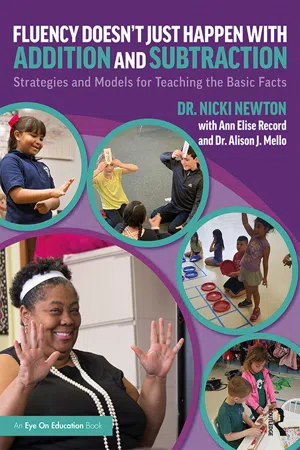
Fluency Doesn't Just Happen with Addition and Subtraction
eBook - ePub

Fluency Doesn't Just Happen with Addition and Subtraction

Strategies and Models for Teaching the Basic Facts

  1. 284 pages
  2. English
  3. ePUB (mobile friendly)
  4. Available on iOS & Android
eBook - ePub

Fluency Doesn't Just Happen with Addition and Subtraction

Strategies and Models for Teaching the Basic Facts

About this book

Fluency in math doesn't just happen! It is a well-planned journey. In this book, you'll find practical strategies and activities for teaching your elementary students basic addition and subtraction facts. The authors lay out the basic framework for building math fluency using a cycle of engagement (concrete, pictorial, abstract) and provide a multitude of examples illustrating the strategies in action.

You'll learn how to:

  • help students to model their thinking with a variety of tools;
  • keep students engaged through games, poems, songs, and technology;
  • assess student development to facilitate active and continuous learning;
  • implement distributed practices throughout the year;
  • boost parental involvement so that students remain encouraged even as material becomes more complex.

A final chapter devoted to action plans will help you put these strategies into practice in your classroom right away. Most importantly, you'll open the door to deep and lasting math fluency.

Trusted byĀ 375,005 students

Access to over 1.5 million titles for a fair monthly price.

Study more efficiently using our study tools.

Information

Publisher
Routledge
Year
2019
Print ISBN
9780367151836
eBook ISBN
9780429619212

PART I

Introduction

CHAPTER 1

Introduction

Do not be content with the right answer. Always demand explanation.
(Van de Walle, 2001, p. 425)

INTRODUCTION

Fluency doesn’t just happen! It is a well-planned journey. This book is meant to help you navigate that journey. Fluency is a multidimensional concept. We like to think of it as a four-legged stool: accuracy, flexibility, efficiency, and automaticity. Ann Elise once said that ā€œAutomaticity has hijacked fluency.ā€ We love this because it is so true. Students need to be able to instantly recall their facts at some point so that they don’t get bogged down in the little stuff when they are working on multi-digit operations and fractions, decimals, and integers. BUT, students must learn their facts through a variety of engaging, ongoing, interactive, rigorous, student-friendly activities that build a fundamental understanding of how numbers are in relationship with each other. The research resoundingly states that computational fluency is multidimensional (speed and accuracy, flexibility and efficiency) (Brownell, 1956/1987; Brownell & Chazal, 1935; Kilpatrick et al., 2001; National Council of Teachers of Mathematics, 2000).
Fluency is a four-legged stool
If one of the legs is missing – then students only have partial fluency. Students can know all their facts instantly and not have any number sense.
The four legs of fluency are:
Accuracy, Flexibility, Efficiency, and Automaticity.

DOLCH WORDS OF MATH

Students should learn their facts rather than memorize them. If you just memorize them, then you can easily forget them. If you learn them, then you can always access them through a variety of strategies based in place value, properties, and the relationships between the operations. There is a continuum for learning basic facts. Baroody (2006) calls it the ā€œPhases of Mastery.ā€ Battista (2012) calls it the ā€œLevels of Sophistication.ā€ This continuum has been discussed by many researchers and guides our work in this book. Basic facts for addition and subtraction are sums and differences within 20. (See Figure. 1.1.)
FIGURE 1.1 Addition and Subtraction Strategies

STRATEGY TALK

As students are learning their facts, there are different approaches to working with numbers. These strategies have names. (See Figure. 1.2.)
FIGURE 1.2 Basic Fact Strategies

CYCLE OF ENGAGEMENT: CONCRETE, REPRESENTATIONAL, ABSTRACT

We strongly believe that students should go through the cycle of engagement so that they have several opportunities to learn about the ways in which numbers are related and work together (see Figure. 1.3). Many researchers maintain that this cycle gives students access to deeper understanding of mathematical concepts (Anstrom, n.d.; Bender, 2009; Devlin, 2000; Maccini & Gagnon, 2000; Van de Walle, 2001). This cycle, known as C-R-A or C-P-A, is a three-step instructional process that allows students to gain conceptual understanding of a strategy by first working with manipulatives or concrete objects. The second part of the cycle is for students to do pictorial representations of the math. The third part of the cycle is for students to work at an abstract level with the concepts.
FIGURE 1.3 C-R-A Cycle
Each stage builds on the previous stage. It is important to give all students an opportunity to work through the stages because otherwise some students can get the answer but don’t understand the concept. For example, if we were teaching students how to double a number, we would give them plenty of opportunities to actually pull objects and make the doubles fact. Next, we would have students draw out doubles facts and work with them on scaffolded strategy flashcards that have visual supports. Finally, we would have students play a variety of dice, domino, card, and board games where they just have to recall the facts.
As students are working through this cycle of engagement – concrete, pictorial, and abstract – they are building their number sense. They are developing familiarity with numbers and the way they work. As Van de Walle (2007) noted:
A rich and thorough development of number relationships is a critical foundation for mastering of basic facts. Without number relationships, facts must be rotely memorized. With number understanding, facts for addition and subtraction are relatively simple extensions.
(p. 120).
Mastery of basic facts occurs as students have ongoing experiences working with number combinations. When students have achieved mastery they are efficient, flexible, accurate, and automatic. They understand when and how to use appropriate strategies. Basic facts are the linchpin of learning mathematics because students will build on this foundational knowledge to do everything else in math. Van de Walle and Lovin point out that mastery is when ā€œa child can give a quick response without resorting to nonefficient means, such as countingā€ (2006, p. 24). Furthermore, they note that ā€œall children are able to master the basic facts – including children with learning disabilitiesā€ (2006, p. 24).

MAKING THE CONNECTION BETWEEN ADDITION AND SUBTRACTION

Throughout this book we will spend some time talking and thinking about subtraction as it relates to addition. Subtraction is much more difficult for many students throughout the grades. A firm foundation in subtraction will do wonders for students later on. The research discusses the need for students to understand the relationship between addition and subtraction.
ā€œA good understanding of the operations can firmly connect addition and subtraction so that subtraction facts are a natural consequence of having learned addition. For example, 12 - 5 is 7 since 5 + 7 is 12ā€
(Van de Walle, 2007, p. 143).
It is important to work with students so that they understand we can use count up strategies to subtract as well as take away strategies. Students should do various activities where they explore addition as a whole in terms of putting parts together to find the sum and subtraction as a missing part by taking away, removing, or comparing to find the difference (Van de Walle, 2007). ā€œRecognizing the inverse relationship between addition and subtraction can allow students to be flexible in using strategies to solve problemsā€ (NCTM, 2000, p. 83).

21ST CENT...

Table of contents

  1. Cover
  2. Half Title
  3. Series Page
  4. Title Page
  5. Copyright Page
  6. Dedication
  7. Table of Contents
  8. Meet the Authors
  9. Preface
  10. Acknowledgments
  11. Part I: Introduction
  12. Part II: Introduction to Exploring and Learning Addition Strategies
  13. Part III: Introduction to Exploring and Learning Subtraction Strategies
  14. Part IV: Other Crucial Elements

Frequently asked questions

Yes, you can cancel anytime from the Subscription tab in your account settings on the Perlego website. Your subscription will stay active until the end of your current billing period. Learn how to cancel your subscription
No, books cannot be downloaded as external files, such as PDFs, for use outside of Perlego. However, you can download books within the Perlego app for offline reading on mobile or tablet. Learn how to download books offline
Perlego offers two plans: Essential and Complete
  • Essential is ideal for learners and professionals who enjoy exploring a wide range of subjects. Access the Essential Library with 800,000+ trusted titles and best-sellers across business, personal growth, and the humanities. Includes unlimited reading time and Standard Read Aloud voice.
  • Complete: Perfect for advanced learners and researchers needing full, unrestricted access. Unlock 1.5M+ books across hundreds of subjects, including academic and specialized titles. The Complete Plan also includes advanced features like Premium Read Aloud and Research Assistant.
Both plans are available with monthly, semester, or annual billing cycles.
We are an online textbook subscription service, where you can get access to an entire online library for less than the price of a single book per month. With over 1.5 million books across 990+ topics, we’ve got you covered! Learn about our mission
Look out for the read-aloud symbol on your next book to see if you can listen to it. The read-aloud tool reads text aloud for you, highlighting the text as it is being read. You can pause it, speed it up and slow it down. Learn more about Read Aloud
Yes! You can use the Perlego app on both iOS and Android devices to read anytime, anywhere — even offline. Perfect for commutes or when you’re on the go.
Please note we cannot support devices running on iOS 13 and Android 7 or earlier. Learn more about using the app
Yes, you can access Fluency Doesn't Just Happen with Addition and Subtraction by Nicki Newton,Ann Elise Record,Alison J. Mello in PDF and/or ePUB format, as well as other popular books in Education & Education General. We have over 1.5 million books available in our catalogue for you to explore.