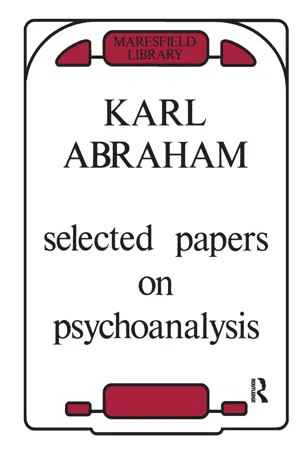
Covering a wide range of topics, the collection consists of twenty-six papers and essays published over a period of two decades. Readers of this book are thus enabled to trace the analyst's development, in which his scientific approach is evident throughout, from his earliest papers through to his last works. First published in 1927 in the International Psychoanalytical Library, the author's Selected Papers on Psychoanalysis has since established itself as on of the seminal works essential to the training of workers in the psychoanalytic field. Includes the author's classic paper A Short Study of the Development of the Libido.
- 528 pages
- English
- ePUB (mobile friendly)
- Available on iOS & Android
eBook - ePub
Selected Papers on Psychoanalysis
About this book
Information
CHAPTER XXVI
A Short Study of the Development of the Libido, Viewed in The Light of Mental Disorders (1924)1
Part I
Manic-Depressive States and The Pre-Genital Levels of The Libido
Introduction
MORE than ten years have passed since I first attempted to trace the aetiology of manic-depressive disorders on psycho-analytical lines.2 I was quite aware at the time of the shortcomings of that attempt and was at pains to make this clear in the title of my paper. But we should do well to remember how very little had been written as yet on any psycho-analytical subject. And in especial there were very few earlier works in existence on the circular insanities. Private psychotherapeutic practice offers little opportunity for the analysis of cases of this kind, so that it was not possible for any single analyst to collect and compare sufficient data on this subject.
Nevertheless, in spite of the shortcomings of that first attempt, its results have proved to be correct in certain not unimportant particulars. Freud’s paper,4 Mourning and Melancholia confirmed my view that melancholia stood in the same relation to normal mourning for a loss as did morbid anxiety to ordinary fear. And we may now regard as definitely established the psychological affinity between melancholia and obsessional neuroses. Furthermore, these two illnesses show similarities in regard to the process of the disengagement of the libido from the external world. On the other hand, it had not hitherto been possible to discover anything concerning the point of divergence of melancholic and obsessional states; nor indeed had any light been shed as yet on the problem of the specific cause of the circular insanities.
After Freud had established the theory of the pre-genital levels in the organization of the libido I made an attempt to discover this specific cause. Freud had been led by the analysis of obsessional neuroses to postulate a pre-genital phase in the development of the libido which he called the sadistic-anal phase. A little later1 he gave a detailed description of a still earlier phase, the oral or cannibalistic one. Basing my views on a large and varied collection of empiric material I was able2 to show that certain psychoneuroses contain clear traces of that earliest phase in the organization of the libido; and I ventured the suggestion that what we saw in melancholia was the result of a regression of the patient’s libido to that same primitive oral level. But my clinical material was not very complete in this respect, and I was not able to bring forward any convincing proofs of my view.
At about the same time Freud approached the problem of melancholia from another angle, and he made the first real step towards the discovery of the mechanism of that illness. He showed that the patient, after having lost his love-object, regains it once more by a process of introjection (so that, for instance, the self-reproaches of a melancholiac are really directed towards his lost object).
Subsequent experience has confirmed in my mind the importance of both processes—the regression of the libido to the oral stage and the mechanism of introjection. And more than that, it has shown that there is an intimate connection between the two. The analyses on which the present publication is based leave no doubt as to this last point. As I hope to be able to make quite clear, the introjection of the love-object is an incorporation of it, in keeping with the regression of the libido to the cannibalistic level.
Two more discoveries in this field of research must be mentioned, again in connection with Freud’s name. In the first place he pointed out that in melancholia the event of underlying importance is the loss of the object which precedes the outbreak of the illness, and that this does not happen in obsessional cases. The obsessional neurotic has, it is true, a markedly ambivalent attitude towards his object and is afraid of losing it; but he does ultimately keep it. The discovery of this difference between the two pathological states is of great consequence, as I hope will become plain in the course of my study. In the second place, Freud has recently given a more definite direction to our investigation of states of manic exaltation.1 It will become clear to the reader presently what an advance his theories represent over my first uncertain attempts in 1911.
In 1920 I was invited to read a paper on the manic-depressive psychoses at the Sixth Psycho-Analytical Congress. I was obliged to refuse, since I had no fresh data in my possession. Since that time I have had an opportunity of making an almost complete analysis of two marked cases of circular insanity, and of gaining a brief glimpse into the structure of some other cases belonging to this class. The results of those analyses confirm in a surprising way Freud’s view of the structure of melancholic and manic disorders. Besides this, they bring forward a number of new points which supplement his theory in one or two important respects.
Motives of discretion impose a great deal of reserve in the publication of my psycho-analytical material. They prevent me, in especial, from giving a consecutive case-history of the two cases which I analysed thoroughly, and I can only bring forward short extracts from each. In order to preclude the possibility of a mistaken diagnosis I may say at once that both my patients had repeatedly been put in asylums or sanatoriums where they were under the observation of able psychiatrists, and that they had been examined by eminent mental specialists. The clinical picture was absolutely typical and the circular course of the illness quite characteristic in both cases, so that in point of fact there was never any doubt about the diagnosis.
In one respect my data is insufficient; and I point this fact out at once, although I do not myself attribute very great importance to it. All the manic-depressive patients I have treated, including the two recent cases I analysed completely, were male. I have only had the opportunity of making cursory psycho-analytical observations of female patients of this class, except for a quite recent case in whose analysis I am still engaged.
But I do not think it likely that an analysis of female patients would lead to any fundamentally different conclusions, especially when we consider that the patients of both sexes exhibit an extremely marked bisexuality in their symptoms, so that they doubtless have many points of similarity.
At the time when I read a part of this publication before the Seventh Psycho-Analytical Congress,1 the interest felt in the subject was clearly shown by the fact that many of the other papers read there dealt with the same questions and arrived at conclusions strikingly similar to mine, although they approached the matter from quite a different standpoint. In especial I may mention the important contribution made by Rόheim2 in which he added a great deal to our knowledge of the psychology of cannibalism.
In the first part of this book I shall briefly examine certain problems concerning manic-depressive states—in particular the problem of the patient’s relation to his love-object during his states of depression and mania and during his ‘free interval’. In the second part I shall treat those problems in a broader way and shall c...
Table of contents
- Cover
- Half Title
- Title Page
- Copyright Page
- Table of Contents
- Translators’ Note
- Introductory Memoir
- I. The Experiencing of Sexual Traumas as a Form of Sexual Activity (1907)
- II. The Psycho - Sexual Differences Between Hysteria and Dementia Precox (1908)
- III. The Psychological Relations Between Sexuality and Alcoholism (1908)
- IV. Hysterical Dream-States (1910)
- V. Remarks on The Psycho-Analysis of a Case of Foot and Corset Fetishism (1910)
- VI. Notes on The Psycho-Analytical Investigation and Treatment of Manic - Depressive Insanity and Allied Conditions (1911)
- VII. A Complicated Ceremonial Found in Neurotic Women (1912)
- VIII. Mental After-Effects Produced in a Nine-Year-Old Child By The Observation of Sexual Intercourse Between Its Parents (1913)
- IX. Restrictions and Transformations of Scopophilia in Psycho-Neurotics; With Remarks on Analogous Phenomena in Folk-Psychology (1913)
- X. A Constitutional Basis of Locomotor Anxiety (1913)
- XI. The Ear and Auditory Passage as Erotogenic Zones (1913)
- XII. The First Pregenital Stage of the Libido (1916)
- XIII. Ejaculatio PrÆCox (1917)
- XIV. The Spending of Money in Anxiety States (1917)
- XV. A Particular Form of Neurotic Resistance Against The Psycho-Analytic Method (1919)
- XVI. The Applicability of Psycho-Analytic Treatment to Patients at an Advanced Age (1919)
- XVII. The Narcissistic Evaluation of Excretory Processes in Dreams and Neurosis (1920)
- XVIII. Contribution to a Discussion on tic (1921)
- XIX. The Spider as a Dream Symbol (1922)
- XX. An Infantile Theory of the Origin of the Female Sex (1923)
- XXI. An Infantile Sexual Theory not Hitherto Noted (1925)
- XXII. Manifestations of The Female Castration Complex (1920)
- XXIII. Contributions to the Theory of The Anal Character (1921)
- XXIV. The Influence of Oral Erotism on Character-Formation (1924)
- XXV. Character-Formation on the Genital Level of the Libido (1925)
- XXVI. A Short Study of The Development of the Libido, Viewed in the Light of Mental Disorders (1924)
Trusted by 375,005 students
Access to over 1.5 million titles for a fair monthly price.
Study more efficiently using our study tools.
Frequently asked questions
Yes, you can cancel anytime from the Subscription tab in your account settings on the Perlego website. Your subscription will stay active until the end of your current billing period. Learn how to cancel your subscription
No, books cannot be downloaded as external files, such as PDFs, for use outside of Perlego. However, you can download books within the Perlego app for offline reading on mobile or tablet. Learn how to download books offline
Perlego offers two plans: Essential and Complete
- Essential is ideal for learners and professionals who enjoy exploring a wide range of subjects. Access the Essential Library with 800,000+ trusted titles and best-sellers across business, personal growth, and the humanities. Includes unlimited reading time and Standard Read Aloud voice.
- Complete: Perfect for advanced learners and researchers needing full, unrestricted access. Unlock 1.5M+ books across hundreds of subjects, including academic and specialized titles. The Complete Plan also includes advanced features like Premium Read Aloud and Research Assistant.
We are an online textbook subscription service, where you can get access to an entire online library for less than the price of a single book per month. With over 1.5 million books across 990+ topics, we’ve got you covered! Learn about our mission
Look out for the read-aloud symbol on your next book to see if you can listen to it. The read-aloud tool reads text aloud for you, highlighting the text as it is being read. You can pause it, speed it up and slow it down. Learn more about Read Aloud
Yes! You can use the Perlego app on both iOS and Android devices to read anytime, anywhere — even offline. Perfect for commutes or when you’re on the go.
Please note we cannot support devices running on iOS 13 and Android 7 or earlier. Learn more about using the app
Please note we cannot support devices running on iOS 13 and Android 7 or earlier. Learn more about using the app
Yes, you can access Selected Papers on Psychoanalysis by Karl Abraham in PDF and/or ePUB format, as well as other popular books in Psychology & History & Theory in Psychology. We have over 1.5 million books available in our catalogue for you to explore.