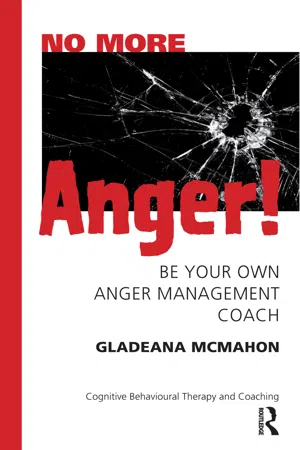
There are now many studies supporting the view that the best treatment for a range of conditions is CBT. Indeed, the National Institute for Clinical Excellence and the NHS have both recommended CBT as the treatment of choice when working with conditions such as depression, anxiety and anger. By adapting many of the strategies associated with CBT allowed to put together a model that helped individuals get the best from everyday life. In addition, by integrating aspects from the new field of Positive Psychology which aims to increase an individual's basic appreciation of life and general happiness it became possible to produce a model that worked for everyone and not just those with an identifiable mental health problem. No More Anger takes the skills and techniques of Cognitive Behavioural Therapy and Cognitive Behavioural Coaching and offers you the opportunity to take control of your anger. It aims to help you understand what is happening to you and teach you how you can overcome your anger. If you use the skills outlined in this book you will learn how to become your own anger management coach.
- 208 pages
- English
- ePUB (mobile friendly)
- Available on iOS & Android
eBook - ePub
About this book
Information
Anger-Free Thinking
The four stages of change
Whenever you learn something new, regardless of whether it is a practical skill like using the Internet or a mental skill such as changing behaviour or negative beliefs, you go through a set sequence of learning:
- stage one, unconsciously incompetent;
- stage two, consciously incompetent;
- stage three, consciously competent;
- stage four, unconsciously competent.
This process is known as Robinson’s Four Stages of Learning.
Stage one: unconsciously incompetent
‘Don’t know it and can’t do it.’
You feel unhappy but have no idea why.
Stage two: consciously incompetent
‘I begin to notice just how often I have negative thoughts but I don’t seem able to change anything.’
During this stage you become aware of what is happening but seem unable to do anything about it. This is the awareness stage: for example, realizing the ways in which you make yourself feel angry by magnifying situations in a negative way, which increases your anger, but not being able to stop.
Stage three: consciously competent
‘I have skills and can handle situations better although I still have to think about what I am doing.’
You now have a range of strategies to use, but you still have to think about what you are doing, as it does not feel natural.
Stage four: unconsciously competent
‘I suddenly realized what I had done and how I handled the situation without even thinking about it.’
The more you practise your new skills the more your behaviour feels ‘natural’. You are now working off your automatic pilot – doing things without thinking about them.
Change happens over time and it is persistence, practice and the belief in taking one small step at a time that wins the day.
Does optimism pay?
Optimists think more positively about life, seeing the good in situations and minimizing the bad. Pessimists think that optimists are foolish and optimists think that pessimists are depressing. Researchers believe that optimism and pessimism have a genetic factor. However, there is also evidence to suggest that it is the environment we are brought up in that shapes the way we think. We discussed earlier in the book the way that behaviours can be learnt, and this is true for optimists and pessimists.
There is research to suggest that there are advantages to being an optimist. For example, it would appear that optimists live longer, achieve more, and have happier lives.
When you suffer from anger, it can be hard to believe that you can ever become more optimistic about life. However, it is possible to relearn behaviours and ways of thinking. The following exercise will help you begin this process.

When you look at your answers, can you spot any patterns forming? For example, are you more optimistic with certain people but pessimistic with others?
Pessimism drains you. However, pessimistic thinking can be changed. Changing your thinking style is perfectly possible if you are prepared to put in some time and effort.
A third group has been identified: those who plan for the worst or devise a fall-back position if things don’t work out as hoped. They never believe anything good will happen automatically. However, they do put themselves forward, even though they do not believe they will succeed. They work hard and prepare. These are called ‘Defensive Pessimists’. Defensive pessimism seems to work for some people. If you have a go you are probably a defensive pessimist — if you don’t, you are a pessimist.
The following exercise is aimed at helping you begin the process of increasing your optimistic outlook on life.

Are my thoughts real?
We try to make sense of the world around us; we interpret the messages we receive and use these to decide on the best ways of coping with our environment. Sometimes what we think is not really what is happening. There is often more than one way to look at a situation. The way we see the world shapes what we do. Once we realize this, we have more choices about the way we behave and can make better decisions.
Look at Figure 3. Is it a vase, or is it two faces looking at each other?
Perhaps you can only see one image. This exercise is rather like life. Often, we don’t see what is right in front of our eyes and, even when it is pointed out, it can be hard to change our viewpoint. Time, patience and a little effort can work wonders.

Figure 3. A vase — or two faces in profile?
How do my beliefs affect me?
Since the 1950s, psychologists have identified a number of beliefs that people apply to their everyday living. In the trauma field, the three ‘life beliefs’ which have been identified as being crucial to the speed at which a person can recover from a traumatic incident are:
- bad things happen to ‘other people’;
- life has meaning and purpose;
- I would always ‘do the right thing’ in an emergency.
All of these beliefs cause their own particular type of problems. For example, bad things don’t just happen to ‘other people’ — they can happen to anyone. Someone has to be a statistic and bad things happen to good people and good people sometimes do bad things.
If you believe that ‘life has meaning and purpose’, then person-made disasters, acts of cruelty, or senseless bloodshed are more likely to be greatly disturbing. Such incidents seem meaningless and with no purpose. In such circumstances, then, an individual may feel very frightened, especially if he or she had always believed that life did have meaning and purpose. In these cases, depending on the individual concerned, a reaction of anger or anxiety or a mixture of both may be present.
For those who believe they would ‘do the right thing’ in an emergency, this belief can become challenged when they find themselves behaving in a different way to the way they would have predicted. When this is the case, the individual may experience a sense of anger at what is seen as their weakness, and this anger may also live alongside feelings of shame.
As mentioned earlier, some of these involuntary and uncontrollable reactions are pre-programmed by our biology. When we are in a life-threatening situation, our stress response kicks in and the body becomes like an alarm system. Either we flee to escape danger or we stay and stand our ground. Either way, it is almost impossible for anyone to predict with any accuracy how he/she will behave in a life-threatening situation.
Human beings tend to use beliefs to guide everyday transactions. For example, ‘I will go to work and come home safely’ or, ‘I will travel on the bus quite safely’. We may find our thinking becomes distorted if our beliefs are challenged by life events that, in turn, can cause us to become hyper-aroused and hyperactive. Anxiety can be a common feature of such thinking.
People who experience anger often have beliefs along the lines of ‘People must treat me fairly’; ‘If you don’t show people that you are strong then they will take advantage’; ‘People are out to get you’; ‘I have to stand up for myself otherwise no one else will’.
As mentioned earlier, beliefs are formed from the messages we receive as children from those around us. It is these messages that shape the way we think about ourselves.
Faulty thinking
There is a considerable amount of research that demonstrates a link between anger and the way we think. Let’s look at the rela...
Table of contents
- Cover
- Half Title
- Title
- Copyright
- Contents
- Dedication
- ABOUT THE AUTHOR
- INTRODUCTION
- HOW WILL THIS BOOK HELP ME?
- WHAT IS ANGER?
- WAYS THAT ANGER CAN SHOW ITSELF
- FREQUENTLY ASKED QUESTIONS
- BECOMING ANGER-FREE
- ANGER-FREE THINKING
- ANGER-FREE EMOTIONS
- ANGER-FREE ACTIONS
- WHAT AN ANGER-FREE LIFE REQUIRES
- THE ANGER-FREE DIET
- WHAT TYPE OF HELP IS AVAILABLE?
- USEFUL RESOURCES
- APPENDICES
- INDEX
Trusted by 375,005 students
Access to over 1.5 million titles for a fair monthly price.
Study more efficiently using our study tools.
Frequently asked questions
Yes, you can cancel anytime from the Subscription tab in your account settings on the Perlego website. Your subscription will stay active until the end of your current billing period. Learn how to cancel your subscription
No, books cannot be downloaded as external files, such as PDFs, for use outside of Perlego. However, you can download books within the Perlego app for offline reading on mobile or tablet. Learn how to download books offline
Perlego offers two plans: Essential and Complete
- Essential is ideal for learners and professionals who enjoy exploring a wide range of subjects. Access the Essential Library with 800,000+ trusted titles and best-sellers across business, personal growth, and the humanities. Includes unlimited reading time and Standard Read Aloud voice.
- Complete: Perfect for advanced learners and researchers needing full, unrestricted access. Unlock 1.5M+ books across hundreds of subjects, including academic and specialized titles. The Complete Plan also includes advanced features like Premium Read Aloud and Research Assistant.
We are an online textbook subscription service, where you can get access to an entire online library for less than the price of a single book per month. With over 1.5 million books across 990+ topics, we’ve got you covered! Learn about our mission
Look out for the read-aloud symbol on your next book to see if you can listen to it. The read-aloud tool reads text aloud for you, highlighting the text as it is being read. You can pause it, speed it up and slow it down. Learn more about Read Aloud
Yes! You can use the Perlego app on both iOS and Android devices to read anytime, anywhere — even offline. Perfect for commutes or when you’re on the go.
Please note we cannot support devices running on iOS 13 and Android 7 or earlier. Learn more about using the app
Please note we cannot support devices running on iOS 13 and Android 7 or earlier. Learn more about using the app
Yes, you can access No More Anger! by Gladeana McMahon in PDF and/or ePUB format, as well as other popular books in Personal Development & Cognitive Behavioral Therapy (CBT). We have over 1.5 million books available in our catalogue for you to explore.